End mills for alluminium

End mills for alluminium

Home Forums General Questions End mills for alluminium

Viewing 25 posts - 1 through 25 (of 29 total)
  • Author
    Posts
  • #25712
    petro1head
    Participant
      @petro1head
      #333404
      petro1head
      Participant
        @petro1head

        I currently use Arc Titan coated 3 flute end mills – http://www.arceurotrade.co.uk/Catalogue/Cutting-Tools/Milling-Cutters/ARC-Premium-HSS-AL-End-Mills/3-Flute-HSS-AL-End-Mill-Standard-Length-TiAlN-Coated

        However they quite often get clogged meaning I have stop and scrape the alloy off the end of the tool.

        Any suggestions of what would be better. Ie 2 flute or split else

        #333405
        JasonB
        Moderator
          @jasonb

          ARC's uncoated ones that are specifically made for aluminium work well for me though the 6mm can chatter a bit due to them being long series in which case I use nncoated FC-3 cutters. Or he does have standard length in carbide specifically for ali.


          Edited By JasonB on 22/12/2017 13:18:24

          #333406
          Mike
          Participant
            @mike89748

            I think your problem may be that you are milling the aluminium either dry or far too dry. If so, lubricate with lots of paraffin or WD40. I've never known the number of flutes to make any difference.

            #333407
            JasonB
            Moderator
              @jasonb

              The coating does not help as it is textured if you magnify it enough so the ali tends to stick to the rougher surface, that video only had a dab of paraffin before the cut wa sstarted.

              #333409
              Anonymous

                There's no advantage in using coated cutters for aluminium. In particular the TiAlN coating needs to run hot (>800°C) to work effectively. So it'll never work properly when machining alumimium.

                There are polished cutters specifically for alumimium that will run dry. However, for manual milling an occasional squirt of WD40 works fine for me. On the CNC mill I use flood coolant, partly to prevent sticking but also to wash away the swarf and prevent re-cutting.

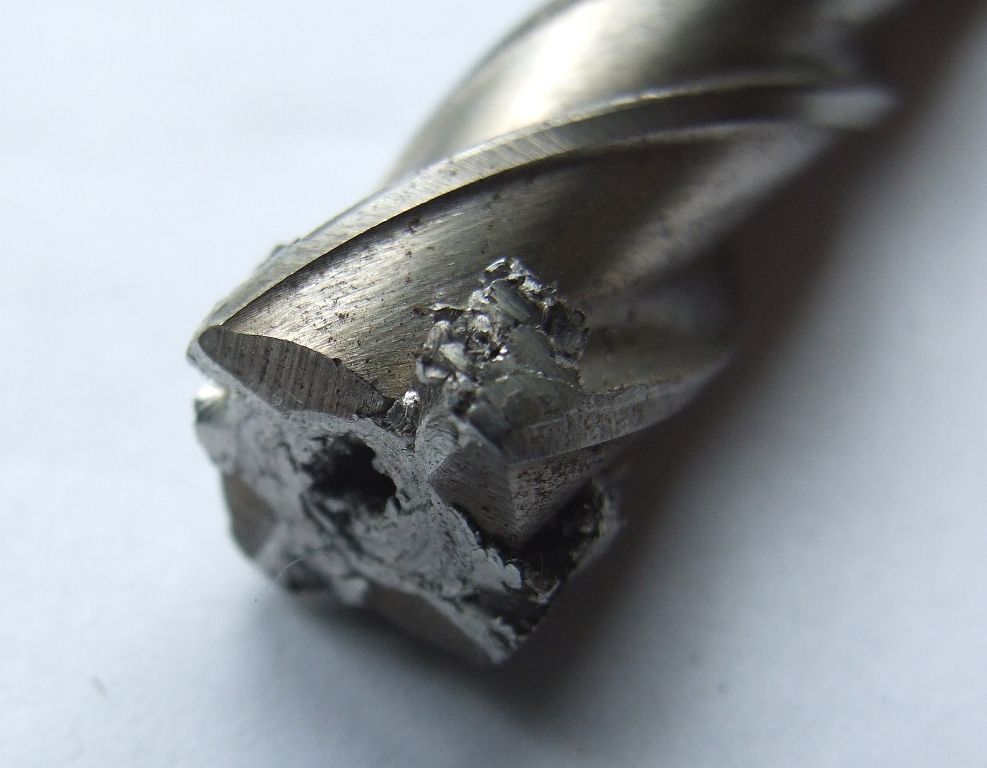
                If one is using sensible feeds and speeds then the number of flutes definitely matters. I only use 2 and 3 flute cutters for alumimium. More than 3 flutes greatly increases the probability of clogging the flutes. Like this embarrassed:

                clogged cutter.jpg

                Andrew

                #333411
                MW
                Participant
                  @mw27036

                  Cutters with polished flutes and high helix tend to work best for alu.

                  #333412
                  SillyOldDuffer
                  Moderator
                    @sillyoldduffer

                    Aluminium has a low melting point and will glue itself hard to HSS if it overheats.

                    Few suggestions in addition to Mike & Jason:

                    • May be due to swarf not clearing and being continually re-cut under the tool:
                      • 2 flutes are better at lifting out swarf, always use them for slots.
                      • the tool rpm and feed-rate aren't adjusted to lift swarf out; experiment.
                      • Use a brush to remove swarf continually.
                    • The tool is rubbing because it is blunt due to:
                      • wear
                      • over gentle cutting by the operator in the past.
                      • a thin layer of aluminium is still stuck on the edge even after the tip's been cleaned. Check with an eye-piece. A solution of Caustic Soda or Washing Soda can be used to dissolve Aluminium.
                      • over enthusiastic removal of stuck aluminium with an abrasive
                    • the Aluminium Alloy you have isn't meant to be machined. (Some alloys are gooey sticky stuff, horrible to work with.)
                    • The professionals use flood cooling or a continuous jet of compressed air to aggressively remove swarf while keeping the tool and work cool.

                    I have a love-hate relationship with Aluminium. It's beginner friendly until it bites back!

                    Dave


                    Edited By SillyOldDuffer on 22/12/2017 13:43:06

                    #333414
                    Jon
                    Participant
                      @jon

                      Depends on the aluminium grade your using, some are a right pain.

                      In short aluminium wont clog unless heats generated!

                      Not keen on the high helix as cant generate fast enough spindle speeds, just lead to chaffing and ribbing.

                      Would be nice to see a finishing cut put on Jason, bet the cutter veered off and why i only use carbide often TiALN it lasts hell of a lot longer.
                      Did have to use a mister for this, heat still built up 2 1/4" square 6082 T6 x 2ft long.

                      Down to 7/8" height on left x 1 3/4" width

                      Certainly for manual machining operators should learn to get a feel for whats happening.

                      #333417
                      JasonB
                      Moderator
                        @jasonb

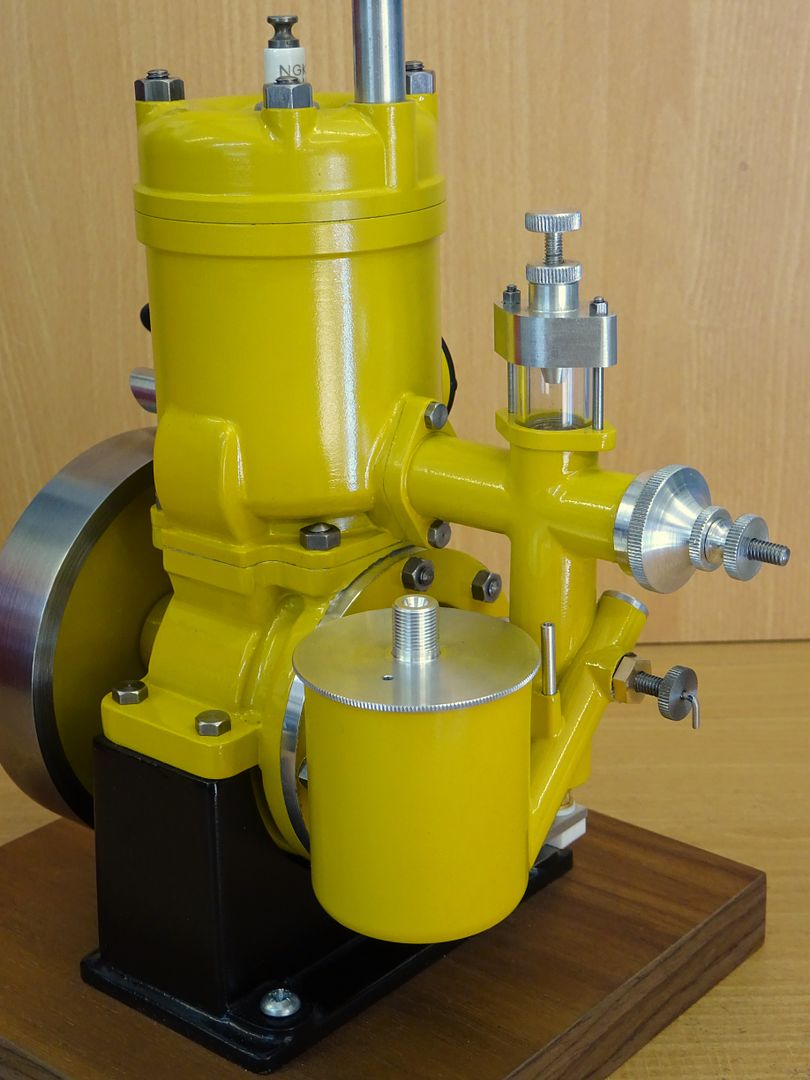
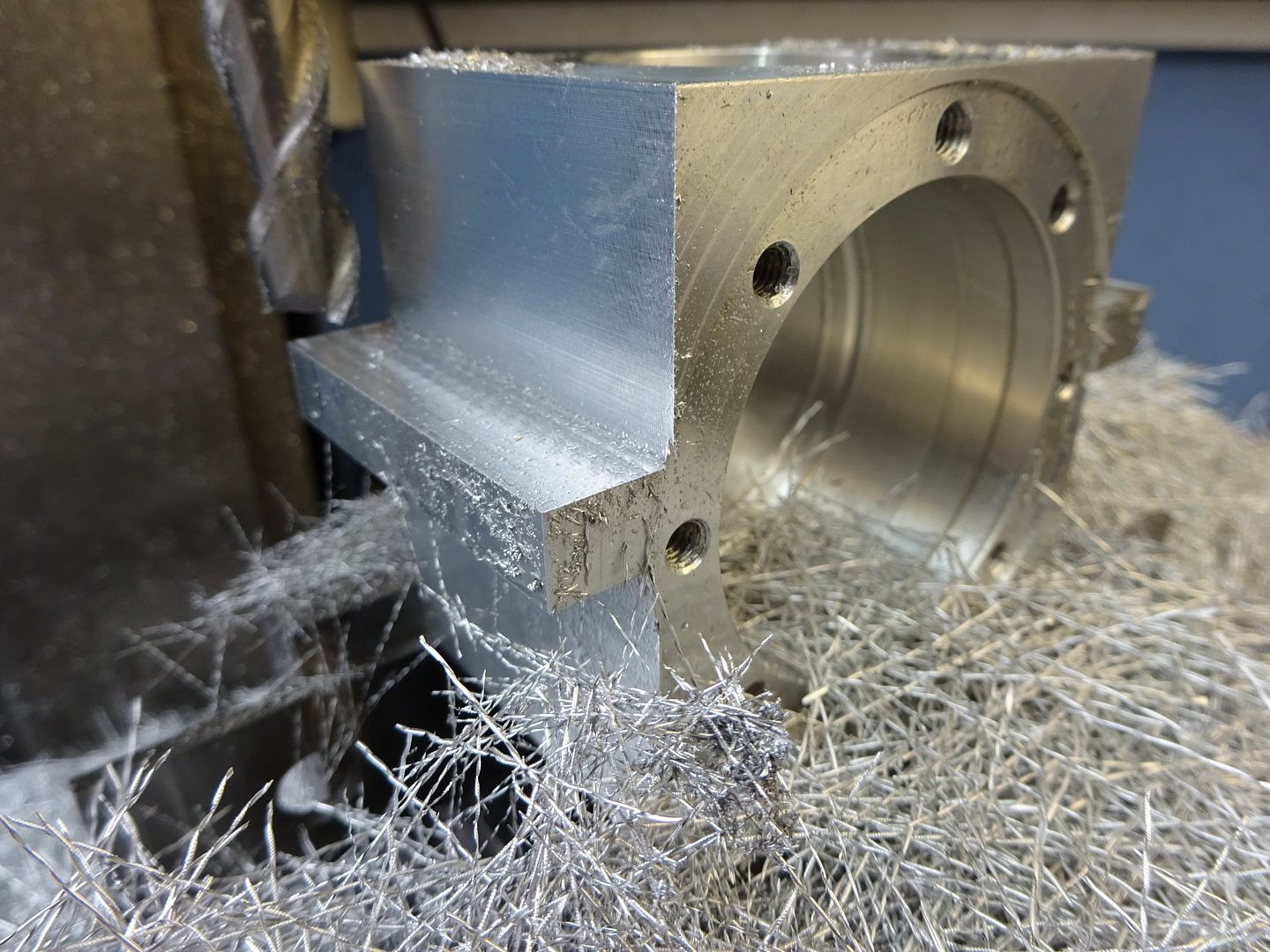
                        Not got a finished shot of that part but was not aiming for anything special as there was a lot more metal to come off and then destined for paint, its the crankcase on this engine, mounting lugs were at the end of the cutter sides now rounded

                        Tell a lie, this was the cut but as I said not aiming for a finish just removing material


                        Edited By JasonB on 22/12/2017 14:41:16

                        #333423
                        colin vercoe
                        Participant
                          @colinvercoe57719

                          try using uncoated cutters the coating process forms a small radius on cutting edge so coated cutters are not as sharp as uncoated ones, they probably require higher spindle speeds as well, This also applies to carbide turning and milling inserts as well

                          #333426
                          petro1head
                          Participant
                            @petro1head

                            Yet again fab quick responces.

                            From what I have gleaned:

                            1) Try not to use coated cutters

                            2) 2 or 3 flute but 2 seem to be an idea but the long ones can cause chatter

                            3) Lubricant like WD40 will help

                            Sillyoldduffer made an interesting comment "over gentle cutting by the operator in the past." I am guilty of this always concerned I may be being too reserved with the amount I take off. A couple of mm at a time seems a lot but maybe I am wrong?

                            The problem mostly happens when I am plunge cutting

                            #333434
                            David Jupp
                            Participant
                              @davidjupp51506

                              Possibly even consider single flute cutters.

                              **LINK**

                              #333435
                              Anonymous

                                I think the pussyfooting cuts referenced by SoD might refer to feedrate rather than width or depth of cut? Depth of cut only determines which part of the cutting edge wears. To a first approximation width of cut doesn't have much effect on wear; it's a balance between each tooth staying in the cut longer versus few passes.

                                What really wears the cutting edges more quickly than normal is too slow a feedrate. If the feedrate is too low as the cutting edge meets the work (assuming conventional milling) then instead of cutting it rubs and the cutter deflects. As the work moves eventually the forces due to a deflecting cutter overcome the material strength and the cutter starts cutting, and so on as the next cutting edge appears. This also means the cutting process is prone to chatter. A higher feedrate doesn't eliminate the rubbing but greatly reduces it, and thus reduces the wear. The extent to which the cutting edge rubs also depends strongly upon it's radius, although there's a trade off between edge sharpness and strength.

                                For carbide cutters there is also a trade off on cost. Remember that carbide cutters are not homogeneous but consist of small particles of tungsten carbide in a carrier matrix, often cobalt, formed by sintering. The smaller the particles the more tungsten carbide is present, and the cutting edges can be sharper, but the more expensive the materials and hence the cutter.

                                I thought my professional grade carbide milling cutters were sharp, until I bought a premium cutter. I managed to slice open my finger just getting it out the packaging. embarrassed

                                Andrew

                                #333437
                                Muzzer
                                Participant
                                  @muzzer

                                  Not seen any evidence either way but I wouldn't be surprised if climb milling is less susceptible to swarf sticking on the cutting edge. That would be consistent with your point about too low a feed rate.

                                  I had a couple of breakages recently – these were the result of swarf not clearing from the work area and ending up being recut and subsequently stuck to the tool. For manual milling I'd say WD40 is essential along with uncoated, polished cutters. For CNC and decent removal rates, flood coolant is essential. I'm currently making a full enclosure for my machine, as I have concluded that the only way to clear swarf effectively is to use compressed air (or high pressure coolant which isn't going to happen here). With compressed air and flood coolant, things get very messy very quickly.

                                  Murray

                                  #333439
                                  Anonymous
                                    Posted by Muzzer on 22/12/2017 16:48:21:

                                    Not seen any evidence either way but I wouldn't be surprised if climb milling is less susceptible to swarf sticking on the cutting edge.

                                    That would be my intuitive understanding too. And, in general, for aluminium on the manual mill I get a much better finish climb milling. But I deliberately didn't mention climbing milling in case I got excoriated.

                                    Andrew

                                    #333446
                                    Muzzer
                                    Participant
                                      @muzzer

                                      Here's an example of swarf buildup that requires air to keep the tool safe. There are several occasions here where the tool movement and coolant flow simply aren't enough to clear the swarf. The last minute or so shows the final finishing pass, where large quantities of swarf are generated and without the air blast, much of it would have been recut, with a fair risk of tool breakage.

                                      Warning – not suitable for the likes of Seasick Neil, due to excessive camera movement! I had to keep dancing about ahead of the tool to blow the swarf clear with the airline. I already have a couple of videos of tool breakages, so that angle has already been covered…

                                      Murray
                                      #333453
                                      Anonymous
                                        Posted by Muzzer on 22/12/2017 17:55:51:

                                        There are several occasions here where the tool movement and coolant flow simply aren't enough

                                        Hmmmm, man size cuts and swarf, but that coolant "flow" would put a small dog to shame. I don't expect much pressure from my coolant systems, but I certainly expect a decent flow rate. My CNC coolant can have trouble clearing a deep pocket, but it should cope with the situation shown. How big is the coolant pump?

                                        Andrew

                                        #333460
                                        Muzzer
                                        Participant
                                          @muzzer

                                          It's not the pump that's the problem – it's the size of the sump. I forget the capacity but it's brim full but still not enough. I can get a fine flow rate initially ("elephantine" perhaps) but it takes a fair time to percolate back down into the sump by which time the sump level is pretty low and the flow rate is seriously diminished.

                                          One solution would be high pressure, low flow rate (would require a new, different type of pump) or alternatively use the existing pump as a lift pump and fit an additional (larger) reservoir tank. That would involve a fair bit of buggerage and effort. And there would be a flooding issue if the lift pump didn't bother working.

                                          This machine wasn't expected to be using modern high speed toolpaths, although it is clearly capable of cutting the mustard so to speak – I suspect that when new (in the 1980s) the spindle motor would typically only achieve rated power when chomping through a large ingot. Most of the time it would have been mincing about, barely getting into a sweat. The problems I am having are the result of recent advances in toolpath generation and are exposing some of the differences between modern machines and older ones like mine.

                                          Murray

                                          #333461
                                          JasonB
                                          Moderator
                                            @jasonb

                                            Would a smaller nozzle help to up the velocity without needing to increase flow, you could only go so far depending on whether the pump has the guts.

                                            #333465
                                            Jon
                                            Participant
                                              @jon

                                              I could make use of that Murray its what i was inferring above.

                                              For the unwise notice the steam that means heat and it has to go some where and aluminium holds heat. WD40 or spot coolant you would have to keep stopping every 2 seconds the job and tool would be hot more susceptable aluminium bonding to cutter .
                                              A mister i rarely use that would have to be run at full chat just shy of becoming airborne to do 50% of that, no way in hell would it cope with full depth unless job and cutter was cool and a cleanup cut.
                                              The whole part would physically come off hot to the touch using the mister with feed rates slowed down.

                                              I do have a similar problem with lathe using a cheap small tank and pump but not the English originals about 4 times the capacity. Coolant builds up in height, drains and filters through mean while tanks almost empty. Larger tank.

                                              #333479
                                              Anonymous
                                                Posted by Muzzer on 22/12/2017 20:01:21:

                                                It's not the pump that's the problem – it's the size of the sump.

                                                Fair point, the tank on my CNC mill drops by about a third when running full chat on the coolant. Fortunately most of the coolant finds its way back into the tank. Although in my early days of sorting out screening, rather a lot ended up on the floor.

                                                Air blast certainly seems to be the way to go. One reason the professionals use air blast is that you don't need to centrifuge the swarf to get rid of excess coolant. And swarf without traces of coolant is worth more. thumbs up

                                                Andrew

                                                #333484
                                                Neil Wyatt
                                                Moderator
                                                  @neilwyatt
                                                  Posted by Andrew Johnston on 22/12/2017 21:36:22:

                                                  Air blast certainly seems to be the way to go. One reason the professionals use air blast is that you don't need to centrifuge the swarf to get rid of excess coolant. And swarf without traces of coolant is worth more.

                                                  Is there any reason why we don't use air blast in our wokshops other than conservatism?

                                                  Neil

                                                  #333485
                                                  Clive Foster
                                                  Participant
                                                    @clivefoster55965

                                                    Lots of air and a weak mix of synthetic Rocol Utracut works well enough in the Bijur Sparymist set up on my Bridgeport. Flood coolant is far too messy. Synthetic seems to be much more slippery than old style soluble oil so the chips throw off almost as they are cut. Which probably helps keep things cool. But you do need the air blast pointed properly into the cut and, as mentioned previously, pussyfooting around with slow feed and shallow cut is counter productive. The cutter needs to work for its living. Easier to see on a lathe than on a mill but the temperature distribution across a sensible size chip helps pull it away from the cutter so it flows off clean.

                                                    Worst thing about the misting systems is the berthing layer of oil that ends up all over the machine. Takes serious wiping to shift it and things slide around too easily when clamping of you don't get it really clean.

                                                    Neil posted whilst I was writing.  Effective air blast needs proper shielding to keep everything in and around the machine.  Sans shielding chips and suds or mist go everywhere.  Ideally you need something approaching VMC enclosures.  The common perspex partial shields for Bridgeport and similar machines are OK with moderate suds flow rate but really are mostly to keep chips and suds centrifuged off the cutter away from the operator.  Shields really get in the way on smaller machines.

                                                    Whole air blast thing needs to be re-thought for our circumstances.  Maybe some form of closed shield around the spindle area, perhaps 3 to 6 inches diameter would be good start if used with near vertical misting nozzle pointing correctly at the cutter and a vacuum extractor to clear the area in and around the shield.  Still need conventional shields to deal with the stuff the vacuum doesn't collect.  I've sacrificed a few envelopes to this sort of idea but not come up with anything I like enough o build.  Yet!

                                                    Clive.

                                                    Edited By Clive Foster on 22/12/2017 22:26:53

                                                    Edited By Clive Foster on 22/12/2017 22:27:25

                                                    #333491
                                                    Robin
                                                    Participant
                                                      @robin

                                                      There is also the layer of Aluminium oxide on the surface of your billet. This cuts a groove in the side of the tool which can be reflected as a raised band on the finishing cuts. If the groove is near the tool tip, probably because you are cutting at a budzillion rpm and it will burn out if you go deep, that could easily start a catastrophic crut build up. However the worst culprit has to be pure aluminium which always prefers to flow when you want it to cut dont know

                                                    Viewing 25 posts - 1 through 25 (of 29 total)
                                                    • Please log in to reply to this topic. Registering is free and easy using the links on the menu at the top of this page.

                                                    Latest Replies

                                                    Home Forums General Questions Topics

                                                    Viewing 25 topics - 1 through 25 (of 25 total)
                                                    Viewing 25 topics - 1 through 25 (of 25 total)

                                                    View full reply list.