Emco Compact 5

Emco Compact 5

Home Forums Manual machine tools Emco Compact 5

Viewing 25 posts - 26 through 50 (of 65 total)
  • Author
    Posts
  • #835746
    Jouke van der Veen
    Participant
      @joukevanderveen72935

      Gray,

      What you suggest is more or less a Time-Sert repair insert, but in your case from phosphor-bronze.

      I remember that Time-Sert makes them in various alloys, depending on the application. This should also result in different frictions.

      Jouke.

      PS.: Who has “the courage” to realize this solution? 😉

      #835750
      Graham Meek
      Participant
        @grahammeek88282

        Hi Jouke,

        I have no experience of the Time-sert inserts. I have used Screw-sert which is for timber applications.

        I thought my solution was a simple way to go, involving the minimum of work on the carriage. Making the components ensures that the parts are what is needed. This cannot always be guaranteed with a commercial item. Plus the salvage can be replaced at a later date if needed.

        Regards

        Gray,

        #835758
        Michael Gilligan
        Participant
          @michaelgilligan61133

          https://www.timesert.com/index.html

          Looks ideal … but expensive for a one-off job on a small lathe

          MichaelG.

          #835761
          Jouke van der Veen
          Participant
            @joukevanderveen72935

            Yes Gray,

            I had not the courage. It is not so easy to keep alignement for the cross-slide and there is no way back, I assume.

            Time-Sert has internal and external threads “in Phase” so that the bush wall be kept rather thin. If I remember well the outer thread is less than 10mm in diameter.
            If the inserted bushing is stable enough for repeated screwing in and out of the leadscrew?

            You are right that the bushing can be replaced when worn out.

            Jouke


            #835779
            JasonB
            Moderator
              @jasonb

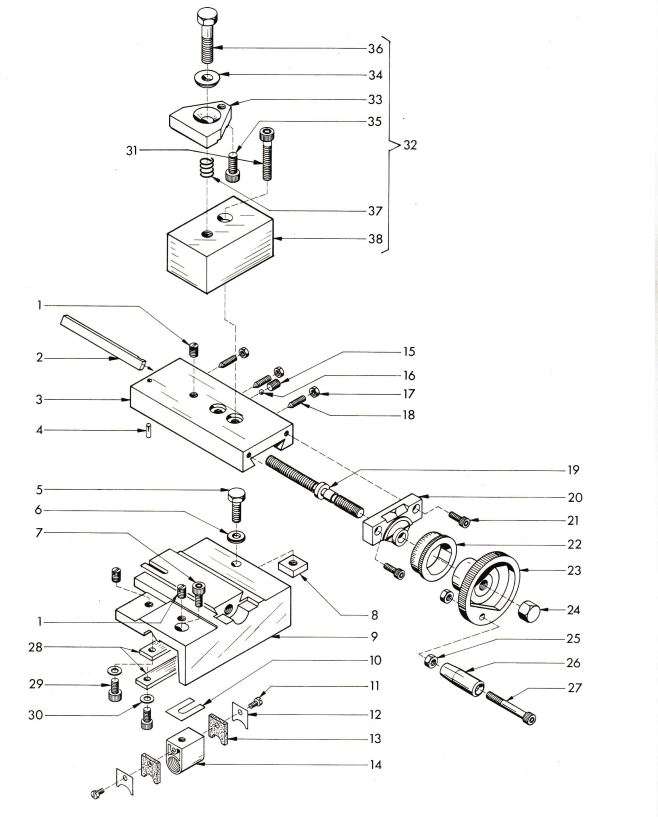
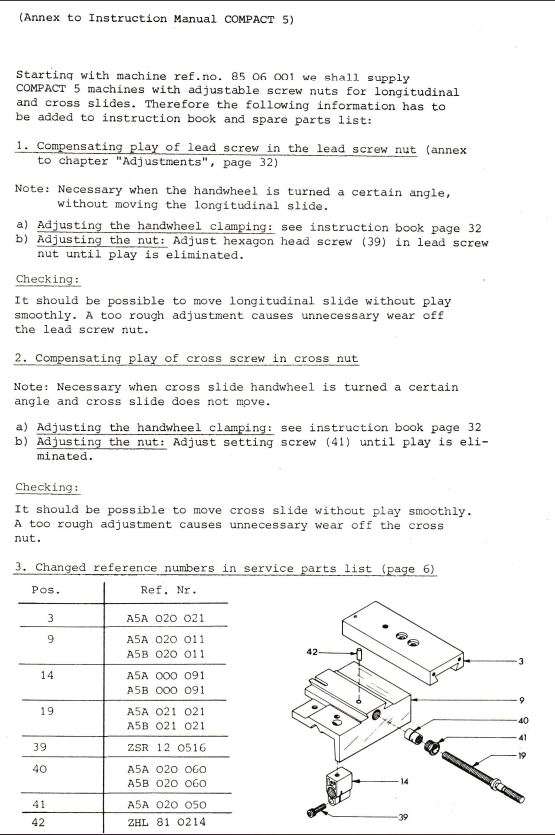
              Graham asked me to post these images of an early and later Compact 5, the later shows the provision of adjustable nuts which an insert would not give.

              c5-1

              c5-2

              #835783
              Roy Birch
              Participant
                @roybirch29994

                I presume that I would then need parts 39,40,41, and 42 to hold part 40 in place?

                #835786
                Roy Birch
                Participant
                  @roybirch29994

                  I would also need the instruction book that covers the set up for the adjustable backlash nut as all I have is a pdf that covers my lathe which did not have this setup.

                  #835791
                  Roy Birch
                  Participant
                    @roybirch29994

                    looking at the diagram, I see that part 40 goes into the front of the carriage, it appears to have a groove and it looks as though a screw or pin part 42 holds this in place, The new carriage that takes all of this does not have a hole where part 42 goes so does anyone know how you place this hole, a picture of the new carriage is below, or am I reading this wrong?

                    s-l1600

                    #835792
                    JasonB
                    Moderator
                      @jasonb

                      That guys ebay listing says they are for the compact 5 PC not the manual machine.

                      #835799
                      Graham Meek
                      Participant
                        @grahammeek88282

                        The part number listed is the correct one for the Compact 5.

                        The groove shown in the drawing is in fact a slot, (one of two), which allows the nut to be compressed thereby adjusting the backlash. The pinhole is drilled on assembly. Although on the machined from solid version of the Carrige which Jason has shown above this hole is predrilled.

                        The only other Carriage I have seen is the one for the C5 CNC which is made from cast iron and uses a ball screw and stepper motor for the Cross-slide. This is the same set-up that is used I believe on the Emcoturn 120 Slant bed.

                        Regards

                        Gray,

                        #835808
                        Roy Birch
                        Participant
                          @roybirch29994

                          removed as the information was supplied by Graham above. it came in while I was typing.

                          #838022
                          Graham Meek
                          Participant
                            @grahammeek88282

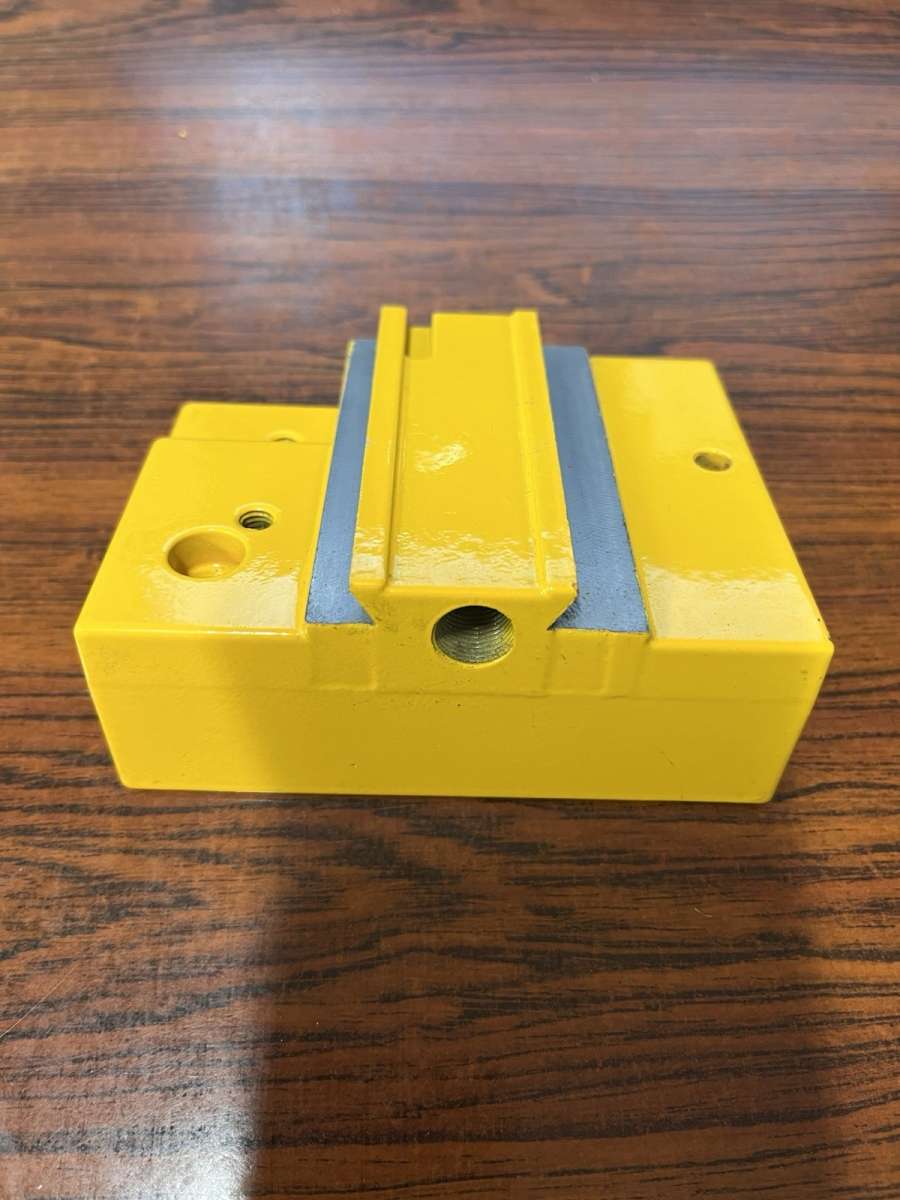
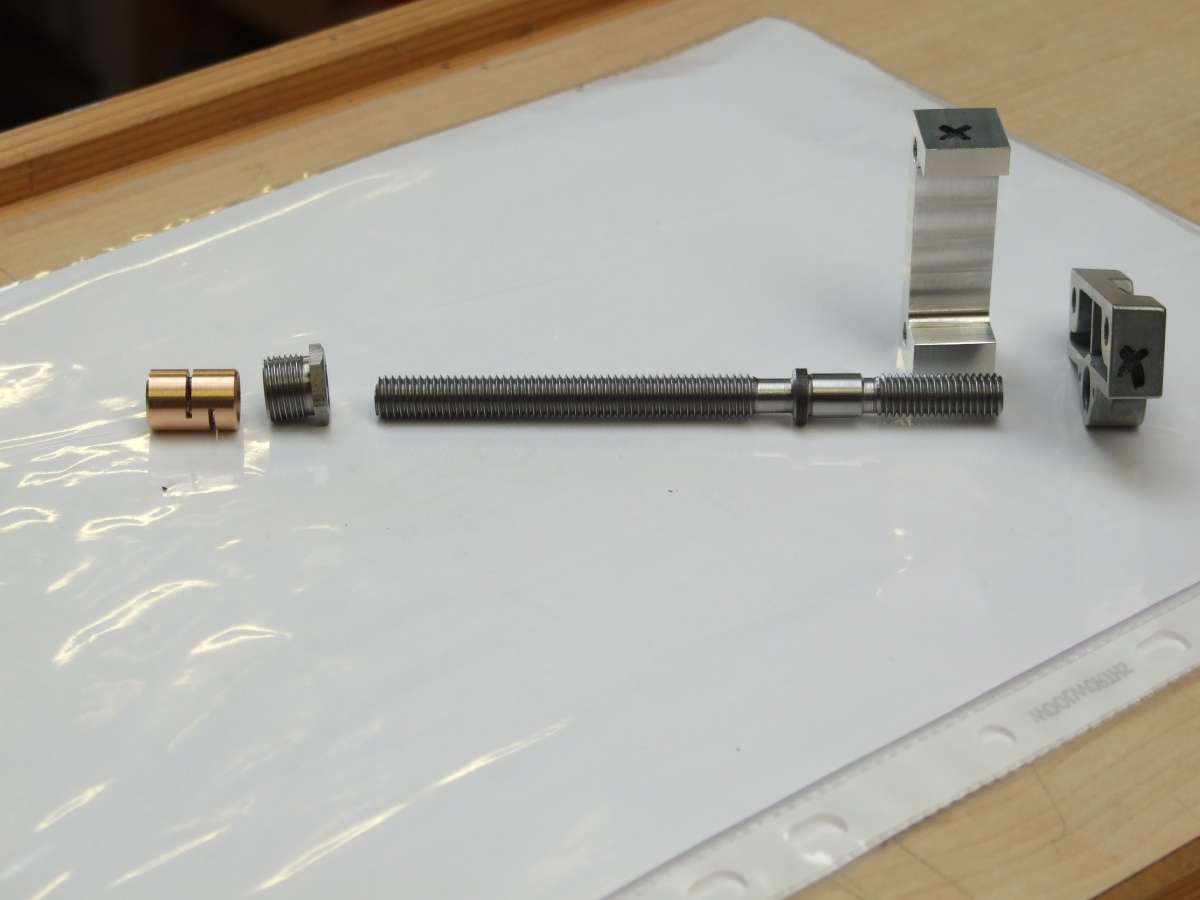
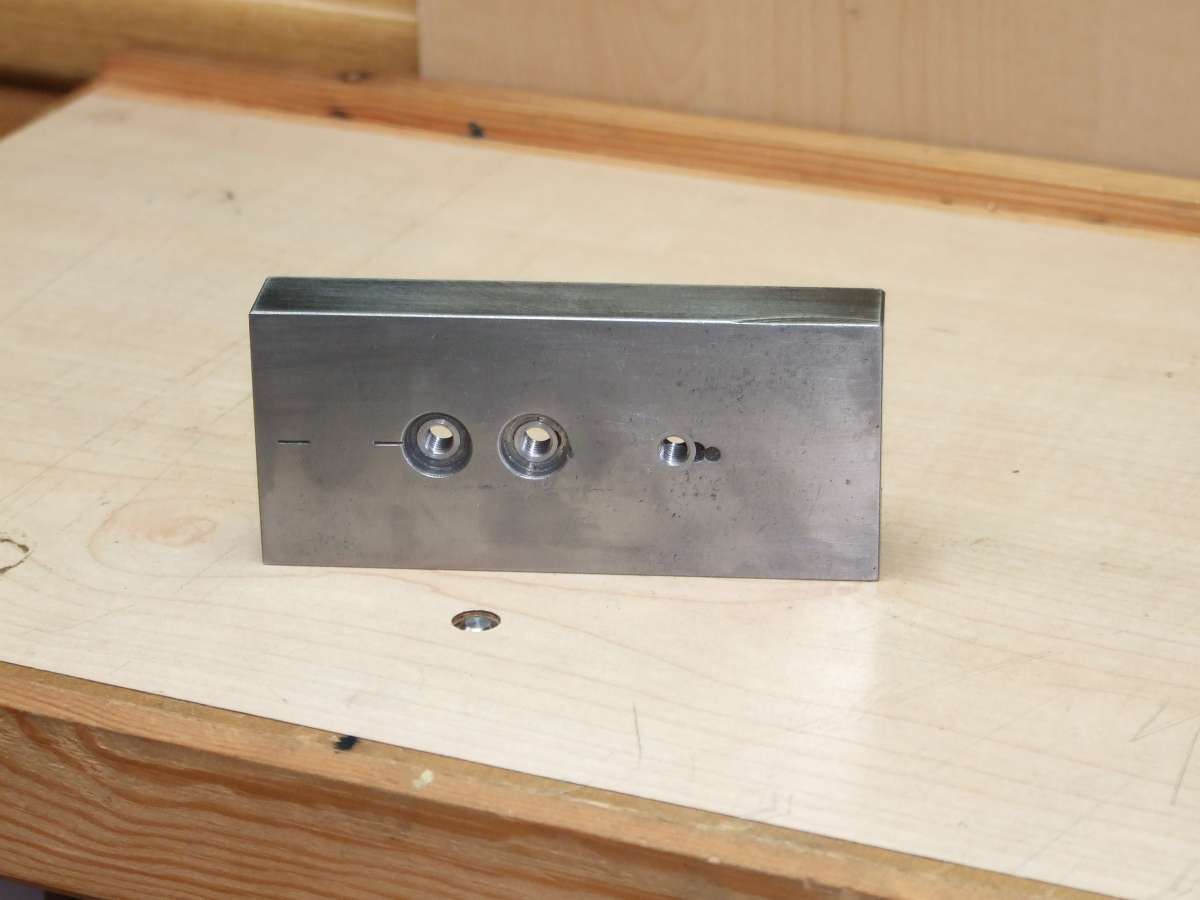
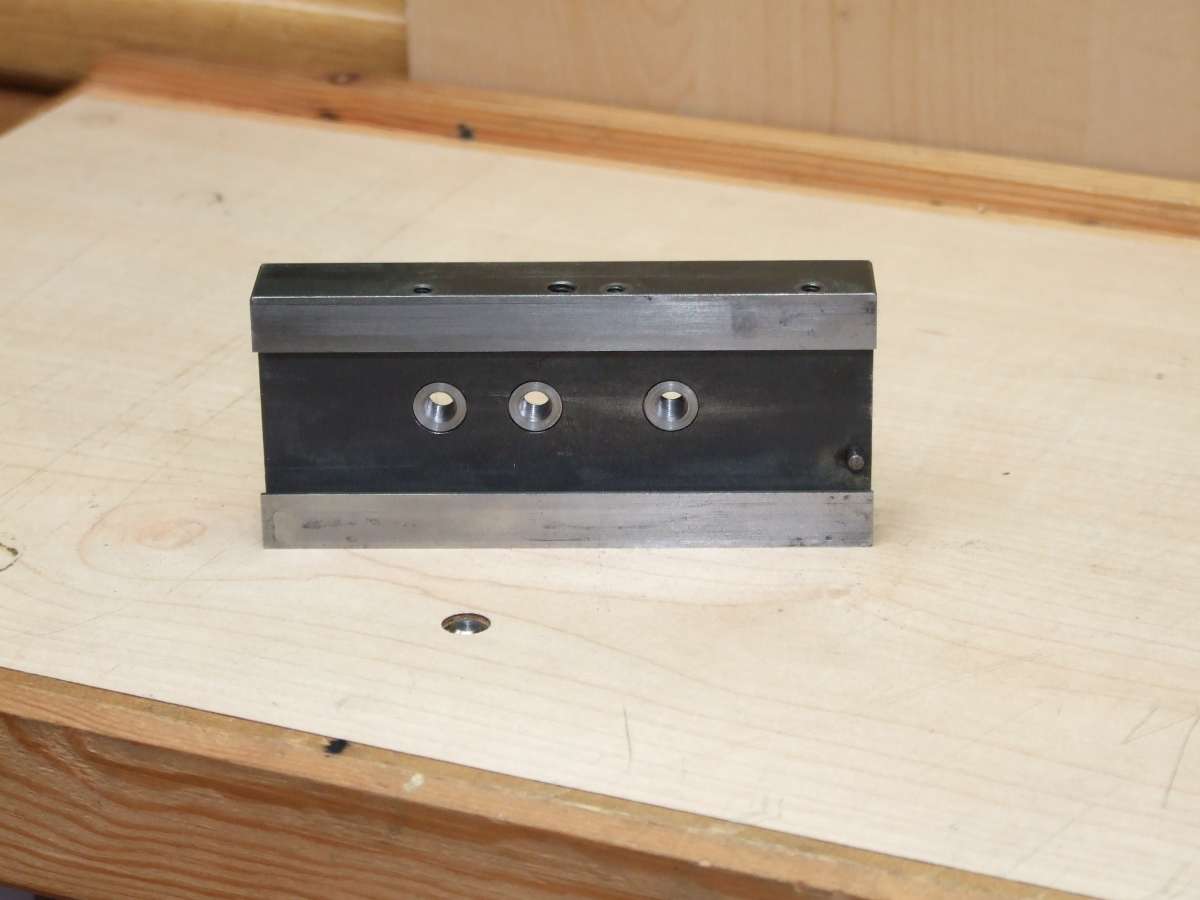
                            Over the past couple of days I have been making the parts required to fit the latest C5 Carriage to the Old Style C5 lathe which has the Cross feedscrew thread actually in the Carriage. As Roy’s lathe is above. The parts actually took about 6 hours to make for those who are interested.

                            Conversion Parts

                            The Emco End Plate is of course already in existence, it is shown so that the relative position of the Packing Piece is clear. The photograph shows the Packing Piece is handed, i.e. this will only fit the one way due to the cross-slide dovetail being off-set to accommodate the Gib Strip.

                            The Packing Piece allows the use of the existing C5 Cross-slide. The newer Cross-slides are longer.

                            While a new feedscrew and feed nut are available as a spare part. The Hex Adjusting screw is not. I guess the spare  feedscrew and nut were only really intended to be fitted to an existing machine with the latest Carriage assembly.

                            Once I have proved to my satisfaction that the parts are correct for fit and function. I intend with Jason’s help to post the drawings for all the parts on my “Emco Compact 5 Modifications” post on this forum.

                            When the new Carriage arrives I will show the complete assembly.

                            Regards

                            Gray,

                            #840159
                            Graham Meek
                            Participant
                              @grahammeek88282

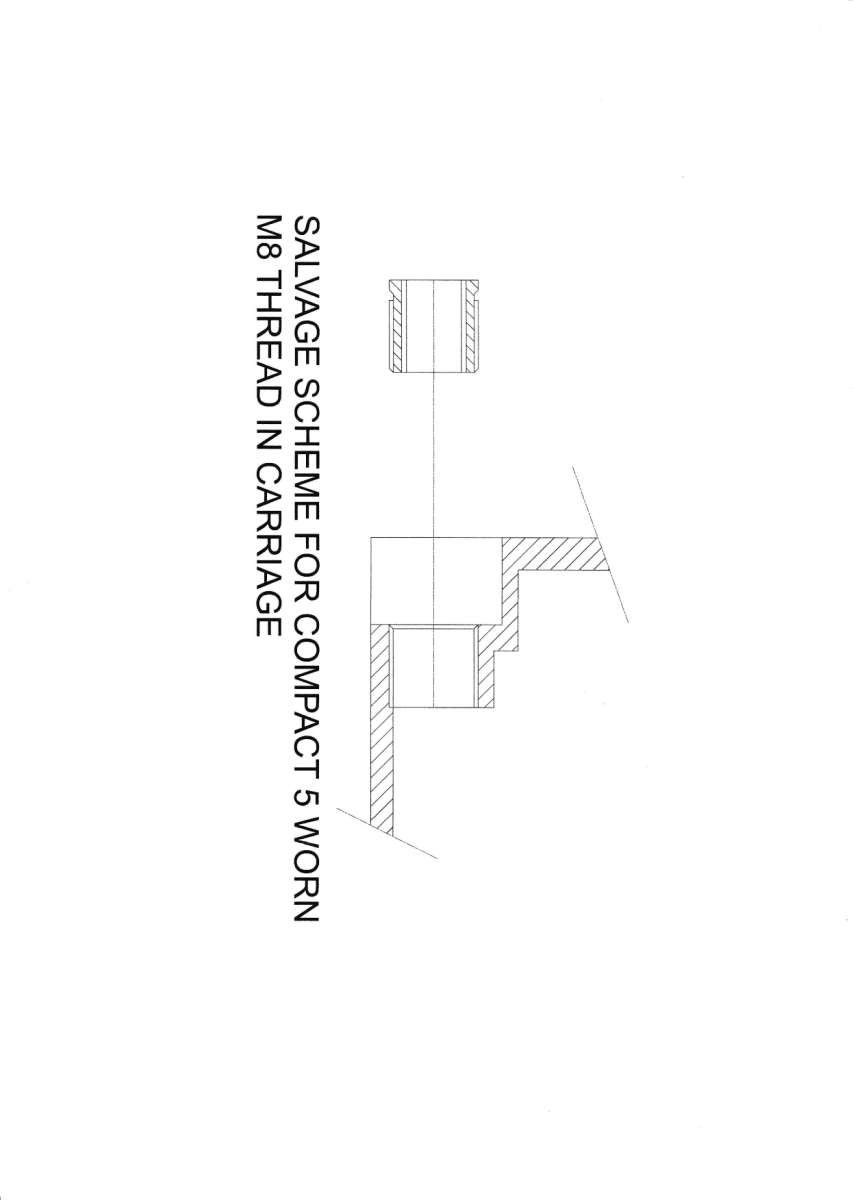
                              Just a quick note to say I now have an old style C5 Carriage to work with and I have come up with a workable salvage scheme which I hope to implement over the coming couple of weeks.

                              C5 Salvage scheme


                              Regards

                              Gray,

                              #840170
                              Bazyle
                              Participant
                                @bazyle

                                Sorry I had not read this thread before as I’m not an Emco user but the backlash owing to worn thread in casting is a standard Drummond problem and the solution is easy if it bothers you.
                                First look at that replaceable nut in the photo above – it has 2 slots so when compressed to make the adjustment the outer 1/3 (LH in picture) end takes most strain for applying cuts, the middle floats, and the near end (RH in pic) takes the strain for withdrawing the slide/tool.

                                All we need to do is provide the RH bit. And as it is not acme or trapezoidal it is even easier, M8 I think was mentioned.
                                So just use a standard tap to make a thread in a 3mm thick round washer that is just small enough to fit on the leadscrew (operator or RH end) without fouling. Put ‘washer’ on, insert leadscrew to wherever it is sloppiest and take up the slack with the washer like doing up a locknut. Back off a tad and mark washer orientation, move to tight end of screw and check it is not locked and if necessary back off more.
                                At this point the washer can rotate so soft solder on a tab and arrange a little screw to hold it in the optimum position. Use soft solder to make it easy to redo after some wear.

                                You have only lost the 3mm of washer thickness on your overall movement range. If you are doing milling maybe make the washer thicker so it has more threads to take the strain.

                                #840233
                                Graham Meek
                                Participant
                                  @grahammeek88282

                                  The sample carriage that I have has worn to such an extent that I can pass a 7.5 mm drill shank through the tapped M8 hole. The Feedscrew is 7.9 mm outside diameter. This gives 0.2 mm of engagement on each side of the thread, provided the screw remains central. If it drops to the bottom where it might be in full engagement the crests of the top of the thread will be in fresh air.

                                  This replacement Nut will be far easier to replace when worn. Plus it returns the lathe to the original status.

                                  The Backlash elimination above is an Emco design change, which over comes the problem of the worn thread and provides the luxury of backlash adjustment. Repairing the worn thread at the moment is my priority for other users.

                                  Regards

                                  Gray,


                                  #840240
                                  Roy Birch
                                  Participant
                                    @roybirch29994

                                    Hello Bazyle

                                    There were a number of ways that I could have done the job myself but the lack of availability of Emco spares if something went wrong was a risk, when Graham offered to help with getting the lathe carriage repaired it would have been foolish for me to consider anything else, although I do have a Myford Super 7 nearly brand new, a Myford Tri-Leva fully kitted and a Boxford VSL fully kitted this lathe is one I have always wanted ever since my meeting with Gerald Wingrove, I feel that I have to do my absolute best to restore this lathe to the best working condition possible as it came to me as the Emco 5 Machining centre after a friends passing, the help from Graham will make a lot of that possible.  It is also a very capable little lathe.


                                    Kind Regards


                                    Roy

                                    #840341
                                    Kiwi Bloke
                                    Participant
                                      @kiwibloke62605

                                      That looks neat! I’m a bit surprised that there’s enough meat in the saddle to hold the replacement thread insert, but Graham Meek certainly knows what he’s doing, so I’ll just be surprised… I guess that the thread insert could be split, so that there’s an adjustment and backlash-reduction facility, if the insert halves can be prevented from rotation.

                                      #840348
                                      Graham Meek
                                      Participant
                                        @grahammeek88282

                                        While a backlash facility would be nice. The problem comes with using a worn feedscrew. Most of the wear on the cross-slide feedscrew is going to be when the cross-slide is on it’s inner most travel. Thus if the backlash is eliminated at this point then the feedscrew will not be able to come out of the nut totally as the outer end of the feedscrew is larger.

                                        The only way this anti-backlash system is going to work is with a new feedscrew.

                                        Having tried the old feedscrew in the tapped hole of the Phos Bronze nut shown above it is not that loose which is really surprising.

                                        Regards

                                        Gray,


                                        #840351
                                        Roy Birch
                                        Participant
                                          @roybirch29994

                                          I did try the feedscrew in a die and also on some nuts of various materials and I also found that it was not that loose, I wondered if a new feedscrew had been fitted to see if that fixed the problem.


                                          Kind Regards


                                          Roy

                                          #840383
                                          Graham Meek
                                          Participant
                                            @grahammeek88282

                                            I have taken time out to measure the feedscrew with 3 wires. The measurements are pretty consistent with a new thread and it is fairly parallel. However the thread flanks are very rough and this would certainly accelerate the wear in the nut.

                                            I am wondering if there has been a piece of Allthreads, or studding, planted on the old screw. As the thread undercut is not to the usual DIN or Emco standard.

                                            Regards

                                            Gray,


                                            #840402
                                            Roy Birch
                                            Participant
                                              @roybirch29994

                                              I agree Graham, the feedscrew did give me the impression of not being the normal standard that I would have expected, I did also notice that the feedscrew felt rough to the touch, my first thoughts were that it had been modified in some way but I did not know how if this is the case.

                                              #840450
                                              Graham Meek
                                              Participant
                                                @grahammeek88282

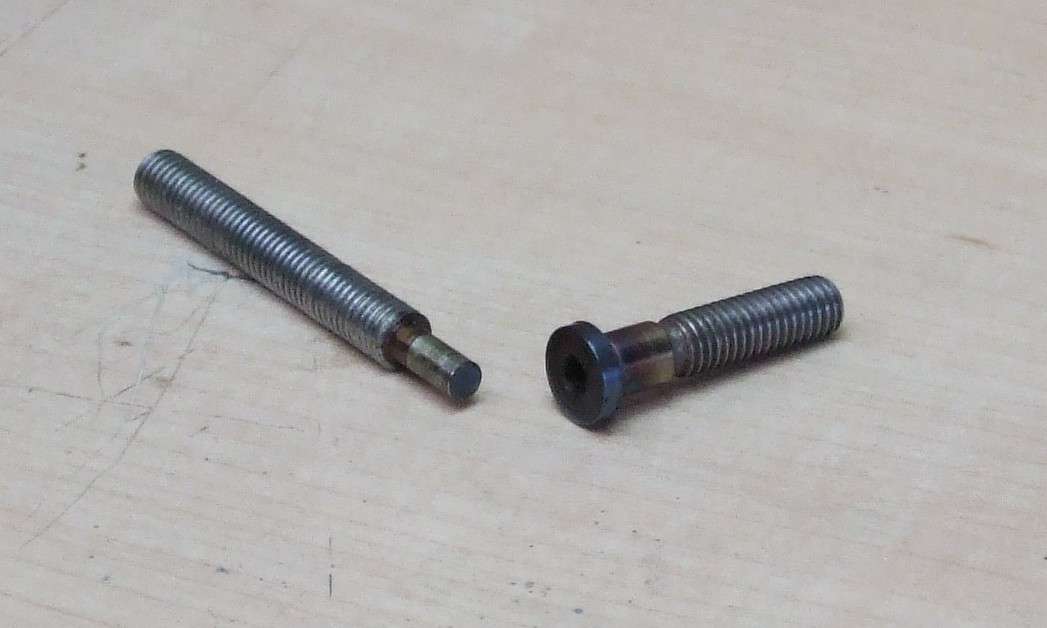
                                                Well Roy we need not speculate any further. I have taken the liberty of applying a little heat to what I suspected to be a joint.

                                                C5 Feedscrew

                                                This view shows that the feedscrew was made in two parts and the roughness of the thread can just be seen in this view.

                                                Regards

                                                Gray,

                                                #840534
                                                Graham Meek
                                                Participant
                                                  @grahammeek88282

                                                  The Cross-slide on Roy’s C5 lathe has had a hard life. The M6 tapped holes which retain the Topslide, (aka Taper Turning Attachment), the Machine Vice or the Milling Table have at sometime all been stripped.

                                                  A repair had been made with Helicoil wire inserts. As I have mentioned earlier, or elsewhere, these are in my mind only intended for semi permanent attachment purposes, not for repeated disassembly. The effect on the cast was such that the Helicoil thread itself had failed in one hole and where the insert was still in the hole it was only attached at either end of the thread. The centre portion acting like a compression spring in a drilled hole.

                                                  DSCF2803DSCF2802

                                                  The above photographs show my solution to this problem which I know others have had.

                                                  The existing holes were clocked from above so that the new thread was concentric. The holes were first of all opened up with a slot-drill before drilling and reaming 8mm diameter.

                                                  Turning the part over in the vice the underside of the holes were counterbored 10.5mm diameter by 1.2mm deep, this dimension is kept constant. Two different lengths of threaded M6 Top Hat bushes were turned from 10mm diameter High Tensile steel to be a press-fit in the holes.

                                                  This will be the 3rd cross-slide I have repaired in this way and I have had no reports of any failures so far. Of course if a thread is stripped then it is a simple matter to press the old part out and press in a new one.

                                                  Regards

                                                  Gray,

                                                  #840559
                                                  Ian P
                                                  Participant
                                                    @ianp
                                                    On Graham Meek Said.

                                                    A repair had been made with Helicoil wire inserts. As I have mentioned earlier, or elsewhere, these are in my mind only intended for semi permanent attachment purposes, not for repeated disassembly. The effect on the cast was such that the Helicoil thread itself had failed in one hole and where the insert was still in the hole it was only attached at either end of the thread. The centre portion acting like a compression spring in a drilled hole.

                                                    .
                                                    .

                                                    Regards

                                                    Gray,

                                                    In my experience wire thread inserts (often Helicoils, but there are others) are mainly used for two reasons, one is to provide a stronger fixing for the same bolt diameter often in softer materials, the second reason is to provide a robust threaded hole for fixings that need to be frequently removed and replaced.

                                                    I’ve never come across an insert only attached at either end, I would presume it was very poorly installed.

                                                    Ian P

                                                    #840572
                                                    Graham Meek
                                                    Participant
                                                      @grahammeek88282

                                                      Hi Ian,

                                                      I don’t doubt for one minute that what you are saying is correct.

                                                      My experience with Helicoils starts with the Fuel System bodies for jet engines. At each Fuel System overhaul the inserts were removed and replaced. In other words single usage. The installation of the new inserts was done to the book in this instance and every “Tang” had to be accounted for.

                                                      There have been two other occasions that I have used them with success. One to repair a stripped sparkplug hole in a cylinder head and the other to repair two stripped tapped holes in the Unimat that I renovated elsewhere on the Forum.

                                                      Those repairs that I have come across during my working career on Production Tooling, drill jigs, milling and assembly fixtures, has always been after a failure. Such tooling can be used many hundreds of times in a day. In every case the mating thread was so badly worn it had to be replaced. As well as a permanent repair to the offending tapped hole.

                                                      Like the above I cannot say if the inserts were installed correctly or not. As regards the Cross-slide both the remaining inserts were flush with the surface. On the Fuel System bodies, and those repairs I did myself, the inserts were always inserted one and a half threads below the surface.

                                                      Regards

                                                      Gray,

                                                    Viewing 25 posts - 26 through 50 (of 65 total)
                                                    • Please log in to reply to this topic. Registering is free and easy using the links on the menu at the top of this page.

                                                    Latest Replies

                                                    Home Forums Manual machine tools Topics

                                                    Viewing 25 topics - 1 through 25 (of 25 total)
                                                    Viewing 25 topics - 1 through 25 (of 25 total)

                                                    View full reply list.