drying out of flux / prefluxing of silver solder.

drying out of flux / prefluxing of silver solder.

Home Forums General Questions drying out of flux / prefluxing of silver solder.

Viewing 25 posts - 1 through 25 (of 35 total)
  • Author
    Posts
  • #220679
    RRMBK
    Participant
      @rrmbk

      Hi all some help please.

      In preparing for silver soldering has anyone fluxed joints before riveting and allowed the flux to dry out in the right place between the joint, say overnight; before silver soldering. My boiler sections are currently fixed together with screws and I would like to be sure the flux has fully coated the surfaces before actually removing these and finally replacing them with Rivets. I presume the water in the flux mix is only there to allow the flux to flow or seep into the joints which it would not do if dry, or does it serve some deeper chemical purpose? my concern would be that the air pressure of the flame might blow the dry flux out from the joints if applied directly Hope this makes sense.

      Kind regards all

      BK.

      #24316
      RRMBK
      Participant
        @rrmbk
        #220683
        julian atkins
        Participant
          @julianatkins58923

          hi brian,

          i partly do what you propose in that for miniature loco boiler work i apply the flux then let it dry out a bit for an hour or so.

          as for flux between joints riveted together, there are perhaps 2 points worth considering. the joints should be cleaned beforehand and roughed up, then riveted. if you have less than 2 thou gap between the riveted joints you wont get silver solder penetration. there are tricks to overcome this – centre popping the joint all along leaving the raised bit created by the centre punch, or coarsely filing criss cross lines (something i do for foundation ring sections).

          if the joint is clean before riveting and the riveting is done shortly before silver soldering ie not left on the bench for a few months, then it is only necessary to apply the flux either side of the joint and not between.

          remember that all rivet heats must have silver solder applied, and ideally the rivets should not be tight.

          just my own personal approach of course.

          cheers,

          julian

          #220688
          RRMBK
          Participant
            @rrmbk

            Thanks Julian.

            My thinking was to pickle the individual boiler parts, and then flux and rivet up with a few bits of thin 2/3 thou shim adjacent to rivets between joints which is then pulled out. Leave overnight and solder up the following day, using a normal fluid flux mix to supplement the joints. I understand the need to coat the rivet heads. This isnt my first boiler but on the last one I did seem to get problems with what appeared to be lack of flux penetration.

            #220703
            maurice bennie
            Participant
              @mauricebennie99556

              Hi RRMBK Try mixing borax with meths into a paste ,when heated it does not bubble and also wets the joint right through.I always use this method when I silver solder my jewelry bits . I also use DIEWRSOL soldar liquid (spelled SOLDAR) ,this is expensive but works well on gold silver and all other non ferrous metals.

              Maurice

              #220705
              maurice bennie
              Participant
                @mauricebennie99556

                Hi again misspelled DIEWERSOL Maurice.

                #220714
                nigel jones 5
                Participant
                  @nigeljones5

                  I do it a little different, I make the joint then apply a weak (i.e. watery) load of flux to one edge so that it is drawn in by capiliary action, then apply a thick paste to either edge. The weak solution will find its way into the rivets and every where else. I often allow it to dry, seems to make no difference.

                  #220715
                  Gary Wooding
                  Participant
                    @garywooding25363

                    The job of the flux is to prevent oxidation of the joint when heat is applied. Oxidation will prevent the solder from flowing. Many propriety fluxes can do a limited amount of cleaning, but you shouldn't rely on that – its best to get the joint as clean as you can before applying the flux.. The water is simply to make it easy to apply the flux to the joint – it has no magic properties. When the joint gets close to the solder melting temperature, the flux will fuse into a clear liquid; as long as as it coats the joint then no oxygen can can intrude. There's a "gotcher" though, if you heat flux for to long, or at too higher temperature, you burn it and it loses its ability to exclude oxygen.

                    #220719
                    Bob Rodgerson
                    Participant
                      @bobrodgerson97362

                      I also mix in a drop of washing up liquid to the flux paste mix. This makes the surface "Wet" and ensures that it doesnt run away from vertical surfaces and probably jelps with flux penetration of the joint.

                      #220740
                      Gary Wooding
                      Participant
                        @garywooding25363
                        Posted by Bob Rodgerson on 12/01/2016 12:47:02:

                        I also mix in a drop of washing up liquid to the flux paste mix. This makes the surface "Wet" and ensures that it doesnt run away from vertical surfaces and probably jelps with flux penetration of the joint.

                        I do this too; it helps with neutralising small amounts of grease or oil that might be present in the joint.

                        #220829
                        RRMBK
                        Participant
                          @rrmbk

                          Thank you all for your advice and suport . greatly appreciated. I feel a lot more confident about the next steps now. Gary – one queery please re your " gotcha" any estimate of how long is too long ?

                          Kind regards All.

                          BK

                          #220835
                          Gary Wooding
                          Participant
                            @garywooding25363

                            Hi BK,

                            It depends on the flux: Easyflow is quite sensitive – if it goes brown then its burnt. This can occur as quickly as a minute or two. High temperature fluxes, such as Tenacity, can withstand higher temperature for longer, but there's a catch: when the joint has cooled down, the flux forms a hard, glass-like, covering. Very hot water removes the Easyflow, but has no effect on Tenacity which often has to be chipped off.

                            Never heat the solder directly, it will ball up and refuse to flow; the normal reaction is then to keep blasting the area which simply ends up burning the flux. Heat the joint; sneak up on it from various directions, but avoid directly heating the solder. When the joint is hot enough it will melt the solder which will then run into the joint.

                            #220837
                            julian atkins
                            Participant
                              @julianatkins58923

                              hi brian,

                              re gary's 'gotcha' i use Thessco F or J&M Tenacity 4A for copper silver soldered loco boiler work where prolonged heating is involved. under no circumstances use ordinary easyflo flux. if the job doesnt get up to heat within say 10 minutes with propane and the joints being silver soldered not done within a few minutes then you will have flux exhaustion problems. (i have never found adding extra flux part way though satisfactory).

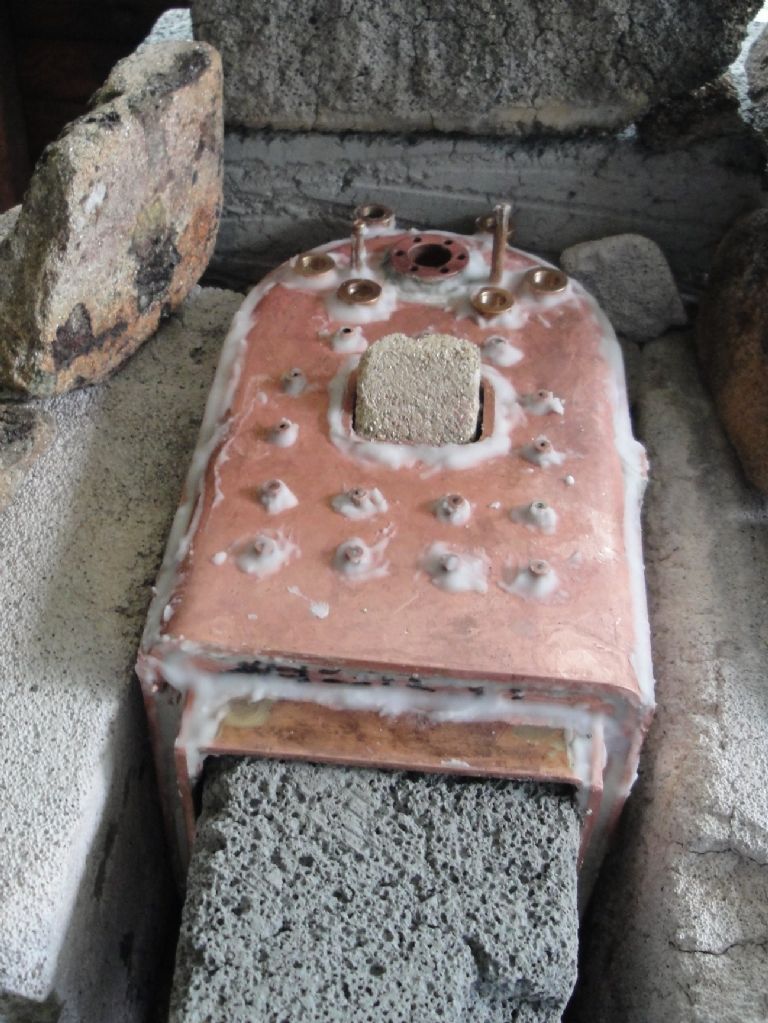
                              this is an idea of the quantity of flux i use – quite a lot. mixed to a stiff paste with as bob says a drop of washing up liquid, and then left to dry a bit before lighting up.

                              dsc00659.jpg

                              your 2 thou shim is a very good idea when riveting. i try and use as few rivets as possible.

                              good luck!

                              cheers,

                              julian

                              Edited By julian atkins on 13/01/2016 08:13:37

                              #220854
                              KWIL
                              Participant
                                @kwil

                                Julan,

                                Do you fully or partially thread your bushes before soldering in?

                                #220863
                                RRMBK
                                Participant
                                  @rrmbk

                                  Gary and Julian thank you. What a great example of " a picture speaks a thousand words" I would never have considered the block in the firebox to conserve heat and protect other areas, and the view of the flux gives me a really good idea of the amount and consistency.

                                  Kwil – I usually partly thread but being daft I often forget when making the bushes and go all the way through. Not had any failures with the fully threaded bushes yet.

                                  Anyhow I can forget about boilers now for a fortnight – snow has fallen and the slopes are beckoning — off skiing hooray !!

                                  Kind regards all

                                  BK.

                                  #220869
                                  CotswoldsPhil
                                  Participant
                                    @cotswoldsphil

                                    Julian,

                                    Thanks for your photo – very informative. Especially how you use Thermalite blocks. What size of burner would you use for this job when you do light up? I'm looking to have a go at a Minnie TE sized boiler. I suspect that the boiler in your photo is a little larger.

                                    Regards

                                    Phil

                                    #220883
                                    julian atkins
                                    Participant
                                      @julianatkins58923

                                      hi phil,

                                      i have a sievert set and 13kg propane bottle. for boiler work i use the 2943 burner.

                                      all bushes PB102/hard drawn phos bronze, and only partly tapped with a taper tap before silver soldering.

                                      glad you like the pic -there are more of this boiler in 2 of my albums. doing the backhead is the final stage and always a bit nerve wracking. i also check beforehand that my propane bottle is still heavy!

                                      cheers,

                                      julian

                                      #220891
                                      CotswoldsPhil
                                      Participant
                                        @cotswoldsphil

                                        Hi Julian,

                                        Thanks for your reply – your album does tell a story.

                                        The Sievert 2943 at 43.5 kw is, according to my research, <> 3.5 times the output of the Bullfinch 1250 that I used in my first failed efforts on a Minnie firebox, perhaps I am getting nearer to understanding what will be required to complete the boiler.

                                        Regards

                                        Phil

                                        #220892
                                        Bob Youldon
                                        Participant
                                          @bobyouldon45599

                                          Hi all,

                                          There's a distinct difference how the flux will perform when sliver brazing steel than when dealing with copper or brass; copper / brass / unleaded gunmetal/ drawn bronze etc, the flux will all work and react in much a similar manner and the Easyflo type flux is most suitable for the much smaller assemblies, but as Julian has said a more a suitable flux where prolonged heating is required such as boiler construction, mechanical cleaning is the norm, but not emery cloth etc, before the application of any flux. Also it is essential to reflect as much heat back onto the job whilst its being heated, the Themalite or similar block being very suitable. Steel should be treated in a very similar manner, mechanically cleaned but using a flux capable of more prolonged heating is required and plenty of it, remember flux is relatively cheap so don't skimp on it. and when silver brazing steel try to bring the job to the correct temperature as quick as possible, support the job off of the hearth on some odd pieces of fire brick rubble to allow the heat to circulate all around the job. Following any silver brazing job let it cool to black even down to a point where you can comfortably pick it up and let the job soak for a couple of hours in clean cold water, you will find the majority of the flux residue will then just rub off. One thing, avoid Borax etc like the plague, the flux when heated goes like glass and is nearly as hard, you'll spend hours trying to clean the job, use a flux compounded and matched to the sliver brazing process.

                                          Regards,

                                          Bob Youldon

                                          #220897
                                          Keith Hale
                                          Participant
                                            @keithhale68713

                                            The basic principle of silver soldering is capillary flow.

                                            Everything that you do for strong sound joints and be successful is to promote that capillary flow.

                                            For capillary flow to occur there must be a gap.

                                            No gap = no flow = no joint

                                            As described earlier, centre punching or roughing up the surface with a coarse file will help produce a 0.1mm gap. Placing foil in the joint will also work but consider using silver solder foil that you do not have to remove.

                                            Pre-cleaning copper, chemically or otherwise, prior to silver soldering is often unnecessary

                                            At the first instance that you apply heat, you create more oxide on the surface that you hve so painstakingly removed. Joint cleanliness, removing oxides and keeping the surface free of oxide, is the job of the flux. Simply make sure the joint is free of oil and grease which the flux cannot tackle. The temperatures involved will drive off any grease from the hands. Note. This comment does not apply when soft soldering

                                            Use a flux that will operate for the heating period.

                                            If necessary use a long life flux eg HT5. Its residues are more difficult to remove but clean the joint afterwards in 10% caustic soda. Flux which becomes exhausted will not keep the joint free of oxides.

                                            The alloy will always flow to where it is hottest.

                                            Heat the joint in the area to where you want the alloy to flow in relation to where you are applying the alloy. This ensures there are no cold spots in the joint that will cause the alloy to freeze, stop flowing and lead to a lack of penetration. As per Gary

                                            HEAT THE JOINT NOT THE ALLOY

                                            For more detailed information go to **LINK**

                                            Stick to the principles af capillary flow and you will be successful!


                                            Keith

                                            Edited By CuP Alloys 1 on 13/01/2016 13:30:39

                                            #220900
                                            Roger Head
                                            Participant
                                              @rogerhead16992

                                              Hi Julian, I've sent you a PM.

                                              Roger

                                              #220930
                                              Tim Stevens
                                              Participant
                                                @timstevens64731

                                                A further idea which may help is to use charcoal as a packing around the part to be soldered. Heat from the torch will light the charcoal so it becomes as it were a negative insulator – adding its own heat, not taking it away. A further advantage is that the extra CO from the hot charcoal provides a reducing atmosphere, easing the job of the flux.

                                                Ordinary barbeque charcoal is good, or collect the black lumps of residue from a wood stove. The only extra to remember is to quench the charcoal thoroughly with water or it will continue to glow quietly and might set the shed on fire.

                                                Regards, Tim

                                                #220934
                                                julian atkins
                                                Participant
                                                  @julianatkins58923

                                                  hi Tim,

                                                  you can use charcoal if you want smoking away and ruining the job. i will stick to my thermalite blocks which dont give off smoke or fumes. i also do all my silver soldering indoors. i dont want a BBQ in my workshop!

                                                  cheers,

                                                  julian

                                                  #220937
                                                  Bill Dawes
                                                  Participant
                                                    @billdawes

                                                    Interested to see Julian's comment on his use of a 2943 nozzle for boiler work, I have struggled with a 3525 (10.3kw) on my Emma Victoria boiler (not that I have got very far with that in 2015, 2016 will the year of great progress!!) As they say I am 3 years into a 3 year project, well that was my original expectation.

                                                    So now have a 2943, not yet put it to the test but Julians comment gives me new heart, accepting Julian's greater expertise is also a big factor.

                                                    Got as far as cutting the boiler for the firebox and one failed attempt at the silver soldering on the extension piece (with the 3525 nozzle) a quick light up of the 2943 shows a fieresome flame.

                                                    I have high expectations of this new nozzle as I have always thought I took all the right care in preparation but most time ended in frustration( apart from small components) the problem I seem to struggle with is complying with the 'rule' of keeping the flame away from the flux/solder,

                                                    Bill D.

                                                    #220947
                                                    CotswoldsPhil
                                                    Participant
                                                      @cotswoldsphil

                                                      Posted by Bill Dawes on 13/01/2016 18:45:31:.

                                                      ………I seem to struggle with is complying with the 'rule' of keeping the flame away from the flux/solder,

                                                      Bill D.

                                                      Is it really possible, or necessary, to keep the flame away from the flux? Keith's mantra (Cup-Alloys) about letting the work melt the silver solder once the flux has gone clear worked very well for me on my test pieces, moving the flame away to apply the silver solder. In Julian's photo of the fluxed up back-head nestling in the Thermalite blocks, keeping the flame off the flux would be impossible.

                                                      Phil

                                                      Edited By CotswoldsPhil on 13/01/2016 19:42:55

                                                    Viewing 25 posts - 1 through 25 (of 35 total)
                                                    • Please log in to reply to this topic. Registering is free and easy using the links on the menu at the top of this page.

                                                    Latest Replies

                                                    Home Forums General Questions Topics

                                                    Viewing 25 topics - 1 through 25 (of 25 total)
                                                    Viewing 25 topics - 1 through 25 (of 25 total)

                                                    View full reply list.