Home › Forums › Workshop Tools and Tooling › D bit grinder work head calculations
Hello Evry Bardy
I think that what we have established thus far is that everyone’s definition of what constitutes a D bit is based on their experience.
David Clarke has kindly offered his technical opinion which as he states is based on his experience.
Hansrudolf’s experience is that of a D bit which cuts at the front as he mentions both a Cannon Drill and his twisted D bit.
Ramon has added a photo of the tools he has made for his excellent Bentley engine and brings up his recent experience of seeing engraving cutters made.
Terry similarly to Hansrudolf says that an engraving cutter is not a D bit.
I think the reason we are having so much difficulty with this is down to taxonomy. I will give three examples of why this is a taxonomic problem.
1 Consider an end mill. We have absolutely no problem with the discussion of what constitutes an end mill. Basically it is a cutter derived from the twist drill in which the face can have a profile (flat, ball) which cuts material. In that, its end cutting capacity is similar to the twist drill. The second similarity is in having a helix. Unlike a twist drill though, the edges of the helix are ground to permit machining.
2 Drills. The twist drill and the spoon drill. Both cut at the face. The twist drill really cuts where the spoon drill is not really much more than a rotary waste of time.
3 The Slocum Centre Drill. There were up to the introduction of this tool more than ten styles of device all designed to perform the same operation, none of them anywhere nearly as effectively. The Slocum Centre Drill, which is a derivative of the twist drill won out.
In each of these cases we have no dispute as to what name means which tool. The reason I say that this is a taxonomic problem is because the D bit is the only one which is named specifically for its form rather than its function.
None of the functions to which the tools everyone here has described with the exception of the engraving cutter, is encompassed in the name of the tool. Excluding the engraving cutter might seem to nullify my argument except for the fact that there are several forms of engraving cutter of which the D bit is one.
The term End Mill describes the function and not the form. As in the case of Drills, the verb is the same as the noun. The name, drill describes what it does, the function of drilling. We then add an adjective to that to describe the form, Twist, Spoon, Centre etc.
In the case of the Centre Drill, we have dropped the name of the Inventor, Slocum and just gone with the function. Unlike the Twist Drill, the adjective Centre does not describe the form, instead it describes the purpose.
The D bit is named for its form and nowhere does it describe any sort of function. Its name is a noun and unlike a drill or mill does not correspond to a verb. It simply names something for its shape, a piece of stuff which when ground and viewed end on is in the shape of the letter D. Nothing more, nothing less.
The use to which one puts them does not alter the basic fact of the name. If you use one to drill deep holes then one may choose – rather cumbersomely but accurately– to name it a deep hole D bit drill.
The fact that someone chooses instead to cut at the edge rather than the end and use it for engraving or for reaming does not change that. The definition of a D bit is that when ground and viewed end on it has the shape of the letter D.
I was incorrect in an earlier posting in saying that a Gun Drill is a form of D bit. Early Gun Drills like the Cannon Drill referred to by Hansrudolf certainly were D bits but the devices supplied as Gun Drills today, and after looking at my 1940 edition of Colvin and Stanley’s American Machinist’s Handbook are not.
Now can we please get back to my question which was one of geometry, not taxonomy?
MGJ: thanks for your reply. Again, the question is not about the geometry of the cutter per se, but making sure that when I move the cutter by a cam action to one side by .Nmm, the scale I have inscribed corresponds to an angle relative to the ground face of said cutter.
You have given me one clue and that is the have a look in The Other Book – Prof Chaddock’s, not GHT.
I don’t really have the inclination to build a Quorn though.
Ramon: thank you for your as always gentlemanly and courteous reply. Thank you also for the offer to find out more about the machinery you viewed. As I mentioned in an earlier post, I am familiar with them.
Andrew: I think that Donald in mentioning Mr Thomas is referring to Terry as in Terry Thomas.
Steve: In response to your first reply. In using a D bit grinder to grind the clearance angle on the cutting edge, you rotate the barrel I described which is in effect a cam. This gives you an offset in one plane moving the cutter past its centre line. You then rotate the cutter through ninety degrees, lock the collet again and then proceed with the grinding. This give you the second axis.
Chris and Steve: I agree. I am approaching dodderhood, well, a way off yet but I can see the sun moving closer to the hills. In spite of my earlier comments about old men making putt putts that go toot toot, the part about staying senility was genuine. More than that I really enjoy all of this stuff and it is only conscience that occasionally rears its head to suggest that I make something of value to others around the house.
Donald: Thank you for your post. I hope that you can elicit something useful from your engineers at work.
Norman: I’m pleased that you are not offended. Thanks. As to the
Norman: I’m pleased that you are not offended. Thanks. As to the type of grinder……… When I get it made, I shall ask you to name it.
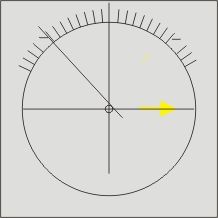
The attached picture is something like what my some described to me. He was very excited that he had come up with a solution as was I. However we haven’t had time to discuss it further so I don’t quite understand how it works other than that it looks as though you make tangential measurements in the X axis relative to the centre of the cam and that as the cam rotates, the centre changes in the Y axis and that if you stick your thumb in the pie, you call out “What a good boy am I” Or Bingo or something.
Any takers?
Edited By Andrew Johnston on 07/05/2011 15:41:05
Edited By mgj on 07/05/2011 21:32:11
Hi Everyone
Thank you all for your replies.
Clive: Thanks. The workshop in which I did engraving had six Deckel 2D’s a Deckel 2 1/2 D, two Alexanders and a Dahlgren computer driven machine. We didn’t much use the Alexander as although it was a copy of the Deckel it was just not as good. The bearings were not as smooth and the lapping on the spindle was not quite as accurate. That may have been down to age or just that we all seemed to prefer the Deckels. We had two Deckel grinders. I understand what you are saying about different materials but in this case my problem is not about the end to which the cutters will be put, rather an aspect of the machine used to produce them.
MGJ: Thanks for your lucid answers. As you say, some time spent with a calculator should get things right.
I have a further question for you though if you don’t mind.
“Obviously the amount of relief applied will vary with diameter for a given angular measure so you”ll need a little chart to relate degrees to amount of relief per unit diameter.”
I don’t understand why the angle should change with the diameter of the cutter. The selection of angle does not take place with the cutter at 90 deg to the wheel or as shown in the illustrations. Instead the collet is loosened, the cutter rotated through 180 degrees, tighten the collet and then select the angle. So as far as the ground face of the cutter is concerned, the eccentric is moved relative to the verticle rather than the horizontal. Once the setting is done, the collet is rotated back through ninety degrees and you start grinding your clearance angle. I may have the sequence slight out of step, it is twenty five years since I used a D bit grinder but the principle is correct.
I’ve sent a crate of whisky to Pythagoras.
Nobby: Thanks for your response Nobby. I understand what you are saying but as in my reply to Clive, I am not so much interested in a cutter/bit at present as the relationship between the position of the cutter in the grinder and the alignment marks used to determine just how much clearance there is on the cutter.
Lawrie

Edited By David Clark 1 on 06/05/2011 17:03:11
Edited By NJH on 08/05/2011 20:24:56
Edited By NJH on 08/05/2011 20:26:06
Hello Evry Bardy
I think that what we have established thus far is that everyone’s definition of what constitutes a D bit is based on their experience.
David Clarke has kindly offered his technical opinion which as he states is based on his experience.
Hansrudolf’s experience is that of a D bit which cuts at the front as he mentions both a Cannon Drill and his twisted D bit.
Ramon has added a photo of the tools he has made for his excellent Bentley engine and brings up his recent experience of seeing engraving cutters made.
Terry similarly to Hansrudolf says that an engraving cutter is not a D bit.
I think the reason we are having so much difficulty with this is down to taxonomy. I will give three examples of why this is a taxonomic problem.
1 Consider an end mill. We have absolutely no problem with the discussion of what constitutes an end mill. Basically it is a cutter derived from the twist drill in which the face can have a profile (flat, ball) which cuts material. In that, its end cutting capacity is similar to the twist drill. The second similarity is in having a helix. Unlike a twist drill though, the edges of the helix are ground to permit machining.
2 Drills. The twist drill and the spoon drill. Both cut at the face. The twist drill really cuts where the spoon drill is not really much more than a rotary waste of time.
3 The Slocum Centre Drill. There were up to the introduction of this tool more than ten styles of device all designed to perform the same operation, none of them anywhere nearly as effectively. The Slocum Centre Drill, which is a derivative of the twist drill won out.
Hi Terry
Thanks for your reply. I think that you have missed the point about experience. I am not out to offend you or anyone else though I may have, especially when speaking about experience being a powerfull determinant in what we see as being right. Our lives are very much governed by it.
“There is no confusion, they may be purchased here at Tracy Tools, ready made”
That Terry’s sell the item that matches you description does not make me incorrect. There are at least ten forms of twist drill on the market all of which may legitimately called twist drill by virtue of the fact that they drill and that there is a twist in their construction. There is a requirement on the part of the purchaser to specify which type he wants or he will just end up with a jobber drill, not a stub, second cut, masonry, tapping drill etc.
“The term D bit is a name given to a specific piece of equipment designed to cut on the front face and produce accurate, flat bottomed holes and make a good substitute for a reamer. “
I am not for a moment saying that the description you have given is incorrect. What I am saying is that the term D bit is very specific to a form, not a function. That a peice of material when ground and viewed end on has the form of a letter D. It is not specific about the use to which it is put as in the case of twist drill etc.
That Tracy tools sell the device you accurately describe only goes to support my argument about experience.
If we talk about an axe, we all know what the item is. We can talk about a pole axe, a double headed axe or any type of axe at all. All are covered under the idea of a peice of hard material which has and will support a robust cutting edge, attached to a shaft and swung to cleave the item at which it is directed. The only type of axe which is specific in regard to nomenclature is a Cleaver. Like the Drill, the name tells you what it does. The term Axe does not, any more than the term D bit tells you that it is “a specific piece of equipment designed to cut on the front face and produce accurate, flat bottomed holes “
Pole Axe tells you that some part of the axe will be a pole, like twist drill will tell you that somewhere in the construction of a twist drill there will be a twist.
There are several artices by Harold Hall in MEW – one in MEW 151 p 11 in which he calls for the making of a D bit with a 10 deg taper. It is designed to ream a hole to take an eleven deg. taper pin to act as a detant.
This does not fit with your definition of a D bit “a specific piece of equipment designed to cut on the front face and produce accurate, flat bottomed holes”? If it is not a D bit then what is it? One can say that because it is made to ream a hole, then it must be a reamer. But does it have the form which most people understand to be a reamer? It does not have multiple cutting edges, it is not a peice of silver steel that has been machined and ground obliquely to provide a single cutting edge. Instead, when viewed end on, it has the form of a letter D.
Lawrie
Hi Lawrie,
I’ve been cogitating on your problem and I think it is more complex than you imagine, let’s start simple. Imagine you have a cylindrical D bit of diameter ‘D’ which you want to use as a sort of single edge end mill so you put it in your eccentric and grind a relief from nothing at the cutting edge to an amount ‘A’ on the other side. The Sine of the relief angle is equal to A divided by half the circumference of the D bit. A 10mm D bit ground to ‘A’ = 1mm would have a relief angle of approximately 3.65°; 7mm dia, same A , relief angle approx. 5.2°; 4mm dia, same A, relief angle approx. 9.2°.
However you are wanting to grind a relief angle on a tapered engraving tool so no one eccentric setting will give the same relief angle all the way down. If you only need to cut on the tip then a relief amount ‘A’ could be calculated to suit the tip diameter, but if you need to have the proper relief angle all the way down the cutting edge then I can only think of two possibilities. 1. The bit must, when it is being ground, move in such a way that it’s axis travels through a conical path, the center of rotation when grinding should be parallel to the cutting edge (I have not attempted to calculate the offset for this axis). 2. Using a cup stone whose inside taper closely matched that of the relief wanted to be ground. Number 1 I think would need a grinder of the complexity of the Quorn with special tool holders, number 2 I think one would be most unlikely to find a stone to suit.
If you want a formula for setting your eccentric offset to give a relief angle at the tip I think I may be able to work that. If on the other hand I am completely wrong I’m sure someone out there will point out the error of my ways.
Good luck (I think you’re going to need it)
Peter.
Home › Forums › Workshop Tools and Tooling › Topics
Started by: barryblundell
in: Materials
howardb
Started by: Speedy Builder5
in: Electronics in the Workshop
Nigel Graham 2
Started by:
Neil Wyatt
in: Locomotives
howardb
Started by: Dr_GMJN
in: Workshop Techniques
ega
Started by:
JasonB
in: Stationary engines
Andrew Crow
Started by: Ian R
in: Locomotives
paul rushmer
Started by:
Neil Wyatt
in: 3D Printers and 3D Printing
Mark Rand
Started by:
David George 1
in: CAD – Technical drawing & design
David Jupp
Started by:
dee
in: Introduce Yourself – New members start here!
dee
Started by: Pippin
in: CNC machines, Home builds, Conversions, ELS, automation, software, etc tools
Derek cottiss
Started by:
John Hinkley
in: CNC machines, Home builds, Conversions, ELS, automation, software, etc tools
John Hinkley
Started by: steven49
in: Introduce Yourself – New members start here!
steven49
Started by: Lee Kennedy
in: Manual machine tools
Nicholas Farr
Started by:
Blue Heeler
in: I/C Engines
Blue Heeler
Started by: Kevan Shaw
in: General Questions
John Purdy
Started by: wigan2026
in: Workshop Tools and Tooling
Grindstone Cowboy
Started by: Andrew Tinsley
in: General Questions
JasonB
Started by: Peter Hoerlein
in: Work In Progress and completed items
Peter Hoerlein
Started by: jimalm
in: Electronics in the Workshop
Julie Ann
Started by: Andrew Tinsley
in: Workshop Tools and Tooling
Chris Crew
Started by:
duncan webster 1
in: Electronics in the Workshop
Robert Atkinson 2
Started by: berwick
in: Beginners questions
alecs
Started by: jaCK Hobson
in: Workshop Tools and Tooling
jaCK Hobson
Started by:
JasonB
in: The Tea Room
Dalboy
Started by: Bill Phinn
in: Website Questions, Comments, and Suggestions
Neil Wyatt