
carbide insert lathe tools

carbide insert lathe tools

Home › Forums › Workshop Tools and Tooling › carbide insert lathe tools

Viewing 10 posts - 26 through 35 (of 35 total)
  • Author
    Posts
  • #870126
    davidwf
    Participant
      @davidwf

      indeed the rotational speed shouldnt matter as long as it is relative to the feed speed

      Yes, the bit seat is OK….and no, it has not hit the chuck

      From previous answers I can confirm that the ally “stuck” to the tip during machining…….I will try the recommended tips for non ferrous

      This never used to be a problem when we used solid lumps of HSS for everything !


      #870133
      peter1972
      Participant
        @peter1972
        On davidwf Said:

        indeed the rotational speed shouldnt matter as long as it is relative to the feed speed

        It is said that low cutting speeds are more likely to cause built-up edges on cutting tools when machining aluminium alloys. However that probably applies mostly for commercial production. For more information, use AI.

        Do you know the composition of the aluminium alloy you are cutting?

        #870210
        howardb
        Participant
          @howardb
          On peter1972 Said:
          On davidwf Said:

          indeed the rotational speed shouldnt matter as long as it is relative to the feed speed

          It is said that low cutting speeds are more likely to cause built-up edges on cutting tools when machining aluminium alloys. However that probably applies mostly for commercial production. For more information, use AI.

          Do you know the composition of the aluminium alloy you are cutting?

          I have a small sheet of aluminium alloy that is so soft it is impossible to drill at any speed with a machine, with any drill bit, with any lubricant, the only method that works is to put a drill bit in a hand brace and do half a turn at a time and then half a turn back to break off the accumulated soft alloy build up on the bit.


          #870218
          southernchap
          Participant
            @southernchap
            On Andrew Tinsley Said:

            Absolutely nothing wrong with using replacable carbide tip tooling on an ML7. I use them a lot on my Myford without any trouble.

            I suspect that you have a lathe problem. Saddle gib strips being loose, worn head stock bearings etc. You should not be using coated tips on aluminium, causes build up of aluminium on the tips then poor cutting and danger of digging in. You have far too much tool protruding from the toolpost. This causes chatter and breakage. ALWAYS use the minimum projection, especially with a well worn lathe.

            Somewhat bothered that you do not want to use top speed on your ML7. Nothing wrong with using any speed the lathe is capable of. I suspect that your lathe is badly worn in some areas. A bare metal repaint will not solve these problems!

            Andrew.


            The above quoted post from Andrew is absolutely spot on as far a tool stick out and speeds go.

            Get that tool way back in the toolpost (oh and for hobbyist purposes, the difference in rigidity between a four way tool pist and a decent quality QCTP, whilst definitely the case, is pretty much irrelevant).

            Check every interface between the bed, saddle, cross slide, tip slide and tool post.  There ought to be be no play anywhere.

            The shear plates for the saddle should be adjusted that you can move the saddle up and down the bed smoothly without binding, but the saddle should not rock.  The same should be the case for the gibs for the cross slide and top slide.

            Spindle speeds? You’re using carbide and turning aluminium, so as fast as you can.  You can go slower, it won’t hurt (and in the case of lathes like mini lathes, where the rigidity is extremely lacking, it can be necessary), but BUE when turning aluminium can be an issue, especially when there’s less lubrication than us ideal.  I follow Stefan Gotteswinter’s example, and use isopropyl alcohol for aluminium, seems to work well.

            The thing about brazed carbide that a lot of people seem to miss, is that the brazed carbide these days doesn’t seem to come ready to use.  At worst they might need actually sharpening on a silicon carbide wheel (the green ones), but a lot just need the cutting edges honing with something like a diamond ‘card file’.

            I’m rather keen on brazed carbide(albeit the brazed carbide tools I have are all from ‘back in the day’s as the kids say, and we’re acquired from auction lots), but I also use CCMT, CCGT, DCMT, and DCGT inserts (I tend to use uncoated versions of the CCGT/DCGT).

            Since like you, I have a benchtop lathe (in my case a Taiwanese Warco 918 from the 90″s), I only use inserts with a nose radius of 0.2 mm or 0.4 mm (so say CCMT09T304, CCMT09T302, CCGT09T304 or CCGT09T302, or the same in DCMT/DCGT).  Our machines don’t really have the rigidity to handle the tool pressure that comes with the larger noise radii.

            I’ve used the cheapy Chinese inserts and genuine Sandvik, Iscar and Kennametal inserts (the latter three ‘pre-owned’ but unused, from trusted sellers on eBay; still not cheap but less eye watering than buying new!), and whilst the name brand inserts are definitely more durable, with careful use and not extracting the urine, the Chinese cheapies do an okay job.

            When you have your Myford nice and tight and well adjusted, don’t be too shy about depth of cut with carbide.  You do need to have the nose of the insert decently engaged with the workpiece.  That means at least a depth of cut of the nose radius or greater (if you’re used to thinking in imperial as well as metric, like some of us, with a 0.2 mm noise radius that’s about .008″ minimum depth of cut).

            Obviously, you can do a shallower DOC, the world won’t end, but the surface finish may well suffer as a result. Nice sharply ground HSS tooling is often better for very shallow DOC really.

            EDIT: it seems you are now getting better results.  Nice one.

            #870231
            duncan webster 1
            Participant
              @duncanwebster1

              The only time I have resorted to brazed carbide was some cast iron wheels with very hard spots. These destroyed tipped tools, but the brazed coped. I suspect this was more to do with the large tip radius and that round inserts might have survived

              #870241
              JasonB
              Moderator
                @jasonb
                On southernchap Said:
                When you have your Myford nice and tight and well adjusted, don’t be too shy about depth of cut with carbide.  You do need to have the nose of the insert decently engaged with the workpiece.  That means at least a depth of cut of the nose radius or greater (if you’re used to thinking in imperial as well as metric, like some of us, with a 0.2 mm noise radius that’s about .008″ minimum depth of cut).

                A **GT insert should be quite happy taking 0.001″ or .025mm depth of cut and still give a good finish, they certainly are in my workshop.

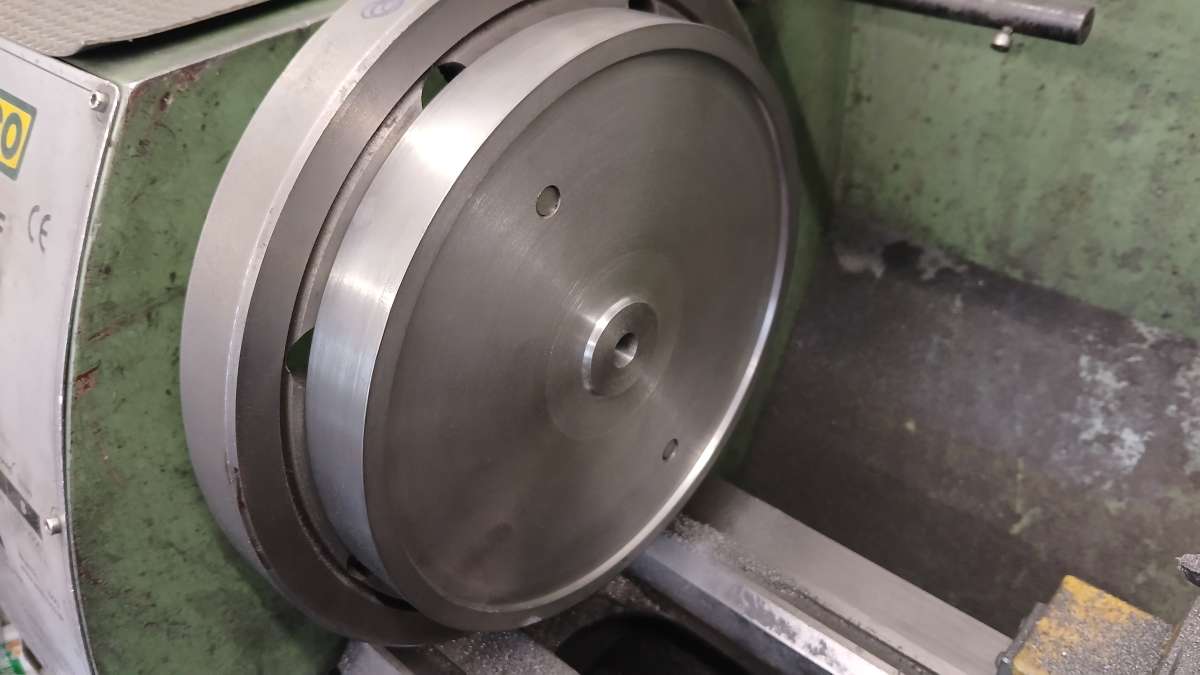
                I don’t mind Brazed carbide, 90% of that Minnie in my avatar was turned using it. Still use it today as I have several with various radius end swhich are good for getting a fillet on an internal corner when replicating castings. You can just see the tool bottom right of this photo taken last week recessing a flywheel prior to milling the spokes

                20261013_142014

                #870246
                southernchap
                Participant
                  @southernchap
                  On duncan webster 1 Said:

                  The only time I have resorted to brazed carbide was some cast iron wheels with very hard spots. These destroyed tipped tools, but the brazed coped. I suspect this was more to do with the large tip radius and that round inserts might have survived

                  I like the brazed carbide tools I have because you can give them a tickle with a diamond ‘card file’ and they’re nice and sharp again.  You can also regrind them (to a greater or lesser extent) to tweak the form.  They’re also, as you say, a bit more durable than inserts too.

                  Oh and despite me regularly mocking many of the members of this forum as being typical British penny-wise-pound-foolish old fellas,  I will admit another advantage that’s attractive to me, is that you can find ‘new old stock’ brazed carbide fairly cheap on eBay. 😄

                  #870258
                  Andy Stopford
                  Participant
                    @andystopford50521

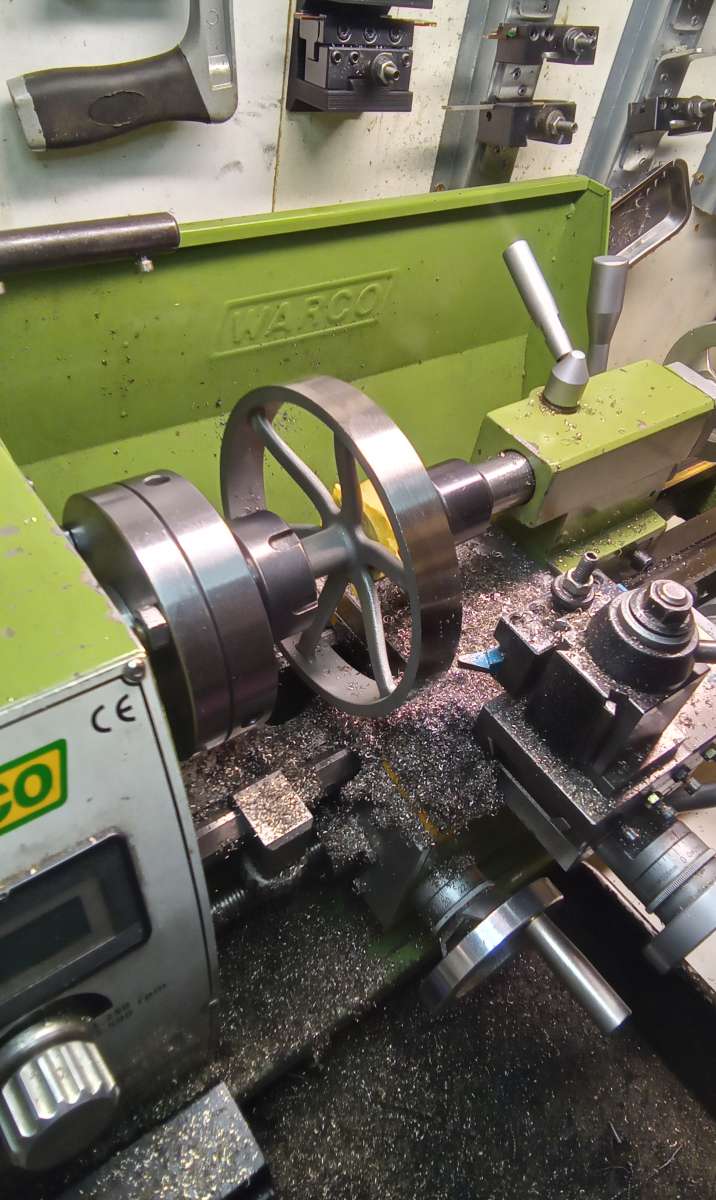
                    I don’t usually use brazed carbide, but I have a few tools courtesy of being in boxes of other stuff, and I recently found one perfect for the tricky job of machining a 3D printed stainless steel flywheel on a lathe which has no backgear and hence very little torque at its slowest electronically controlled speed.

                    At a speed fast enough to prevent the motor stalling, HSS rapidly lost its edge, and CCMT inserts tended to dig in and also stall the motor.

                    Brazed carbide to the rescue:

                    20261008_123042

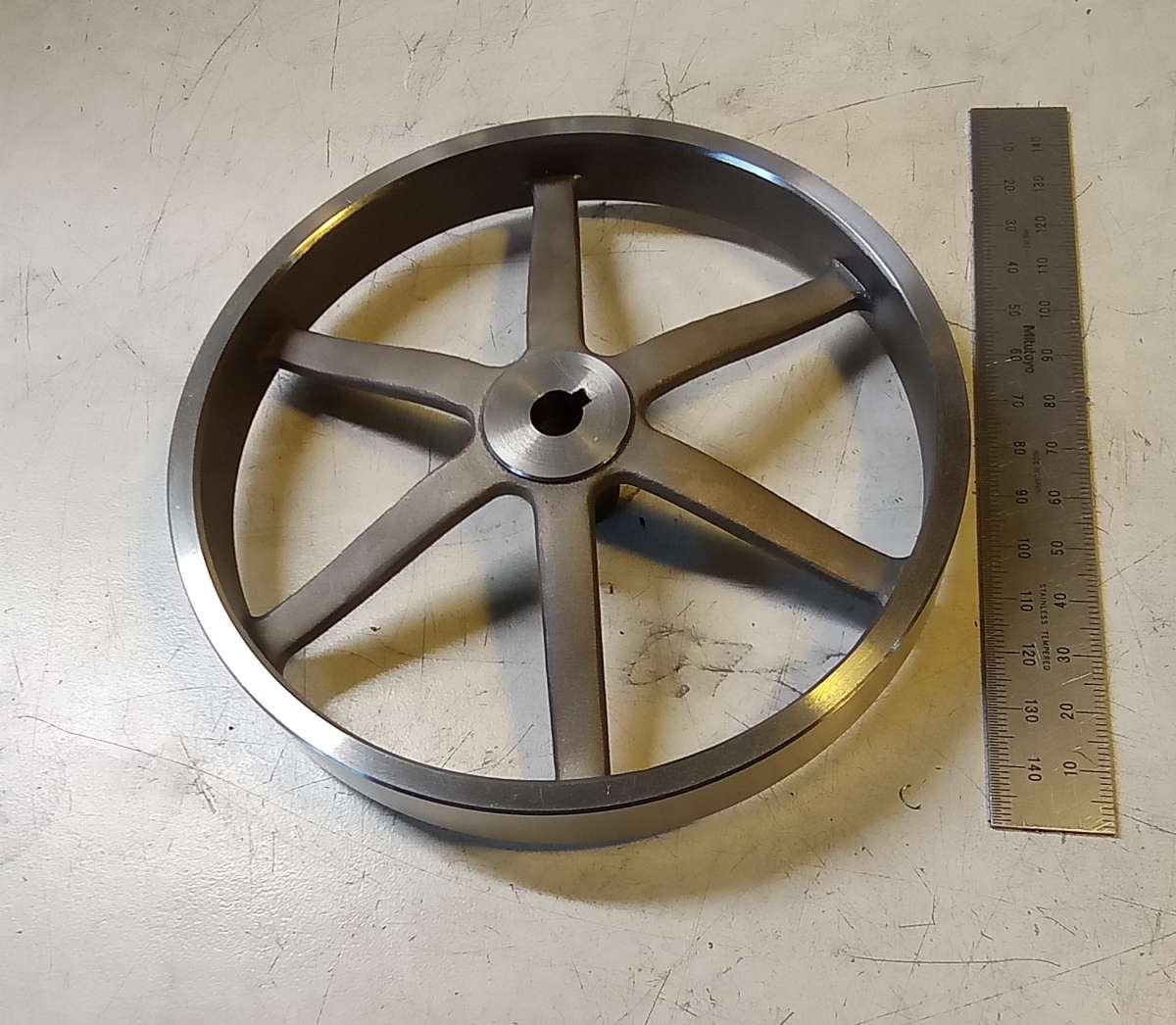
                    It came out very nicely:

                    20261009_152616

                    (The irregularity adjacent to the keyway is a photographic artefact)


                    #870264
                    Vic
                    Participant
                      @vic
                      On Howard Lewis Said:

                      Actually, my favourite go to is the Tangential Turning tool. Once the capital is invested, a 1/4″ toolbit lasts a long time, even in my hands, and can be resharpened at 9 pm on a Saturday night when the the shops are closed and the last carbide tip has just failed!

                      As an aside, I don’t get on with brazed tips.  They do seem to chip very easily in my hands!

                      Initially, I had problems with chatter because of excess overhang. so keeping the tip as close as possible to the toolpost cured that.

                      I always set any tool to centre height, to avoid problems (Which is why I suggest newbies making a Centre Height Gauge as an early project)

                      Howard

                      Agreed on all points. I made a centre height gauge many years ago specifically for my Tangential tool.

                      #870305
                      old mart
                      Participant
                        @oldmart

                        Just it has been overlooked, aluminium needs a tiny bit of lubricant or it will stick to even the polished GT type inserts, HSS tools or drills. Steel benefits from lubrication, but cast iron rarely needs any.

                      Viewing 10 posts - 26 through 35 (of 35 total)
                      • Please log in to reply to this topic. Registering is free and easy using the links on the menu at the top of this page.

                      Latest Replies

                      Viewing 25 topics - 1 through 25 (of 25 total)
                      Viewing 25 topics - 1 through 25 (of 25 total)

                      View full reply list.