
Close-coupled Tees (Underfloor heating)

Close-coupled Tees (Underfloor heating)

Home › Forums › The Tea Room › Close-coupled Tees (Underfloor heating)

Viewing 16 posts - 1 through 16 (of 16 total)
  • Author
    Posts
  • #870353
    Andy Stopford
    Participant
      @andystopford50521

      Someone has asked me to connect some pipework in a central heating system with a new underfloor heating (UFH) system on the ground floor, and radiators on the first floor (they didn’t fancy doing the soldering).

      There is no plan for exactly how to connect the two systems, and much talk on Youtube etc. about using a close coupled tee to hydraulically isolate them. Much of the talk expresses conflicting opinions, and possible total nonsense, as one might expect.

      Does anyone know how this is supposed to be done – where the tee goes, is the branch to the UFH supposed to be in series with the radiators or parallel, etc.?

      #870365
      Andrew Crow
      Participant
        @andrewcrow91475

        Hi Andy, I have never dealt with underfloor heating but, I would have thought it should be treated as another radiator in the system and therefore in parallel to all other radiators in the system otherwise all the other radiators would be a little cooler. Just a thought!

        Andy

        #870366
        JasonB
        Moderator
          @jasonb

          Jobs I have been involved with all the UFH has had a separate pump and mainifold to the pipe loops. Motoirised valves isolate and open when either upstairs/existing radiator stats call for it or the UFH stats.

          Several were adding UFH to just one room and they plumbers never just added it to the radiator loop.

          #870369
          Andy Stopford
          Participant
            @andystopford50521

            This has a manifold with its own pump,  and a mixing valve which effectively controls the UFH temperature which has to be lower than the temp in the primary (radiator) circuit.

            So you have two circuits joined together,  and the problem is stopping the pumps either fighting each other,  or working together to double the pressure (which apparently can cause pump failure). To prevent this,  two of the pipes are bridged by a short pipe (the close coupled tee), but the question is which two pipes,  and where?

            #870391
            Oldiron
            Participant
              @oldiron

              Question probably best asked on a proper central heating forum.

              #870399
              Adrian R2
              Participant
                @adrianr2

                I have a book “Complete plumbing and central heating” by Collins aimed at the DIY homeowner. Obviously it isn’t complete but it does have a couple of pages on adding UFH to an existing system. They show the pipe layout as adding a new feed and return in parallel with radiator supply, both pipes go to a mixer valve with a balance pipe across, then on to a dedicated UFH pump and manifold. There are also cautionary words on making sure the system is in good order and of sufficient capacity before starting work.

                “Someone” will then need to balance the system so that upstairs or downstairs doesn’t dominate, this can be fiddly and is not something I’d like to attempt in someone else’s house as I don’t want the responsibility for them being too hot or cold at inconvenient times.

                On a related note I replaced my circulating pump a few years back using this book as a reference. The new one (Grundfoss) adapts its power level according to system demand so should not fight against anything.

                #870429
                Andy Stopford
                Participant
                  @andystopford50521

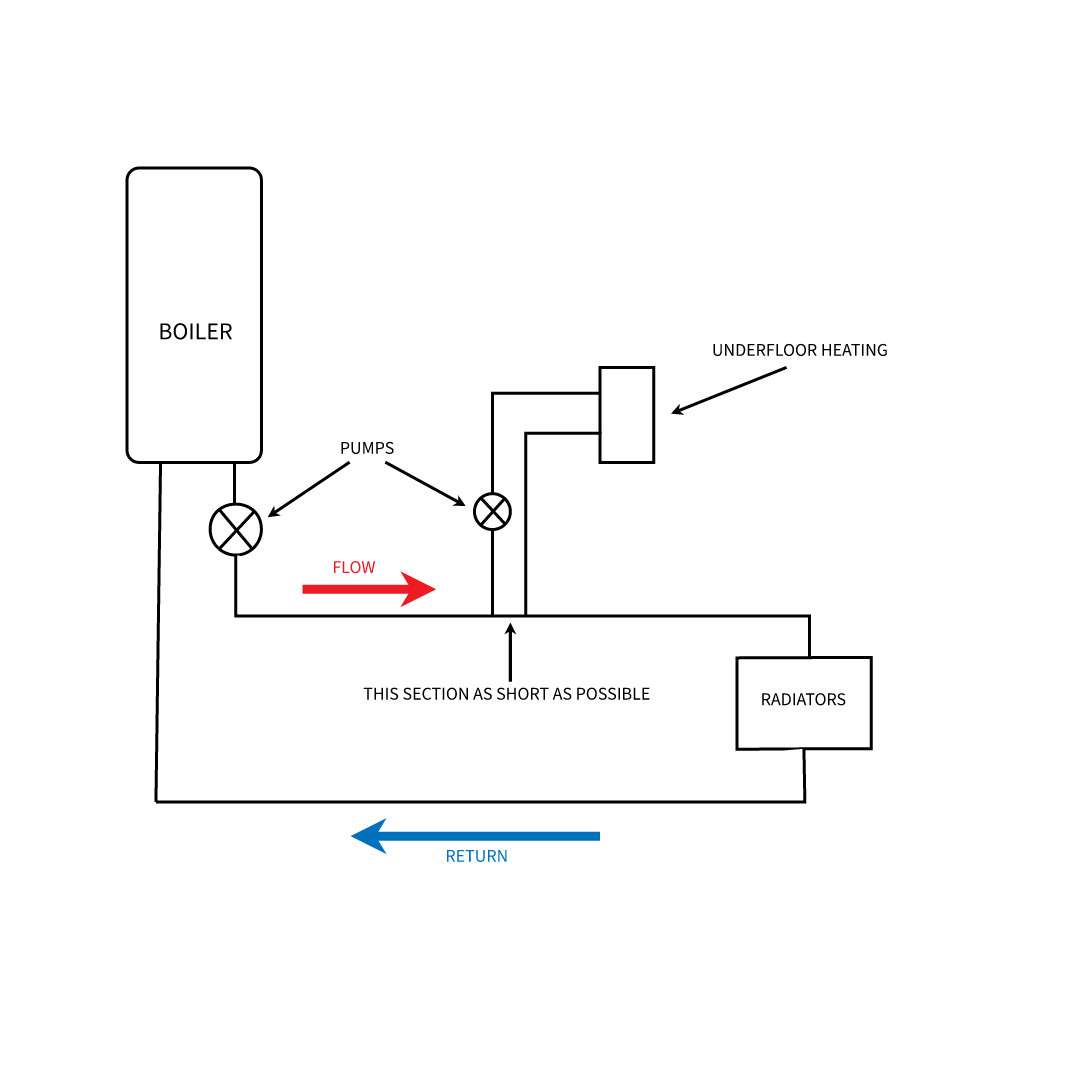
                  Further reading on this from some rather complicated websites devoted to hydronics (no, nor me. Apparently it refers to heating or cooling systems which use water or steam as the heat transfer medium – https://en.wikipedia.org/wiki/Hydronics) suggests that the requirement is basically this:

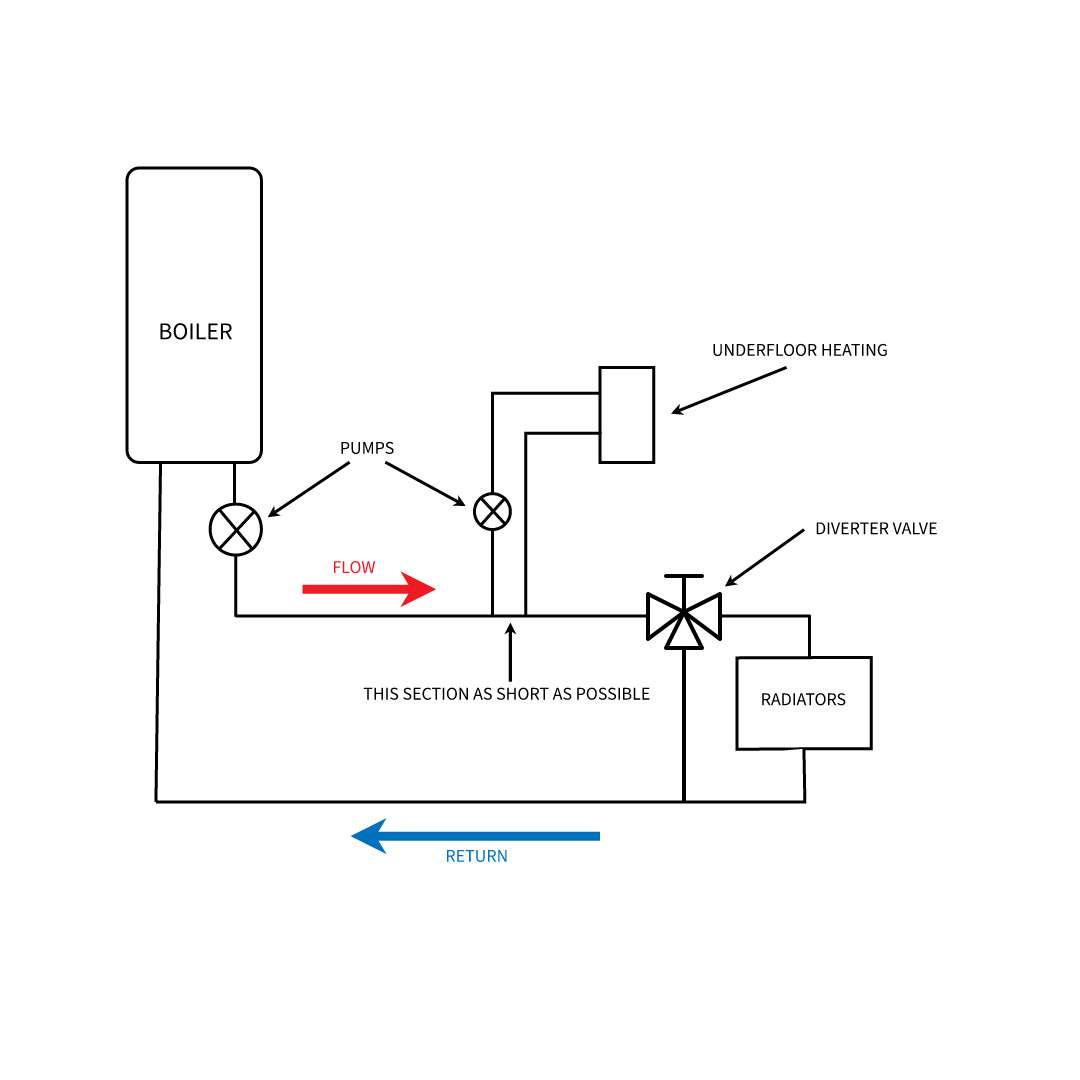
                  CloseCoupledwhere the short section between the feed and return to the UHF circuit ensures that there is a minimal pressure gradient across those two pipes and therefore the main pump doesn’t try to drive water through it.

                  I’ve omitted the motorised valves and thermostatic mixer from the above.

                  #870468
                  Adrian R2
                  Participant
                    @adrianr2

                    Pumps and balancing aside I can’t see that series arrangement working well as the UFH is robbing heat from the radiator supply. Maybe OK if assume UFH dominant until it gets up to temperature and manifold valves close but does that fit with the household lifestyle?

                    I think I’d recommend that someone use push fit fittings negating the need for you to solder and making it easier to replumb if it doesn’t perform as expected.

                    #870515
                    Andy Stopford
                    Participant
                      @andystopford50521
                      On Adrian R2 Said:

                      Pumps and balancing aside I can’t see that series arrangement working well as the UFH is robbing heat from the radiator supply. Maybe OK if assume UFH dominant until it gets up to temperature and manifold valves close but does that fit with the household lifestyle?

                      I think I’d recommend that someone use push fit fittings negating the need for you to solder and making it easier to replumb if it doesn’t perform as expected.

                      Yes,it seems that way to me as well, but there’s lots of clever stuff goes on inside the boiler control system which may mitigate that, also, the UFH behaves differently from standard radiators, with a lower flow temperature and a relative trickle of water from the primary system.

                      Anyway, the way that the existing plumbing is arranged makes it fairly trivial to swap from series to parallel using the compression fittings I’ll be using for this area.

                      If I find out definitely I’ll post here for the benefit of anyone who faces the same question (I do begin to have a suspicion, based on the variety of opinions I’ve seen online, that it may not actually make much difference…).

                      #870517
                      Andy Stopford
                      Participant
                        @andystopford50521

                        Thinking further about it – if the return leg of the UFH circuit is connected to the return of the primary circuit, then the close coupled bit effectively short circuits the primary…


                        #870523
                        Macolm
                        Participant
                          @macolm

                          Underfloor

                          Taking the concept shown in the previous diagram and reducing it to a simple example as above, consider we have four rooms, one with under floor, the other three conventional radiators, and that all four rooms need exactly the same heat. If the system has reached a steady state, the under floor heating top up must need exactly the same temperature and volume flow from the core system as do the other conventional radiators.

                          However, as a lower delivery temperature is necessary, the secondary under floor loop must circulate a considerably greater volume than the flow from the boiler so that as heat is lost to the surroundings, the correct low temperature is maintained. All this assumes that at this temperature, the heating capacity of the under floor pipe work is adequate.

                          The originally suggested arrangement sounds like a bodge. It is not clear how it is intended to work, nor how to control it over the necessary range of heat output.

                          #870530
                          Stuart Smith 5
                          Participant
                            @stuartsmith5

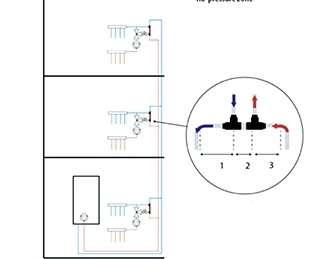
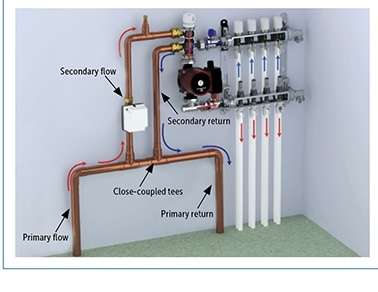
                            This website describes it.

                            https://www.pandhengineering.co.uk/advice/how-to-ensure-trouble-free-heating

                            IMG_2932

                            IMG_2932

                            It is connected between flow and return pipes ( ie in parallel), not in series.

                            No experience of these, but this seems to make more sense to me.

                            Stuart

                            #870548
                            Andy Stopford
                            Participant
                              @andystopford50521

                              @Macolm, the radiator circuit and the UFH circuit each have their own thermostatic control, and as drawn in your diagram, the pump are in series so their outputs would sum, hence the need for the short bypass.

                              @Stuart- yes I’d seen that page, and it’s on the (intuitively obvious) parallel side of the argument, it’s just that others show a variety of different arrangements, hence my posting here. e.g. This guy’s video describes the in-line arrangement as in the drawing I posted above, but he has another video which has the parallel connection as in your post:

                              https://heat-geek.vercel.app/articles/closely-spaced-tee-tip

                              Quite a lot of information on this seems to originate from the US and (I think) concerns much more complex systems in hospitals and the like, which maybe behave differently from simple domestic ones. Here’s one of the more easily digestible ones:

                              https://www.laars.com/uploads/products/7009C-NH.pdf

                              The first, historical, bit is quite interesting, even if you haven’t been unwise enough to get talked into connecting up someone else’s wacky underfloor heating.


                              #870562
                              Adrian R2
                              Participant
                                @adrianr2

                                That was indeed interesting and yes I can see that if you can make a large installation work using just a single pipe primary circuit then it would offer a commercial advantage.

                                #870622
                                Macolm
                                Participant
                                  @macolm

                                  Thanks for posting the P&H website information, it makes it quite a lot clearer. The action of the close coupled T-s is presumably to induce strong turbulence to mix and transfer heat, with a minimal pressure drop along the primary flow. What is not so clear is the transfer mechanism from the secondary loop to the heating circuit. However, it is obvious that this interface too has a very short common section, so that interactions between the two pumps should be very low.

                                  If it can be made to work well enough, and be able to be controlled to set the heat output, it certainly has minimal content to achieve that function. You can see this by comparing it with Technical Issue 36 on the same site, which shows what is necessary to accomplish the function using a heat exchanger unit for total isolation between the pumps.

                                  #874097
                                  Andy Stopford
                                  Participant
                                    @andystopford50521

                                    Well, we’ve now fired the system up, connected as in my diagram above, and it works correctly with the UFH mixer valve and pump bringing the UFH up to set temperature surprisingly quickly, and the upstairs (radiator) circuit working as normal, with no sign of one robbing from the other.

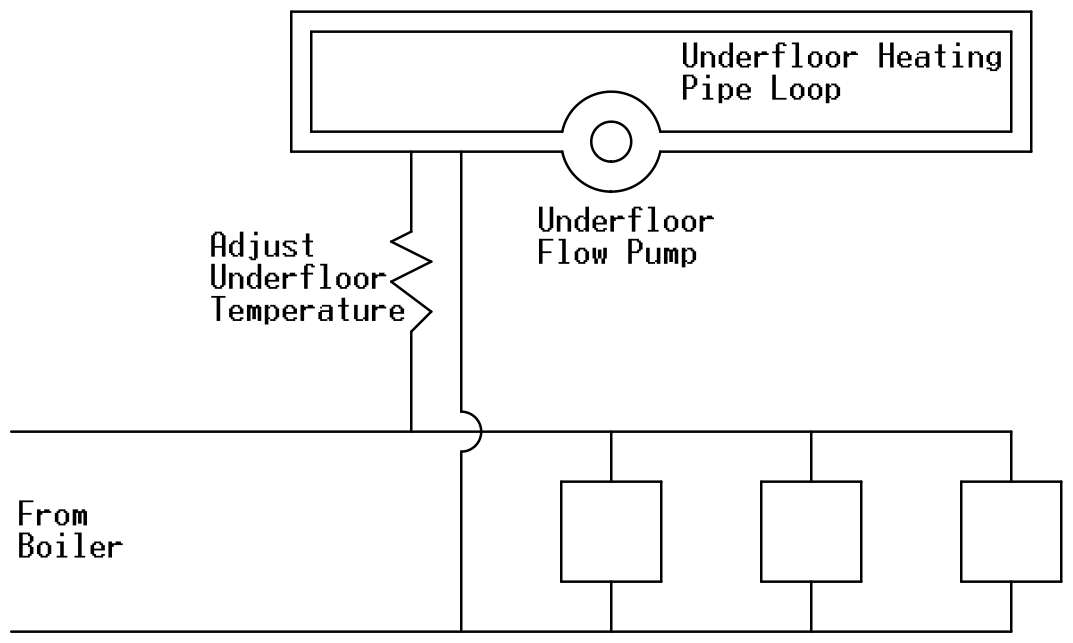
                                    However, to run the UFH without any heating upstairs needs, ideally, a diverter valve (though the owner already has a couple of motorised valves which I think she will want use instead):

                                    CloseCoupled

                                  Viewing 16 posts - 1 through 16 (of 16 total)
                                  • Please log in to reply to this topic. Registering is free and easy using the links on the menu at the top of this page.

                                  Latest Replies

                                  Home › Forums › The Tea Room › Topics

                                  Viewing 25 topics - 1 through 25 (of 25 total)
                                  Viewing 25 topics - 1 through 25 (of 25 total)

                                  View full reply list.