Should a standard turning tool be mounted at a slight angle?

Should a standard turning tool be mounted at a slight angle?

Home Forums Beginners questions Should a standard turning tool be mounted at a slight angle?

Viewing 25 posts - 1 through 25 (of 31 total)
  • Author
    Posts
  • #9231
    Ross Lloyd 1
    Participant
      @rosslloyd1
      #359111
      Ross Lloyd 1
      Participant
        @rosslloyd1

        Hi

        I have a couple of regular turning tools that seem to suffer from chip evacuation problems. I noticed I was getting an awful finish during turning and a lot of noise, so I tried angling the cutter slightly in the horizontal plane, about 10 degrees nose towards the chuck. The chips seemed to flow out more smoothly.

        Should this be necessary? One tool is self made, and another I wrecked and reground on a grinder. I am wondering if they just both lack the correct relief or if an angle is usually needed?

        #359128
        Hopper
        Participant
          @hopper

          Do whatever works for you. There is no hard and fast rule about the angle of the tool presentation. I often swing mine around the other way a bit, so the point is trailing the leading edge. Seems to spit the chips out better. Only about 10 or 15 degrees needed. On the ohter hand, many carbide inserts are deliberately made with a point of 80 degrees or so, so that both cutting edges are angled a bit away from the face being machined, providing clearance.

          Presenting the cutting edge square on to the job does seem to generate long, straightish strarnds of swarf that are a pain to deal with. Angling the tool tends to curl the chips up more conveniently.

          Also experiment with feed rates and rpm. Different combinations affect chip generation.

          #359132
          Mick B1
          Participant
            @mickb1

            Rotating a knife tool with a cutting corner of less than a right angle slightly towards the chuck can have a couple of benefits:

            (i) on light finishing cuts, a small plan trail angle results in a shaving action along the edge that's nearly parallel to the work surface, giving a potentially good finish, and

            (ii) where a number of passes have been made to reach a size up to a shoulder, the shoulder can then be squared-off neatly by withdrawing the tool at a slowish 'reverse-facing' feed.

            However, there's risk that on roughing cuts the tool will be dragged deeper into the work by the forces acting on the negative angled chuckside edge. Theoretically you might overcome that by locking the crossslide, but in practice that would lose you most of the time saved by the deeper cut and introduce additional variables that would make the size achieved less certain, so not many people that I know of do it. Better to present the chuckside edge square or with a positive plan approach angle for heavier cuts.

            #359155
            Neil Wyatt
            Moderator
              @neilwyatt

              Angling a tool gives thinner, wider chips, which, especially with HSS, can lead to freer cutting.

              A knife tool with just the end cut across at an angle is best set at about ten degrees to allow easy working into a corner and facing as Mick describes.

              Angling it the other way (or grinding across the corner), by rather more (say 20 degrees or more) creates a roughing tool that may be able to deliver deeper or faster cuts but won't cut up to a shoulder.

              For the best finish a rounded tip and/or small flat on the tip parallel to the work (which shoudl ideally be a bit longer than the amount of feed per revolution) will help.

              'Polishing' the ground edges with a slipstone or diamond card can help too.

              Neil

              #359258
              John Reese
              Participant
                @johnreese12848

                By varying the lead angle of your tool you get a lot of control over the evacuation of chips. I made a custom toolholder for HSS to fit my Aloris toolpost. The holder had a 12* back rake built into it. I had about 8* side clearance on the tool and a15* rake chipbreaker on the top surface. If I had the tool perpendicular to the work the chips impinged on the just machined surface and damaged the finish. I found that about 15* of lead angle eliminated the problem of chip impingement.

                #359277
                SillyOldDuffer
                Moderator
                  @sillyoldduffer
                  Posted by Ross Lloyd 1 on 22/06/2018 23:05:15:

                  Hi

                  I have a couple of regular turning tools that seem to suffer from chip evacuation problems. I noticed I was getting an awful finish during turning and a lot of noise, so I tried angling the cutter slightly in the horizontal plane, about 10 degrees nose towards the chuck. The chips seemed to flow out more smoothly.

                  Should this be necessary? One tool is self made, and another I wrecked and reground on a grinder. I am wondering if they just both lack the correct relief or if an angle is usually needed?

                  No, but it may not matter. I guess your grinding is a little off and – as you suggest – angling the tool provides the relief that a more accurately ground tool would have built-in.

                  Good tip I got off the forum (forgot who, apologies) was to put an extra 10mm (or so) on top of the grinding platform so that the wheel naturally undercuts the tool at a tangent, and then grind at a horizontal angle, say 15 degrees, to provide relief. Works for me.

                  As a tool wears, it sometimes helps to angle it to present a different part of the edge to the work. I usually resharpen instead.

                  I'm not good at grinding (facets galore, cooked steel, and burnt fingers) and prefer carbide. Even so, about 10-20% of the time I go back to HSS, usually on small diameter work where a fine finish is needed.

                  Dave


                  Edited By SillyOldDuffer on 24/06/2018 09:34:03

                  #359281
                  Vic
                  Participant
                    @vic
                    Posted by SillyOldDuffer on 24/06/2018 09:32:56:

                    I'm not good at grinding (facets galore, cooked steel, and burnt fingers) and prefer carbide. Even so, about 10-20% of the time I go back to HSS, usually on small diameter work where a fine finish is needed.

                    Dave

                    Make yourself a Tangential tool Dave, easy to make on the mill and grinding the tool bit is simple. smiley

                    #359306
                    John Haine
                    Participant
                      @johnhaine32865

                      If you are wanting repeatability when changing between tools, better to make sure any such angle is ground into the tool, not imposed by turning the toolpost. I've gone to a lot of trouble to make a very solid toolpost base that is rigidly located on the cross-slide, and the Dickson block is dowelled to it to be precisely square. All my tools are snugged into their holders and tightly clamped, so I can be sure that it goes back into exact position. Makes CNC turning and I suspect using a DRO system much more convenient.

                      #359311
                      SillyOldDuffer
                      Moderator
                        @sillyoldduffer

                        Posted by Ross Lloyd 1 on 22/06/2018 23:05:15:.

                        …I noticed I was getting an awful finish during turning and a lot of noise …

                        Just another thought, that could be chatter. In addition to the relief & tool grinding mistooks already discussed, there are other causes:

                        • Blunt tool rubbing and scuffing
                        • Wrong coolant/lubrication
                        • Too much tool and/or work overhang allowing vibration
                        • Tool at wrong height, digging in or scuffing
                        • Excessive depth of cut and/or feed-rate
                        • Wrong speed
                        • Difficult material (many metals don't machine well!)
                        • Loose gibs or toolpost
                        • Worn bearings

                        Recognising these comes with experience. Don't be afraid to experiment and don't be discouraged. It's a little like learning to drive: kangaroo petrol, dings, crunching gears, over-revving, stalls, clutch abuse, right-turn terror, hitting kerbs, parallel parking, and many, many foolish misjudgements.After a bit of practice you drive better than Lewis Hamilton, or at least I think I do.

                        Dave

                        #359314
                        Mick B1
                        Participant
                          @mickb1
                          Posted by SillyOldDuffer on 24/06/2018 14:52:03:

                          After a bit of practice you drive better than Lewis Hamilton, or at least I think I do.

                          Dave

                          And then again, Lewis Hamilton's driving is of a specialised type, and tells you little of how he'd do in the Tuesday evening rush hour on the bypass.

                          Similarly, you'll probably find it best to suit your tools to the type of work you're going to do. Accurate repeatability isn't often required unless you're making batches of components, which hasn't often been needed in my model engineering experience. It's been more useful to me to have a versatile go-to tool I can use on a variety of materials and cutting angles, as the spectrum of both that I've encountered has tended to be broad.

                          #359339
                          Ross Lloyd 1
                          Participant
                            @rosslloyd1

                            Hi guys

                            Thought it might help if I show you the tool I am using. Its my first home brew tool, but I also am having trouble with a bought one that I reground after an encounter with some extremely hard "I found this lying about and wont be repeating that mistake anytime soon" machining experiment. Its left hand turning (and pristine) brother has no such issue though. 

                            Below is the home brew un-angled, I realise there is no radius which might help to add. There is a 7 degree relief on all appropriate faces:

                            Edited By Ross Lloyd 1 on 24/06/2018 21:58:00

                            #359367
                            John Reese
                            Participant
                              @johnreese12848

                              That tool would be great for facing shoulders on turned work. I would expect chips leaving the tool will impinge on the just cut surface and scuff it. Rotating the toolpost 10* to 15* clockwise should cure that problem, The alternative is to grind the front face to give a front cutting edge angle of 10* to 15*.

                              #359379
                              Anonymous

                                I'd agree with SoD; I suspect the noise/finish issues are nothing to do with the angle of the tool to the work. Looking at the tool in the picture I'd add a bit more top rake for low carbon steels.

                                While I use mainly inserts on the manual lathe on the repetition lathe I exclusively use hand ground HSS. There is no way to twist the tool; the tool carousel presents the toolbit at right angles to the work come what may. I always grind a slight side relief, so to get a sharp shoulder you need to traverse and then move out from the work. Which is what you'd do anyway.

                                Generally I don't have problems with swarf ejection or scuffed surface finishes, with one exception. That being aluminium alloys; whatever you do the swarf has a tendency to birdsnest and get trapped. That changes the surface finish from shiny to dull. A variation of sods law (not the SoD above!) means that birdsnesting and trapping always seems worst on the final cut. sad

                                Andrew

                                #359387
                                SillyOldDuffer
                                Moderator
                                  @sillyoldduffer

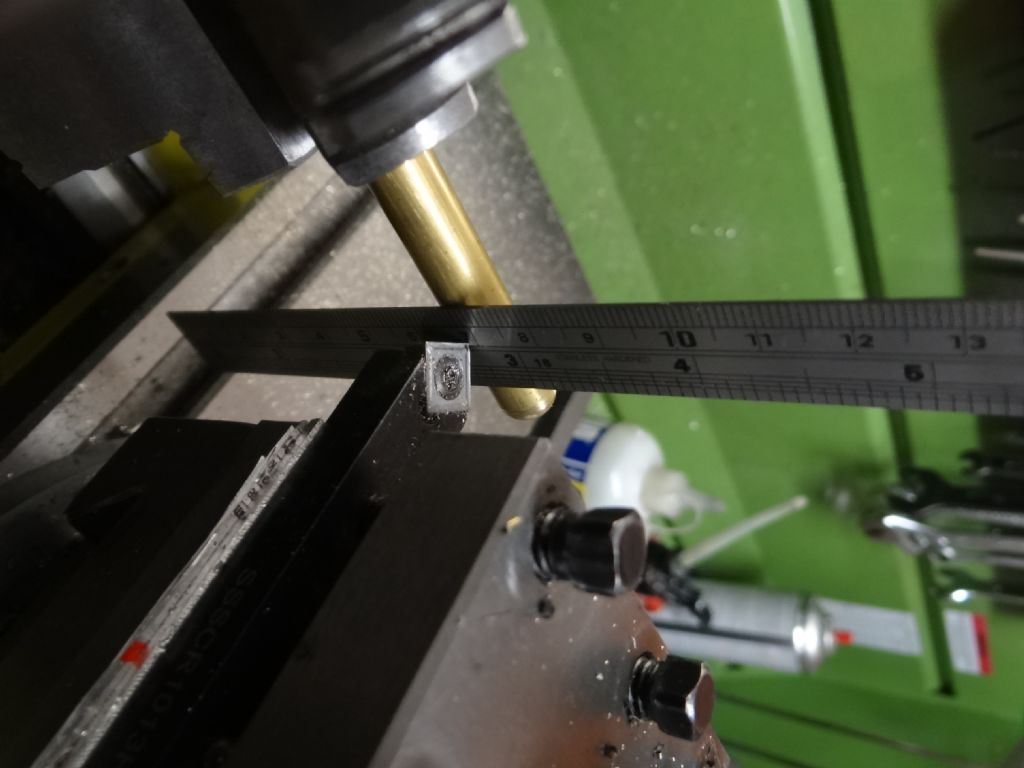
                                  Hard to tell from your picture Ross but the tool looks high to me. Are you aware of the metal strip method for checking it?

                                  dsc04505.jpg

                                  With the lathe stopped gently pinch a metal strip vertically between the tool-tip and a rod. If the top of the strip leans away when you tighten the pinch, the tool is too high. If the bottom leans away the tool is too low. Adjust by shimming until pinching doesn't move the strip in either direction; slightly low is OK.

                                  Further to Andrew's comments about SoDs, I've just had a birthday. Now I'm an old sod.

                                  Sorry about the sideways photo!

                                  Dave

                                  #359388
                                  David Standing 1
                                  Participant
                                    @davidstanding1

                                    Be careful about using that metal strip/rule method with inserts, particularly small tip radius ones, it is easy to snap the point off the insert if they are snucked up too tight against the rule, particularly if it is set low.

                                    I set all my tool centre heights with a fine point dead centre held in a parallel sleeve in the chuck.

                                    #359392
                                    SillyOldDuffer
                                    Moderator
                                      @sillyoldduffer
                                      Posted by David Standing 1 on 25/06/2018 10:47:37:

                                      Be careful about using that metal strip/rule method with inserts, particularly small tip radius ones, it is easy to snap the point off the insert if they are snucked up too tight against the rule, particularly if it is set low.

                                      I set all my tool centre heights with a fine point dead centre held in a parallel sleeve in the chuck.

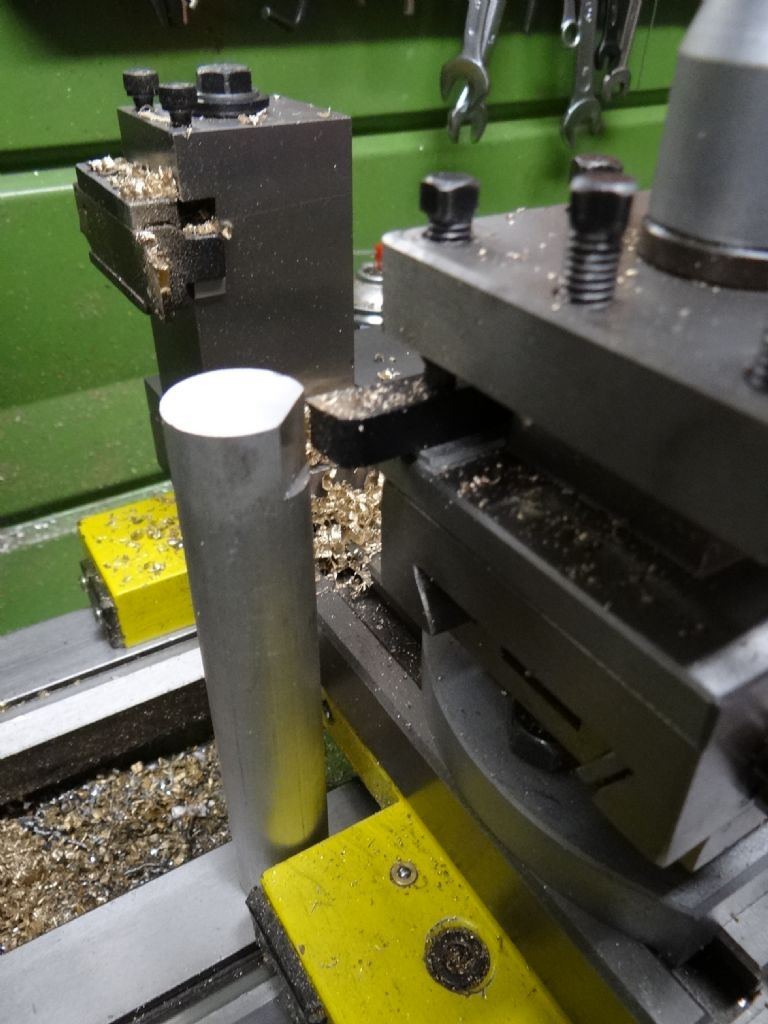
                                      Very true. Because it's quicker I normally set tool height with a home-made height gauge.

                                      dsc05240.jpg

                                      With a fingernail you can feel amazingly small differences in height between the tool tip and the flat top of the gauge.

                                      Main disadvantages are making the gauge accurately in the first place and having to move the saddle so the gauge can sit flat on the ways while offering up the tool.

                                      I made the gauge from Aluminium rod which picks up dings if you sniff at it. With hindsight mild-steel would be better.

                                      Dave

                                      #359396
                                      Mick B1
                                      Participant
                                        @mickb1
                                        Posted by David Standing 1 on 25/06/2018 10:47:37:

                                        Be careful about using that metal strip/rule method with inserts, particularly small tip radius ones, it is easy to snap the point off the insert if they are snucked up too tight against the rule, particularly if it is set low.

                                        I set all my tool centre heights with a fine point dead centre held in a parallel sleeve in the chuck.

                                        I've not found that an issue with smaller lathes like the Myford Speed 10 I used to have and the Warco WM250V I use now. Though It'd more likely be a possibility with industrial-size machines with less sensitivity in the crossslide.

                                        I've made 'L' section toolpost inserts that present a 1/4" square HSS tool at centre height with a few thou ground off the top in producing the top rake. If I have to grind the side or tip back, I might have to put a few thou of thin card or shim under the tool to bring it back up to centre, but if that's not enough I'll grind the blank back to full square section and remake the tool – that's why I prefer the 4" long blanks, 'cause you can do that several times.

                                        I check for CH with a light facing cut, making sure it cuts off any pip. Of course for work with existing axial holes, you don't generally need to be that cute.

                                        #359398
                                        duncan webster 1
                                        Participant
                                          @duncanwebster1

                                          don't get too carried away with setting centre height. The main effect of having it wrong is the front clearance changes. If you're machining something 6" diameter and you've got the tool height 1/16 too high it will reduce the front clearance by just over a degree. I'm not going to get worked up about that. Obviously for small stuff it matters more, and for facing off.

                                          There is also a very small effect on diameter, in the above example if I feed the tool in by 0.1" the actual reduction in workpiece radius is 0.10002". Again it has more effect on small work.

                                          When I worked in a machine shop many years ago, the thinnest packing available for the 4 tool turrets was 1/16", but this means you can get within 1/32" up or down

                                          #359399
                                          Vic
                                          Participant
                                            @vic

                                            3cc85565-514d-4879-a16f-79c56048ce02.jpegThis is my setting gauge, very quick to use with a Tangential tool holder.

                                            #359400
                                            Hopper
                                            Participant
                                              @hopper

                                              Usually more critical on smaller diameters. You can get away with the tool set well below centre and it still cuts ok. But too far above centre on small diameter and the front face can rub on the job, instead of the cutting edge. Also, if there is any tool movement, as on a small flexible lathe, or an old worn one, a tool set above centre will dig into the job deeper, sometimes causing problems. A tool below centre will flex downwards and away from the job.

                                              #359616
                                              Ross Lloyd 1
                                              Participant
                                                @rosslloyd1

                                                I reground the tool so it had more clearance angle on side and top rake, and added a little radius. Cuts MUCH more nicely now, beautiful smooth finish to the eye, slight ripples to the touch.

                                                What's weird though is I bought a 12x12mm index tool holder, not amazingly expensive, about 20 quid from arc eurotrade. Using the supplied carbide tool it immediately had the same problems as the home brew tool did before, even when adding some angle. Makes me think there is something else I am doing wrong.

                                                Am going to experiment with locking the cross slide, as it does seem super sensitive, as well as getting the tool overhang as small as possible.

                                                Cheers

                                                #359626
                                                Hopper
                                                Participant
                                                  @hopper

                                                  12 x 12mm index tool holder? Sounds pretty large for a small lathe. Check the tip is not sitting above centre height.

                                                  Some small lathes don't like carbide tools because they are not rigid enough. Maybe that's the problem. Some improvement might come from using the ground finish inserts instead of moulded. (eg a CCGT insert instead of CCMT etc.)

                                                  Also, you would want to have the rpm about double what you were using for HSS. And keep up a good feed rate to it. Ditto depth of cut. Inserts like to work, hard. Generally, they often will not give as good a finish as a good HSS tool because you can't take such light cuts to finish with.

                                                  #359633
                                                  Mick B1
                                                  Participant
                                                    @mickb1
                                                    Posted by Ross Lloyd 1 on 27/06/2018 11:40:10:

                                                    Am going to experiment with locking the cross slide, as it does seem super sensitive, as well as getting the tool overhang as small as possible.

                                                    Cheers

                                                    Yep, first thing to check. Lock all the slides except the one delivering the cut. If you get an improvement, check and adjust the gibs over as full a range of movement as you can.

                                                    #359641
                                                    Vic
                                                    Participant
                                                      @vic
                                                      Posted by Hopper on 27/06/2018 12:14:50:

                                                      12 x 12mm index tool holder? Sounds pretty large for a small lathe.

                                                      I use several 12 x 12 tool holders on my 8 1/2” by 14” lathe and they work fine. I’ve actually Araldited some gauge plate to the underside of the tool holders so they’re always on centre height in my four way. I keep thinking I should have got the 16 x 16 holder and milled off a couple of mm till it reached centre height.

                                                    Viewing 25 posts - 1 through 25 (of 31 total)
                                                    • Please log in to reply to this topic. Registering is free and easy using the links on the menu at the top of this page.

                                                    Latest Replies

                                                    Home Forums Beginners questions Topics

                                                    Viewing 25 topics - 1 through 25 (of 25 total)
                                                    Viewing 25 topics - 1 through 25 (of 25 total)

                                                    View full reply list.