Headstock alignment and more

Headstock alignment and more

Home Forums General Questions Headstock alignment and more

Viewing 22 posts - 1 through 22 (of 22 total)
  • Author
    Posts
  • #836729
    Sonic Escape
    Participant
      @sonicescape38234

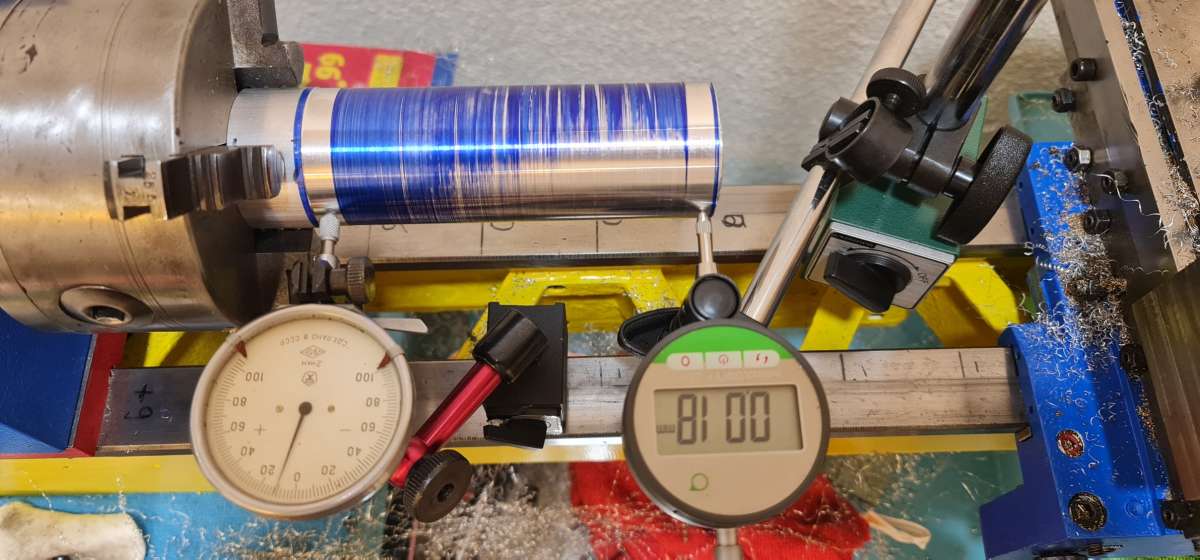
      I have an Emcomat 7 lathe that I took apart to clean and am now trying to put back together. The headstock has no alignment mechanism. The lathe has a flat bed, not a V-shaped one. The headstock is held in place by 6 M6 bolts and I tried to align it as best as I could. For this I used an MT3 test bar.


      20260207_211208
      According to the specifications, the test bar has a maximum concentricity deviation of +/-5μm. I don’t know exactly where these 5μm are measured but from the past I know that it is quite good. Moreover, if I rotate the bar the indicator does not show a deviation greater than 7μm right next to the spindle. At 100mm the deviation is 12μm and at 200mm it increases to 25μm. I suspect that these are normal values ​​in this case.

      The problem is that when the carriage approaches the headstock there is a point where the indicator suddenly jumps by more than 0.1mm! This is perfectly repeatable and always appears in the same place.

      I know the most relevant one will be the dumbbell test. But still, this seems like a serious problem, right?

      I have a 200mm grade 00 straight edge. I walked it along the side of the bed and found serious signs of wear in about the same place where the indicator suddenly changes.

      20260207_180248

      I think a prismatic bed wouldn’t have this issue. How serious is this problem? I suspect the dumbbell test will come out completely wrong.


      #836731
      Sonic Escape
      Participant
        @sonicescape38234

        It wasn’t me who posted this topic twice!

        #836732
        Michael Gilligan
        Participant
          @michaelgilligan61133

          Nicely illustrated … and yes, it looks serious

          MichaelG.

          #836746
          duncan webster 1
          Participant
            @duncanwebster1

            Just shows, paint doesnt improve accuracy.

            #836750
            Sonic Escape
            Participant
              @sonicescape38234

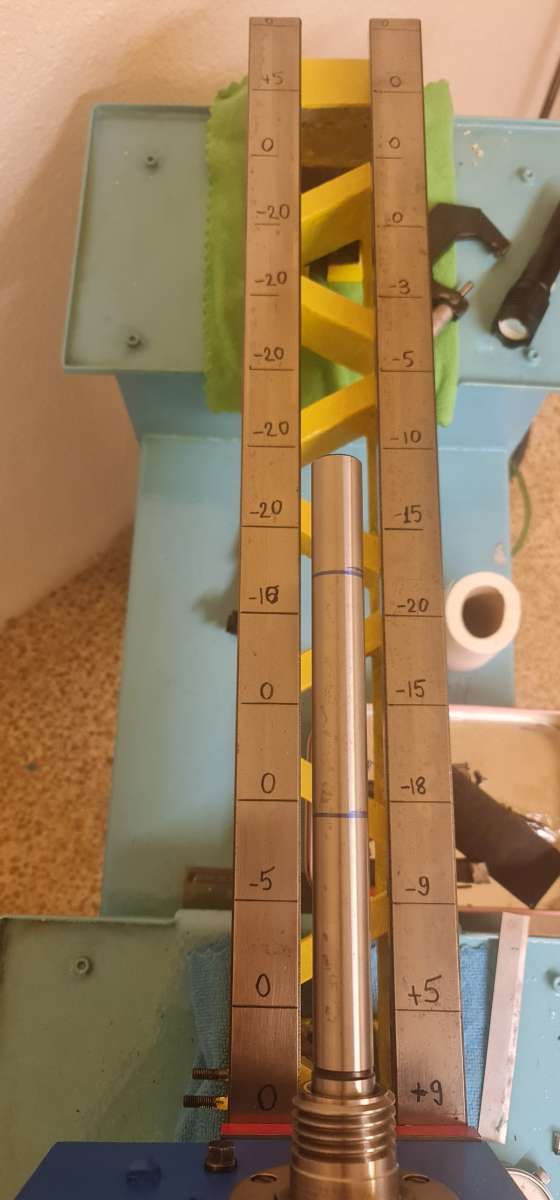
              I measured the width of the two slideways to understand what is happening. In fact, on this lathe, only the two vertical sides of the slideway on the right matter. I considered the end from the tailstock as the reference. The numbers represent the difference in microns from the reference.

              Now I think I found the explanation for that indicator jump. The first ~100mm have very little wear. Because the chuck prevents the carriage from reaching there. I think the dumbbell test is the only relevant one.

              It seems strange to me that the slideway on the left does not have a constant width. Its vertical sides are untouched. Since the bed is symmetrical I was thinking of mounting the headstock at the opposite end. That way the lathe would practically have two lives.

              20260207_230659

              #836751
              cedric 1
              Participant
                @cedric

                Reversing the bed is a good idea if it’s symmetrical. Also, Google ” Myford wide guide conversion”. You may be able to do something similar to fix this common problem with flat bed lathes.

                The wear your photo shows is not as critical as wear on the rear vertical surface of that way  which is the surface the carriage is pushed against by the cutting forces.

                #836798
                Pete
                Participant
                  @pete41194

                  This is a bit lengthy to properly explain.

                  I don’t automatically trust an accuracy specification for any tool or gauge. You have to start from a known base line and work from there. Better would be to first start with checking your test bar by measuring along it’s length with a very good micrometer while checking for any variations in it’s diameter.  Then indicating it in a pair of V blocks while checking for straightness would be the first checks I’d do. If it does measure as being parallel, then rotating it in a pair of V blocks and indicating at various points to locate any areas of inaccuracy in its straightness and how much out that may be. Yes in an ideal world we wouldn’t have to check, I’ve also found in a brand new set of “certified” as accurate to low millionths of an inch gauge blocks there were two identical blocks that were marked and measured the exact same size. Mistakes or even defects can turn up with even the best manufacturing and quality control no matter what the supposed guarantee of accuracy might be.

                  Morse taper test bars no matter how well made and accurate they may or may not be also depend on an almost perfect condition female taper. Any previous internal damage, rusting, or even the slightest speck of missed dust or contamination makes the test results while using one just about worthless. Frankly and in my opinion, most hobbyist’s don’t or aren’t willing to look after those high precision head and tail stock tapers as well as they should. And at one time I was certainly no different. I’m also not against using those test bars, I have them myself. But I’m very careful to check any Morse Taper there being used in first.

                  In one way or another, the worlds machine tool manufacturing industry still use the same methods and procedures developed by a Dr. Georg Schlesinger that can be found in this PDF. https://pearl-hifi.com/06_Lit_Archive/14_Books_Tech_Papers/Schlesinger_Georg/Testing_Machine_Tools.pdf

                  And despite what some seem to assume is correct, the better built lathes even when brand new are not aligned to face parts perfectly flat for a couple of very good reasons. Properly set up, its desirable to always have them face very slightly concave and never convex. That way two mating part surfaces joined face to face will sit flat and not rock. And a lathe first set up to face dead flat from new would begin to wear towards facing convex as the cross slide ways start to inevitably wear. Secondly and on the better lathes, there’s usually some misalignment purposely added to attempt to compensate for possible large work piece weights and cutting forces. In general, those would show the head stock and also the lathes tail stock to be pointing up and also towards the operator by approximately .001″ over about a 12″ length of extended test bar. Not all lathes are set up this way, but in general the more expensive ones would be. The cheaper and more hobby level lathes today might be anything but correctly aligned unless they do come with a certificate of accuracy. Even then I still verify those numbers myself.

                  Afaik there’s two different methods used that vary between manufacturers to force a lathe to face concave. Some miss-align the head stock, while some bias the cross slide way surface grinding and / or scraping to do the same. Without exact details to fully prove it, I believe that cross slide bias may be more of a North American method, and very slightly twisting the head stock towards the operator is more of an European method. Although I suspect that isn’t universally true in all cases. Only my personal opinion, but for a few reasons I think the European method is still the better choice.

                  However it’s done, that introduced concave facing alignment isn’t very much. From memory and depending on the grade specification of the lathe, around .001″ for something like a tool room lathe -.002″ maximum for something like a more general purpose lathe over about a 24″ part diameter. Which doesn’t help us with our much smaller swing lathes. Since a lathe cuts on both the front and rear of the part as it’s facing, that 24″ diameter face is in reality a 12″ facing cut. So the misalignment to face concave is only around .000083″ – .00017″ per inch of cross slide travel. At those numbers it’s getting fairly hard for what most of us might have available to even measure it.

                  Impossible it’s something new as without question others would have come up with the same method and long before I was even born. Although I’ve not yet seen it mentioned anywhere else. But I did figure out a way that our smaller swing lathes can be checked, and a bit easier to verify by doubling those very small numbers.

                  You’ll need either a lathe face plate or a short and fairly thick metal disc that’s just about the largest diameter your lathe can swing. How and what you manage to use for the test cuts is up to what you have available and how much effort your willing to put into this. Secondly at least a .0001″ or it’s metric equivalent reading dial or dial test indicator. Your cross slide gib should be properly adjusted to allow a smooth but shake free travel. On a highly worn lathe that’s also going to have a direct effect on your measurements. Your lathes head stock bearings should also be in good condition and correctly adjusted for there specified radial clearances and end play amount.

                  Make a clean up facing cut across that face plate or disc. Now make a fine and steady facing cut maybe a few thou deep across the whole face with the very best surface finish you can manage. Then withdraw the cross slide back towards you. I’ll use a clock face and it’s numbers for explanation purposes. Looking from the tail stock end of the lathe at the object you just faced, 9 o’clock would be the left edge of the face plate or disc, and 3 o’clock would be the right side or furthest away from the operator during normal lathe operation. Set up and zero the indicators dial at 90 degrees to the part face about to be measured, and in the case of something like a face plate, just past it’s center hole. Slowly and gently move the cross slide inwards with the indicator tip traveling towards the 3 o’clock position on your face plate or part disc.

                  What that does will then show double the measurement of what the cutting tool removed to produce either a concave, dead flat, or convex facing cut. If you set up your indicator to travel the same path the cutting tool did, it will tell you nothing of importance since the indicator tip is then duplicating the exact same path the cutting tip did. With those measurements, then make your head stock adjustments accordingly until it will produce that concave facing cut within the above numbers. It takes almost as long to explain the how to as it does to do it.

                  This is also a very good example of never touching a lathes head stock unless you do fully understand what your doing and what the actual alignment numbers ought to be first. However the test method I’ve detailed can still be used to verify any new or used lathe. But it still won’t tell you everything, worn cross slide ways could easily indicate the head stock is out when in fact that wear should be the item to be addressed first. So some proper judgement about the lathes condition and amount of wear needs to be used as well.

                  That Dumbell or I’d assume the Two Collar test method was what was meant is simpler, but part deflection can also affect the test numbers. And with highly worn or a less than perfectly straight lathe bed, it also won’t tell you everything about the head stocks alignment. Doing a very large facing cut on a face plate or disc will at least provide direct measurements of an issue or misalignment with either the head stocks position on the ways, or an indicator of an undesirable amount wear on the cross slide way surfaces. It then depends on the lathe condition itself for what needs addressing. Lathes are fairly simple machine tools, but there alignments aren’t because theirs so many individual parts directly related to there measurable accuracy for any parts being produced on them.


                  #836823
                  cedric 1
                  Participant
                    @cedric

                    Ahh, the old lathe alignment endless debate.

                    The problem with using a facing cut is that the error could well be the cross slide out of alignment.

                    And, angling the headstock to get a concave facing cut would then result in the lathe turning a taper on regular turning cuts on say the “dumbell” or two collar test.

                    According to Conolly’s Machine Tool Reconditioning, lathe spindle should be aligned to the levelled bed. Then the cross-slide or carriage scraped to give 0 to .001″ concave facing cut. Schlesinger says much the same IIRC.

                    All of which is a bit moot on a worn out little hobby lathe. Best thing Sonic can do is put it all together and take some test cuts, measure what’s going on in real term, and take it from there.

                    Getting bogged down with often unreliable test bars and Schlessinger limits and precision levels and the like is a good way for the novice to spend pleasant days and weeks chasing his tail.

                    #836830
                    Dave Halford
                    Participant
                      @davehalford22513

                      This is why I wouldn’t buy a lathe that has new paint on it. The lathe was probably built on a jig in the factory.

                      #836835
                      Pete
                      Participant
                        @pete41194

                        As I already mentioned, any inaccuracy could be in either the head stock alignment or the cross slide. I thought I already made that clear enough. It’s then up to the lathe owner to logically decide where any inaccuracy is being created. And that can be one or the other, or even a combination of both. But you have to start somewhere.

                        I’m debating nothing since there’s no need, that Schlesinger PDF provides industry standard and factual information. The only endless debate is due to those not fully understanding the basics of machine tool alignment. The machine tool manufacturers don’t debate amongst themselves. There intelligent enough to use the simple logic and basic test methods Schlesinger came up with as far back as the early 1930’s, or possibly even before that. And it’s all there for free for anyone willing to study it enough to then understand what its trying to demonstrate and why its being done in that way.

                        Even the Connelly MTR book borrowed heavily from Schlesinger’s writings, that much was quite obvious the first time I read it. And if there was any real debate, machine tool manufacturers wouldn’t be using his exact same methods today. Maybe if we did the same there wouldn’t be that endless debate there always is.

                        And if there was that much of a negative part taper result while turning a short shaft unsupported with the tail stock, the lathe manufacturers wouldn’t purposely build in that misalignment would they. Were talking less than .0002″ taper per inch of length on a hobby level lathe and with the added inaccuracies of our usual work holding methods. The real point of my previous post was to demonstrate lathes aren’t set up to face dead flat for some good reasons which so far no one else had decided to even mention yet. If we aren’t going to bother trying to help the more entry level people, then why does this forum exist?

                        #836925
                        cedric 1
                        Participant
                          @cedric

                          The endless debate I referred to was on forums such as this, not among manufacturers, who obviously know their stuff.

                          They don’t set lathes to face concave. They set them to face non-convex. IE 0 to .001″ concave. The zero end of that tolerance is dead flat, not concave.

                          And if, hyporhetically, you set your headstock alignment to face .001″ concave over say a 4″ radius  , that would give you a .001″ taper over 4 inches when cylindrical turning. Which is why headstoch alignment is not used to adjust facing tolerances. Cross slide alignment is.

                          And the debate goes on, and on…

                          #836933
                          Tony Pratt 1
                          Participant
                            @tonypratt1
                            On cedric 1 Said:

                            The endless debate I referred to was on forums such as this, not among manufacturers, who obviously know their stuff.

                            They don’t set lathes to face concave. They set them to face non-convex. IE 0 to .001″ concave. The zero end of that tolerance is dead flat, not concave.

                            And if, hyporhetically, you set your headstock alignment to face .001″ concave over say a 4″ radius  , that would give you a .001″ taper over 4 inches when cylindrical turning. Which is why headstoch alignment is not used to adjust facing tolerances. Cross slide alignment is.

                            And the debate goes on, and on…

                            Cedric 1, no debate amongst people like us who actually know what they are talking about! Basically the lathe would be set up to turn parallel [headstock aligned to the bed] and the cross slide machining introduces the desired degree of concavity [non-convex] facing.

                            Tony

                            #836936
                            Graham Meek
                            Participant
                              @grahammeek88282

                              One can hypothesize on what to do with this lathe until the cows come home.

                              All the measurements above are being taken off faces that have been subjected to wear.

                              The only portion of the bed which will not have worn is under the Headstock or the extreme end of the Bed at the tailstock end. This would be the Zero dimension. This is of course assuming no-one has tried to rectify this lathe before?

                              A straight edge the length of the bedway and feeler blades will ascertain which of the vertical faces is the straightest and least worn. All measurements are then taken from this face to get a true picture of the wear.

                              This bed could be rectified by scraping, but that is a tedious job at best. The easiest course or action would be to grind the top face and kiss-grind the vertical faces at the same time. This only being done after first grinding the Bed mounting faces with the bedways on the grinders magnetic table.

                              Regards

                              Gray,

                              #836940
                              Sonic Escape
                              Participant
                                @sonicescape38234

                                Now I’m waiting for a new belt, some gearbox oil and some steel and aluminum bars for testing. I want to see how accurate the lathe really is.

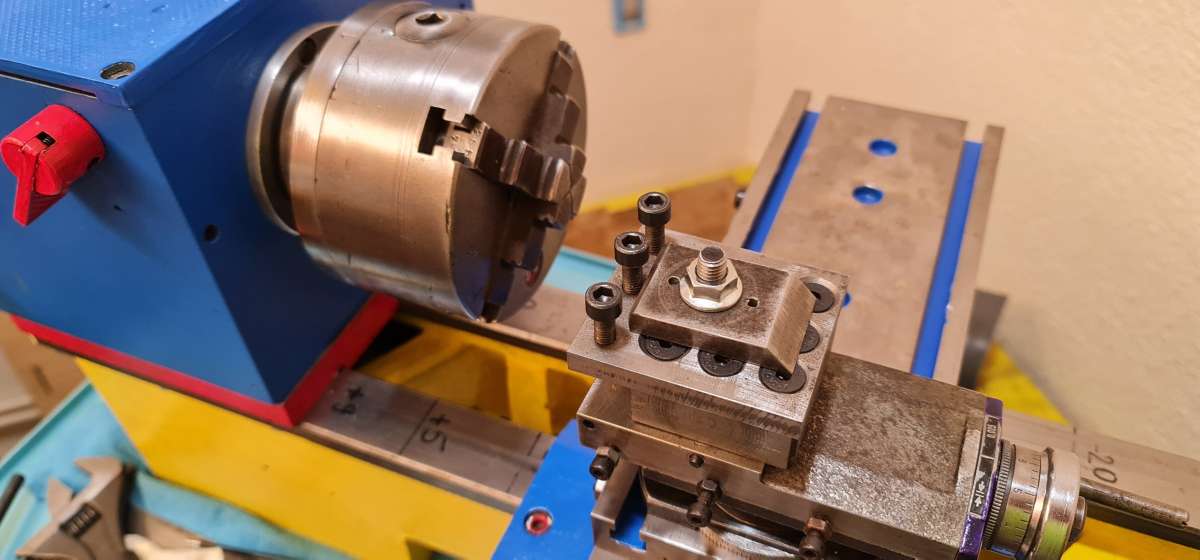
                                I managed to reassemble everything except the lead screw. Looking at the tool post I would say the previous owner was not lacking in creativity.

                                20260209_160651

                                If it turns out that wear greatly influences the accuracy then there would be a few possibilities. I found a workshop that could rectify the bed for ~200 euros. But that would involve putting it on a cart and an hour’s journey with two metros and a train. Then back. And then again one week later. Let’s see.

                                In retrospect, it would have been very useful if I had done some tests before disassembling the lathe.

                                On Dave Halford Said:

                                This is why I wouldn’t buy a lathe that has new paint on it. The lathe was probably built on a jig in the factory.

                                I painted it 🙂

                                #841104
                                Sonic Escape
                                Participant
                                  @sonicescape38234

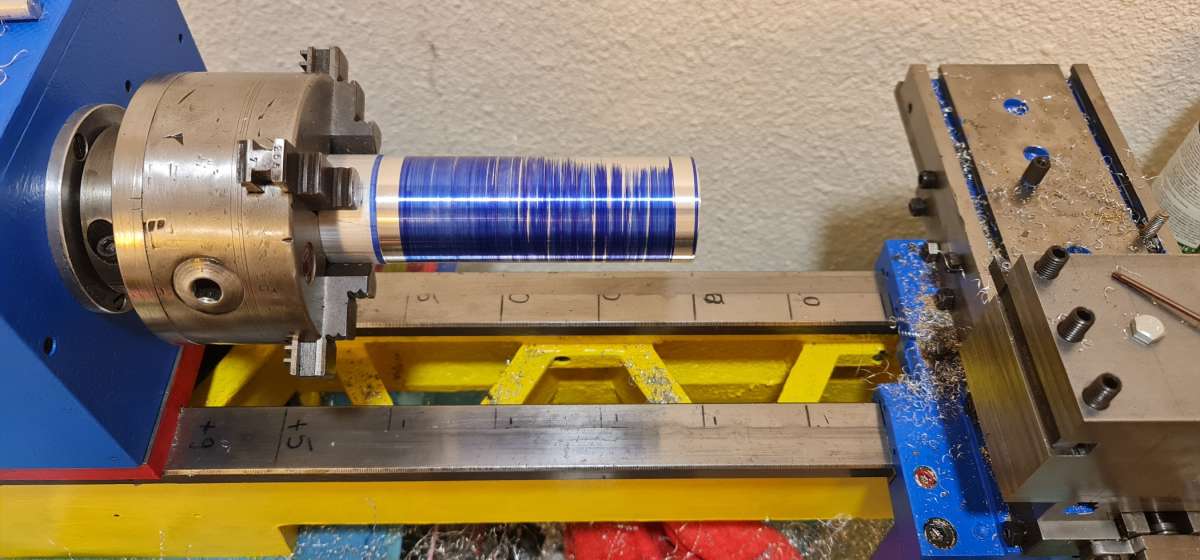
                                  I made a dumbbell test bar from aluminium (45mm diameter). The difference in diameter across a 100mm distance was 20μm. The diameter was larger at the end. So the previous alignment using the MT3 test bar bringed me already close.

                                  20260313_204322

                                  Next I tried to align better the headstock. I used two indicators. The idea was to keep the left indicator unchanged while the right one should indicate 10μm more. This was easy to do, but every time I tried to tighten the six screws that hold the headstock the left indicator was incrementing with >20μm. No matter with what screw I started first or if I adjust them all in parallel in small steps.

                                  Also I noticed that if I push the chuck the indicators easily register a 10μm deviation! This is very frustrating, how to align it if the lack of rigidity causes deviation comparable with the error I want to correct? Is this deviation normal for small lathes? Or should I preload more the spindle bearings?

                                  20260313_210910

                                  Next I cut the test bar for ~35mm starting close to the chuck. The difference in diameter over such a short distance and where the bar doesn’t deflect was less than 10μm. So at least I can make relatively precise small parts.

                                  At the end I wanted to align the tailstock. Here is where the stupid design of this lathe is causing the biggest problem. The tailstock is aligned between between the two vertical surfaces between the two slideways of the bed. Since there is some wear, if I adjust the tailstock to have no play close to the chuck then it will get stuck when moving right to the second half of the bed. A prismatic bed would avoid this problem. This is just poor design in my opinion. The result is a 65μm play on the tailstock when it is on the first half of the bed. I think this is very bad. There is no easy fix for it, right?

                                  #841111
                                  Pete Rimmer
                                  Participant
                                    @peterimmer30576

                                    0.02mm is less than a thou, which is pretty good for a small lathe like that. You’ll probably get more deflection by resting your weight on the tailstock, as some people like to do when turning.

                                    #841118
                                    Dave Halford
                                    Participant
                                      @davehalford22513
                                      On Sonic Escape Said:

                                      Now I’m waiting for a new belt, some gearbox oil and some steel and aluminum bars for testing. I want to see how accurate the lathe really is.

                                      I managed to reassemble everything except the lead screw. Looking at the tool post I would say the previous owner was not lacking in creativity.


                                      On Dave Halford Said:

                                      This is why I wouldn’t buy a lathe that has new paint on it. The lathe was probably built on a jig in the factory.

                                      I painted it 🙂

                                      I knew that, you shouldn’t have with out the assembly jig. Enjoy (O:

                                      #841143
                                      southernchap
                                      Participant
                                        @southernchap

                                        The truth ultimately is in the cut obviously, but I’m surprised there’s been no mention of Rollie’s Dad’s Method (RDM) for checking alignment.

                                        #841150
                                        Tony Pratt 1
                                        Participant
                                          @tonypratt1
                                          On southernchap Said:

                                          The truth ultimately is in the cut obviously, but I’m surprised there’s been no mention of Rollie’s Dad’s Method (RDM) for checking alignment.

                                          I would rather check the lathe actually cuts parallel.

                                          Tony

                                          #841170
                                          Martin Johnson 1
                                          Participant
                                            @martinjohnson1

                                            I seem to recall a fairly recent description in ME or MEW of an adaptation to overcome Sonics headstock alignment problems.  It involved bolting square sections under the headstock which had grubscrews in.  By adjusting the grubscrews the shift in alignment could be finely adjusted and then the holding down bolts tightened.  Hope that is enough for someone to look it up in the indexes.

                                            Martin

                                            #841189
                                            old mart
                                            Participant
                                              @oldmart

                                              I found that the Atlas 12 x 24 that we have at the museum has an acceptable headstock alignment, but the MT3 on the spindle was not very good when checked with a MT3 test bar, even though there was nothing particularly visually wrong with the internal taper. I ended up by taking a tiny skim to clean up from the bore with a solid carbide boring bar with an aluminium insert. The taper was too long for the stroke of the Atlas top slide, so I set up the spare NOS Smart & Brown model A one on the Atlas temporarily and successfully improved the alignment of the taper. Arbors sit about 3/16″ deeper now.

                                              #841234
                                              southernchap
                                              Participant
                                                @southernchap
                                                On Tony Pratt 1 Said:
                                                On southernchap Said:

                                                The truth ultimately is in the cut obviously, but I’m surprised there’s been no mention of Rollie’s Dad’s Method (RDM) for checking alignment.

                                                I would rather check the lathe actually cuts parallel.

                                                Tony

                                                You will, when you do your first cut after doing RDM. 😉😄

                                              Viewing 22 posts - 1 through 22 (of 22 total)
                                              • Please log in to reply to this topic. Registering is free and easy using the links on the menu at the top of this page.

                                              Latest Replies

                                              Home Forums General Questions Topics

                                              Viewing 25 topics - 1 through 25 (of 25 total)
                                              Viewing 25 topics - 1 through 25 (of 25 total)

                                              View full reply list.