Wiring mains socket

Wiring mains socket

Home Forums General Questions Wiring mains socket

Viewing 25 posts - 1 through 25 (of 31 total)
  • Author
    Posts
  • #833606
    duncan webster 1
    Participant
      @duncanwebster1

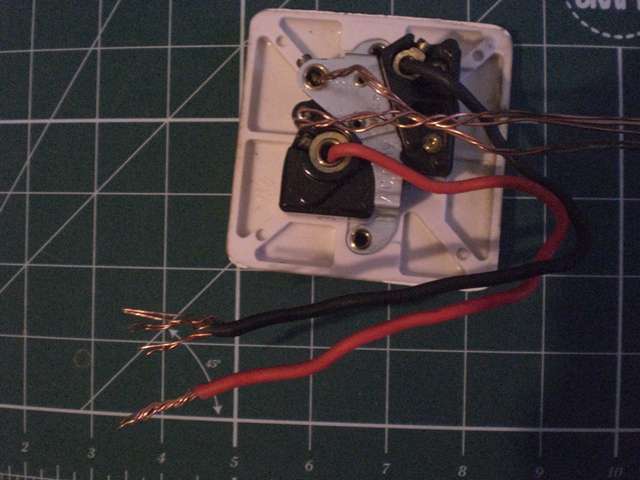
      Something has fallen against one of the mains sockets in the house and broken the surface mount backbox. When I take the socket out I find that the wires are twisted together before being inserted into the connector and screwed down. Not seen this before, so look on Utube. There I find 2 different approaches, one just pushes 2 wires into one hole and clamp down, no twisting, the other has each wire being doubled over before insertion, making sure tat the doubled wires are atop one another, which sounds a bit iffy. Can someone who knows what he’ is on about tell me which is correct, or does it matter. For this one I’m going to replace the socket with one with built in Wago clips, as they seem idiot proof, and I’m going to go round and make sure all other sockets have the screws tightened down, but I don’t fancy rewiring them all

      #833609
      John Haine
      Participant
        @johnhaine32865

        It can be a bit hit-and-miss  ensuring that both wires are properly clamped in the same hole if you just insert them, doubled or no.  May be OK when installed but give problems later, and of course if one of the connections is not made you wouldn’t necessarily ntice but it would affect the “diversity” of the ring main.  My vote would be to twist them if you can.  The Wago clips sound like a good idea for new sockets.

        #833612
        Engine Builder
        Participant
          @enginebuilder

          45 years as an electrician, Do not twist. Assuming solid conductors, fold them back to increase the size and fill the terminal.


          #833613
          Robert Atkinson 2
          Participant
            @robertatkinson2

            I agree with John. A quality branded socket with spring clamps (two holes each for live, neutal and earth) removes the skill factor.
            Years agow I was taught to twist the two wires. This has fallen out of favor as it takes more time, If it’s a ring with two wires put them straight, single wire fold it in two. This allows the screw to set into the “V” between two wires in each case.

            Robert.

            #833615
            blowlamp
            Participant
              @blowlamp

              This may help.

              John Ward is a star. 😉

              #833629
              duncan webster 1
              Participant
                @duncanwebster1

                Thanks chaps, on the basis of the various advice I’m not going to go round and untwist, just make sure they are tight

                #833660
                SillyOldDuffer
                Moderator
                  @sillyoldduffer

                  Definitely don’t go round untwisting wires because one might snap off, causing a real problem.  If it ain’t bust don’t fix it!

                  Curiously,  the last broken socket I replaced had the live pair twisted and the neutrals straight in.   The socket was in an awkward tight corner, making it difficult to get the live wires into the terminal together, so maybe the pair were twisted so they steered into the terminal together.  The neutral terminal was easier to get at.   Or perhaps the electrician just changed his mind!

                  Any horror stories?

                  My teen daughter blew the upstairs lighting fuse with a hair dryer plugged into a 13A socket: should never happen.  Socket was one of a pair each side of her bed and original to the house, circa 1970.  On investigation, the electrician had connected one socket to the dining room light circuit below and ignored the nearby ring cable.  The lighting cable was a foot further away, and obviously thinner.  What was he thinking?  Done after a boozy lunch maybe!  The rest of the house is competently wired.

                  Dave


                  #833733
                  Vic
                  Participant
                    @vic
                    On Engine Builder Said:

                    45 years as an electrician, Do not twist. Assuming solid conductors, fold them back to increase the size and fill the terminal.


                    This is what I’ve seen in my last two houses and also online recently. In my earlier properties I saw quite a few twisted cables though.

                    Edit: Some time ago I fitted a Crabtree cooker socket and it had wire clamps that bore down on the cable rather than direct contact with the screws. This seemed like a better idea to me. Sadly not always very easy to get Crabtree stuff locally.

                    #833735
                    howardb
                    Participant
                      @howardb

                      Does anybody have any idea why the UK persists with specifying and using square socket back boxes?

                      Is it a case of “we’ve always done it this way” or some other criteria?

                      #833737
                      Kiwi Bloke
                      Participant
                        @kiwibloke62605

                        A sparkie friend gave me a good tip: re-tighten the terminal screws after having wrestled the socket onto/into its box. (Pull it out just enough to access the screws, of course.) The unavoidable tight bending of the conductors as the socket is pushed into position puts enough strain on them to loosen the screws’ grip. Experience confirms.

                        #833758
                        John Haine
                        Participant
                          @johnhaine32865

                          Talking of “professional” electricians, when we had some new wiring installed and new consumer unit, the chief sparkie confidently told me there was an earth fault on an outside light tripping a breaker. Turned out they had wired the immersion heater to the lighting circuit. Later some new led lights in a corridor failed, on investigating I found the little transformer thing had been buried in the loft insulation and nearly set the house on fire.

                          #833761
                          Robert Atkinson 2
                          Participant
                            @robertatkinson2
                            On howardb Said:

                            Does anybody have any idea why the UK persists with specifying and using square socket back boxes?

                            Is it a case of “we’ve always done it this way” or some other criteria?

                            Well as most socket faceplates are rectangular or square it makes sense and gives more room for wiring etc. North america also use square or rectangular. Another question is why do mainland europe use round? Even the twin outlets tend to have rouned ends on the back boxes. The probable answer is its easier to make the hole, you just need a hole saw.

                            Robert.

                            #833769
                            Engine Builder
                            Participant
                              @enginebuilder
                              On Vic Said:
                              On Engine Builder Said:

                              45 years as an electrician, Do not twist. Assuming solid conductors, fold them back to increase the size and fill the terminal.


                              This is what I’ve seen in my last two houses and also online recently. In my earlier properties I saw quite a few twisted cables though.


                              Sounds like your installation was done by a qualified electrician, not one following the incorrect advice given by other menbers here.

                              Solid cores should never be twisted together.

                              #833793
                              SillyOldDuffer
                              Moderator
                                @sillyoldduffer
                                On Engine Builder Said:
                                On Vic Said:
                                On Engine Builder Said:

                                45 years as an electrician, Do not twist. Assuming solid conductors, fold them back to increase the size and fill the terminal.


                                This is what I’ve seen in my last two houses and also online recently. In my earlier properties I saw quite a few twisted cables though.


                                Sounds like your installation was done by a qualified electrician, not one following the incorrect advice given by other menbers here.

                                Solid cores should never be twisted together.

                                Can you explain what the incorrect advice being given by members is?  People are reporting twisted wires, presumably installed by qualified electricians. I’m not seeing advice other than your “don’t twist”.

                                Where does “don’t twist” come from?  Is there a reference?  I’m not an past or present trained electrician, but an advantage of twisting is that it ensures continuity of the ring even if the screw terminal comes loose.  When parallel wires are inserted continuity depends on the terminal screw staying tight, and they don’t always.  Could cause a fire…   What does BS 7671 say?

                                In other fields ferrules are preferred to twisting and pairing!  Are ferrules ever applied to ring main sockets? I don’t know…

                                Dave


                                #833808
                                Robert Atkinson 2
                                Participant
                                  @robertatkinson2

                                  Last question first. Ferrrules are used for relatively finely stranded wire not the single conductor used for UK ring main wiring or even low strand count used for higher power wiring.

                                  I know of no formal guidance not to twist the wires in ring main (2.5mm2 single strand) wires. I’ve seen it said that it stresses the conductor but a “U” bend is much higher stress with near zero inside bend radius.

                                  Robert.

                                  #833815
                                  peter1972
                                  Participant
                                    @peter1972

                                    Where does “don’t twist” come from?

                                    I have heard a wire having broken where the screw has come down onto the wire where it passed over the other wire in a twist.

                                    #833880
                                    Engine Builder
                                    Participant
                                      @enginebuilder

                                      When I started my aprenticeship back in the late 60s cables for socket circuits had stranded cores and were imperial sizes e.g 7/029 was 7 strands of .029″ area copper. Convention was the 7 strands should be twisted to form a solid core.  When cables changed to metric sizes the cables had a single solid condutor and the cable manufactures advice was not to twist. I would suggest any instalation you have where solid core cable have been twisted together have not been done by a compedent electrician.

                                      #833898
                                      Vic
                                      Participant
                                        @vic

                                        This thread seems to confirm my experience.

                                        https://www.electriciansforums.net/threads/twist-or-no-twist.194905/

                                        #833921
                                        howardb
                                        Participant
                                          @howardb
                                          On Robert Atkinson 2 Said:
                                          On howardb Said:

                                          Does anybody have any idea why the UK persists with specifying and using square socket back boxes?

                                          Is it a case of “we’ve always done it this way” or some other criteria?

                                          Well as most socket faceplates are rectangular or square it makes sense and gives more room for wiring etc. North america also use square or rectangular. Another question is why do mainland europe use round? Even the twin outlets tend to have rouned ends on the back boxes. The probable answer is its easier to make the hole, you just need a hole saw.

                                          Robert.

                                          That is exactly what I was leading up to.

                                          The standard socket back box in France requires a 68 mm dia hole, the hole saws are sold in every diy store as I found when I wired my workshop to french “consuel” regs – the boxes are available in various depths depending on the quantity of wiring you need to collect and connect in the box behind the socket or switch.

                                          The square faceplates just clip on as a finishing garnish.


                                          #833952
                                          Robert Atkinson 2
                                          Participant
                                            @robertatkinson2

                                            There are dozens of pages on twist or not on the electricians forums. That is all just opinion. No formal guidance.
                                            I stand by my earlier comment. Twisting was the old way and still OK. Discontinued mainly because of time taken. Nothing wrong with it.

                                            I will add another reason for it falling out of favour – the introduction of regular testing of installations. Some of the tests require the ring to be broken which is harder with twisted wires.

                                            You should not untwist / retwist wires “just to check”.
                                            Sockets that use cages, leafs or spring clamps are much better as there is no rotating screw contacting the wire and damaging it.

                                            Robert.

                                            #833957
                                            duncan webster 1
                                            Participant
                                              @duncanwebster1
                                              On howardb Said:
                                              On Robert Atkinson 2 Said:
                                              On howardb Said:

                                              Does anybody have any idea why the UK persists with specifying and using square socket back boxes?

                                              Is it a case of “we’ve always done it this way” or some other criteria?

                                              Well as most socket faceplates are rectangular or square it makes sense and gives more room for wiring etc. North america also use square or rectangular. Another question is why do mainland europe use round? Even the twin outlets tend to have rouned ends on the back boxes. The probable answer is its easier to make the hole, you just need a hole saw.

                                              Robert.

                                              That is exactly what I was leading up to.

                                              The standard socket back box in France requires a 68 mm dia hole, the hole saws are sold in every diy store as I found when I wired my workshop to french “consuel” regs – the boxes are available in various depths depending on the quantity of wiring you need to collect and connect in the box behind the socket or switch.

                                              The square faceplates just clip on as a finishing garnish.


                                              Hole saw doesn’t work terribly well on brick wall. Much easier to chisel a rectangular hole

                                              #833960
                                              Nicholas Farr
                                              Participant
                                                @nicholasfarr14254
                                                On Engine Builder Said:

                                                When I started my aprenticeship back in the late 60s cables for socket circuits had stranded cores and were imperial sizes e.g 7/029 was 7 strands of .029″ area copper. Convention was the 7 strands should be twisted to form a solid core.  When cables changed to metric sizes the cables had a single solid condutor and the cable manufactures advice was not to twist. I would suggest any instalation you have where solid core cable have been twisted together have not been done by a compedent electrician.

                                                Hi, yes, in older days the early twin & earth were stranded, and twisting them even on a radial system, made it much easier to get then into the socket holes, as otherwise, very often if you left them strait you would often get one or two strands snag on the edge of the hole and would end up outside of it, and if it was in a tight place, made it even harder, and things were worse on a ring main in getting two straight stranded wires into one hole. Photo below shows a 13A single socket with stranded 3mm sq’ twin & earth, which went through a wall to another 13A socket, to join a radial twin & earth, but I suspect the two sockets were originally the old 15A round pin type. this was a disconnected line which was just left in place during a complete rewire before I live here, and I removed it all, as the twin and earth was fixed to the top of the skirting board, but some of it was hanging adrift so it all had to come off.

                                                Old twin & earth

                                                Regards Nick.

                                                #833964
                                                noel shelley
                                                Participant
                                                  @noelshelley55608

                                                  I worked in the trade for a while – I was/am appalled at the workmanship of some  “professional ” electricians now. My house was rewired and later tested by the same company only to have some of it deemed unsafe – when I told him his colleagues had wired it he went quiet ! Noel.

                                                  #833975
                                                  Clive Foster
                                                  Participant
                                                    @clivefoster55965

                                                    Solid copper progressively collapses and runs away from the clamp load. Single strand pushed in will work loose over time. Won that argument with a sparky type ages ago by getting him to put a single wire in a spare socket, presumably a decent one as it was left over from a job he done, as a test object telling him we’d look at it in three years.

                                                    Passed the pull-out test when done.

                                                    Three years later slid out quite easily!

                                                    I suspect that after 5 the wire would have been just lying there with no clamp pressure. Which wouldn’t have boded well for a real connection. I’ve pulled a few old faceplates off and left the wire behind when helping folk out on weekend / evening emergencies. Something I avoid as much as possible but sometimes you have to step in. I’ve noticed that the connections in modern sockets don’t grip as well as the old style ones. Contact area on switches can be pretty pathetic too.

                                                    I’ve always used the U bend technique which gives much more area for the screw to contact meaning less load and less flow. Never seen one of mine come loose. U bend also gives more contact between a pair of wires. I also arrange enough slack so the faceplate folds out flat making it far easier to wire in. When I had my extension done I was surprised that a very experienced sparky, who’d done work before, hadn’t shown his new guy “apprentice” the fold’n shape technique. Very strange as I’d shown him 20 years before.

                                                    Twisting does increase the contact area and reduces the load as the twists come down against each other as the connection is more secure. The risk with twisting is that the wire may be partially work hardened and snap. Either during twist or if the wire is jogged or manipulated after insertion. Had to replace one of those cheap’n nasty plastic box choc-block style joiners hidden in a cupboard when the trailing, tested together, wires had been jogged by accident. OK total bodge by whoever put it in. Wrong type of connector, cable clamps not done up and no wiring clips so it would have come out a New York minute after I’d gotten a proper junction box anyway. But you don’t expect the wire to snap.

                                                    Clive

                                                    #834022
                                                    duncan webster 1
                                                    Participant
                                                      @duncanwebster1
                                                      On Clive Foster Said:

                                                      …….

                                                      I’ve always used the U bend technique which gives much more area for the screw to contact meaning less load and less flow. Never seen one of mine come loose. U bend also gives more contact between a pair of wires. I also arrange enough slack so the faceplate folds out flat making it far easier to wire in. ……

                                                      Clive

                                                      Hmm. If 2 wires are doubled back and poked in one hole then they will tend to sit one atop the other or side by side in a sort of square array, so the screw will still only contact two bits of wire. On a spur it seems best to double the wire. Until this recent episode it’s probably over 30 years since the others were touched. Mondays job is to check tightness, I’ll report back

                                                    Viewing 25 posts - 1 through 25 (of 31 total)
                                                    • Please log in to reply to this topic. Registering is free and easy using the links on the menu at the top of this page.

                                                    Latest Replies

                                                    Home Forums General Questions Topics

                                                    Viewing 25 topics - 1 through 25 (of 25 total)
                                                    Viewing 25 topics - 1 through 25 (of 25 total)

                                                    View full reply list.