Thinking of getting into 3D printing – others experience sought

Thinking of getting into 3D printing – others experience sought

Home Forums 3D Printers and 3D Printing Thinking of getting into 3D printing – others experience sought

Viewing 25 posts - 1 through 25 (of 53 total)
  • Author
    Posts
  • #832277
    Phil Lingham
    Participant
      @phillingham79132

      I’d be interested to hear others experience with 3D printing.

      It’s something I’ve thought I might like to get into for a while but don’t want to spend money on something that will end up taking up space and not getting much use.  I’ve been looking at the Bambu Labs P1S.

      As a bit of background I retired in 2018 having spent 33 years as a process development engineer in the medical device industry and had limited experience of both FDM and Stereo Lithography towards the end of my career.

      I have a Warco GH1224 lathe and GH Universal milling machine since about 2010 and can’t imagine being without them as they get lots of use mainly making motorcycle parts and repairs but various other obscure things from time to time.  A support bearing arrangement for an Oast house cowl among the more bizarre.

      A couple of close friends have Creality 3D printers and I’ve had them print a few things for me (mainly prototype parts). I would describe myself as reasonably proficient with Fusion 360 and would be mainly interested in printing my own designs.

      In summary what have others found?  Is it something they cannot imagine being without, another interesting thing to learn and occasionally useful or a bit of a white elephant?

      Thanks for any feedback.

      #832279
      Peter Cook 6
      Participant
        @petercook6

        I started as an interesting thing to learn, and bought a Creatility 3 to go with a copy of MoI 3D modelling software. Four years on I still find it extremely useful for making lots of bits and pieces.

        Custom boxes, stands and holders for a variety of uses, tools and jigs where plastic is adequate for the purpose.

        #832288
        Grindstone Cowboy
        Participant
          @grindstonecowboy

          I pondered for quite a while before picking up a second-hand Ender 3 Pro locally, and now I wouldn’t be without it. I’ve also learned to use Solid Edge to a certain extent, enough to design quite a few bits and pieces which I couldn’t find on Thingiverse.

          The first few weeks, I was printing all sorts of stuff, a lot of which wasn’t actually useful, but it helped the learning curve. After the initial excitement wore down, I settled on things that were actually useful.

          I’d go for it.

          Rob

          #832299
          SillyOldDuffer
          Moderator
            @sillyoldduffer

            I’m feeling jaded about my Ender 3 Pro at the moment because I broke it a week after fixing a worn drive sprocket and replacing the magnetic bed and bowden cable.   I left it printing a largish electronics box with various complicated apertures for a display and controls, and the filament tangled on the drum leaving the poor thing thrashing for a few hours before I noticed.  It’s a mess.  Arrgh!

            Is it useful?  Very, though it depends on what you do.  I’m into experimental work, often implemented as a mix of plastic and metal parts, possibly with electronics.   Metal for strength.  Plastic for complexity.  Shapes that would be difficult or even impossible to machine are often easily printed.   The technologies complement each other well.

            I would use 3D printing even more if I was keen on anything like model railways because objects like seats, lampposts, signage, curved carriage roofs etc can be quickly created in 3D CAD and then printed.  Figures are possible with other software, and there are libraries of them too.

            Also good for repair work, such as replacing the broken catch on my workshop vacuum and various plastic kitchen objects.   Tricky part is getting the measurements right on the CAD model.  After that printing is easy, at least with PLA.   Other plastics available!

            Not into making moulds for casting myself, but good for that too.

            I’ve used FreeCAD, F360 and SolidEdge.  I dropped Fusion for licence not technical reasons, switching to SolidEdge for complex designs.  FreeCAD is fine for single parts.  They all work well, in my case via the Cura slicer.  If you can drive Fusion, that’s 3/4 of the battle!   I agree with Rob – go for it!

            Now, should I fix my Ender 3, or upgrade?  I ought to sort it out before I need to print something.  Broken 3D printers are useless…

            Dave


            #832310
            Fulmen
            Participant
              @fulmen

              I have an old Creality CR6SE, basically an improved Ender 3. Very happy with it, always printing fixtures, prototypes doohickeys and thingamajigs. I wasn’t completely convinced it would see much use, but now I couldn’t imagine being without one.

              #832318
              Huub
              Participant
                @huub

                A few years ago, I bought a € 200 Artillerey Genius 3D printer to check my 3D designed parts before making them from metal. It has printed a lot since and I think it is the best bang for the buck (CNC) machine I have bought. If the printed parts are good enough, I do not make them from metal anymore. I regret not getting a 3D printer sooner.

                #832319
                Bazyle
                Participant
                  @bazyle

                  The latest generation eg Bamboo and Qidi a re much faster than older ones but if you are just wanting to try it out just get a second hand one initially. Then you can move up in size and quality when you know what you want. It is like the endless discussion of lathes on this forum – is it really sensible to drop huge amounts of money on the best machine available when you are a total newbie.
                  Other things to consider are the pong and fumes of all but the most basic materials, though for starters you can make a lot using just PLA which is domestic friendly. ABS etc move to the shed. Resin printers give better detail, important for finescale models but can be messy.
                  Now that printed metal parts are available the OP could most likely use one to make trial parts for his own designs before committing to a printing agency.

                  It all depends what you are doing though and it can be another tool like an electric screwdriver or a hobby in itself.

                  #832325
                  Speedy Builder5
                  Participant
                    @speedybuilder5

                    Make sure you have a clean dry and warm place for the printer. If possible have an enclosed “box” around it to keep dust away and also control the temperature within.

                    I have a Prusa Mk 3 which works fine, but find that printed parts do not have the strength of moulded parts.

                    Bob

                    #832326
                    jimmy b
                    Participant
                      @jimmyb

                      I’ve now got 2 Creality K1 printers. As with all my metalwork machines, I would not be without them!

                      Looking at my purchase history of filament, I have used 35kg of hyper filament in yhe last 2 years.

                      Since getting ill I have mostly been been designing and printing things to make life easier in the shed!


                      As for CAD, I stick with Fusion360


                      Jimb

                      #832330
                      JasonB
                      Moderator
                        @jasonb

                        As I was asked about it in my “Willy” thread I will also reply here.

                        In the light of another thread wrt 3D printers just started, Jason did you do a test print of the design bof the standard in plastic before committing to metal?

                        I don’t do a plastic print first to verify my CAD model. I will assemble all the parts and then check that they all move as they should and that I am happy with the look of the part in CAD. This is the same for parts I cut on the CNC, they go straight from screen to machine. So I don’t feel the need to have a 3D printer to do trail runs.

                        Out of interest do those making plastic parts tend to run a coarse print with low fill percentage first particularly if the final print is going to take many hours?

                        I have come close to getting a BambooLabs one a couple of times. It would have been for printing patterns for casting but on the first instance the person I did quite a lot of CNC pattern making for decided to get a printer. Then more recently I wanted a pattern for a 9″ flywheel and after cutting a wooden one on the CNC which moved when I brought it into the warmer  house. I though about getting a now cheaper one of the same printers but in the end decided to use Craftcloud again to get an ABS one done which is suppose to be easier to sand and smooth. Well even with a good quality print there was so much sanding needed that I decided not to bother and stick with my CNC which produces paint ready surfaces.

                        Also from the “Willy” and “Kelsey” threads it would seem people think I work very efficiently so is there really a need for me to make things like change wheel holders when a box has done me for 20years? My box also takes up about 1/3rd the spave of some of teh storage solutions I have seen as I don’t need space between each wheel and somewhere to print the numbers, depends on the size of your workshop I suppose. I do think a lot of what I see is “Have Printer must find something to print” rather than “have a real need so must get a printer”.

                        I see a lot of plastic prints being used for casting patterns and I see an equal amount of castings with nasty layer lines reproduced on the surface. I suppose some are happy with that but I’m not.

                        I have also received reasonable reward for doing CAD work for others that either can’t or are not very good at CAD but have access to a 3D printer so would say to anyone thinking about it to get upto speed with CAD first, see if you can design a few of those parts you need before buying as there are only so many Benchys that you can print.

                        #832350
                        noel shelley
                        Participant
                          @noelshelley55608

                          Jason has pointed it out and so will I ! DO NOT think that your 3D printer unless of industrial quality will make patterns and be the answer to a pattern makers prayer it will not be . Only with much spray filler and sanding Etc will you land up with a usable pattern.

                          I have been asked many times to cast from 3D printed patterns, the layer lines and ridges made it impossible to extract the pattern from the mold. I gave up accepting printed patterns for casting, it was costing me to much time making very poor castings.

                          Having left a 3D printed part in the car on a hot day I found a badly distorted and useless lump of plastic, PLA ?

                          Noel.

                          #832353
                          SillyOldDuffer
                          Moderator
                            @sillyoldduffer
                            On JasonB Said:

                            As I was asked about it in my “Willy” thread I will also reply here.

                            … I do think a lot of what I see is “Have Printer must find something to print” rather than “have a real need so must get a printer”…

                            A really important point, and not just 3D printers!  Is any tool worth buying?

                            As a complete newcomer to the hobby I wasn’t crystal clear about what I needed.   My engineering and procurement training both emphasised the importance of getting the requirement right, but Model Engineering is a hobby, done for fun and interest as much as anything else.

                            Those obliged to focus by limited cash, space and time avoid wasting resources on tools that will never be used.  But it’s not the law. Some people collect tools, others like to have capability even if rarely needed, and others enjoy learning with no particular object in mind.  Tinkering allowed!  People buy lathes for the same reason, interested in the idea of turning metal or wood without anything particular in mind.   They ask for suggestions and are pointed at simple tools and basic engines that develop skills.   Though most home-made tools are inferior and/or more expensive than their manufactured equivalents, they’re motivational.

                            3D-printing is the same – folk without a clear need looking for things to print that might be useful.   They’re finding their way.  No reason not to: Ender3-class printers are cheap enough to buy speculatively, perhaps only printing models downloaded off the net.

                            But I agree the real value of 3D-printing comes when a designer directs CAD skills to a goal, 3D-printing parts not otherwise available.  Or CNC cutting them in metal at home or by outsourcing them.   Being able to design with 3D-CAD is a much larger investment in time and effort than simply buying a 3D-printer and running off objects designed by others..  To get design skills, beginners have to start somewhere.  A gear-holder is as good a place as any!

                            Dave


                            #832363
                            Dave S
                            Participant
                              @daves59043

                              I’ve had a 3d printer since 2013… The first one was somewhat of a pain to get good results from, but I did use it for things like prototypes and patterns.

                              This old thread shows one I did back in 2016, and This one shows that subsequently turned into a bronze case.

                              The pattern for the bronze casting was scaled in CAD for the shrinkage and then printed. I filled and painted it and the blanks came back fine.

                              My Kids have also grown up with 3d printer as a tool – the eldest absolutely stunned her science teacher when the homework was to make a model of a red blood cell – He still uses the 3d printed model in class, many years later.

                              I currently have a Bambu X1C, and no it’s not connected to the network and it doesn’t therefore have all the latest updates. But it still does work as it did when I got it 2 years or so ago.  It has very good ease of use, and unlike the first printer, which needed babysitting this one is press go and walk away capable.

                              Unlike Jason I do print out my CAD as a check – I am not very good a thinking through all the things (yet?), so a physical model really helps me.  The brass case I made a few months ago for instance had a square ended blind trough. Easy in CAD and 3 D printing, less so in machining.

                              More recently I had to reverse engineer a watch case (Thread Here). For that the 3D print helped me check that I had got my dimensional guesses in CAD correct, and that where I had deviated (the Lugs for instance) that the new design choice was OK to fit the existing hardware.

                              Dave


                              #832367
                              jaCK Hobson
                              Participant
                                @jackhobson50760

                                To find out if you ‘need’ one, you can’t go wrong with bambu mini for £150. It just works, every time. Software great. Simples

                                I had an ender 3 which I massively upgraded at significant time and expense. The bambu beat it ‘out the box’ on everything except print volume… and you can’t upgrade it (outside of bambu eco system) 🙂

                                #832368
                                Julie Ann
                                Participant
                                  @julieann

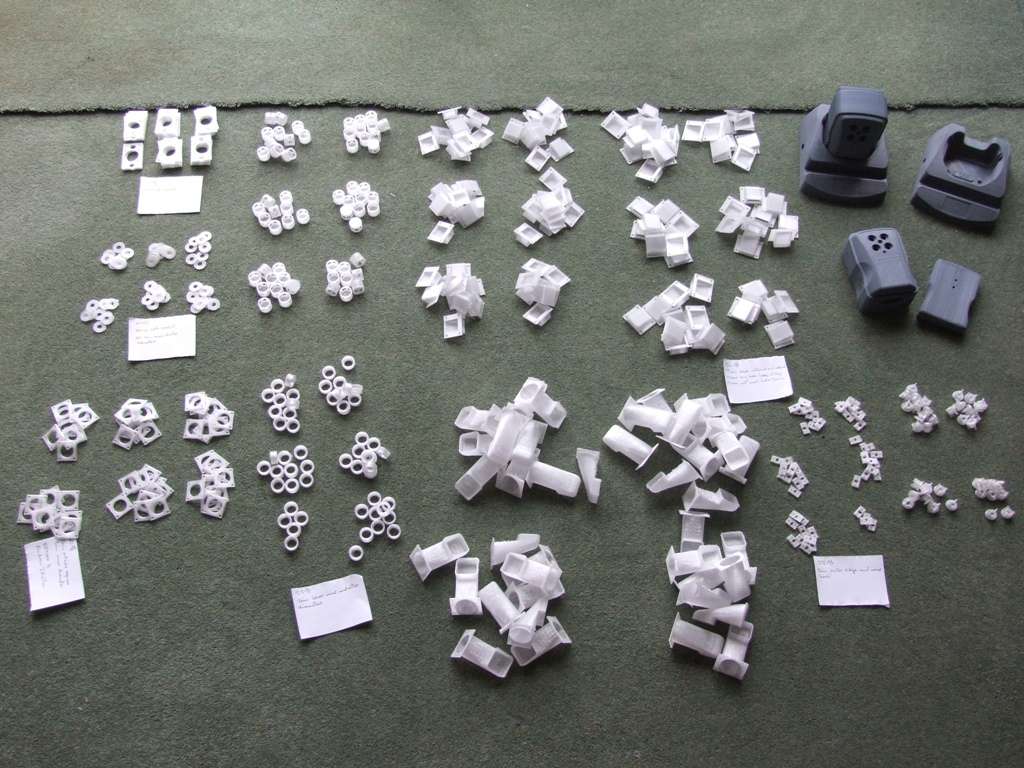
                                  I bought my first 3D printer in 2013, an Ultimaker2. This has been used to print thousands of parts for prototyping, fit and feel as well as production parts:

                                  Production 3D Printing

                                  More recently I bought a 3D resin printer, primarily for printing patterns for investment casting. My Ultimaker finally gave up the ghost last year. Rather than waste time and money debugging and repairing it I bought a Prusa CoreOne. As expected 3D printing has moved on significantly since I bought the Ultimaker. Now that I am retired I mostly print items for home; my paint tin roller is 3D printed. I also print a lot of fixtures to hold engine parts for painting.

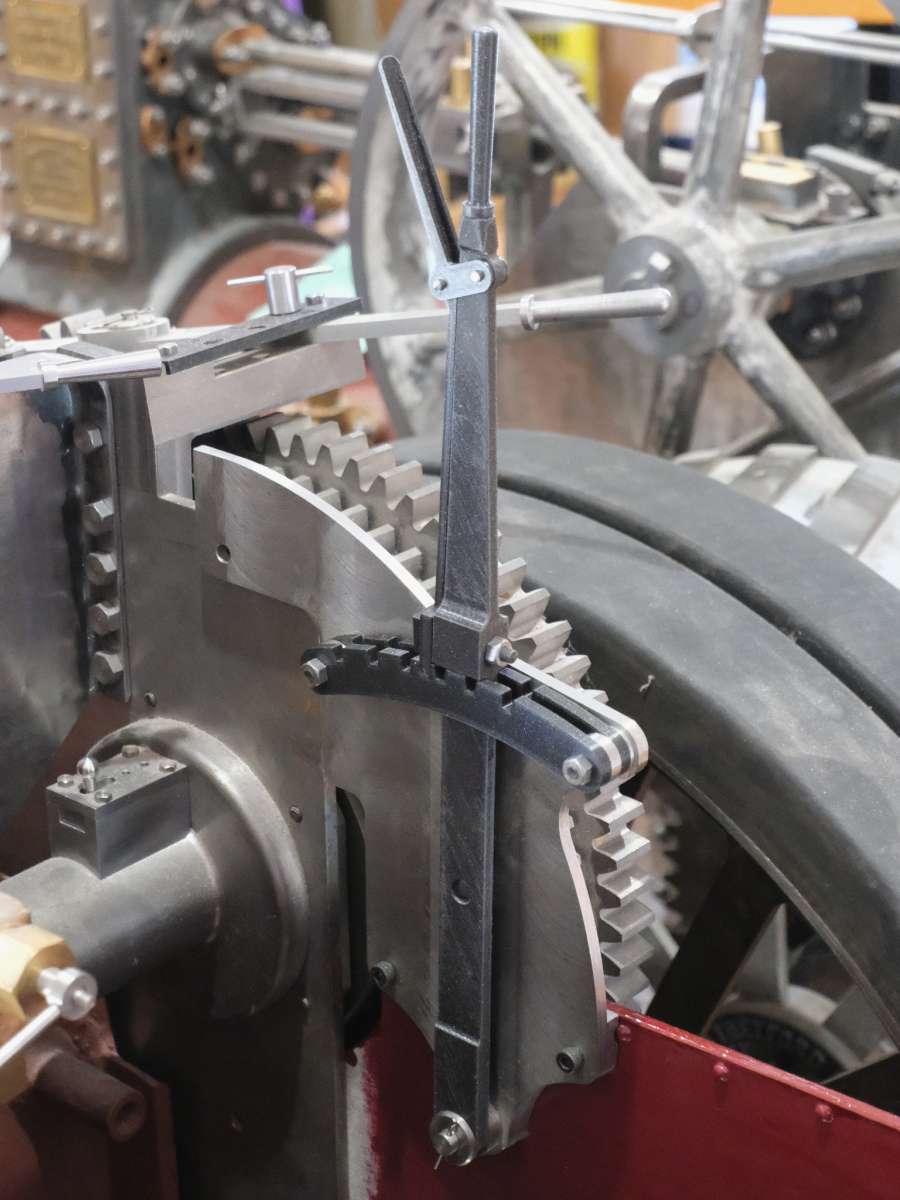
                                  I do print parts to assess look and feel, and fit. In meetings with clients it is much better to have a real part than everyone looking at a computer screen. While my model engines are extensively modelled in 3D CAD (I’ve been using 3D CAD professionally for 25 years) it is sometimes helpful to see how parts look in the real world:

                                  Reversing Gear - Resized

                                  The firebars for my traction engines have been modelled in 3D CAD based on the full size drawings. These will be cast in iron using the 3D printed patterns. Out of interest I have just measured surface roughness. The firebar pattern is around 1.5 to 2um Ra. A commercial iron casting for my engine, picked off the shelf at random, measures 7.5um Ra. So significantly worse than the 3D pattern.

                                  For me, at least, 3D printers are extremely useful and a great addition to the workshop. Albeit it mine are in the sitting room not the workshop proper.

                                  Julie

                                  PS: The links provided by Dave simply tell me that I am banned for ever.

                                  #832385
                                  JasonB
                                  Moderator
                                    @jasonb

                                    A lot depends on the shape you are printing. With teh Bamboo PS1 that I was thinking of having a minimum layer height of 0.08 when you get to the flatter areas of curvy 3D shapes those layer lines look more like the contour lines on a map. So putting an ra tester on steps that size is likely to show 80 microns or about 3 thou. Not so bad on near vertical surfaces that just have a couple of degrees of draft but as you get to the crown of a flywheel spoke not very smooth.

                                    Its a bit like the finish I get on the CNC when the adaptive steps down in vertical increments which show on the flat areas but hardly anything on the vertical. The advantage of the CNC is that the finishing cuts work by spacing the scallop ACROSS any surface so they are consistant all over and a ball nose cutter smooths them out more than a print nozzle could.

                                    So for anyone thinking of using a 3D printer for pattern making they would be better off spending their pocket money on a cheap gantry type CNC Router which would be Ok for woods, PU Model Board and solid plastics and a lot faster than a mill based CNC.

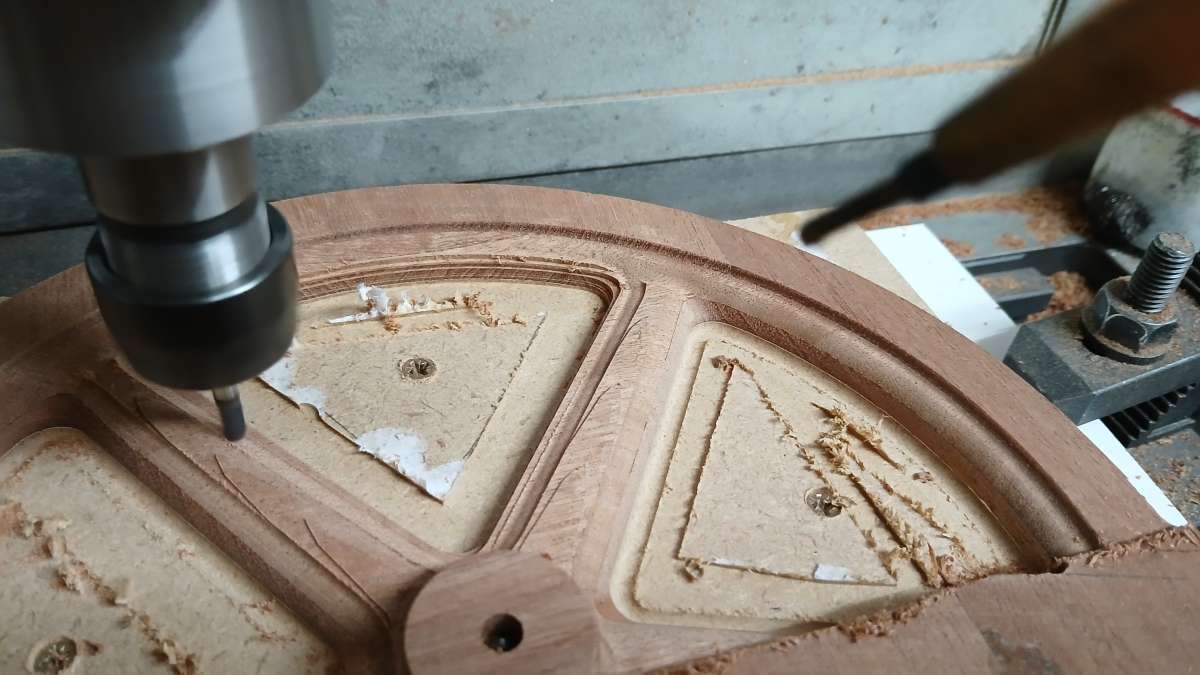
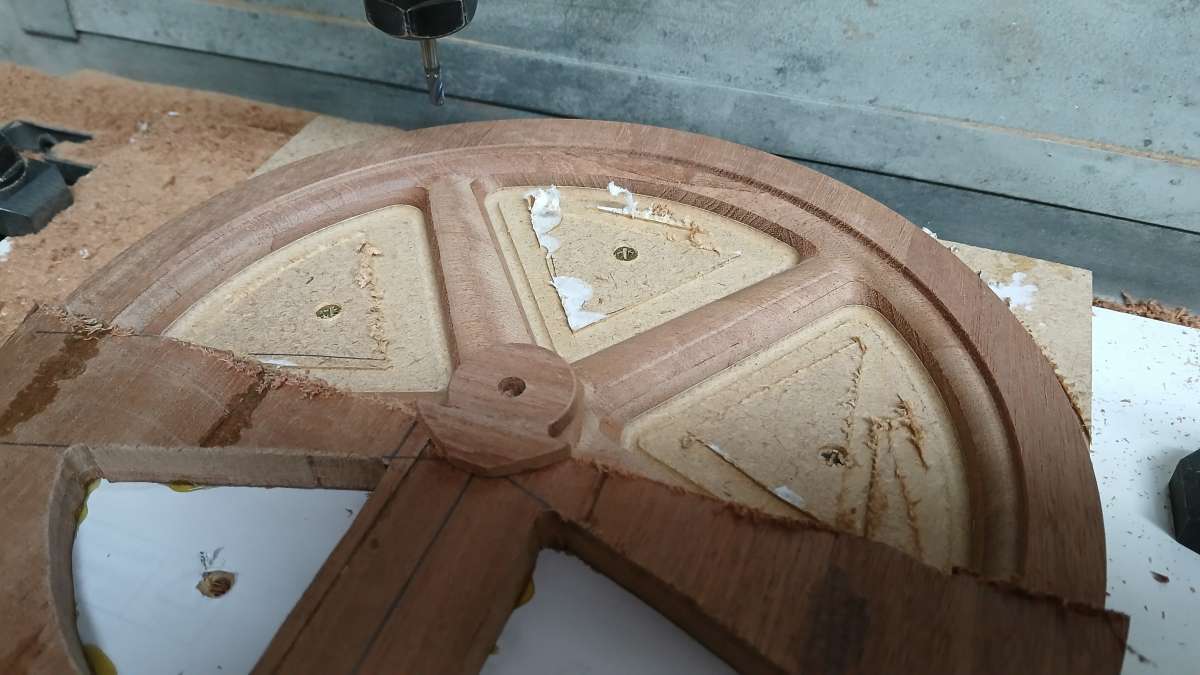
                                    As an idea this is the wooden pattern being done, you can see the contour line son the spokes which I think were 0.5mm so there would be more lines but smaller steps between each from a print depending on layer height used.

                                    20251024_155115

                                    And after the finish tool path which is ready for a very light sanding

                                    20251024_163858

                                    One coat of High5 later

                                    20251110_091523

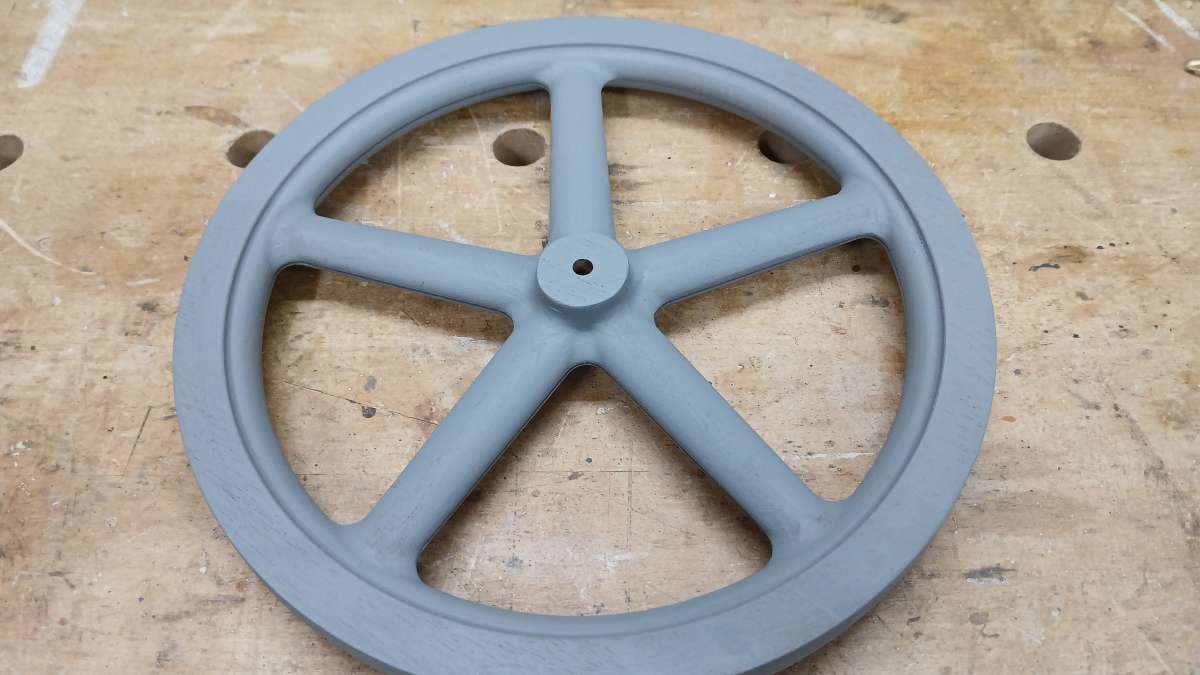
                                    Compared with the PLA prints after about 2Hrs sanding each side and several coats of High Build between, you may be able to still see some lines where spokes meet the hub which were the hardest areas to get to.

                                    20251110_091446

                                    And from the numbers posted earlier it should be easy to see that if the print is rougher than your casting process you are going to replicate those lines in the casting unless you spend a lot of time working on them.

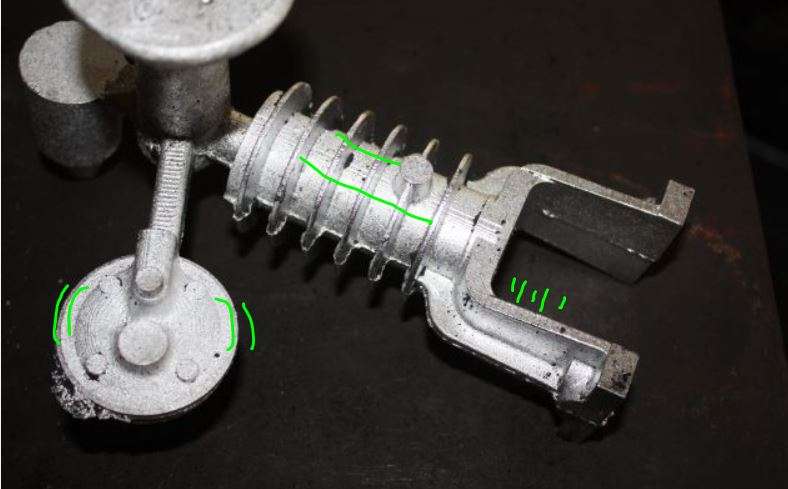
                                    layers 1

                                    layers 4

                                    #832434
                                    blowlamp
                                    Participant
                                      @blowlamp

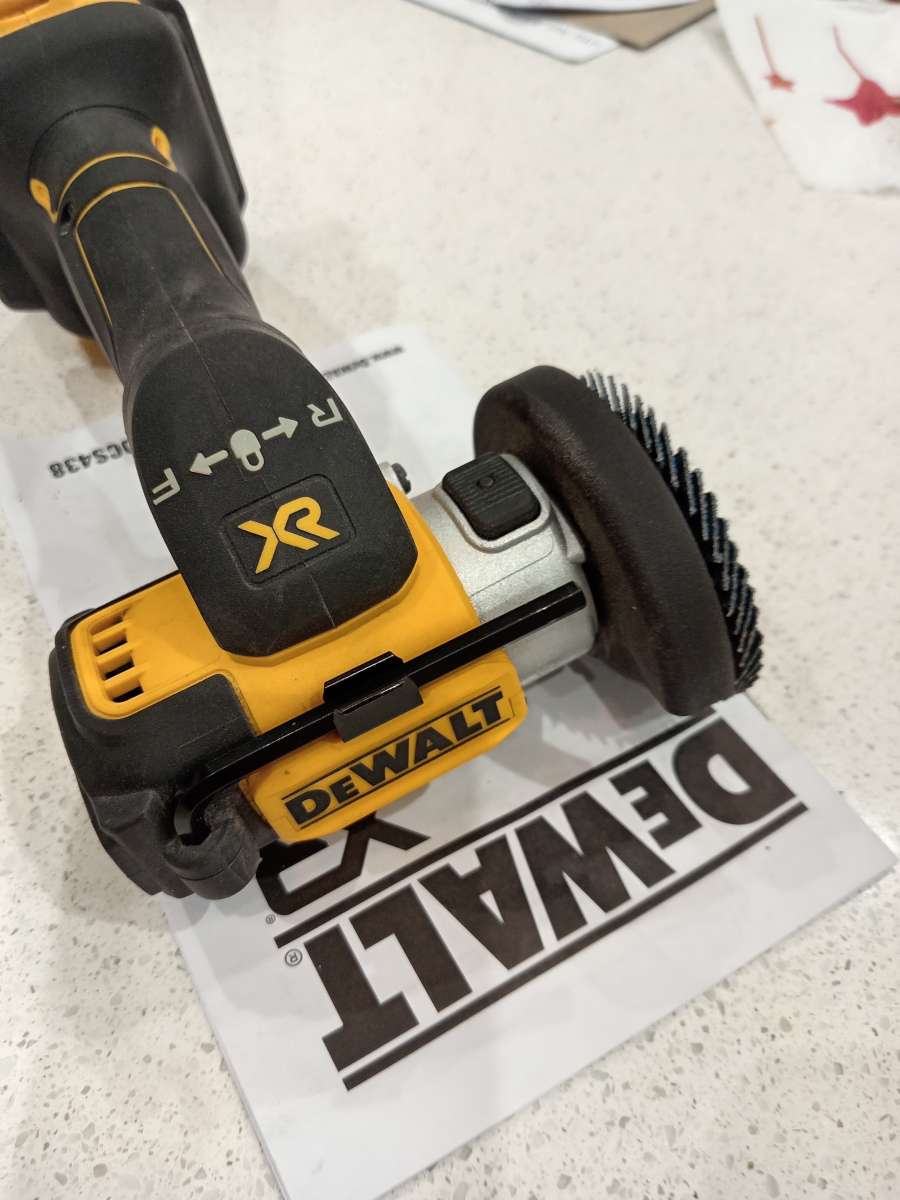
                                      I bought one of these a few years ago and it is very handy.

                                      IMG_20260113_165327

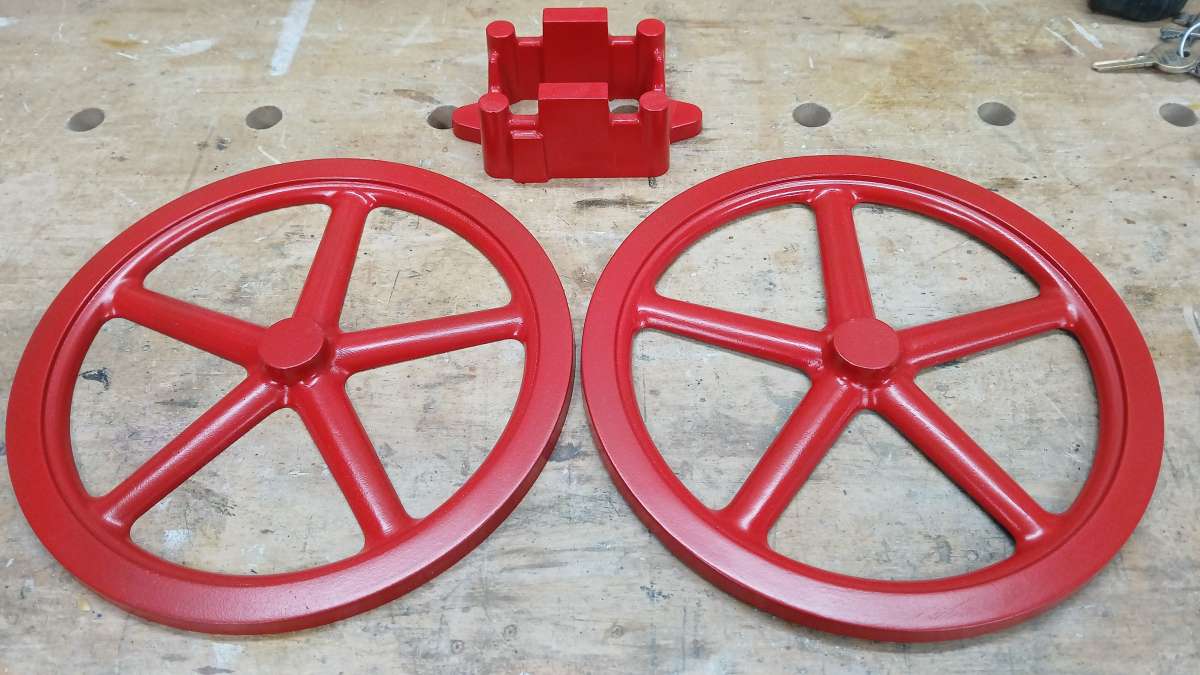
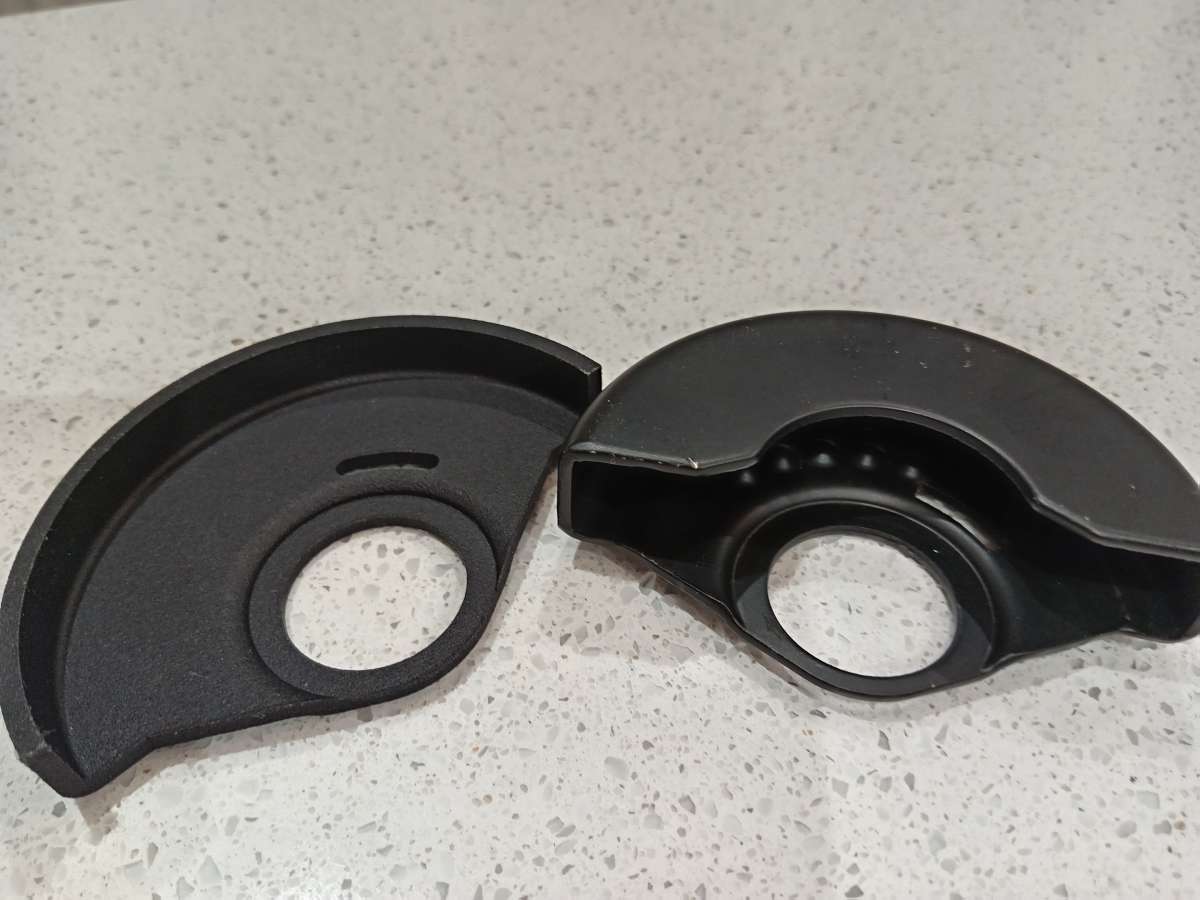
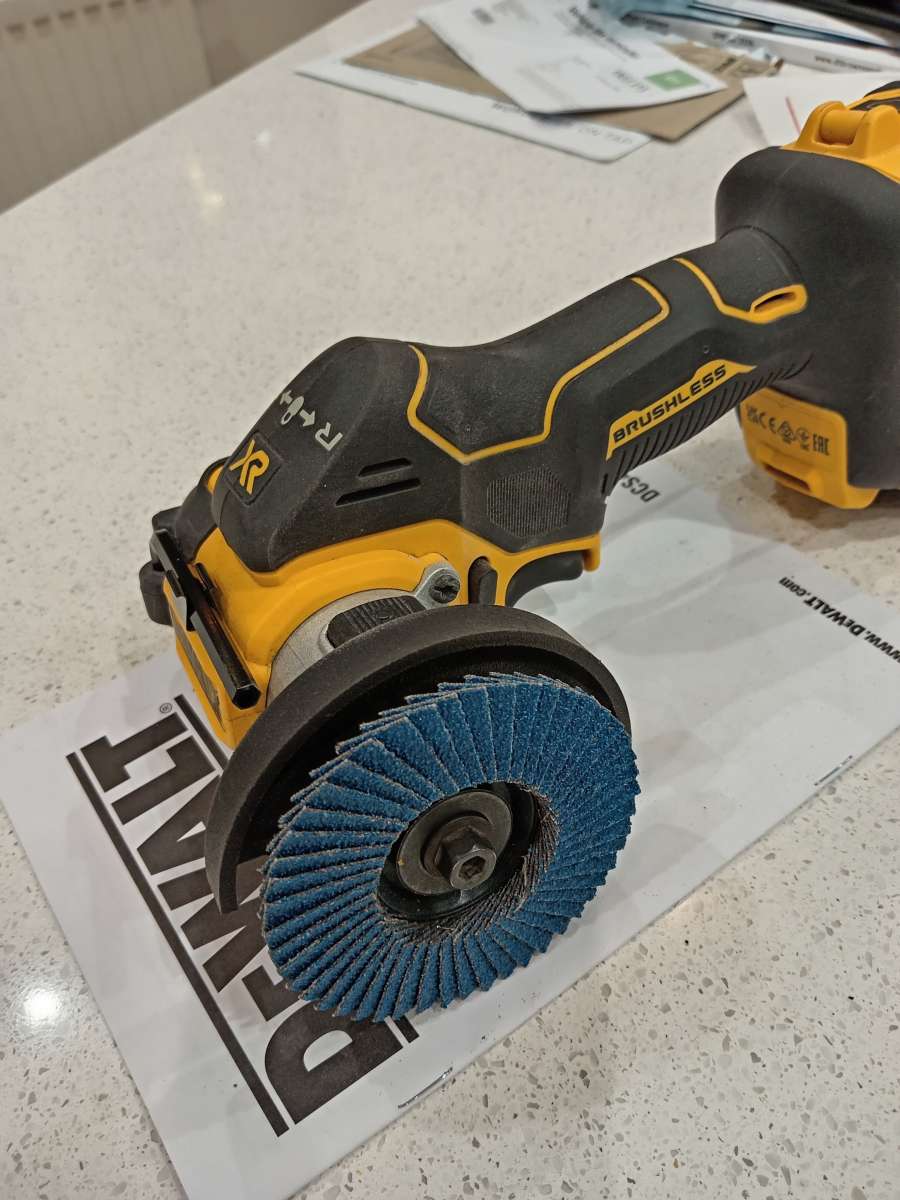
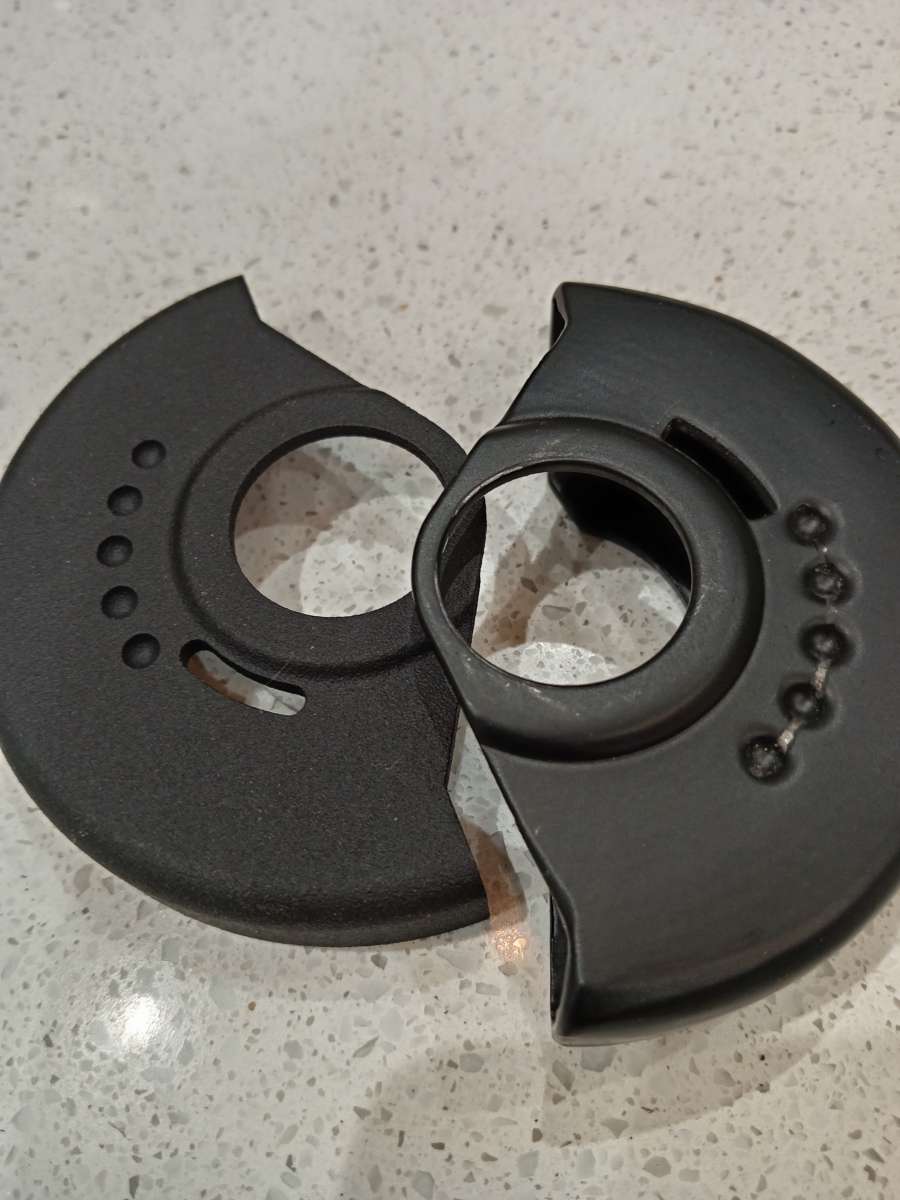
                                      The only problem with it is that abrasive flap discs can’t be used because the supplied steel guard is fully enclosed and doesn’t allow enough room for fitment. The one on the right is the original and the one on left is my substitute.

                                      IMG_20260113_165138

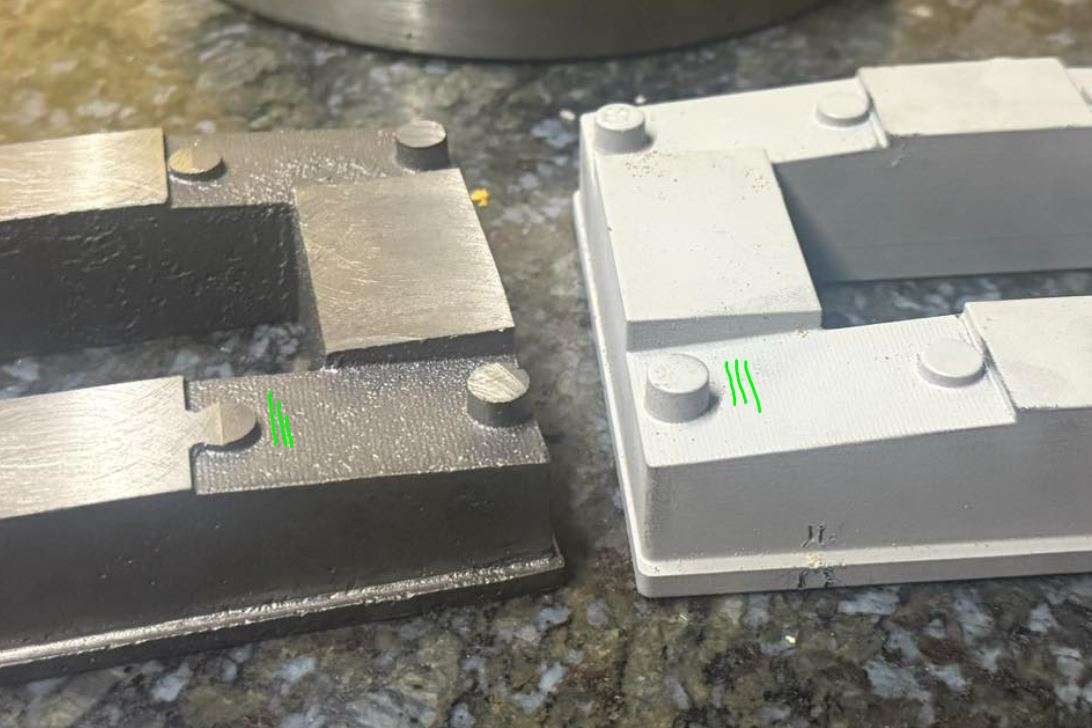
                                      So I drew it in MoI, generated a fairly dense STL file that captured the fillets accurately and then had it 3d printed somewhere in Hong Kong. They made it from high-temperature nylon and gave it a bead-blasted finish – in fact I had two made, just in case one got damaged. They cost £25 all in and were delivered in about ten days.

                                      IMG_20260113_165316

                                      As you can see from these pics, they turned out very well and are just right for this particular job. I can’t really fault the quality as it looks very much like the ‘real thing’.

                                      IMG_20260113_165408

                                      If I were looking to achieve similar with my own 3d printer I’d probably look at the QIDI printers with enclosed chamber heating.


                                      Martin.


                                      #832443
                                      JasonB
                                      Moderator
                                        @jasonb

                                        Things like that are OK for the easy to get at areas but like the flywheel much harder to get into corners or the bosses in the last photo I posted and will easily take off any detail. You also need to watch out for overheating the surface. The deburring/stripping pads are said to be better a bit like Scotchbrite with abrasive stuck to the fibres.


                                        I have the flap type and also the deburring that fit Roloc holders which I hold in the drill press and then bring the work upto the abrasive which gives me two hands to hold th ework.

                                        #832449
                                        John Hinkley
                                        Participant
                                          @johnhinkley26699

                                          My Bambulab X1 carbon printer has to live out in the (unheated) garage/workshop so I’m glad I went for a fully enclosed printer with automatic filament feeder.  I’ve had great success printing carbon reinforced filament, for example the brackets for mounting the stepper motor and spindle encoder for the ELS conversion to my mini lathe.  Design is done in Alibre Atom then transferred as a step file to Bambu Studio for slicing. It’s connected to my home network but printing is done via the Bambu cloud transfer system.  Works for me, and finish is fine and could be made smoother by fiddling with various settings, I’m led to believe.

                                          John


                                          #832450
                                          blowlamp
                                          Participant
                                            @blowlamp

                                            Jason. The reason I showed my DeWalt cutoff tool is because I had a new guard 3d printed to allow flap wheels to fit.

                                            It is a great little tool though. It cuts through anything from plastic to porcelian and with the new guard I can now use it for dressing welds or paint removal. 😉

                                            Those stripping pads you linked to are great for rust removal.


                                            Martin.

                                            #832519
                                            Phil Lingham
                                            Participant
                                              @phillingham79132

                                              Hi all

                                              I just wanted to say thank you to everyone for the insightful responses. The consensus with very few exceptions seems to be “go for it”. So I think I am going to order a Bambu Labs P1S with the AMS system. Not because I have any interest in making multi coloured figures but I like the idea of being able to load different materials and especially dedicated support filament. My friend who has printed some items for me said that would be a very useful feature.

                                              My intention is that it will be another interesting hobby that can supplement my existing metalwork habit.

                                              #832522
                                              John Hinkley
                                              Participant
                                                @johnhinkley26699

                                                Good choice Phil.  I would suggest that you also add a textured PEI bed plate, if it doesn’t come with one as standard. Not cheap, but since getting one for my X1 Carbon, I’ve had no problems with bed adhesion and if the print is left to cool for a minute upon completion, the resulting print will simply “pop” off the plate.

                                                Happy printing,

                                                John


                                                #832553
                                                Packmule
                                                Participant
                                                  @packmule

                                                  I’ve been using a Prusa  Mk3s+ for a few years now and have printed with carbon fibre/nylon to pla and the results are great. I have repaired so much stuff from the Christmas tree to new gears for the mill, even the end bracket on the strip light holding the connections which broke. All in all it has been worth every penny and I wouldn’t be without it.

                                                  Bob

                                                  #832595
                                                  jimmy b
                                                  Participant
                                                    @jimmyb

                                                    I even managed to 3D print a new drive gear for my mill. Lasted long enough to swapped out and saved for a spare when the new one arrived!


                                                    Jimb

                                                    #832597
                                                    Phil Lingham
                                                    Participant
                                                      @phillingham79132
                                                      On John Hinkley Said:

                                                      Good choice Phil.  I would suggest that you also add a textured PEI bed plate, if it doesn’t come with one as standard. Not cheap, but since getting one for my X1 Carbon, I’ve had no problems with bed adhesion and if the print is left to cool for a minute upon completion, the resulting print will simply “pop” off the plate.

                                                      Happy printing,

                                                      John


                                                      Hi John

                                                      P1S printer and AMS ordered today, according to the Bambu website the P1S includes the textured PEI plate.

                                                      I was helping a friend of mine today at his business, next door is a very high end guitar maker who he knows well and we got chatting.  They took delivery of a Bambu H2C last week (they already have 2 other 3D printers) and were absolutely raving about it and how it just works out of the box.  One of their others is a Creality and they said every print job was a struggle to get a successful result.

                                                    Viewing 25 posts - 1 through 25 (of 53 total)
                                                    • Please log in to reply to this topic. Registering is free and easy using the links on the menu at the top of this page.

                                                    Latest Replies

                                                    Viewing 25 topics - 1 through 25 (of 25 total)
                                                    Viewing 25 topics - 1 through 25 (of 25 total)

                                                    View full reply list.