Frame for lathe and mill

Frame for lathe and mill

Home Forums General Questions Frame for lathe and mill

Viewing 25 posts - 1 through 25 (of 30 total)
  • Author
    Posts
  • #828452
    cejm78
    Participant
      @cejm78

      On Thursday, my Warco GH Universal will be delivered straight from Warco. Arrangements for the delivery/collection of my second hand Warco GH1330 still need to be made.

      I had really planned to have everything in the garage by now but it took the skip company 3 weeks to collect their skip. The skip was blocking the easiest entry into the garage and stopped me from getting my trailer onto the drive.

      During the construction of the garage I had several steel beams put in to aid lifting with a chain hoist. However, they are not where the lathe and mill will be situated.

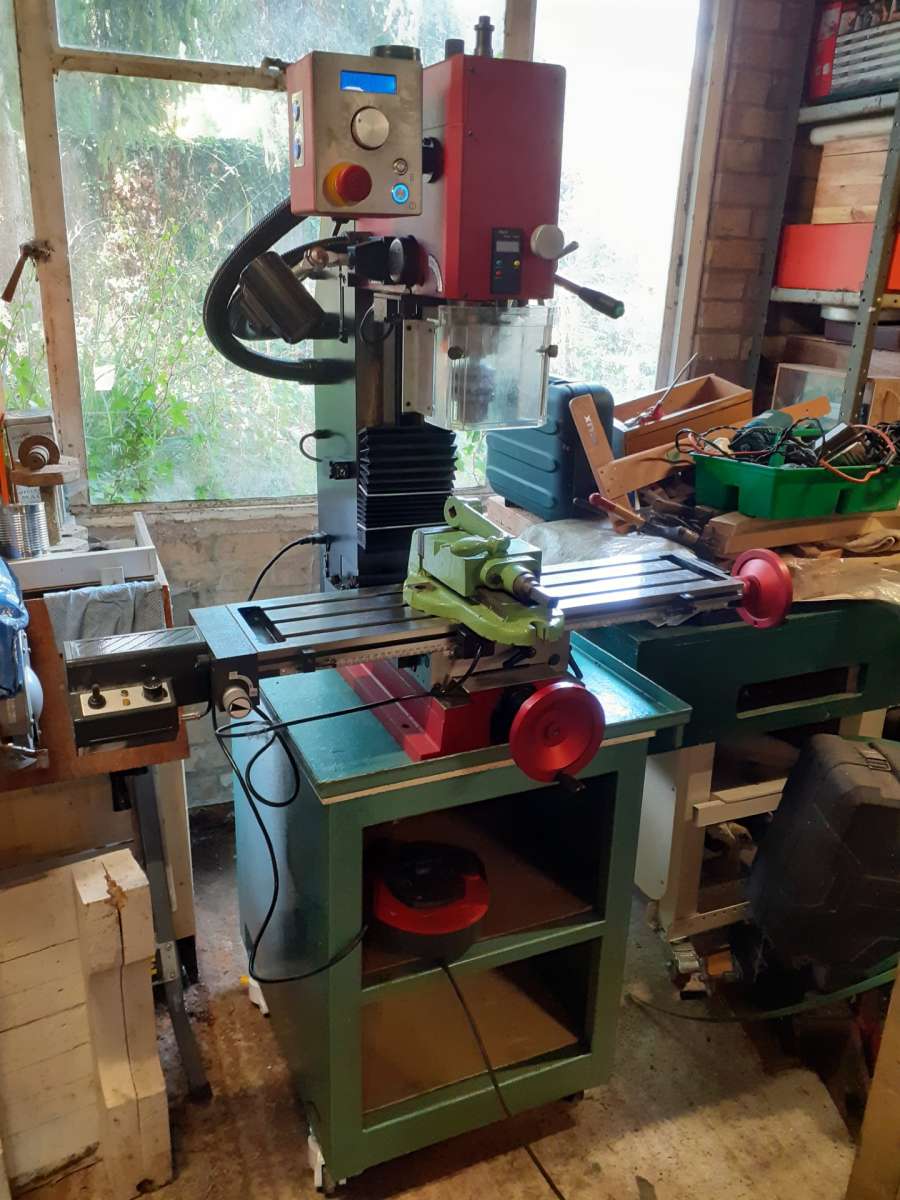
      I am thinking about making two platforms/cradles that can be moved around with a pallet truck. This would allow me to assemble the machines with the chain hoist and then manoeuvre them into position with the pallet truck. Ideally they stay on the platform/cradle, so it needs to be a sturdy construction. The plan is to make it out of steel. The machines can be bolted down to the platform/cradle and the platform/cradle can be bolted down to the floor. It gives me the option to move machines around with relative ease if required.

      There will be no caster wheels involved.

      Is there anything obvious i am missing?

      #828458
      noel shelley
      Participant
        @noelshelley55608

        Moving a vertical mill at any time is a task to be treated with great caution. Most if not all are very top heavy and will at the slightest provocation fall over often doing damage to both flesh and metal. This also applies to some lathes and also may well compromise their accuracy. For a mill the base will need to be both wide and deep to give stabillity. Good luck. Noel.

        #828462
        SillyOldDuffer
        Moderator
          @sillyoldduffer

          Sounds good to me, but:

          • The frame should be strong enough to support the weight and – more important – rigid enough to resist vibration.  Plenty of cross-bracing.
          • Reducing a frame’s footprint so it isn’t a trip-hazard makes the moving the machine more hazardous. Lathes and mills are notoriously top heavy, famous for toppling over during moves.
          • A frame will lift the height of the controls.  Possibly helpful if the operator is tall, less so if the operator is short!  Tall is more likely, so consider making the frame high enough to put the controls at comfy height.
          • Levelling:  before positioning the machines, put levelling compound down.  (How necessary depends on the floor – mine is only approximately level and ridged.)  Make sure the frame is level, especially when loaded with a heavy machine.  As metal bends, might be worth incorporating levelling screws in the frame.
          • Bolting down depends on the quality of the floor.   Garage floors often consist of a stone chip bed with a concrete layer on top.  Possibly with a plastic damp-proof sheet sandwiched between. The concrete layer can be quite thin because any weight placed on the floor goes straight to ground, no problem except thin concrete floors aren’t ideal for bolting down. And ff the floor is laid on wet ground, think twice before punching holes in the DPC.   No problem if the floor is thick concrete on dry ground.
          • Ideally a two person job, even if the assistant is only there just-in-case to dial 999!

          Wish I had a workshop for toys that big!

          🙂

          Dave

          #828467
          Clive Foster
          Participant
            @clivefoster55965

            Excellent idea. Don’t overthink things though. Many machines have been run “forever” whilst still bolted down to a pallet. Either au natural or lightly modified to put front to back beams directly under the machine feet. Assuming g the spacing works right I’d consider a solid top, ply or even waterproof tung and groove flooring board, with ex-pallet stringers front to back as being neater than just a pallet.

            Welded metal frames tend to distort so best done with levelling feet. Metal is essential if you go the jack up caster route for independent mobility but as you have the pallet truck simplicity is virtue.

            Several ways of doing anti-tip devices. Had an off camber curve to negotiate when moving my Bridgeport in so I made some timber H frames to strap under the ends of the table. Knee movement lent me adjust them for an inch or so of clearance above the path so it only tipped a bit before hitting the ground. Creative use of a pry bar let it be moved round the bend in several bites until back on the level. Overkill for you methinks but simpler versions are possible. Alternatively beams front and back to give bit of extra width work fine. The art is in keeping potential tip angle to a minimum as this keeps the loads small so if it does tip it sits nice and stable whilst you figure out what to do.

            Clive

            #828469
            Bazyle
            Participant
              @bazyle

              A complication is that the machine will have its bolt holes where its feet ultimately would be for best support so you also end up wanting the pallet feet close by.
              If you go for adjustable feet you only need one corner to be such (front tailstock), or two if you are lazy. (both front). No point in having the back ones adjustable as just hard to reach. You shim the 3 fixed ones if the floor is badly out of whack and just trim the levelling with the one adjustable.

              #828479
              Howard Lewis
              Participant
                @howardlewis46836

                The frames need to be rigid, so if possible fill the ends with sheet metal, diagonal braces,or gusset plates.

                When moving the mill, wind the head down, to lower the centre of gravity as far as possible, but still be VERY careful about stability.  Do have a helper standing by to help steady the loads as they are moved.

                By all means put levelling feet on the benches, to prevent them rocking, and ideally under the lathe feet.

                Read Ian Bradley’s book, (“The Amateur’s Workshop” and / or “Myford Series 7 Manual”) to see how to level the the lathe (Remove twist from the bed) to ensure that it turns parallel. Sometimes referred to as “Rollie’s Dad’s Method”

                When positioning the benches, if possible, allow space ate each end for work that will over hang the mill table, or pass through the lathe spindle.

                It can be useful to have a shelf behind the lathe, on which to place things like steadies, drill  and collet chucks, or QCTP tool holders.

                Positioning the benches  is a good time to decide where the work lights can best be placed.

                Howard

                #828489
                Diogenes
                Participant
                  @diogenes

                  Easier to hire an engine crane? ..a lot of places do them..

                  What quarter of the country are you in?

                  #828499
                  peak4
                  Participant
                    @peak4

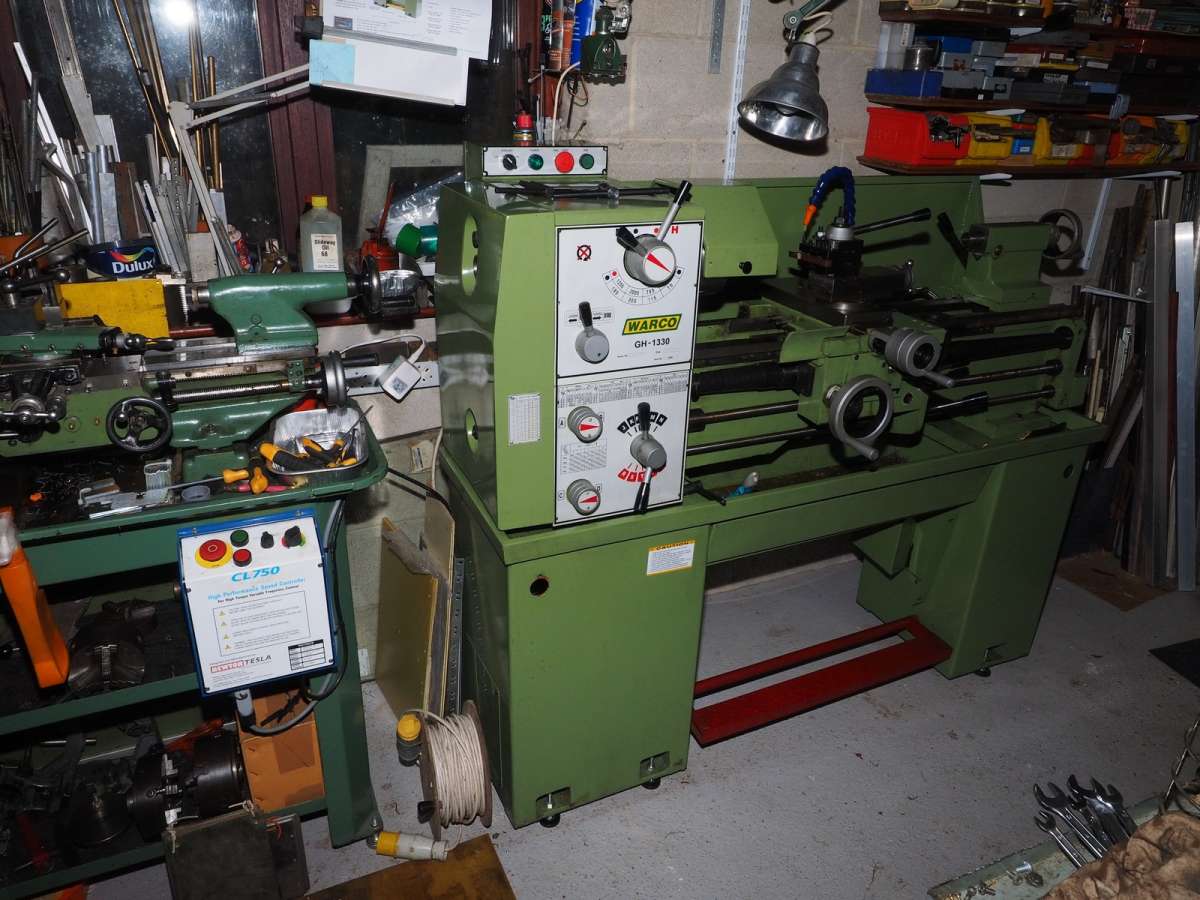
                    Re the GH1330, bear in mind that the cabinet is effectively two separate pillars with a void between them.
                    6 bolt down points, which in my case house adjustable feet.
                    The pockets above those bolt down points are solid topped and have about 2¼” vertical clearence.

                    Also, the switch cabinet is on the rear of the headstock, so if it’s going against and parallel to a wall, some thought might need putting into, either the location, or a means of moving a heavy machine for maintenance.

                    BB050077_tn

                    In my case I positioned the lathe with the headstock overlapping a window, to at least permit occasional access from outside the garage.

                    BB050078_tn

                    p.s. you also need access to the right hand side of the tailstock base, as this gives access to the coolant reservoir and pump; I use a water free, oil based one from Pennine Lubricants.

                    Bill

                    #828505
                    JA
                    Participant
                      @ja

                      Most people, including me, put the back of a lathe against a wall. If you have room put it at an angle so you have access to the back. You loose the use of shelving behind the lathe but that can be replaced by a tool store on casters.

                      My first two lathes were bolted to the floor but my present main lathe, at the manufacture’s suggestion, has sat on ISOMOUNTS for the last 14 years without any problems.

                      JA

                      #828736
                      cejm78
                      Participant
                        @cejm78

                        Thank you everybody.

                        My plan had been to built a pallet out of metal. Obviously, it is a bit difficult to come up with the specifics at this point as I haven’t seen the machines yet.

                        For the mill, I have been thinking about a metal pallet with four uprights. The uprights are as tall as the cabinet, and then run some steel plate from side to side. So that it sandwiches between the mill cabinet and the mill. In effect, enclosing the sides and top of the cabinet. The mill will be bolted through the steel onto the cabinet. I would then make a couple of outriggers that can be bolted to the pallet to aid stability when moving. The floor it will be moved along is smooth concrete, so shouldn’t cause too much issue.

                        i was thinking about a similar set up for the lathe, but I need to see the machine first to work out the specifics.

                        Hopefully this makes some sense.

                        The machines don’t need moving often. I just haven’t got enough space to have easy access to them on all sides.

                        #828744
                        Clive Foster
                        Participant
                          @clivefoster55965

                          cejm78

                          What you propose for the mill will work just fine but I consider you are really overthinking things.

                          Odds are the mill, or at least its base, will come on a basic pallet. Whether proper free standing or bottom of the cardboard box. If is it would seem simple to loose the bottom rails and do a bit of judicious beefing up, eg ply or T&G underfloor panels, on the top, and perhaps an extra stringer or two to make the base bit wider. So long as the lift is limited, inch or less should be fine on a smooth floor, any tilt angles before something hits the floor will be too small to create a tip risk.

                          I once saw a Bridgeport tipped of a pallet jack at significant lift. The tilt angle achieved before it went over was quite impressive. As was the bang when it hit the concrete pathway. I’m inclined to think that if the pallet jack lift had been lower, little more than enough for it to roll, the machine would have slid sideways without falling off.

                          When it comes to the lathe the emergency stop / brake bar between the plinths is going to seriously get in the way of a pallet and jack system. Easier, but more ££, would be a small frame round each plinth carrying three jack up castors. I’m unconvinced as to the ability of the chip tray to properly distribute any bending stresses through the middle if only two were used on each side.

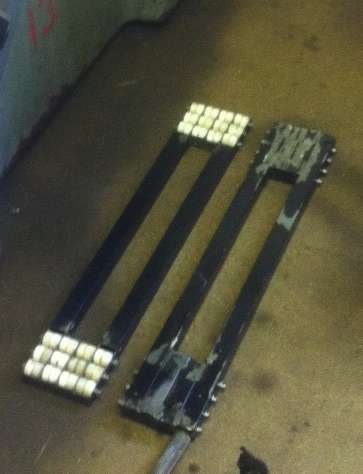
                          My lathe solution for in shop movement on a smooth floor was a heavy duty version of those cheap low profile furniture / white goods shifting doobies. About 1 1/4″ deep with lots of rollers on 1/4″ Ø axles it handles 1 1/2 tons of Smart & Brown 1024 just fine. I got creative with car jacks and pipe through the lifting holes for raising and lowering. Basic structure is 1″ square speed-frame tube welded together with a pair of nylon rollers across each 1″ width. I imagine one of something similar slid under each plinth would do fine for lathe moving. Multiple narrow roller are essential to permit things to steer.

                          Lathe Shift Roller Frames

                          Clive


                          #828749
                          IanT
                          Participant
                            @iant

                            When I got the Sieg 3.5, I moved my Warco drill press to the bench and used it’s welded steel cabinet for the mill. I fitted it with these Holkie leveling castors, which can be jacked down once in place. I lower the head right down when moving but it moves smoothly enough and seems very stable once in place with the jacks down. I will get some more I think for the lathe when I update it’s stand eventually.

                            Of course, as with any heavy machinery, I take it nice and easy when shifting it.

                            Holkie Castors

                            Regards,

                            IanT

                            Sieg_Lift_4

                            #829335
                            cejm78
                            Participant
                              @cejm78

                              Clive and Ian, thank you.

                              The mill was delivered yesterday. You wonder why you include delivery instructions when they get ignored anyway.

                              I told Warco that it needed to be delivered on a 7.5 tonne lorry. Anything bigger does not fit down the lane. Palletways in their infinite wisdom completely ignored this and sent the mill on an 18 tonne lorry. Fortunately, the driver could not find our house and called before going too far down the lane.

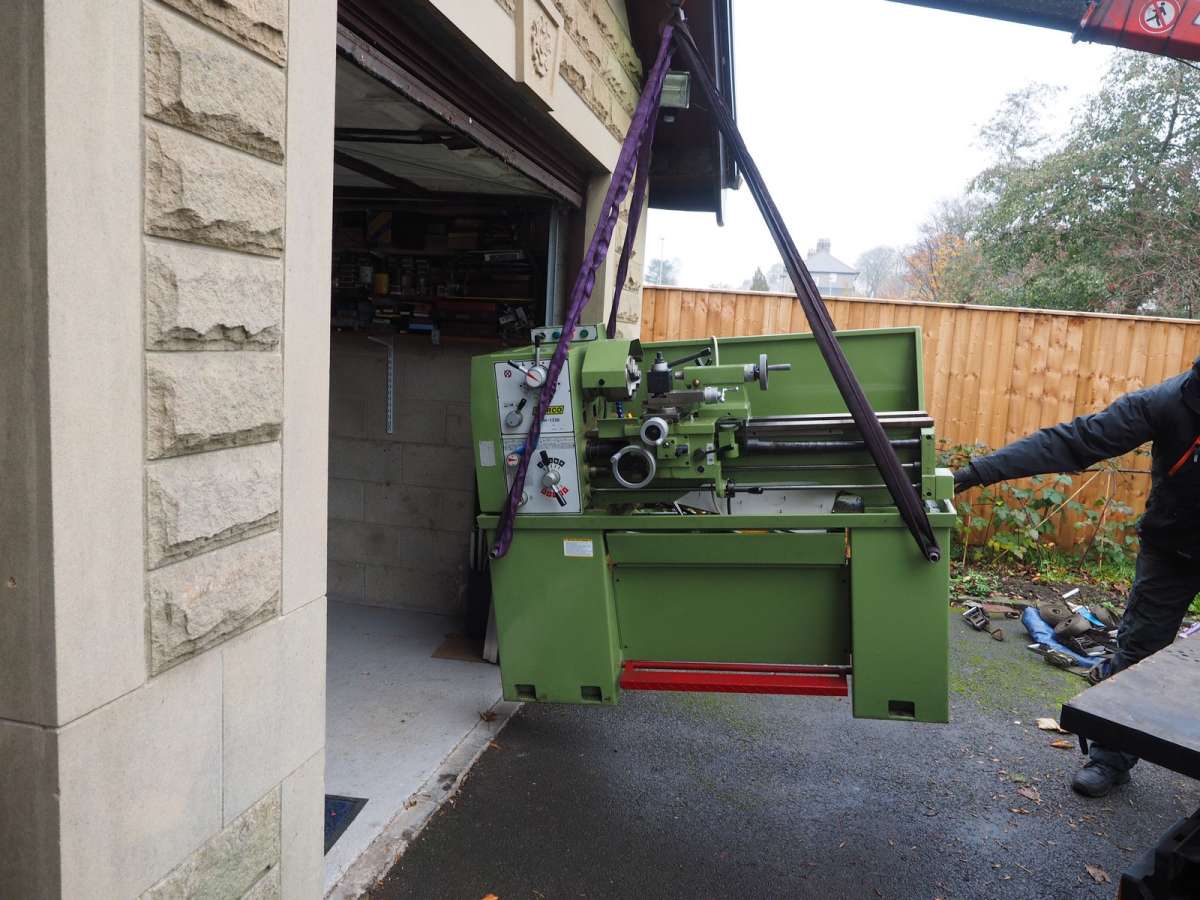
                              In the end we offloaded straight from his tail lift onto my plant trailer. Once home, it was fairly easy to offload the mill with the pallet truck. Coming down the ramp was a bit of a challenge as you will not hold 450kg back once it starts going. I lifted the pallet up only slightly, so that it was still dragging a little bit. This ensured a controlled descent down the ramp.

                              She is all unpacked now and has been tested. Putting the mill on the stand will have to wait till the Christmas break.

                              Clive, I think that you are right and that I am making it to complicated. I had a quick look yesterday and I was planning on making a platform out of some spare i-beams. Tied together with some 5mm box section, and it should be rock solid.

                              However, having looked at the Holkie castors, they might do the trick quite nicely. The machines won’t be moving often but I want to have the option to move them if required.

                              Apart from my workbench, everything will be on wheels or moveable by pallet truck.

                              For the lathe I was thinking about using 2 or 3 i-beams running lengthwise. Tied together with 100 x 60 x 5mm box sections. Making sure the box sections support the plinths. This should leave the emergency brake/stop bar unaffected.

                              The downside is that it raises the lathe a good 200/250mm which might make it uncomfortable to work with. As I haven’t seen my lathe it is a bit difficult to come up with a plan. Otherwise your solution might be better.

                              #829358
                              Howard Lewis
                              Participant
                                @howardlewis46836

                                Somewhere, I read that when the lathe is at the ideal height for the operator, the handwheels will be at the height of the operators bent arm (Forearm horizontal)

                                I am 5′ 8″ and my lathe and mill are on bench (The benches were surplus, bought from work, 33″ from the floor) This arrangement has suited me pretty well, for over 20 years

                                But each to his own.

                                The essential thing is that the machines are on rigid supports.

                                Howard

                                #829410
                                Nicholas Farr
                                Participant
                                  @nicholasfarr14254

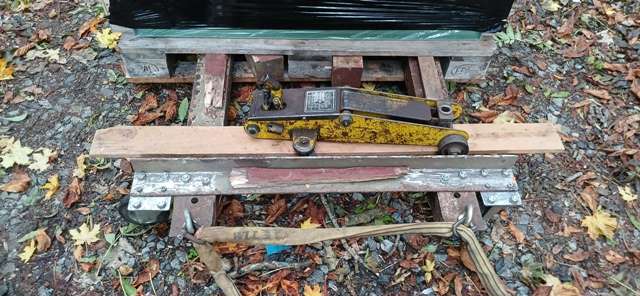
                                  Hi cejm78, maybe you had the same 18 Tonne lorry that delivered my lathe from Warco, fairly recently. I said not to try delivering with a big lorry, but, a big lorry came, and it was so long it couldn’t even turn into the lane to mine. The driver said all he could do was to unload it onto the lane, but he did use his pallet truck to get it down to mine, however, he got half way down the lane and his truck went into a pot hole, and grounding the pallet. So I had to fetch my own version of a pallet transfer truck, with some bolted together angle irons and casters.

                                  20251016_100253A

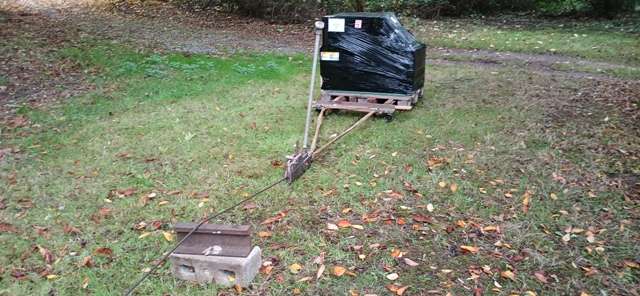
                                  I could pull it down to my area without too much effort, but I then had to swap the angle irons through the other way, (good job it was a four way pallet) and then pull it to my drive, but, I only got it a meter or so across a grassed area, which stopped me dead. But I had a trick up my sleeve that my truck didn’t know about, and it didn’t argue with it.

                                  20251016_103527B

                                  A  wire rope Tirfor did the job with ease, and with luck, I got it down before the postie came, as he wouldn’t have got past it, to get to mine or my nearest neighbour.

                                  Regards Nick.

                                  #829443
                                  Vic
                                  Participant
                                    @vic

                                    Agreed about mills being top heavy. When I moved house I split my Warco VMC into three parts and moved the two heavy parts around bolted on wooden dollies. Disassembly and assembly was done with an engine hoist.

                                    #829450
                                    Diogenes
                                    Participant
                                      @diogenes
                                      On cejm78 Said:

                                      .. …For the lathe I was thinking about using 2 or 3 i-beams running lengthwise. Tied together with 100 x 60 x 5mm box sections… ..

                                      .. …The downside is that it raises the lathe a good 200/250mm which might make it uncomfortable to work with… ..

                                      A likely problem with that much ‘extra’ height is being able to see where/what the tool-tip is/doing over the top of the toolpost or holder – having to stretch over the cross-slide handwheel & apron controls and crane one’s neck will get tiresome very quickly..

                                      I think for a 600kg lathe you could probably dispense with the I-beams altogether – the size of tubing you suggest should be more than capable of supporting that load.

                                      IIRC a couple of people here have made ‘mobile’ bases for largish lathes, I think generally with overhung castors cantilevered off the outside of the frame/s to keep them low and stable..?

                                      #829603
                                      cejm78
                                      Participant
                                        @cejm78

                                        Howard, seems to be similar to the ideal vice height. The lathe comes on its own stand and to be honest, I have no idea how high it is. It will be delivered during the first week of January. So we will have to wait and see.

                                        Diogenes. The reason for the i-beams would be to create space so I can get my pallet truck under the lathe. The box section is sufficiently strong to support the lathe but too low for my pallet truck.

                                        Nick, that is quite an undertaking to get the lathe home! The driver was very helpful and it wasn’t his fault that Palletways didn’t read the delivery instructions. Our house is roughly 1/3 of a mile down a single lane track. With a relatively steep hill and a 90 degree corner at the bottom. On a damp/wet road a truck will struggle to reverse back up the hill, as they won’t fit round the corner. The local tow companies are quite familiar with our lane as they have to winch a truck up once every 2 to 3 years.

                                        What lathe did you buy?

                                        #829608
                                        Bazyle
                                        Participant
                                          @bazyle

                                          A better take on the elbow height thing is to pick up your lates copy of ME&W, put your glasses on and start reading. Freeze! The line of text you are reading is where you want the lathe tool tip to be. Any lower and you will end up bending over and get a sore back.

                                          #829613
                                          Nicholas Farr
                                          Participant
                                            @nicholasfarr14254

                                            Hi cejm78, it’s  the WM 250V, plus the stand and quick change tool post.

                                            Regards Nick.

                                            #829619
                                            peak4
                                            Participant
                                              @peak4
                                              On cejm78 Said:

                                              Howard, seems to be similar to the ideal vice height. The lathe comes on its own stand and to be honest, I have no idea how high it is. ……………….

                                              The lathe shown in my earlier post is on adjustable feet, raising the base to about 35mm off the concrete.
                                              Height to centre of cross slide wheel is 1045mm

                                              Bill

                                              #829621
                                              Pete Rimmer
                                              Participant
                                                @peterimmer30576

                                                A good location to place a lathe and mill if you have the option is either side of a doorway, sticking out from the wall and facing each other. That space is dead space anyway since you have to keep it clear as an entrance/exit so if you put a machine either side of it the space can serve triple-duty – it’s not only your access but also your standing space for using the mill and standing space for using the lathe. It also keeps your machining chips concentrated in one area.

                                                #831379
                                                cejm78
                                                Participant
                                                  @cejm78

                                                  Happy New Year to you all!!

                                                  The mill sits a bit lower on its stand, so that was quite easy. I built a frame out of 3 i-beams which run front to back. On these i-beams from side to side run 4 50x50x5mm box sections. The mill is bolted to the box section. This allows me to pick the mill up with the pallet truck. Under each i-beam I have two adjustable machine feet to account for any unevenness in my floor.

                                                  i am waiting for the temperature to go up a few degrees so that I can paint it. The plan was to have a wood burner installed before Christmas but the installer is waiting for a hip replacement. So that will have to wait a bit longer. A bit of a pain when you are trying to paint but it is too cold.

                                                  The lathe arrived today. It was strapped to a wooden pallet and it became clear that a pallet doesn’t work. It just puts the lathe too high to work comfortably with. I will have to position it under a steel beam so that it can be lifted with a chain hoist in case it needs moving.

                                                  First have to fit a VFD as it is a 440v machine and I only have 240v available. This shouldn’t be too much work and I look forward to doing it.

                                                  #831816
                                                  cejm78
                                                  Participant
                                                    @cejm78

                                                    I have been talking to Peter Symonds at Inverter Drive Supermarket. Somebody recommended him, as he knows a lot about Warco machines.

                                                    Whilst my lathe is a 440v machine, the motor can be rewired to 240v without the need for VFD.

                                                    I have read on here that a 3 phase machine gives a nicer finish compared to a 1 phase machine. As it is only a hobby lathe, I don’t think it will make much difference to me.

                                                    For the time being, I will rewire the motor to 240v. If, in time, the finish becomes an issue I can always rewire it back to 440v and install a VFD.

                                                    #831820
                                                    duncan webster 1
                                                    Participant
                                                      @duncanwebster1

                                                      In the UK at least, a 440V motor is almost certainly 3 phase star connected. It may well be possible to rewire it to be 240V delta connected, but that won’t make it run off single phase without a VFD or converter or a Steinmetz circuit

                                                    Viewing 25 posts - 1 through 25 (of 30 total)
                                                    • Please log in to reply to this topic. Registering is free and easy using the links on the menu at the top of this page.

                                                    Latest Replies

                                                    Home Forums General Questions Topics

                                                    Viewing 25 topics - 1 through 25 (of 25 total)
                                                    Viewing 25 topics - 1 through 25 (of 25 total)

                                                    View full reply list.