Metal cutting bandsaw issue

Metal cutting bandsaw issue

Home Forums General Questions Metal cutting bandsaw issue

Viewing 25 posts - 1 through 25 (of 28 total)
  • Author
    Posts
  • #820830
    aytact
    Participant
      @aytact

      Hi,

      I have purchased metal cutting bandsaw from Warco (4 1/2″ universal).

      Issue is either cutting aluminium or mild steel, it is tearing from bottom section. I mean till the end of cut it is cutting without any issue. But when it is cutting the lower part, tearing is happening. I am working generally on aluminium.

      Is there any technic which I need to follow? For example fastest setting for aluminium, slowest setting for mild steel.

      Is there any documentation which shows trick sections to handle different materials?

      Thank you so much

      #820836
      howardb
      Participant
        @howardb

        Warco sell bandsaw blades for this machine. It is supplied with a 14 tpi blade.

        If it’s “tearing” fit a 24 tpi blade to have more teeth in the cut on thin sections.


        10 tpi – Large selection bar stock.
        14 tpi – General purpose blade for most bar stock in mild steel, aluminium, brass and plastic.
        24 tpi – Light gauge material, for instance light wall tube and extrusions.

        https://www.warco.co.uk/replacement-blades/72-universal-bandsaw-blades-64-inch.html

        #820854
        noel shelley
        Participant
          @noelshelley55608

          Can you adjust the down force ? There should be a spring loading, as the angle changes so does the load, may be to heavy at the lower part of the cut. Loosen the screw that tensions the spring. Good luck. Noel.

          #820874
          Diogenes
          Participant
            @diogenes

            Yes, what Noel say – there’s a thing that look like the handle of a toilet brush to the left of the vice handle – screw this in / clockwise to make the saw blade rest ‘lighter’ on the work – alternatively support the weight of the ‘bow’ at the end of the job by letting the tension knob just rest on your fingers as the cut finishes – DO NOT hold the moving part of the saw anywhere else whilst it’s running.

            And yes, run the saw at it’s fastest speed for aluminium.


            #820881
            SillyOldDuffer
            Moderator
              @sillyoldduffer

              The blades supplied with these saws are usually “too cheap”, so replace with a bimetallic type when it stops cutting.  Mine only lasted a few weeks; a few broken teeth gave the game away!  The replacement lasted a few years.

              Cutting speeds from fastest to slowest:

              • Aluminium,
              • Brass, Free-cutting steel,
              • Bronze, Cast Iron,
              • Mild-steel, Stainless
              • Cast Iron

              Aluminium should be lightly lubricated.  I use Paraffin.  (Don’t splash it about – fire hazard!)

              I support the work when the cut gets close to the end.  The weight tends to bend and snap the last few millimetres.

              Dave

              #820974
              larry phelan 1
              Participant
                @larryphelan1

                As Dave says,the blades supplied with these saws are usually not the best.

                Change to a Bi metal blade with more teeth for use on Ali and you should have no problem. However, you might still need to support the frame of the saw when getting close to the end of the cut. Just like a hacksaw, it tends to break through the last bit.

                I cut mostly steel sections or box and I often find that light/thin sections need to be watched.  Also, as Dave said, check your speed, fast for Ali, Slow for steel.

                #821071
                not done it yet
                Participant
                  @notdoneityet

                  I can recommend Tuff Saws for replacement blades.  Nothing other than a satisfied customer (after reading several positive reviews, too).

                  #821076
                  Nigel Graham 2
                  Participant
                    @nigelgraham2

                    When cutting thin-walled material I ease the pressure around the narrowest areas, by gently taking some of the weight of the bow. (I am very careful not to put my hands where hands should not be.)

                    When the cut-off length is long I take its weight by hand or overhead hoist, and control the break-off point.


                    I do not chnage the blade speed. No need. It stays on the slowest, as I cut mainly steel.

                    It does not have to be fast for aluminium (or wood) merely because it can be: all that happens is the cutting takes longer.


                    What would be better for the softer, cloggy materials is a coarser blade but…

                    a) I have never found any, (perhaps I ought try Tuff Saws!) and

                    b) on my “Alpine”-badged, Taiwanese clone machine fitting a blade is a right pain, needing all sorts of antics with blocks of wood and clamps, and wearing safety-glasses lest it spring back at me, to do so at all, especially safely. So I do so only to replace a worn or broken blade, or re-fit one that has jumped off the pulleys as they do occasionally.

                    .

                    Use industrial hacksawing, circular-sawing and vertical bandsawing machines on a variety of metals, as was my employment for eight years, and you realise high-speed “recommendations” might be relevant professionally but are otherwise specious! The reciprocating and circular saws had two speeds: slow and less slow.

                    The circular one, Italian-made judging its name I forget, was a lovely tool leaving a square-cut finish akin to horizontal-milling. I used it once to make three small taper gib-&-cotter pairs as a “homer”! I am surprised these saws are not sold by “ours”, but they and their blades are expensive.

                    #821122
                    larry phelan 1
                    Participant
                      @larryphelan1

                      I forgot to add that using a support piece underneath the workpiece, similar to what is called a “Spelch Block” when cross cutting on a tablesaw [Jason will understand what I mean ], will help to avoid tearout. Even a piece of hardwood such as hard Maple [ex dancefloor ] might do.

                      Worth a try.

                      #821157
                      Nigel Graham 2
                      Participant
                        @nigelgraham2

                        I use something similar when cutting an oblique outline, assuming space permits.

                        Screw the part, aligned appropriately, to a suitable wooden block or board, and grip that.

                        Stopping the saw as soon as the offcut departs, means the board is still available for other tasks!

                        This is simpler if the component-to-be already has holes that can be borrowed by the wood-screws, but screws snugged up against the edges with the heads overhanging the part, are effective.

                        #821244
                        Hollowpoint
                        Participant
                          @hollowpoint

                          I bought a Warco bandsaw about 18 months ago and I have been really surprised at how well the standard saw blade has held up!

                          I was recommended Dakin-Flathers for bi metal blades, they are made in the UK and are the countries largest supplier. Lots of good reviews for them. I was surprised to find there huge factory is only about 5 miles from where I live too, which is a bonus.

                          #821291
                          Diogenes
                          Participant
                            @diogenes

                            HP, I’ve had the standard (Sheffield-made?) carbon steel blade in mine for about 5 years, it still cuts clean straight and true.

                            The bi-metal one that the internet at large told me I needed is still hanging in it’s bag on the wall..


                            #821293
                            John Hinkley
                            Participant
                              @johnhinkley26699

                              Late to the party, as always – I bought a Warco small bandsaw many years ago.  Soon chewed through the standard blade (probably through my own incompetence) and replaced it with a bi-metal variable pitch one from Tuffsaws.  Very good.  I would note that it benefitted from an hour or so checking and adjusting the blade for squareness to the vice in both horizontal and vertical axes.

                              John


                              #821298
                              Andrew Tinsley
                              Participant
                                @andrewtinsley63637

                                Hello Nigel,

                                I too have an Alpine bandsaw (Rung Fu, Taiwanese make). I thought it rubbish and side lined it for 40 years. Big mistake as it just needed some careful adjustment and decent blades.

                                I find it not very difficult to change blades, so I am somewhat puzzled by your problems. Could it be that the wheels are not coplanar or there is an angle between the two wheels? I had this problem when I fettled my saw and it did cause difficulties in changing blades and the blade popping off the wheels for no apparent reason.

                                After putting it on a trolley, I find it to be the best value for money piece of kit, I have ever purchased.

                                Andrew.


                                #821340
                                john fletcher 1
                                Participant
                                  @johnfletcher1

                                  I to have an Alpine and have made many simple mods to it in the passed 40 odd years. I fitted a proper motor starter with NVR , down feed micro switch, I could go on, as Andrew above says, best bit of kit in the workshop. Oh I forgot, soon made a blade repair kit, scarf joint jig, then Silver solder. soon back in business once again. With a correct blade, I also cut lengths of wood in the upright position. Ted

                                  #821350
                                  southernchap
                                  Participant
                                    @southernchap

                                    One mistake many make (including me) is being scared of the blade tension knob.  If you don’t have the blade tensioned tight enough, it causes all sorts of bother.

                                    You should be able to pluck the bandsaw blade like the string of a guitar and it should make a clean “twang” noise.

                                    #821612
                                    Howard Lewis
                                    Participant
                                      @howardlewis46836

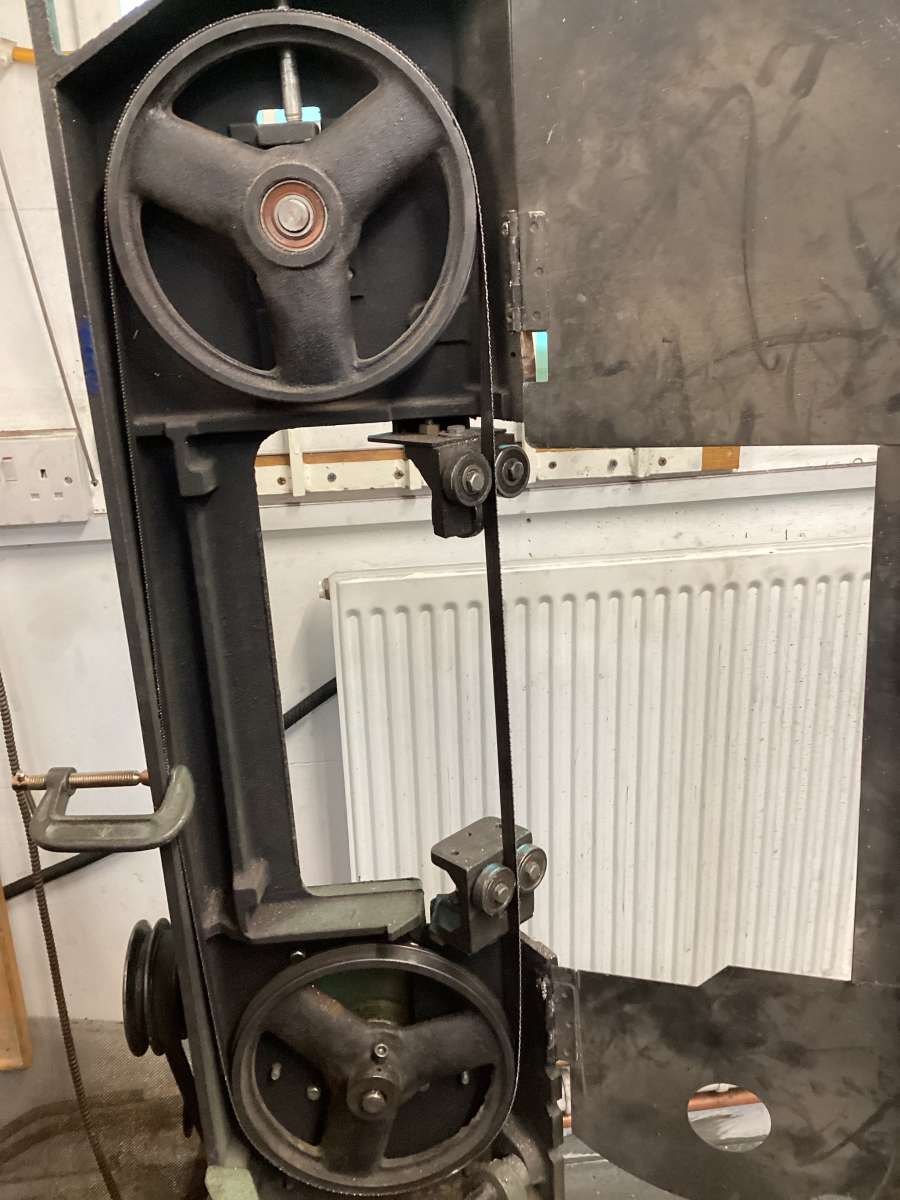
                                      Would be worth carefully setting up the saw (Blade guide rollers, tracking)

                                      The blade guide rollers are on eccentrics, so,can be adjusted to keep the blade in the correct line.

                                      Make a Blade Tension meter, and set the tension.

                                      Having done that, the blade life improved to the point where the blade wears out rather than breaking.

                                      If the down force is excessive, the cut will, be curved, so reduce the force if this happens.

                                      HTH

                                      Howard

                                      #821672
                                      Perko7
                                      Participant
                                        @perko7

                                        I was bothered by the large overhang of the workpiece on my bandsaw as the blade was a good 25mm past the end of the support plate. I added a short length of RHS which has a foot on the far end and a spigot on the other end that slips into a hole in the support plate with a grubscrew to keep it there. One pass with the saw made a slot in the top which gives the workpiece good support on both sides of the blade and stops the offcut from bending down as the blade nears the end of it’s cut. So far it has survived 18 months of regular use without any problems although the slot is now a bit wider than it was originally due to slight misalignment of replacement blades.

                                        #821711
                                        Nigel Graham 2
                                        Participant
                                          @nigelgraham2

                                          Andrew, John –

                                          It may be that my machine, which I bought second-hand, is simply worn out, but the blade roller adjustments don’t seem to do very much.

                                          The problem with fitting blades seems either the wheels cannot approach closely enough, or perhaps the blades I bought (Machine Mart) are slightly under specified length. It would take only a couple of mm short to be difficult even if the adjustable wheel is so far in the screw comes out of the nut.

                                          Whatver is wrong creates a struggle to push the blade already on one wheel, onto the other. I have to resort to temporary restrainers using bits of wood and small clamps.

                                          #821734
                                          Clive Foster
                                          Participant
                                            @clivefoster55965

                                            Like Andrew and John I have the Alpine version of this bandsaw. early model purchased by my father whilst my back was turned at a Guildford model engineer exhibition day. Muttering in dad’s hearing that …. something … might be nice was dangerous.

                                            Worked but was always a bit iffy until I got fed up and reworked the guide roller adjustment. New eccentric bearing carriers with more travel, so the blade could be properly pinched, made from decent size hexagon bar so they could be accurately adjusted made a major difference. Also did a bit of re-working to the balance spring abutment and screw to improve head support.

                                            Coupled with better blades it became an OK tool providing it was used sensibly in full understanding of it being a low end tool sacrificing performance for cost. Nowadays mostly retired as a Rapidor power hacksaw and upright Startrite 14″ do virtually all my cutting.

                                            The savage twist applied to the blade between wheels and guide rollers really doesn’t help. Big brother with a more gentle blade twist, more rigid blade and all round improved design has always been much better. At much greater price.

                                            Clive

                                            #821739
                                            Howard Lewis
                                            Participant
                                              @howardlewis46836

                                              Fitting a new blade can be difficult.

                                              The blade does not want to be twisted through 45 degrees, twice, and springs out at every opportunity!

                                              Once in place, the tension will help to to keep it in place.

                                              The tracking is liable to alter according to the blade tension.

                                              It is well worth while making and using a Jacques Maurel Tension Meter. A simple device but SO useful

                                              From memory, with the standard 64″ x 12″ blade, an extension of 0.05 – 0.07 mm is correct.

                                              Having set the tension, the tracking can be adjusted, and the guide rollers adjusted to position the blade correctly

                                              Since setting the machine up, it has been possible to use a blade until it wears out, rather than to replace it when it breaks. (It normally runs at a nominal 100 f p m.)

                                              Also, it cuts more accurately; on one trial (never expected to be repeated) a trial disc ,was the same thickness within a thou! But don’t expect that to be the norm!

                                              Excessive down force will result in a curved cut, so don’t be tempted to rush and apply too much pressure with the handle on the side.

                                              HTH

                                              Howard

                                              #821765
                                              Zan
                                              Participant
                                                @zan

                                                Putting the blade on is easy

                                                1 screw the tension screw down to give plenty of clearance

                                                2 rough fit blade but ignore the guides

                                                3 the important bit. Use a small G clamp to teach the blade some manners  and keep it in one place

                                                4 fit into guides and tighten the blade

                                                the clamp stops the annoying habit of the blade sequentially jumping off the top then bottom pulls when the other is being fixed!  Originally I kept the bottom in place with my foot, but not that easy these days…….  This way is much better

                                                I keep mine permanently on the middle speed, for blades 30 years ago I bought a 100 ft coil for a very good price, then joint  with a tiny chamfer produced with a wood jig on the inisher. A micro flame silver solders it together.  Got enough left for 5 blades. They do last a long time IMG_1341

                                                #821767
                                                Zan
                                                Participant
                                                  @zan

                                                  Here’s the jig with one end ready to be ground and the other in the crude but very effective jig for soldering

                                                  the packing/clamping pieces have to be narrower than the blade or they jam on the teeth and cause problems they need to extend close to the joint in order to keep the blade straight, and lining it up requires it to be pushed hard into the back of the angle to keep the  joint straight  the packing is also very sleightly bent down at the end to stop the tendency for the blade lifting and having a wide gap which can cause blade jumping out  of the guides during use

                                                  takes only 5 mins to make a new blade once the kit is located!

                                                  IMG_1343


                                                  #821787
                                                  Andrew Tinsley
                                                  Participant
                                                    @andrewtinsley63637

                                                    I made up a blade tension measuring device. Must admit it was a total waste of time. For the standard blade, I get the correct tension (extension) when I cannot turn the tensioning handle any further! As for the bimetallic blade, if I remember Jacques article correctly, the tension (extension) needs to be twice as great. No chance with my saw! This may be something to do with my muscle wasting disease, but other people have had the same problem with my saw!

                                                    Cannot emphasise enough that the guides need to be adjusted correctly so the blade is vertical, Do not have the rollers too tight as nipping the blade causes problems. The wheels must be coplanar and parallel. When changing blades you need to recheck the guide set up

                                                    I do have some spare bimetallic blades, but have never used them as good quality carbon steel blades seem to last forever.

                                                    Andrew.

                                                    #821791
                                                    Howard Lewis
                                                    Participant
                                                      @howardlewis46836

                                                      Andrew,

                                                      My saw is also a Warco, of some vintage. (The bearing spacer on the drive shaft failed, so had to fit new oil seal, bearings and make a proper spacer rather than a bit of tin tube)

                                                      As you say, setting the guide rollers properly is most important,

                                                      Jacques has provided his calculations for the correct extension to tension the blade, on more than one occasion.

                                                      I M E setting up and tensioning the blade correctly has done wonders for the saw, and for blade life.

                                                      The time involved in setting up is well spent.

                                                      Howard

                                                    Viewing 25 posts - 1 through 25 (of 28 total)
                                                    • Please log in to reply to this topic. Registering is free and easy using the links on the menu at the top of this page.

                                                    Latest Replies

                                                    Home Forums General Questions Topics

                                                    Viewing 25 topics - 1 through 25 (of 25 total)
                                                    Viewing 25 topics - 1 through 25 (of 25 total)

                                                    View full reply list.