Best receptacle for CA glue

Best receptacle for CA glue

Home Forums General Questions Best receptacle for CA glue

Viewing 25 posts - 1 through 25 (of 33 total)
  • Author
    Posts
  • #819989
    Bill Phinn
    Participant
      @billphinn90025

      I typically buy CA glue in 50ml plastic bottles with a nozzle, e.g. Everbuild or Soudal brands.

      No matter how carefully I wipe the nozzle or seal the cap, one of three things always happens:

      1. most of the glue dries out in the bottle before I get to use it;

      2. the nozzle clogs with dried glue between uses and needs to be bored out or snipped shorter virtually every time you go to use the glue again;

      3. the nozzle detaches itself from the top of the bottle and gets permanently stuck to the underside of the lid, meaning you need to use grips to open the bottle and the glue then has to be dispensed with a Q tip or similar.

      Once the bottle has reached this third state the risk of the contents drying out in storage increases, and, worse, the risk of glue getting everywhere if the opened bottle is knocked over becomes very real. This afternoon I spent over an hour cleaning up virtually an entire 50ml bottle that had emptied its contents all down the front of a newish roller cabinet full of tools, going into every drawer, down every drawer front, and then on to the floor in the process.

      Is there a better way of buying or dispensing CA glue that avoids these problems?

      #819992
      SillyOldDuffer
      Moderator
        @sillyoldduffer

        Yes, but it’s not good news.  Don’t expect it to last!  In addition to the problems listed by Bill, it loses strength too.  My answer is to buy new glue.  My local pound shop sold glue in small tubes, which worked well.  None in stock last time I went in, and I had to buy a big container.  Used it twice, and threw most of it away.  Most upsetting, but it solves the problem…

        🙁

        Dave

        #820004
        bernard towers
        Participant
          @bernardtowers37738

          fridge it, it lasts much longer.

          #820009
          SillyOldDuffer
          Moderator
            @sillyoldduffer

            AI agrees with Bernard!  I asked grok ‘Does chilling superglue extend shelf life’, and got this answer:

            Yes, chilling superglue (cyanoacrylate adhesive) can significantly extend its storage time by slowing the polymerization process triggered by moisture in the air. Unopened bottles typically last 12–15 months at room temperature, but opened ones may harden in as little as 1 month if not stored properly. Refrigeration can push this to 2–3 years or more for opened glue.

            Key Tips for Chilling Superglue
            Temperature range: Store at 35–50°F (2–10°C) in the fridge; avoid freezing unless specified by the manufacturer, as it risks condensation upon thawing.
            Prevent moisture: Seal the bottle tightly and place it in a zip-top plastic bag or airtight container to block humidity.
            Before use: Let it warm to room temperature for 30–60 minutes to avoid condensation inside the nozzle, which could clog it.
            Labeling: Clearly mark it (e.g., “Superglue—Keep Away from Food/Children”) and store out of reach.
            This method is widely recommended by manufacturers and hobbyists for maintaining potency without affecting performance.

            Yes, chilling superglue (cyanoacrylate adhesive) can significantly extend its storage time by slowing the polymerization process triggered by moisture in the air. Unopened bottles typically last 12–15 months at room temperature, but opened ones may harden in as little as 1 month if not stored properly. Refrigeration can push this to 2–3 years or more for opened glue.

            Key Tips for Chilling Superglue
            Temperature range: Store at 35–50°F (2–10°C) in the fridge; avoid freezing unless specified by the manufacturer, as it risks condensation upon thawing.
            Prevent moisture: Seal the bottle tightly and place it in a zip-top plastic bag or airtight container to block humidity.
            Before use: Let it warm to room temperature for 30–60 minutes to avoid condensation inside the nozzle, which could clog it.
            Labeling: Clearly mark it (e.g., “Superglue—Keep Away from Food/Children”) and store out of reach.
            This method is widely recommended by manufacturers and hobbyists for maintaining potency without affecting performance.

            Dave

            #820011
            mark costello 1
            Participant
              @markcostello1

              Wonder if CO2 from a Mig welder would slow up the process?

              #820012
              Bill Phinn
              Participant
                @billphinn90025

                Thank you for the replies.

                Dave, for people like you and me at any rate, buying several small tubes at a time rather than bottles seems the way to go, though I hope your experience at the pound shop doesn’t mean small tubes are going to be hard for me to find.

                Sometimes (e.g. when wood turning), I think I’ll still need a superglue that comes in a bottle, so the fridge will have to double up as a glue store.

                On another note, I’m still in search of a clear glue that will mend acetate spectacle frames. No superglue I’ve used works, and I must have repaired about twenty frames over the last few years. I now melt the breaks in the frames with a soldering iron, but it’s not always possible to disguise the repair.

                #820019
                Clive Steer
                Participant
                  @clivesteer55943

                  I remember repairing a Perspex windshield on my motorbike fairing with Chloroform I got from a chemist. Probably not a good idea to ask for it now though.

                  #820025
                  bernard towers
                  Participant
                    @bernardtowers37738

                    Phil, you could try the glue thats used for watch glasses. Try Cousins, Meadows and passmore or there is one more but the name escapes me at the moment, a bit too early.

                    #820027
                    Robert Atkinson 2
                    Participant
                      @robertatkinson2

                      Bill,

                      Have you tried a dichloromethane based plastic solvent? A good example is EMA Plastic Weld. Random stockist fom Google search:
                      https://www.modelscenerysupplies.co.uk/ema-plastic-weld-cement-plasweld Other suppliers avilable.

                      On CA small tubes and the fridge is the way to go. Tesco often have generic small tube twin packs in their £1.99 “handy item” displays of odd harware bits.

                      Robert.

                      #820028
                      Kiwi Bloke
                      Participant
                        @kiwibloke62605

                        Bill, ‘plastic’ spectacle frames used to be – and some may still be – made from celluloid, which is mostly cellulose nitrate. For that, acetone is the traditional solvent-welding ‘adhesive’. I believe that it also works for cellulose acetate. Usual trick – hold the pieces together loosely, and allow capillary attraction to suck in the solvent. Then hold in position, with a little compression across the junction plane, once the broken surfaces have softened.

                        +1 for keeping CA in the ‘fridge or freezer, preferably in a container with the smallest possible ‘dead space’. Tubes are therefore a good idea (for small jobs).

                        #820039
                        Michael Gilligan
                        Participant
                          @michaelgilligan61133

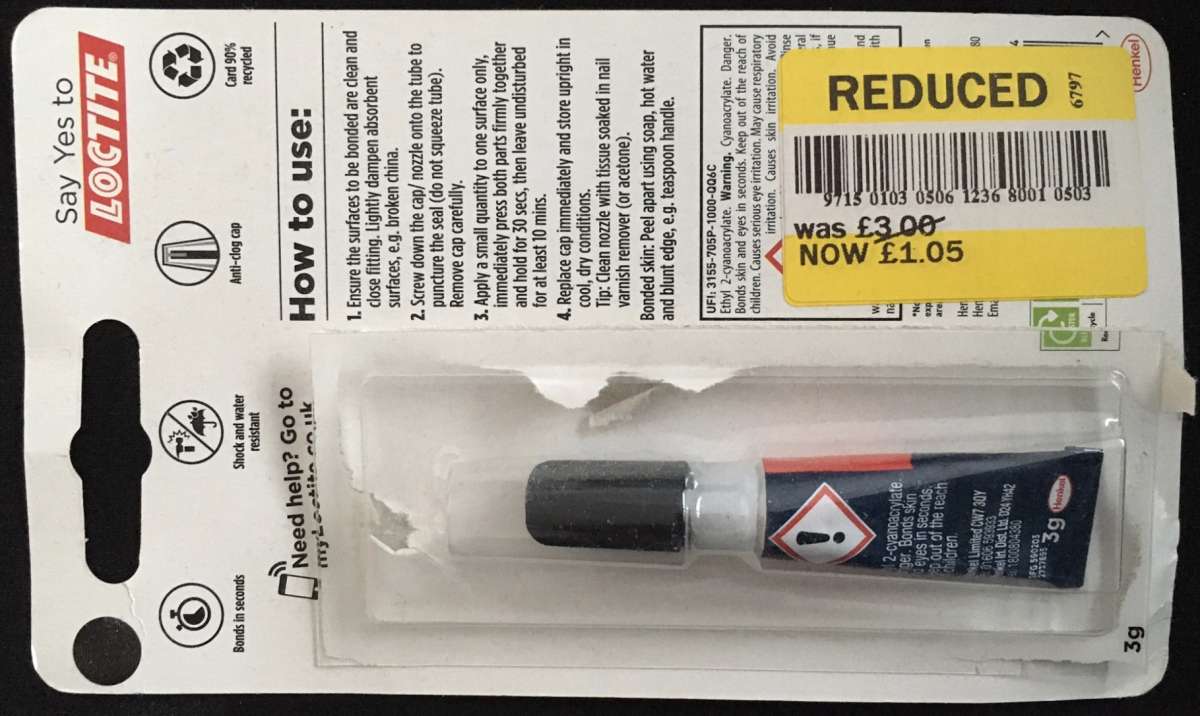
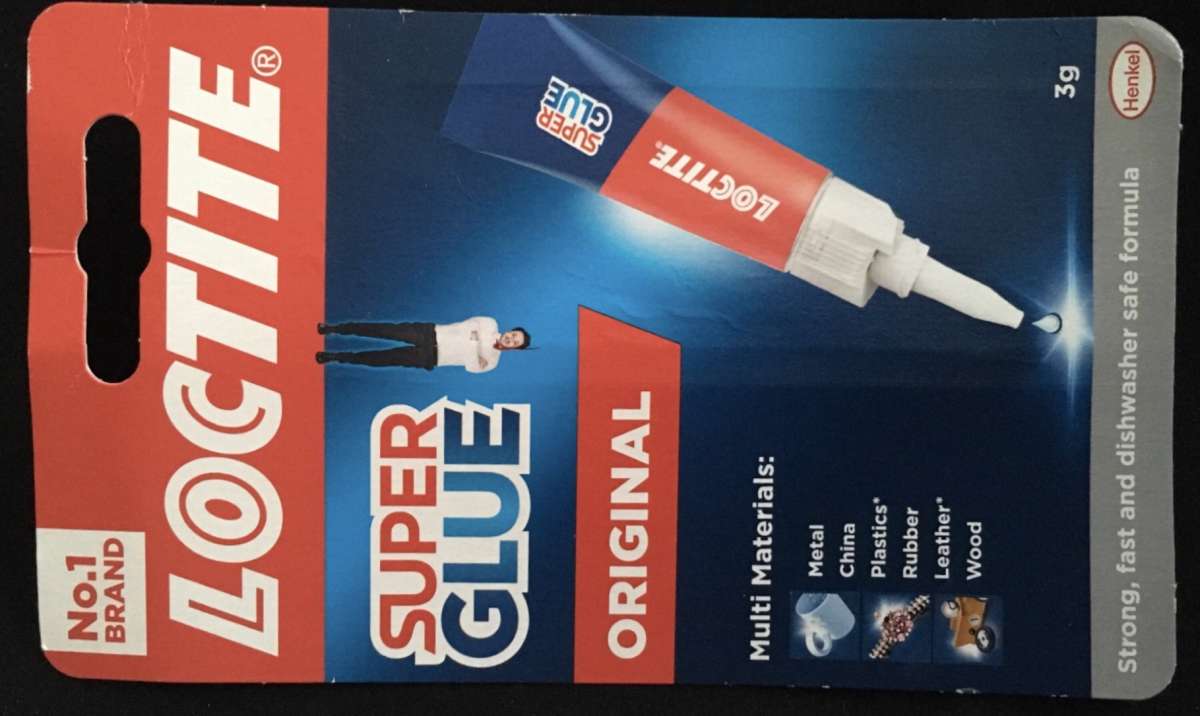
                          On a statistically insignificant sample of one tube … I am inclined to believe that [Henkel] Loctite has found the Holy Grail of CyanoAcrylate storage.

                          Purchased as a ‘remainder’ at Tesco

                          it works very well, and has stored very well

                          MichaelG.

                          .

                          IMG_1141IMG_1142

                          #820057
                          Martin Kyte
                          Participant
                            @martinkyte99762

                            +1 for Acetone as a welding agent.

                            Our mechanical workshop has a special mix that includes acetate chips to increase viscosity plus a few ‘nasties’ which is why you need a fume cupboard to make the stuff.

                            #820061
                            Eric Olthwaite
                            Participant
                              @ericolthwaite

                              Loctite product in its plastic bottle kept wrapped in a zip lock bag in the fridge for special jobs. One -shot throwaway packs from the supermarket for general use. I got sick of all those hardened almost unused squeeze tubes .

                              #820068
                              simondavies3
                              Participant
                                @simondavies3

                                I buy 50cc or so bottles from the supermarket with built in drip. Once removed from the packaging the bottles is stored in a small jam jar with a couple of packs of desiccant (free from the packs inserted with most bits of technology, a good idea to dry them out as well)  to keep it dry. This seems to increase the shelf life significantly, I was under the impression that moisture helped cure it more rapidly so this method maybe helps slow the curing.

                                Works for me anyway!

                                #820079
                                Andrew Tinsley
                                Participant
                                  @andrewtinsley63637

                                  Be interesting if someone answered the question. What is the best receptacle for CA glue? I tend to buy 50cc plus of CA at a time and decanting into smaller bottles appears to be a good idea.

                                  Going off topic again. I ALWAYS keep my CA in the fridge. Lasts for ever, or so it seems.

                                  Andrew.

                                  #820080
                                  Michael Gilligan
                                  Participant
                                    @michaelgilligan61133
                                    On Andrew Tinsley Said:

                                    Be interesting if someone answered the question. What is the best receptacle for CA glue? […]

                                    That was the answer that I attempted to give

                                    The Loctite receptacle is better designed than any I have seen before.

                                    … it seals properly

                                    MichaelG.

                                    #820081
                                    old mart
                                    Participant
                                      @oldmart

                                      In Weston Super Mare we have a local chain of general shops which sell superglue in little tubes about 15 to a board and I get these so that only one is used at a time and might last a few days. The others are still sealed and would last for years if not opened. This is a very economical way to buy the stuff unless you intend to use a large quantity within a day or so.

                                      #820103
                                      Andrew Tinsley
                                      Participant
                                        @andrewtinsley63637

                                        Michael,

                                        Your solution is fine if you want to buy Loctite in small tubes at a high price, even at the “bargain” price of your example.

                                        I buy in much larger quantities and your suggestion is not a solution to the problem.

                                        I seem to remember that aero-modellers were offered various diameter flexible spouts for dispensing CA. I cannot remember if there was also a supply of bottles to go with them.

                                        Andrew.

                                        #820105
                                        SillyOldDuffer
                                        Moderator
                                          @sillyoldduffer

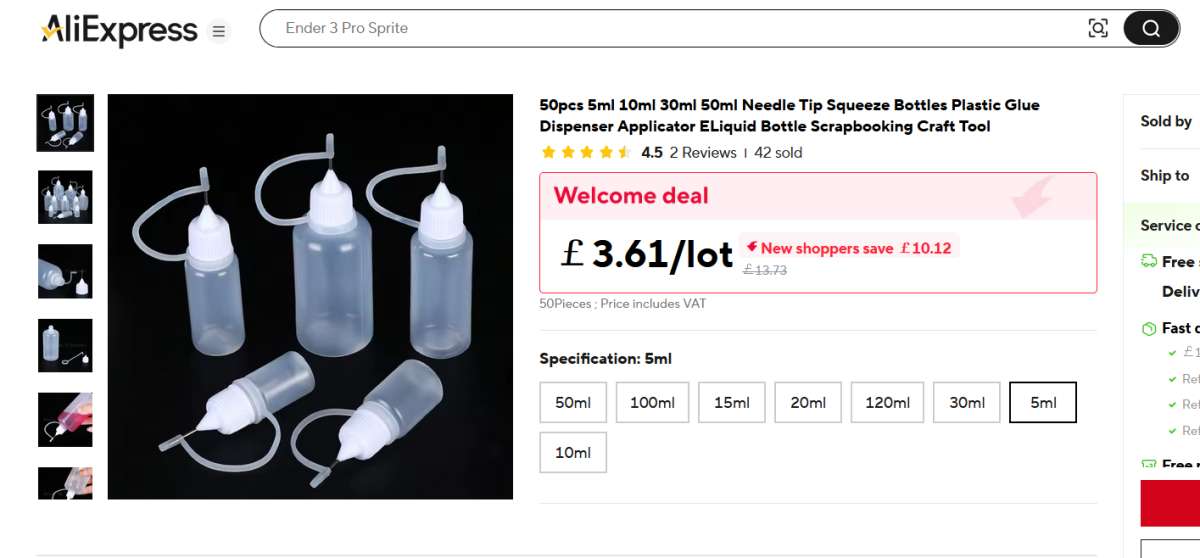
                                          Decanting super-glue sounds dodgy to me, but if Andrew is stuck on the idea, how about these:

                                          Screenshot 2025-10-13 205123

                                          Dave

                                          #820110
                                          Bill Phinn
                                          Participant
                                            @billphinn90025

                                            Thanks a lot for the very helpful replies.

                                            Bernard, I’ve not looked at watch glass adhesives. Presumably they stick plastics as well as glass.

                                            Robert, I’ve not met the EMA plastic weld cement. The only thing vaguely similar I’ve tried is Everbuild P16 (it didn’t work), but this was only on one or two pairs of glasses, and they could well have been made of incompatible plastic, or my technique was wrong.

                                            KB, thanks for reminding me about acetone. I have used it with limited success a handful of times; it was obviously melting the plastic but, probably down to my technique, it didn’t seem to penetrate right into hairline cracks in the frames. From what you describe, if I try using acetone to mend frames with cracks again I should immerse just the cracked area in a small pool of acetone. Dabbing on acetone using Q-tips, which is what I did, may well have been completely inadequate.

                                            Andrew, could you clarify what sort of small bottles you decant your glue into? Dave’s squeezy bottles look very convenient for dispensing but I suspect aren’t going to keep the glue liquid for long.

                                            Overall, it looks like the best container for ensuring your glue is usable over a reasonably long period and waste is kept to a minimum is the small tubes, though I accept that they may not be practical for heavy users or good value for money.

                                            But then for 50cc bottles there is always the fridge, which I haven’t tried yet, and more thorough wrapping, which I’d never thought of.

                                            #820111
                                            Michael Gilligan
                                            Participant
                                              @michaelgilligan61133
                                              On Andrew Tinsley Said:

                                              Michael,

                                              Your solution is fine if you want to buy Loctite in small tubes at a high price, even at the “bargain” price of your example.

                                              I buy in much larger quantities and your suggestion is not a solution to the problem.

                                              […]

                                              We obviously have very different use-cases, Andrew … and therefore different storage problems.

                                              I use CA one tiny drop at a time.

                                              First saw CA in use on the KODAK production line in the mid 1970s, for assembling and positioning small lenses, and have used it in that manner ever since.

                                              MichelG.

                                              #820124
                                              Kiwi Bloke
                                              Participant
                                                @kiwibloke62605

                                                Bill Phinn said: …[acetone]didn’t seem to penetrate right into hairline cracks in the frames… if I try using acetone to mend frames with cracks again I should immerse just the cracked area in a small pool of acetone.

                                                Aargh! No, don’t do that! The solvent (acetone, or what’s appropriate for whatever material you’re ‘welding’) will attack everything it touches, potentially ruining the surface. If the hairline crack allows, stress it enough to open the crack a little (without breaking …), and add tiny drops of solvent, delivered by blunt needle, etc. directly to the crack (use magnification if necessary). Because many useful organic solvents evaporate so quickly, you may need to feed the crack several times – it often takes a few minutes to soften the crack surfaces sufficiently. If you already have two pieces, hold them well aligned (plasticine?) and do as above. You can also stand the broken bits in a very shallow pool of solvent, allow the material to soften, then push them together, but the area around the break may deform more than the previous method.

                                                Methyl ethyl ketone (MEK) is another useful and versatile plastic solvent, working exceptionally well for polystyrene and ABS repair, to name but two. Model shops used to sell it for plastic kit making. Now, they sell something different. I caused considerable concern in one local establishment when I asked whether any MEK was available. Apparently it’s used by low-life for nefarious purposes… Eventually, probably to get rid of me quickly, I was directed to somewhere which gave me a small bottle. They refused payment, presumably again wanting me out of the place PDQ, and not wishing to be an accessory to whatever crime I was going to commit. Later, I discovered that the primer used for PVC plumbing joining was >98% MEK, and was readily available from plumbers’ merchants. The world has gone mad…

                                                #820128
                                                Andrew Tinsley
                                                Participant
                                                  @andrewtinsley63637

                                                  I do use CA in large quantities. My particular use started when a friend of mine ran a manufacturing set up making CA. I would purchase a litre at a time. This made me decant the CA into smaller bottles. No Dave. it isn’t in the least dodgy if done correctly, how do you think that manufacturers decant bulk CA into smaller containers?

                                                  My friend retired and I now buy CA in 100ml quantities, The bottles that Dave identified are the ones I was remembering, but didn’t use correct terms when doing a web search. I can confirm that these bottles are ideal for the OP’s requirements having used them in my aeromodelling days.

                                                  I gave up on CA in this context because I found the joints to be too brittle, I understand that advances in CA technology allow a more flexible joint to be had these days, if required.

                                                  Andrew.

                                                  #820151
                                                  SillyOldDuffer
                                                  Moderator
                                                    @sillyoldduffer
                                                    On Andrew Tinsley Said:

                                                    I do use CA in large quantities. My particular use started when a friend of mine ran a manufacturing set up making CA. I would purchase a litre at a time. This made me decant the CA into smaller bottles. No Dave. it isn’t in the least dodgy if done correctly, how do you think that manufacturers decant bulk CA into smaller containers?

                                                    …Andrew.

                                                    I’m intrigued by why super-glue is used by the litre, and guess it’s not “Model Engineering”?

                                                    I doubt manufacturers decant super-glue at all if they can avoid it! Rather a pump transfers a metered dose of liquid into a metal tube of the type described by Michael and instantly seals it.  Or injects into a larger plastic container that is also quickly sealed.  No humans near it!   And old glue isn’t allowed in the system – fresh chemical, and the machine is kept clean.   Nothing amateur about it.  No bottles, lipped beakers, funnels, or syringes.

                                                    Adding the caveat “if done correctly”, doesn’t help me.  I’m a clumsy oaf, liable to stick my eyelids together when handling super-glue.  What is ‘done correctly’?

                                                    General point: helps enormously if questions explain either the context or the questioners actual requirement. Otherwise we have to guess!  Here in Hobbyland, Michael’s Use Case is far more common than Andrew’s.  In my world most of us buy superglue in gram quantities and apply it infrequently by the milligram!   We pay for a convenient disposable small-quantify container, plus cost of retailing it, and tax.  But Andrew expects us to ignore that despite leaving out an important detail like him using super-glue by the litre!

                                                    Leaving important detail out of questions isn’t unusual.  The forum gets lots of questions where someone seeks advice on making their particular solution work, when a different approach would be better.   For example, no need to drill a deep close fitting precision hole if an ordinary bolt passed through a wide inaccurate hole will do the job.

                                                    A few visitors ask over-broad questions only to take us through a painful series of rejections, whereby the questioner slowly reveals we’re all wrong because they live in Timbuctoo, won’t buy Chinese on political grounds,  want illegal chemicals or unobtainium materials and insist on a long defunct brand-name or service that was obsolete 50 years ago.  And of course it must be top-quality and dirt cheap!  Hard to tell the difference between an innocent questioner who doesn’t realise he’s left out vital information and a Troll…

                                                    Dave


                                                    #820192
                                                    larry phelan 1
                                                    Participant
                                                      @larryphelan1

                                                      Oh DAVE !!!!!! you can be SO hurtful, so you can !

                                                      But at the same time, so accurate !

                                                    Viewing 25 posts - 1 through 25 (of 33 total)
                                                    • Please log in to reply to this topic. Registering is free and easy using the links on the menu at the top of this page.

                                                    Latest Replies

                                                    Home Forums General Questions Topics

                                                    Viewing 25 topics - 1 through 25 (of 25 total)
                                                    Viewing 25 topics - 1 through 25 (of 25 total)

                                                    View full reply list.