THE WINSON/MODELWORKS 5″ 9F (the loctite express)

THE WINSON/MODELWORKS 5″ 9F (the loctite express)

Home Forums Locomotives THE WINSON/MODELWORKS 5″ 9F (the loctite express)

Viewing 18 posts - 1 through 18 (of 18 total)
  • Author
    Posts
  • #817455
    noel shelley
    Participant
      @noelshelley55608

      For those who read my HOW HEAVY post please sit down, before you collapse laughing ! Those too polite to express their thoughts, I have seen the nods and winks indicting that they think that I may be insane ! Love is in the eye of the beholder, I grew up near the S&DJR, The Pines Express, and later 92207.

      I have just become the proud owner of one of these fine models, are there any members on here so encumbered ? It carries boiler No 088, is complete to the extent that it runs on air and is new/unused. There is untidy pipework and numerous loose fittings, nuts bolts pins Etc. Has someone already started to fettle this one ? There appear to be some strange faults eg pipe fittings cut off. The prototype had 2 lubricators the model only one – why ? Cost ? It has 2 injectors. The tender has been built with steel bolts in the water space and the hand brake operating gear is absent. Does any one have any information on this engine or paperwork on construction. Were they built using metric or imperial ( ME and BA ) threads, or both ? I’m led to believe 100 were made is this true ?  Any help or information will be most gratefully received.

      In the meantime I’m making the gear to be able to just move the thing.  Noel.

      #817465
      Brian Baker 2
      Participant
        @brianbaker2

        Greetings Noel, and as the builder of 3 7/4 in gauge Winson/Modelworks kits (A3, A4 and a Brit),I wish you joy.

        There is no doubt that the quality of design, machining and selection of materials is poor, but with a bit of effort a competent Model Engineer, such as yourself, can make a fine loco out of most of the bits.

        Modelworks produced no drawings for issue, just poor building instructions.  the threads were all metric, except for those on the boiler which were ME threads to match the purchased, as well as home made fittings.

        They usually only supplied one lubricator which had a split feed to the cylinders.

        I understand that as many as 100 5 in gauge models may have been sold as kits, how many running, I am not sure, the 71/4 kits were produced I much smaller numbers, usual batch size of 25.

        your boiler number is very early and may have been made by contracted coppersmiths rather than Modelworks staff.

        Hope that helps,

        Regards

        Brian B in (not) sunny E Norfolk

        #817475
        noel shelley
        Participant
          @noelshelley55608

          Hi Brian, thanks for the reply. One name that has been mentioned in the context of the boiler is Cheddar Boilers. one thing that helped me decide to get this was that I had a 4 castored trolley in stainless that had supported a heavy catering dishwasher. Open in the middle it will make a fine transporter/steaming bay/inspection pit, just the right height for my car. How’s that for luck ?

          You may see my post in the Winson PUG thread. No sun here either. Noel.

          #819864
          noel shelley
          Participant
            @noelshelley55608

            Well here we are ! The more I look at the 9F the more I find wrong/missing . The tender is easy to move so I started on that. No axle pump return pipe. Non feeds to the injectors or axle pump. No strainers on any feed pipes including the hand pump. Hand pump with a 3/4″ bore but only drilled for 3mm outlet. Pivot bolts on hand pump drilled 5mm and fitted with 2BA bolts very sloppy. Hand pump mounted on floor of tender so tender top had to be removed to operate.

            Hand pump has been raised 80mm so there is room for intake pipe and strainer, it can now be operated through the hole in the tank top. All pipe work on the tender will be 1/4″ pipe. The pump will be opened up and fitted with a side outlet as it is now too high for the top outlet, this will be plugged. To what extent I will be able to use 1/4″ on the loco time will tell.

            Although I’ve seen it run on air and bits of half burnt charcoal were in the fire box/ash pan I don’t think this loco has ever run or been steamed.

            The trolley mentioned has proved an ideal way to move the model and be able to work on it. 2 lengths of 1.5 thick timber 8″ wide with stainless angle on the inside edges act as track leaving a 5″ gap – I can lay under the trolley and see up between the frames. So far, So good !

            I’m still looking for a set of the build notes if anyone has them ?  Noel.

            #819905
            Adrian R2
            Participant
              @adrianr2

              Some passed through Station Road Steam in 2008 – they may still be in touch with the purchaser?

              https://www.stationroadsteam.com/5-inch-gauge-winson-9f-stock-code-3573/

              Description: “Complete with original build instructions, parts lists, boiler certificate, livery & lining sheets and other pictures and reference information relating to the full-sized prototypes.”


              #819927
              Nigel Graham 2
              Participant
                @nigelgraham2

                A single functioning cylinder lubricator (sometimes with a second, dummy, one for fidelity) on a miniature locomotive is common, but of course the other faults you mention are probably a mixture of Winson errors, and ones by the particular kit’s original builder.

                The company’s advertising seemed to imply it particularly invited customers who wanted a live-steam model but had limited experience and even less facilities. Though there probably were buyers who found the project beyond them, the proprietors really had only themselves to blame for the poor quality reputation.

                It would be interesting to know how many Winson kits did end up as fully-operable machines, and how many were abandoned in despair. That despair though is likely true of many projects as builders went out of their depth, or external forces like illness stopped the music. The second-hand stalls at the exhibitions usually have assorted, forlon rusty wrecks and orphaned castings for unknown engines, and those can’t all be ex-Winson.

                #819936
                noel shelley
                Participant
                  @noelshelley55608

                  Hi Adrian, thanks for that. Somebody must have these documents about and no longer need them – the more so of the kits built as glass case models. I have put a request on the MECH site as well in the hope of finding a set.

                  Nigel G , In the case of the one I have, in view of what was NOT fitted I dont think it was ever built with the intention of running it, or that decision was made as the kit was built. It’s history is unknown, and I had half hoped that some of the faults may have been dealt with but then somebody not knowing could have wrecked it so better I try to sort it out ! Some of the design is so obviously wrong one wonders HOW such mistakes could have been made ?

                  Ah well all good fun !  Noel.

                  #820097
                  Gary Brown 3
                  Participant
                    @garybrown3

                    Hello fellow Winson 9f owners… welcome to the therapy thread it would seem!

                    So im the proud owner of an early Winson 9f that has been worked over covering but not limited to the following:

                    • New valve steam chests in cast iron
                    • “New” piston valves.. now being replaced
                    • Multiple fittings changed out, essentially everything except the hand pump and axle pump.. but they may go eventually
                    • Tender adapted for ground running
                    • Lubrication system replaced and updated to a lubricator per side
                    • Extensive changes to cladding, running boards, cab and other details.

                    I have a YouTube channel that follows the works, there are plenty of them with the main focus on the valves and the very irregular set up of the valve bobbins.

                    Cheers Gary


                    #820113
                    Nigel Graham 2
                    Participant
                      @nigelgraham2

                      Thanks Noel!

                      I suspect the decision would have been in part-build. If the loco was only ever going to sit all forlorn in a glass box I don’t suppose it would have had a hand-pump, etc; badly-fitted joints or not.

                      It could be someone found it too much for him, and some of the clangers might even have been perpetrated by a second owner trying to put the first attempt right, before you acquired it!

                      Anyway, good luck with it and I hope it does one day prove itself on the track!

                      #820627
                      Dave Wootton
                      Participant
                        @davewootton

                        Not for the 9F but as I imagine there are shared standard parts might be useful, at the Midlands ME today I saw that The Engineers Emporium have copies, presumably reprints, of the instruction manual for the Winson Brit and were selling them on their stand. Might have the 9F manual as well.

                        Dave

                        #820662
                        noel shelley
                        Participant
                          @noelshelley55608

                          Hi Dave , I’m just back from the show. Adrian at the EngEmp very kindly lent me for the night a set of the Brittania Build notes, very interesting ! One big difference that I’ve become aware of is that the early Winson 9Fs were BA theads where as the later Modelworks ones were metric and having just invested in small metric gear at the show now hope that mine IS metric. EngEmp own the interlectual property rights and spares for the Winson/Modelworks models and NO the 9F is not reprinted, demand for them is it seems to small. The question of how many 9F kits were made range from 30ish to about 100.  Noel.

                          #821321
                          doughewson
                          Participant
                            @doughewson

                            Hello Noel,  I have just joined the forum and came across your post.  First of all, can I just say, even with a Winson engine you get a hack of a lot of engine for your money!  I had to go down to Winsons one day so I took a freind with me for company.  We ent own to look at the new BR 16 ton mineral wagon but that was by the by.  The had just got the first 9F up and running and were very proud to show us it.  The problem was that it was hobbling along like a man on two sticks and it was on a stand with an oil bath beneatch it, but the bath was 1/2 ince deep in oil and to say it was running, It certailny wouldn’t have been to my satisfaction.  We were asked to build five Winson Britannias but we never had any 9Fs through our books. I would agree with Garry the you do not need any pumps as they went out in the 1800s, but just use two injectors.  I would suggest you talk to John Holroyd about those, at the Steam Workshop.  I have two of his on my BR 4MT.  I would also recomment two Jim Ewins lubricators, one each side as Gary also said.  The cab was made from the same material as the tender frames but again if you try the St Works again for that.

                            #821342
                            noel shelley
                            Participant
                              @noelshelley55608

                              Hi Doug, thank you for the comments. Your right about getting a lot for your money – provided you know how to build a loco and can adjust bits to fit properly or be able to make/modify parts. The axle pump has issues, though I shall leave it in place and reduce the piston dia and sleeve the bore. The tender pump I am modifying and will keep, and the other tender pipe work will be 1/4″. It has 2 injectors both piped up so they will be tested on the test boiler to see they work. and in due course a second lubrication pump will be fitted.

                              It does run on air – slowly and rather lumpy but it is new, not run in ! The valve gear may not be well set, never mind about all the other issues one may find in this area.

                              My first task is to sort the tender and make it water tight.

                              It is currently on a castored table with an open centre so the under side can be inspected and I’m planning to make a lifting/ rotating frame to make working on it easier – once I can work out what is solid enough to lift on.

                              The logistics of having a loco this size is not for the faint hearted.

                              Best wishes Noel.

                              PS It came from Steam workshop Services.

                              #821809
                              Gary Brown 3
                              Participant
                                @garybrown3

                                Hi All

                                So work on my 9F continues, having had an ok running loco she had a bad turn earlier in the year, this has led to a number of things been made and have just started to machine up new piston valve bobbins, all cast iron as my 9F has a singke modified valve liner, single piece with increased ports to aid steam flow.

                                I have however run into an issue in that one of my combination levers has bent and deformed! Now i do the other side to go off… but i could be adding in any errors and having researched this a bit, an error in the spacing can multiply quickly and impact valve travel significantly!

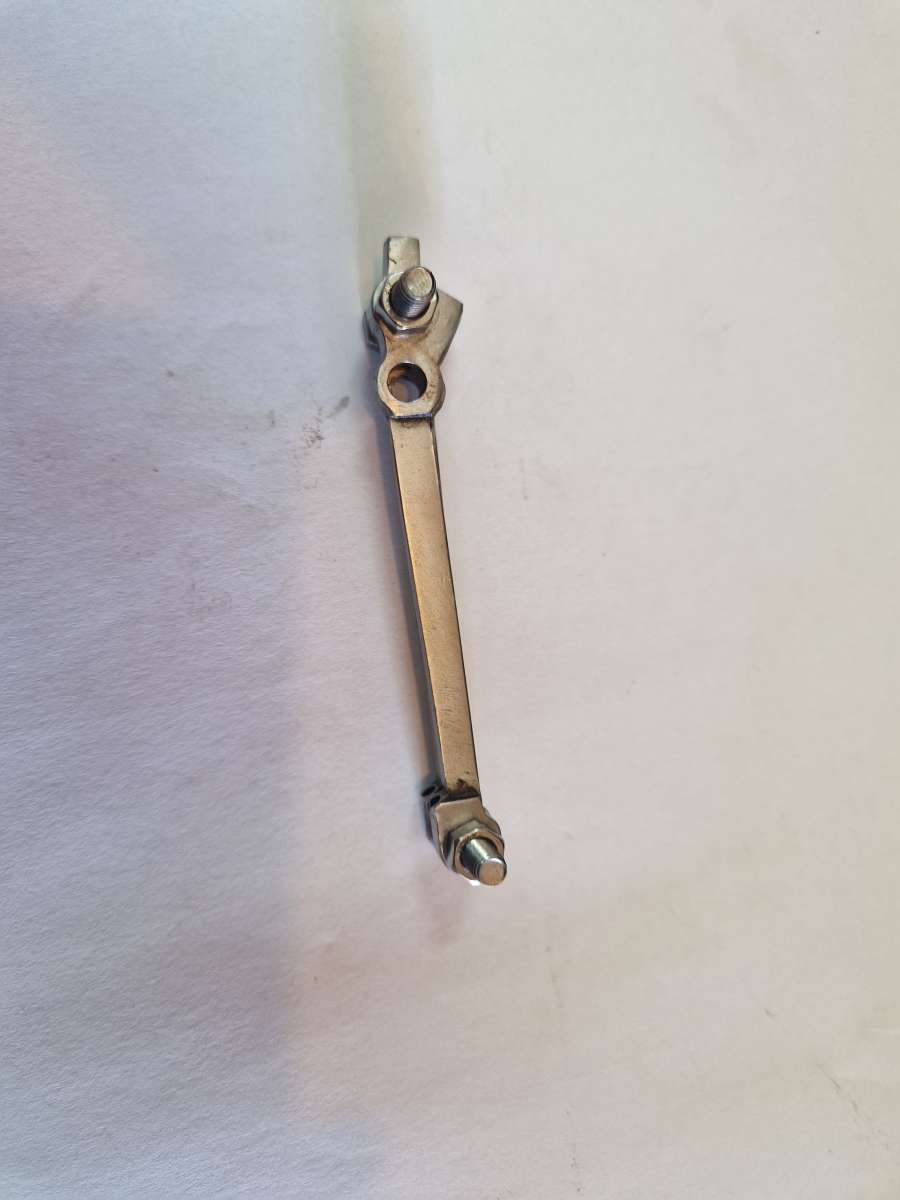
                                So does anybody have the dimensions of the combination levers and specifically the distance between centres of the three holes? 20251025_144939

                                #821824
                                noel shelley
                                Participant
                                  @noelshelley55608

                                  Hi Gary, I’m sorry I’m not able to give any dimensions you need. Not having run mine I have no idea as to whether they are right.

                                  Working on the tender to replace the 3/16″ pipe with 1/4″ There were 2 holes in the tender sole so 2 fittings were made up, one for the hand pump and the other for the axle pump return and taken forward to the tender buffer beam. The water supply to the injectors and axle pump will be taken from fittings in the tender sole – all feeds taken through fine mesh strainers.

                                  It now seems that there was NO return from the axle pump – where did it go ? Any answers ? Noel.

                                  #823265
                                  Gary Brown 3
                                  Participant
                                    @garybrown3

                                    Hi Noel
                                    <p style=”text-align: left;”>Think i can help with the return from the axle pump question but im not sure its a Winson set up! I have a bypass valve on the RH side of my footplate to return the pump water to the tender, i believe this is a modification but would need to look at other 9Fs. So essentially the bypass either feeds into the boiker or back into the tender. I will look tomorrow and send over some pictures etc for you to help give a steer.</p>
                                    On mine i have two injectors, axle pump and hand pump so it gets a bit complicated in places, im also looking to sort out the pipework around the injectors as it looks awful! Nothing like the prototype and thats a very prominent feature on the big locos when viewed from that side

                                    #823913
                                    noel shelley
                                    Participant
                                      @noelshelley55608

                                      So Far ! The work on the tender as stated earlier has been done. I now have a copy of the early Winson build notes and it seems that the return/ bypass from the axle pump is taken to the Rt Hand injector feed/ bypass valve assembly and then returns through the feed pipe, now acting as a return. The hand pump clack on the backhead was loose, caused by the solid feed pipe between the tender and loco, this will be replaced with a high pressure flex pipe. The fire hole doors wouldn’t work, the handle is too long, needs bending 1/4″ lower, several hours work got the mechanism to work properly. The 4 fixing screws I may open up to 4BA. The fire grate is neat, The 2 side sections are held by long rods that thread through 2 eyes at the rear and 2 at the middle, the centre section is fixed by the middle rod and the front rod. The front rod SHOULD have a knob on the end so it can easily be withdrawn, at which point the grate pivots on the middle rod and the fire is dropped. My front rod had 2 nuts on it ! The missing pin in the valve gear has been replaced. The ash pan and fire box are of steel so when not in use or after using need a squirt of Duck oil to prevent corrosion or the ash pan doors seizing. Some steam pipework is too short eg the blower, leaving the valve in the wrong place. The blower valve rod and both injector steam valve rods slip on the valves and the control wheels slip on the rods. Cleaning and loctiting the rods at the valve end and new wheels with square holes at the other.

                                      So far progress is good.   Noel.

                                      #828264
                                      noel shelley
                                      Participant
                                        @noelshelley55608

                                        YOU COULDN’T MAKE IT UP ! Though Winson/Modelworks tried to !

                                        I started to look at the workings of the 9F and having heard it’s steam circuit was poor, I thought I would start at the regulator handle, the linkage was loose and poorly fitted. Having got it working I was not happy with the way the regulator and it’s spindle worked, lumpy and tight. The dome cover is secured in theory by a 6BA countersunk bolt but the threaded hole it goes into is already used. The dome cover plate supports the regulator assembly on a 6BA bolt in a threaded hole and another threaded hole in the regulator support. The regulator spindle has a a milled hole to take the flattened end of the 1/4″ ball valve spindle. Having removed the 12 dome plate bolts and the plate all was revealed !

                                        In my case the 6BA bolt missed the thread in the regulator support, acted as a jack screw, twisted the regulator and split the regulator spindle ! The spindle now fatter would not come out of the boiler shell bush – it did in the end !

                                        Play stopped whilst I had my car crushed by a falling tree !

                                        Sunday was wet, so could I, A, remove the boiler or, B, was it possible to remove the smoke box ? 2hours later I had the smoke box off. A 1″ af spanner soon had the wet header/banjo out and then the regulator !

                                        I can now say with out fear of contradiction that NO 9F built as supplied could EVER have run properly and I’ll tell you why ! Figures in brackets are sectional areas in inches. Please forgive the mixing of imperial and Metric.

                                        The regulator bracket has 3 x 3mm holes (.033sq”) these feed to a banjo bolt with 2 x 3mm holes (.022sq”), the fully open regulator has a 4.5mm hole (,025sq”), the outlet pipe to the wet header has a bore of 6mm (.044sq”), the banjo assembly has a 8.5 bore (.088sq”) and the 2 inlets to the super heater have an orifice no bigger than ( .077sq”). The 2 super hearter pipes are 20″ long of 3/8″ copper.

                                        The plan is to fit a 3/8″ ball valve (.110sq”) and deal with how to get the steam in. One may care to note that early locos had tall chimneys and high steam domes, platforms were built and tunnels dug and a loading gauge was used, the same gauge as now (approx). Boilers got bigger, chimneys got shorter and eventually the dome all but disappeared, creating a problem of how to get dry steam.

                                        A stainless 1/2″ pipe will be grafted to the bored out banjo assembly, leaving only the super heater orifices as any sort of restriction to steam flow, but over 3 times the original size.

                                        That should sort out the top end. I believe I have a later piston valve set up so may try and steam it and see what happens.

                                        Merry Christmas to one and all.   Noel.

                                      Viewing 18 posts - 1 through 18 (of 18 total)
                                      • Please log in to reply to this topic. Registering is free and easy using the links on the menu at the top of this page.

                                      Latest Replies

                                      Home Forums Locomotives Topics

                                      Viewing 25 topics - 1 through 25 (of 25 total)
                                      Viewing 25 topics - 1 through 25 (of 25 total)

                                      View full reply list.