Facing a casting in the lathe

Facing a casting in the lathe

Home Forums Beginners questions Facing a casting in the lathe

Viewing 21 posts - 1 through 21 (of 21 total)
  • Author
    Posts
  • #82764
    Peter Wood 5
    Participant
      @peterwood5
      When facing in the lathe is it better to use a left hand tool, set ‘paralleI’ to the surface or a right hand tool at right angles. I both cases I am assuming working towards the centre.
       
      I am currently facing the casting for a Myford rear tool post. I started with a left hand tool but to get safe clearance had to set it over about 30 degrees which seemed to work OK.
       
      However I am now wondering whether a RH tool might be better.
       
      Any thoughts?
       
      Peter
       
      #5886
      Peter Wood 5
      Participant
        @peterwood5

        Which tool geometry?

        #82767
        MICHAEL WILLIAMS
        Participant
          @michaelwilliams41215
          Hi Peter ,
           
          When doing any lathe work it is only what the tip of the cutting tool is doing which matters . Prvided the tool is securely fixed and with minimum overhang the way the tool shank is arranged is just a matter of clearance , convenience and safety .
           
          A very good tool to use for facing is one with a radiused cutting tip . Apart from usually cutting freely and producing a nice finish this type of tool is very tolerant as regards the exact angle of cutting to which it is set . Basicaly the round tip looks the same to the work several degrees either way of the ideal setting angle .
           
          A tool which is useful for facing and a variety of other purposes is a V tool with cutting tip rounded end as described above .
           
          A sometimes significant problem with facing large diameter work is that the cutting speed is high at the outside but drops rapidly as you approach centre . Wth , for instance , an uncooperative casting it is sometimes better to turn away a lot of material at the outer diameters at a low spindle speed then change to a higher spindle speed for final facing of the whole surface .
           
          MW

          Edited By MICHAEL WILLIAMS on 23/01/2012 09:47:08

          #82768
          JasonB
          Moderator
            @jasonb
            I tend to use a L/H tool most of the time either HSS or Tipped just saves swapping things around but does depend on the size of the job.
             
            The good thing with variable speed is you can wind the wick up as you get nearer the centre
             
            J
            #82769
            KWIL
            Participant
              @kwil

              One of the advantages of inverter driven 3 phase motors on a lathe is that you can vary the speed continuously as the diameter drops and come close to constant surface speed which is what you really want for a fine finish.

              #82775
              Versaboss
              Participant
                @versaboss

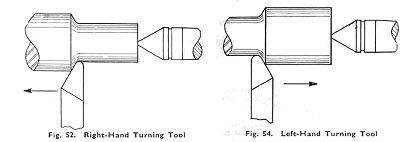
                Peter (and Jason too I think), you seem to mistake lefthand and righthand lathe tools.

                Assume the tool is mounted 90 deg. to the lathe bed, a righthand tool cuts from right to left, and a lefthand tool from left to right. If you don’t believe that, look how the shanks for carbide inserts are designated (e.g. SCLCR versus SCLCL).

                That said, a lefthand tool mounted parallel to the bed is ok for facing towards the center, but round-nosed tools work a treat also.

                Greetings, Hansrudolf

                #82781
                Chris Gunn
                Participant
                  @chrisgunn36534
                  When I was an apprentice, i was taught to use a tool with a 45 degree chamfer on it to face across a workpiece, and then one could use the same tool to put a chamfer on the machined face to break the edge. I still do this today but with a throwaway tip tool which gives me 4 edges. To turn down the diameter, we always used a right hand tool with a tip with a small radius. Nowdays I use a throwaway triangular tipped tool, giving 3 edges. I have a round nosed tipped tool for occasions where a nice big radius is required in the corner, in either direction, but this will chatter a bit if too big a cut is put on, and when getting into the corner when it is cutting on 90 degrees of the tip. The previously mentioned tools will not chatter with the same cut, this is no doubt due to the longer cut length. These 3 tools will do 95% of what I need.
                  Chris Gunn
                  #82790
                  JasonB
                  Moderator
                    @jasonb
                    Hansrudolf, You are right I just looked at Peters terminology and use a tool parrallel to the face of the work.
                     
                    J
                    #82797
                    Peter Wood 5
                    Participant
                      @peterwood5
                      Thanks for all the comments and particularly to Hansrudolf. I never could tell my right hand from my left!
                       
                      My query was out of curiosity as to whether there is a theoretically correct geometry rather than any problem I was having.
                       
                      Nevertheless, I was particularly taken with Chris’s suggestion about using a 45 degree chamfer tool which could then be used to break the edge. Ironically the reason I am making the rear tool post is primarily to have chamfering tool always at hand.
                      #82813
                      Chris Gunn
                      Participant
                        @chrisgunn36534
                        I have a rear toolpost, and use it for a parting tool which is always there ready to go, but really the most useful accessory IMO is a quick change tool post, and 5 or 6 tool holders, then you can have the 3 or 4 tools you need all the time permanently set up and at the right height, and a couple of spare holders for the tools you use occasionally, which you can change over as required. if you do this, you can get a lot more done.
                        Chris Gunn
                        #82814
                        Clive Hartland
                        Participant
                          @clivehartland94829
                          A bit of a mix up here about left and right hand tools in the lathe.
                          If you stand at the back of the lathe, a tool travelling towards the chuck is a Right Hand tool. away from the chuck it is a Left hand tool .
                          Anymore takes on this?
                           
                          Clive
                          #82816
                          JasonB
                          Moderator
                            @jasonb
                            Depends what you term ” behind the lathe” to me that would be between the wall & lathe, I stand infront of it to use it.
                             
                            May be easier to say “standing as you use the lathe.”
                             
                            I have maybe 20 tool holders but its still quicker to use a R/H tool for both facing & turning, this would likely be even more so if I had a DRO on the Lathe as it would save having to enter the tool each time its changed.
                             
                            J
                             
                             
                            #82823
                            Terryd
                            Participant
                              @terryd72465
                              Hi Guys,
                               
                              This is what Boxford had to say on the subject of RH and LH tools.
                               
                              Regards
                               
                              T

                              #82827
                              Clive Hartland
                              Participant
                                @clivehartland94829
                                Yes Terry, that is how I have always been taught and what I pass on to others learning the lathe.
                                Takes a bit of getting used to though.
                                Having made HSS lathe tools during my apprenticeship all this was hammered into us.
                                 
                                Clive
                                #82846
                                Chris Gunn
                                Participant
                                  @chrisgunn36534
                                  The guys at Boxford obviously never wanted to turn up close to a shoulder or into a corner going towards the chuck with the tools they show in the illustration, or is this just artistic licence? I would describe what Boxford calls a LH tool as a RH tool being used in the wrong direction, and vice versa. The “LH” tool would go into a corner or close to a chuck, and could be used to face off as well.
                                  Chris Gunn
                                  #82863
                                  Clive Hartland
                                  Participant
                                    @clivehartland94829
                                    You may call the tools what you will but it will NOT change the book description of what hand they are!
                                    Clever engineers will make/grind a tool to suit an application at that time and have an assortment of tools build up from different tasks.
                                    Left or Right, who cares?
                                     
                                    Clive
                                    #82869
                                    JasonB
                                    Moderator
                                      @jasonb
                                      What the Boxford drawings do not show is the angle of the top rake, you can bet the R/H tool slopes down from the left edge and the L/H tool down from the right meaning they can only be used in the direction shown.
                                       
                                      J
                                      #82876
                                      Chris Gunn
                                      Participant
                                        @chrisgunn36534
                                        Jason you are right about the top rake of course. However I do think the shape of the tools shown in the picture in the Boxford manual is confusing in the context of the original question asked.
                                        Chris Gunn
                                        #82888
                                        Sub Mandrel
                                        Participant
                                          @submandrel
                                           
                                          > The good thing with variable speed is you can wind the wick up as you get nearer the centre
                                           
                                          > you can vary the speed continuously as the diameter drops and come close to constant surface speed
                                          Isn’t English a wonderful language?
                                           
                                          Neil
                                           
                                          #82897
                                          Anonymous
                                            Posted by Clive Hartland on 24/01/2012 13:51:17:

                                            Clever engineers will make/grind a tool to suit an application at that time and have an assortment of tools build up from different tasks.

                                             
                                            And the really clever engineers re-design the part so they don’t need to muck about making custom tooling.
                                             
                                            Regards,
                                             
                                            Andrew
                                            #82908
                                            Terryd
                                            Participant
                                              @terryd72465
                                              Posted by Chris Gunn on 24/01/2012 17:39:54:

                                              Jason you are right about the top rake of course. However I do think the shape of the tools shown in the picture in the Boxford manual is confusing in the context of the original question asked.
                                              Chris Gunn
                                               
                                              Hi Chris,
                                               
                                              just imagine the toolpost rotated so that the leading edge of the tool is at 90º to the centre line of the work – you could then work up to a shoulder. Surely that is what we all do from time to time, i.e. rotate the toolpost to provide the best tool geometry?
                                              Regards
                                               
                                              Terry
                                            Viewing 21 posts - 1 through 21 (of 21 total)
                                            • Please log in to reply to this topic. Registering is free and easy using the links on the menu at the top of this page.

                                            Latest Replies

                                            Home Forums Beginners questions Topics

                                            Viewing 25 topics - 1 through 25 (of 25 total)
                                            Viewing 25 topics - 1 through 25 (of 25 total)

                                            View full reply list.