What tool to use please

What tool to use please

Home Forums Workshop Tools and Tooling What tool to use please

Viewing 25 posts - 1 through 25 (of 28 total)
  • Author
    Posts
  • #528253
    Sam Longley 1
    Participant
      @samlongley1

      I have a Warco 240MV lathe & have removed the topslide. The 4 jaw chuck is permanently mounted on the cross slide for better rigidity. I have a variety of cutters (HSS, Brazed carbide & indexible)& because I have several of the following pieces to make, I might consider buying the right tool based upon advice received.

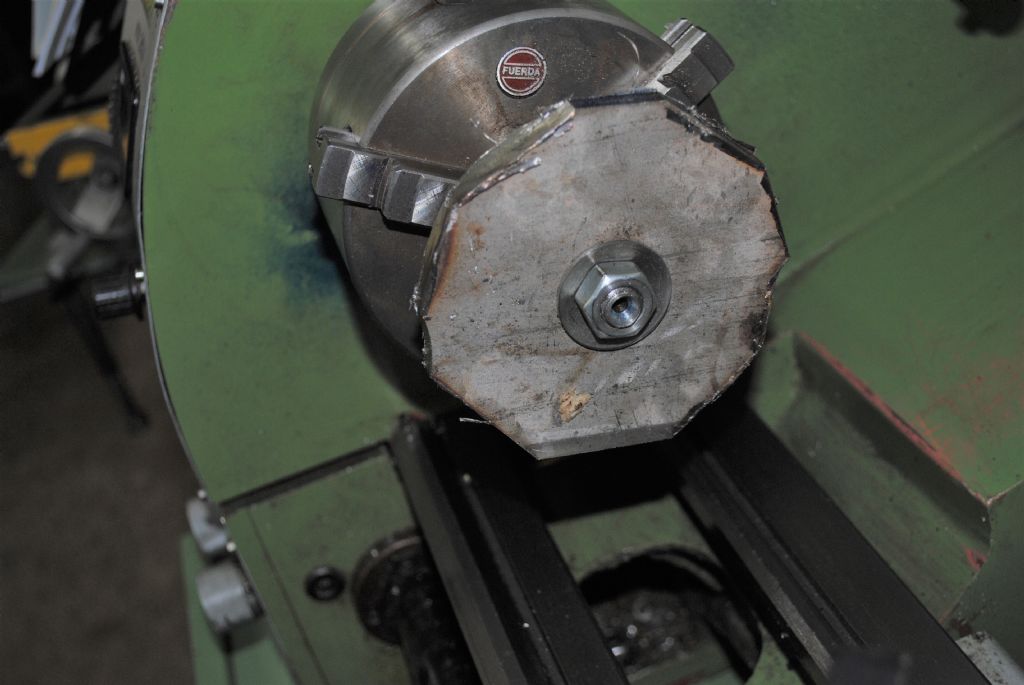
      I am making a rope cutter for a prop shaft of a yacht out of 316 stainless steel. I am starting with 13 mm * 100 mm plate which I have cut to a rough shape with an angle grinder. then mounted it in a 4 jaw chuck, bored for the shaft. then mounted on a mandrel in a 3 jaw chuck.

      I am now faced with a piece of stainless with a very rough hit & miss turning problem. I tried taking a piece off whilst still in the 4 jaw & it vibrated like h..l.

      So my problem is what is the best toolbit -Type, end size, radius etc then lathe speed to get a reasonable cut & get it round.

      Having done that I am going to turn it to 85mm diam & the cutting part will be 6mm the ( the boss is the 13mm) chamfered to a sharp edge.

      In this edge will be 6 No semicircular notches 8mm diam ( so they will be 4mm deep) to aid cutting when it spins. So when i get to diameter I will drill 6 holes on the circumfrence then machine the edge . Once again I will have an interupted cut.

      This may preclude my usual lightweight cheepo chinese disposable tips

      So can anyone please suggest the best tooling for the job & if they added some idea of speed that would be great.

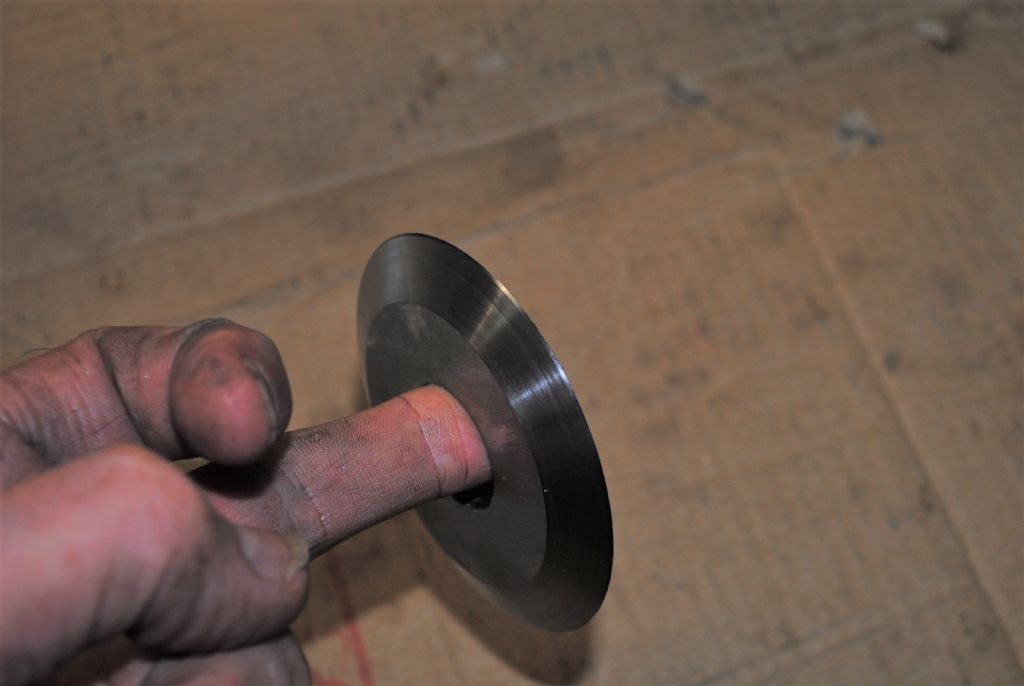
      I am enclosing a picture of the disc in the lathe ready to go & a picture of a cutter that does NOT have the 6 notches to give an idea of what it might look like

      Thanks

      Sam L

      ss disc.jpg

      disc cutter.jpg

      #20161
      Sam Longley 1
      Participant
        @samlongley1
        #528258
        Frances IoM
        Participant
          @francesiom58905

          could you start with a SS cutting disk and then add the boss
          eg as part of a parcel of bits I wanted I have maybe 8 or so 80mm dia 1mm thick sharpened to a cutting edge as used for meat slicing of those lumps of cooked mince seen in many takeaway establishments

          Edited By Frances IoM on 18/02/2021 11:44:39

          #528259
          noel shelley
          Participant
            @noelshelley55608

            Hss to start with but the tool MUST cut ! If it rubs it will almost instantly harden the 316 and be a real problem. As to the design, I would query the wisdom of notches in the periphery, They will catch the rope and pull it round the shaft ! Look at the shape of the blades on a No Weed Propellor, fitted to the DUKW. A far better plan is to NOT to rortate the prop whilst a rope is in the water and ALWAYS have a very sharp knife to hand to cut away any rope or net ! Noel

            #528260
            Nick Wheeler
            Participant
              @nickwheeler

              Take the blank out of the lathe and using the angle grinder knock off the corners so it's 'rounder'

              That will make your choice of lathe tool less critical because it doesn't have so much to do.

              #528262
              Anonymous

                A plate mounted on a small spigot is an open ended invitation to Mr. Chatter, whatever tooling you use. The ratio of OD to finished bore doesn't look too bad.

                I'd mount the rough plate in a 4-jaw chuck held on the OD. Face off and drill/bore the centre hole. Turn it round in the 4-jaw and face to width. It wouldn't take long to knock off more of the edges on the rough part. Finally mount on a spigot, with a thick washer (not a thin commercial one) and machine the OD and chamfer. In my experience 316 turns very nicely with insert tooling. I'd mill the peripheral slots after machining to avoid an interrupted cut and allow one to form a better shaped edge for cutting.

                Andrew

                #528265
                Sam Longley 1
                Participant
                  @samlongley1
                  Posted by Andrew Johnston on 18/02/2021 11:50:39:

                  A plate mounted on a small spigot is an open ended invitation to Mr. Chatter, whatever tooling you use. The ratio of OD to finished bore doesn't look too bad.

                  I'd mount the rough plate in a 4-jaw chuck held on the OD. Face off and drill/bore the centre hole. Turn it round in the 4-jaw and face to width. It wouldn't take long to knock off more of the edges on the rough part. Finally mount on a spigot, with a thick washer (not a thin commercial one) and machine the OD and chamfer. In my experience 316 turns very nicely with insert tooling. I'd mill the peripheral slots after machining to avoid an interrupted cut and allow one to form a better shaped edge for cutting.

                  Andrew

                  I started with it in the 4 jaw to bore the shaft hole. I then tried taking off some of the outer edge but with only 6mm held in the jaws I felt that i was in fro a piece of plate flying out across the workshop. Taking tiny cuts with a brazed cutter was just work hardening the material. So that is why i decided against leaving it in the 4 jaw. At least in a mandrel it is securely held. Perhaps I will cut the notches in the mill afterwards. I have to work out how to get sharp edges on them as well, so a ball cutter may be needed.

                  #528266
                  Sam Longley 1
                  Participant
                    @samlongley1
                    Posted by noel shelley on 18/02/2021 11:44:50:

                    Hss to start with but the tool MUST cut ! If it rubs it will almost instantly harden the 316 and be a real problem. As to the design, I would query the wisdom of notches in the periphery, They will catch the rope and pull it round the shaft ! Look at the shape of the blades on a No Weed Propellor, fitted to the DUKW. A far better plan is to NOT to rortate the prop whilst a rope is in the water and ALWAYS have a very sharp knife to hand to cut away any rope or net ! Noel

                    I would love to comment to the contrary — But Jason would not allow it disgust

                    #528267
                    Dave Halford
                    Participant
                      @davehalford22513

                      Have you tried setting the tool angle for face cutting and then advance it like a boring tool. If that doesn't work a carbide milling cutter tip will withstand the interrupted cut.

                      This is one of those times when the £80 Lidl Parkside plasma pays for it's self.

                      I don't see why the commercial rope cutters are just plain blades if notched was better? You may end up with a rope catcher cum propshaft bender.

                      #528268
                      Hopper
                      Participant
                        @hopper
                        Posted by Sam Longley 1 on 18/02/2021 11:27:59:ss disc.jpg


                        Yes definitely round those corners off with the angle grinder. And please, please grind or file off those razor sharp grinder cut-off burrs while you are at it. What you have there is a visit to the emergency room waiting to happen. Ouch! Fingertip injuries really hurt. Lots of nerves there.

                        A tailstock centre in the end of the mandrel might help rigidity and make cutting easier. And a beefier washer as already suggested would help stop slippage too.

                        I would use a HSS toolbit ground with a bit of a radius on the end to minimise chances of the point being knocked off.

                        Spin at 50 to 80rpm for a HSS tool bit at that diameter on stainless. Or double that if you use good tough indexable tooling with a radius on the corner.

                        And don't let the tool rub on stainless steel lest the work-hardening fairy does bless your job.

                        Edited By Hopper on 18/02/2021 12:19:36

                        #528272
                        Anonymous
                          Posted by Sam Longley 1 on 18/02/2021 12:09:25:

                          I started with it in the 4 jaw to bore the shaft hole. I then tried taking off some of the outer edge but with only 6mm held in the jaws I felt that i was in fro a piece of plate flying out across the workshop.

                          That's why I didn't say machine part of the OD in the 4-jaw chuck. smile

                          A disc supported only at the centre is a ………. cymbal! Good in a drum kit but not so useful on a lathe. For the spigot I'd make the diameter of the backing surface about half the OD of the part, say around 50mm barstock. Same for the washer at the front, and I'd use a SHCS instead of a nut. Making the diameter of the driving surfaces a good proportion of the part OD means that the part is less likely to slip when taking proper cuts to avoid work hardening.

                          Andrew

                          #528274
                          Sam Longley 1
                          Participant
                            @samlongley1
                            Posted by Andrew Johnston on 18/02/2021 12:35:48:

                            Posted by Sam Longley 1 on 18/02/2021 12:09:25:

                            I started with it in the 4 jaw to bore the shaft hole. I then tried taking off some of the outer edge but with only 6mm held in the jaws I felt that i was in fro a piece of plate flying out across the workshop.

                            That's why I didn't say machine part of the OD in the 4-jaw chuck. smile

                            A disc supported only at the centre is a ………. cymbal! Good in a drum kit but not so useful on a lathe. For the spigot I'd make the diameter of the backing surface about half the OD of the part, say around 50mm barstock. Same for the washer at the front, and I'd use a SHCS instead of a nut. Making the diameter of the driving surfaces a good proportion of the part OD means that the part is less likely to slip when taking proper cuts to avoid work hardening.

                            Andrew

                            Apologies. i needed to read your post again

                            But my mandrel is 45 mm at the back. So I very nearly got one bit rightsmiley

                            But for the life of me –SHCS– Brain fade perhaps ?????

                            #528276
                            roy entwistle
                            Participant
                              @royentwistle24699

                              SHCS Socket head counter sunk perhaps cheeky

                              Roy

                              #528277
                              JasonB
                              Moderator
                                @jasonb

                                Socket Head Cap Screw even.

                                #528288
                                Clive Foster
                                Participant
                                  @clivefoster55965

                                  Tightly trapping an intermediate plate of reasonably thick "improved wood" (Mdf, osb, flooring board or whatever you have) firmly between the plate and ends of the chuck jaws will give better support and help dap out any ringing. Hafta accept a bit of dust if you cut into the face of the plate but generally its not going to be silly messy.

                                  Most of the improved woods are remarkably flat too so contact is good. Waterproof chippbard underfloor is my favourite as the surface is slightly rough for a better grip.

                                  As my lathe takes 5C collets direct in the spindle I'd fix the backing plate to the faceplate and grab the work holding spigot in a collet using the tailstock to push job and backing plate into really intimate contact.

                                  Maybe consider a bit of threaded rod as a drawbar to pull the job hard against the backing plate before finally tightening the chuck.

                                  Clive

                                  #528292
                                  Anonymous
                                    Posted by Sam Longley 1 on 18/02/2021 12:44:24

                                    But my mandrel is 45 mm at the back.

                                    thumbs up

                                    Jason is correct on the acronym, athough a countersunk screw would work. But the Allen key will be smaller, so you need a smaller gorilla to do it up.

                                    Andrew

                                    #528293
                                    Sam Longley 1
                                    Participant
                                      @samlongley1
                                      Posted by JasonB on 18/02/2021 13:12:37:

                                      Socket Head Cap Screw even.

                                      Ahhh !!surprise

                                      Not after I have already cut a male thread on the end of my mandrel me thinks.sad

                                      But why a bolt instead of a nut on a stud? What can the reasoning be behind that?

                                      (At least I can push the tail stock to it if I want.)

                                      Anyone know?

                                      #528294
                                      Chris Evans 6
                                      Participant
                                        @chrisevans6

                                        I would cheat and profile the diameter very close on the mill/rotary table.

                                        #528310
                                        Sam Longley 1
                                        Participant
                                          @samlongley1
                                          Posted by Chris Evans 6 on 18/02/2021 15:23:18:

                                          I would cheat and profile the diameter very close on the mill/rotary table.

                                          I thought about that. I have a top quality 8 inch rotary table. However, the mill is a rubbish Warco m16. The vibration is ridiculous. Pretty useless for machining metal. Simple drilling holes is better done on my pillar drill.

                                          #528318
                                          Bill Phinn
                                          Participant
                                            @billphinn90025
                                            Posted by Sam Longley 1 on 18/02/2021 16:39:19:However, the mill is a rubbish Warco m16.

                                            Can we take it you mean the example of a Warco WM16 you own is rubbish, not that all Warco WM16s are rubbish?

                                            #528362
                                            Chris Evans 6
                                            Participant
                                              @chrisevans6

                                              I suppose it helps running a Bridgeport and a choice of 10" and 14" rotary tables. The big rotary only gets used about once a year but I could not part with it.

                                              #528375
                                              Anonymous
                                                Posted by Sam Longley 1 on 18/02/2021 15:21:42:

                                                But why a bolt instead of a nut on a stud? What can the reasoning be behind that?

                                                I use a lot of split mandrels, so it's natural for me to use bolts. It's simpler and quicker for me to drill and tap than it is to turn down and thread. I also find it quicker to use a bolt than a nut and spanner.

                                                Andrew

                                                #528389
                                                SillyOldDuffer
                                                Moderator
                                                  @sillyoldduffer

                                                  Sam may be guilty of cruelty to machine tools if this job is typical!

                                                  Stainless 316 is on my avoid list because it work hardens. That roughly shaped octagon causes difficult interrupted cuts likely to break carbide, which is otherwise a better bet than HSS. 316 conducts heat poorly causing HSS to overheat and blunt quickly. The web recommends flood cooling HSS and 316 and also making sure the HSS stays sharp throughout the cutting. About 60 RPM for 85mm diameter.

                                                  Before turning it, I'd round the blank more with an angle grinder and remove the hangers on. Then very light cuts with carbide at about 200 rpm until the circle is formed, at which point go in a bit harder. I'd expect the disc to work harden as the tool rubs either side of the peaks, but carbide should cope without breaking provided it's not asked to chop metal too quickly.

                                                  Holding the blank is tricky too: it needs to be rigid with no chance of coming loose. Not sure what to suggest. I would try super-gluing to a fat mandrel as well as bolting. A problem with bolting as shown is shock loads tend to loosen the nut.

                                                  Dave

                                                  #528394
                                                  Sam Longley 1
                                                  Participant
                                                    @samlongley1
                                                    Posted by Bill Phinn on 18/02/2021 16:57:39:

                                                    Posted by Sam Longley 1 on 18/02/2021 16:39:19:However, the mill is a rubbish Warco m16.

                                                    Can we take it you mean the example of a Warco WM16 you own is rubbish, not that all Warco WM16s are rubbish?

                                                    Obviously I can only speak for mine , but I am Soooo disappointed with it.

                                                    #528395
                                                    Nigel Graham 2
                                                    Participant
                                                      @nigelgraham2

                                                      Would it matter if there were some extra holes in the plate?

                                                      As far I can make out it won't affect the function and not really spoil the appearance on a purely functional item if you were to drill a neat ring of 4 or 8 holes to bolt it to the faceplate, with a intervening piece of thick plywood or similar.

                                                      It's certainly the approach I'd use, where extraneous holes don't affect form or function.

                                                      ==

                                                      I am not convinced by your remarks about your milling-machine… I owned a Warco mill-drill, one of the round-column machines, for a few years and found no problems with it other than the inconvenience of having to recover the centering by moving the head up or down.

                                                    Viewing 25 posts - 1 through 25 (of 28 total)
                                                    • Please log in to reply to this topic. Registering is free and easy using the links on the menu at the top of this page.

                                                    Latest Replies

                                                    Viewing 25 topics - 1 through 25 (of 25 total)
                                                    Viewing 25 topics - 1 through 25 (of 25 total)

                                                    View full reply list.