Warco GH Universal or Bridgeport

Warco GH Universal or Bridgeport

Home Forums Workshop Tools and Tooling Warco GH Universal or Bridgeport

Viewing 25 posts - 1 through 25 (of 32 total)
  • Author
    Posts
  • #824524
    cejm78
    Participant
      @cejm78

      Similar to my thread on the lathe, I could do with some advice on a mill.

      I like to buy a half decent mill. Currently I have been looking at buying new from Warco (GH Universal) or buy a second hand Bridgeport. The Warco is single phase whilst the Bridgeport is 3 phase, so a vfd needs to be installed.

      Or, instead of a vfd on the lathe and mill, I buy a rotary converter that can power both. A bit more expensive but it means that the machines don’t have to be altered.

      https://www.simplypowersupply.com/RCK3KW-Rotary-Single-To-Three-Phase-Converter

      #824548
      Robert Atkinson 2
      Participant
        @robertatkinson2

        A 3 phase motor and VFD will beat a single phase on the same machine anytime. A rotary converter is not only more expensive to buy, it’s also more expensive to run. They are very inefficient so use more electricity including quite a bit when running unloaded.
        On used machines condition is everthing. Getting one with a lot a accessories can be big cost saving.
        Personally, if I had the space, I’d have a Bridgeport universal mill over a Warco GH assuming it’s not worn out. It’s not that difficult to fit a VFD to one.

        Robert.

        #824553
        Chris Gunn
        Participant
          @chrisgunn36534

          Bear in mind you have 3 or more motors on a 3ph Bridgeport, the head, the suds, and the feed motor(s). You can run the whole machine from a single 1ph to 3 ph converter, like the Transpower style. I have run mine for the last 25 years like this once the main head is running the other motors can be started up. I am not sure how you would run all these with VFD’s.

          Chris Gunn

          #824558
          cedric 1
          Participant
            @cedric

            With the Bridgeport, it all comes down to condition. If good, it is about the best milling machine ever for light to medium duty work such as toolroom or home hobby use. But if worn out, pretty useless.

            Being an industrial machine built to industrial quality, a Bridgeport in good condition is streets ahead of the average Chinese hobby grade machine.

            If you can find a genuinely good Bridgeport, I wouldn’t hesitate to pay the extra for suitable power supply.

            But a bad one will be a source of grief, hence the popularity of the plug and play Chinese machines with a warranty and service.

            Caveat emptor!

            #824566
            Clive Foster
            Participant
              @clivefoster55965

              Having moved up to a Bridgeport from a R8 spindle square column bench mill very similar to a Warco GH, albeit with two speed belt drive and 3 phase vid controlled motor rather than geared head perhaps I can help with the comparison.

              1) From a home workshop metal removal perspective the performance is effectively equal. Both are capable of generating chips at a a significantly greater rate than you want to deal with in the shed or home shop.

              2) Again from a home shop perspective the machines are equally ridged and stiff assuming both are in good order. Pro machinists, rightfully, complain that a Bridgeport is wimpy and flexible compared to production machinery of the same vintage. But folk like us won’t notice as we simply won’t drive our baby hard enough.

              3) Physical sizes are vastly different. If arranged back to back you could drive 4 GH machines in the space needed to run a Bridgeport. Maybe 6 if the operators are friendly!

              Most short on space folk put a Bridgeport canter wise across the angle of a corner. Thats what I did. It’s not ideal and doesn’t save as much space as it might at first sight seem. You loose a lot of wall space too. Cupboards or shelves are possible but poor access means only for the occasional things. Neglecting the angle I put my big pillar drill more or less parallel to the Bridgeport which maximised the length of components I could handle. Everything being cunningly arranged so that with only minor shuffling really long stuff can project over the garden through the side door. Longest I’ve ever handled so far is about 16 ft, theoretically I could handle 30! If you are only dealing with smaller items it might be feasible to put your pillar drill sideways to the Bridgeport in line with the column so the Bridgeport table can come past the drill. Restricts the length of components on one side of the drill tho’.

              A Warco GH can be just plonked on a bench, cupboard or its stand without vastly restricting access behind. I’d lift one up a few inches so you can readily use the bench space under the table for temporarily putting things down. Whatever you best intentions about keeping things clear of swarf are you will plonk stuff there so make out easy. I seriously considered a drawer on each side to the mill was effectively sunk into the bench top. But I didn’t have a power feed unit.

              4) Operating as a basic vertical mill the two major advantages of a Bridgeport are its large table and slim head. I found the large square head on the GH style machine both very intrusive when setting up work and seriously limiting the visibility of the job. Native spindle fitting collet work with smaller cutters needed the quill well extended just to see what was going on. Clarkson auto lock chuck helped but it’s still easier to see with a Bridgeport. My square column machine was a short (28″) table version so pretty much alls setting up had to be done under the head or a bit to the side. The 49″ table on the Bridgeport lets you move setup of pretty much anything you can lift out to the side giving easy access and good visibility.

              The GH style machine was also rather short of vertical real estate under the head. The hand crank operating the head lifting screw on mine was rather short so shifting the head was hard work. Not only does the Bridgeport win on space the big crank makes lifting the knee much easier despite the weight. Sometimes I get fed up with the number of handle turns needed tho’. Seriously seriously consider the powered head lift version of the GH style.

              5) The ram and two plane tilting head of a Bridgeport are much more versatile than the simple swivel on a GH style head. But like many Bridgeport users I hardly ever move the ram or the head. There is enough room to get tilting vices et al under the head for a decent range of job sizes. A tilting vice or sine table is just easier to set than adjusting the head. Which has to be put back afterwards anyway.

              Do remember that the centre line of the quill on square column machines doesn’t cover the full width of the table so the actual machining real estate is less than it might at first seem. Not usually an issue because the un-reachble space is generally needed for vices, fixture or hold down set al.

              6) One thing that really annoyed me about the square head machine was the silly screw up and down quill stop. Fine thread meant it took forever to move and the floppy bearing at the bottom made it less than reliable. I junked the screw for a plain rod, drilled the thread out of the slider, lost the arrow plate and put a wing headed screw in to lock it at the requisite height. Much faster to set and solid. If I really needed accuracy teh inside jaws of a vernier caliper were effective. Standard Bridgeport height setting device also takes forever to move but it is accurate and solid. The quickset accessory versions have very little adjustability and cannot be set accurately.

              it is said that the gear heads are noisy which may be intrusive when concentrating on smaller jobs. My two speed belt drive was quiet and the VFD speed range good.

              Bottom line is I work 12 inch to the foot scale and need a full size machine. All too often I was pushing the square column machine beyond its realistic work size capability.  The GH style is fine for smaller jobs if you can live with the visibility issues inherent to the large head and limited, in comparison to the Bridgeport, table space.

              Clive

              #824574
              Hollowpoint
              Participant
                @hollowpoint

                As already said, if you can find a Bridgeport in good condition and you have the space then go for it.

                But have you also considered a Warco VMC? Some people call it the baby Bridgeport. I bought one about 18 months ago and I have been happy with it.

                Whatever mill you go for, I would go with 3 phase. I bought my VMC in single phase as that is all they had in stock at the time. There’s hardly a day goes by that I don’t wish I had gone 3 phase with a VFD!

                #824575
                Diogenes
                Participant
                  @diogenes

                  If you mean a used Bridgeport at a similar price to a GH Universal (c.£3k), then the answer is “probably not”, unless (and please forgive me for saying, if so) you have prior knowledge or experience of them.

                  What (very broadly) kind of work might you be doing? It really does help people give better advice..

                  Not sure I agree about 3phase being too important – most of mine are single and it doesn’t bother me at all..

                  #824583
                  Dave Wootton
                  Participant
                    @davewootton

                    One thing to bear in mind if buying a Bridgeport to run on a converter is that the two speed short ” pancake” motor model will not run on a static phase converter, the vari-speed head model with single speed motor will with no problems. Obviously both will run fine on a rotary phase converter. Despite the negative comments about rotary phase converters I’ve used them for years enabling me to use all sorts of ex industrial machinery without modification, still retaining full use of all the ancilliary motors, even the low voltage lights still work! Until I got a proper rotary converter I ran a two speed Bridgeport on a Transwave static converter with a 2HP 3000RPM pilot motor connected, as long as the pilot motor was started before the main motors it ran fine. Used this arrangement for years, This was done at the suggestion of Peter at Transwave who knows a thing or two.

                    Just noticed we have a new member with a Thiel 158, reminded me the static Transwave and pilot motor arrangement above was also used to run one of these, I sold the mill and the Transwave to a friend about fifteen years ago and still in heavy use building 6″ scale traction engines, would think if it was to let the smoke out it would have done it by now.

                    #824593
                    Robert Atkinson 2
                    Participant
                      @robertatkinson2

                      There have been a couple of coments on using a VFD on a bridgeport:
                      Chris Gunn said “Bear in mind you have 3 or more motors on a 3ph Bridgeport, the head, the suds, and the feed motor(s).” This is true. However you only need the VFD on the spindle motor. The feed motors are actully DC and the supply to their power supply is single phase. at most you need a 110V transformer.
                      The suds pump can be run on a steinmetz type capacitor connection or a small fixed speed single to 3 phase converter.

                      Dave Wootton said “One thing to bear in mind if buying a Bridgeport to run on a converter is that the two speed short ” pancake” motor model will not run on a static phase converter..”

                      Can you clarify this? I can understand that you may need a 415V output VFD but that is less of an issue than it used to be.

                      I also note that the 3kW output rotary converter the OP linked to needs a 25A feed. This means that in the typical domestic situation you will have to factor in the cost of having a dedicated connection installed. These days that means using a qualified electrician as it is notifiable work. Unless your consumer unit a.k.a fuse box is less than about 5 years old they will probably insist on replacing that at the same time.

                      Robert.

                      #824605
                      Dave Wootton
                      Participant
                        @davewootton

                        My comment stated only that the pancake two speed motor will not run on a static phase converter, I made no mention of a VFD. According to Transwave it’s because the short pancake motor has not enough iron content to generate the third phase, from practical experience when trying to run from a static converter the motor will just sit and hum at you, adding a pilot motor, I used a heavy old iron one at their suggestion, or using a rotary converter, enables the magic to happen and it runs fine.

                        #824606
                        Julie Ann
                        Participant
                          @julieann

                          Picking up on a few points regarding Bridgeport Series 1 mills:

                          • The Bridgeport is a big machine by hobby standards, over 7 feet tall with the non-pancake motor. I have to stand on tippy toes to get a spanner on the drawbar.
                          • My Bridgeport used to be a corner but, as Clive says, that didn’t work well so it is now against a wall but twisted so the table is at an angle to the wall.
                          • A Bridgeport is flexible, in two senses. First it is versatile in the work it can do but in a less good sense it is not particularly rigid.
                          • Depends on the work in hand but I run my Bridgeport to the limits when I need to shift metal; if I really need to shift metal I use my horizontal mill as it leaves the Bridgeport standing.
                          • I use the ram now and then to get coverage on oversized work but haven’t tilted the head in many years; it’s a pain to reset and is easier to tilt the work.
                          • I run on a 3-phase supply; just makes life so much easier. When I moved into my current place I needed to upgrade the 60A single phase supply anyway so it seemed sensible to go for 3-phase at no extra cost.
                          • I think that the need for condition is rather overstated. My Bridgeport has around 0.8/1.2mm play on X and Y but, with the addition of a 2-axis DRO, it is no problem holding tolerances better than a thou.
                          • Due to the large installed base a huge range of spare parts are available for Bridgeports, albeit at a cost, and will remain so for the foreseeable future.
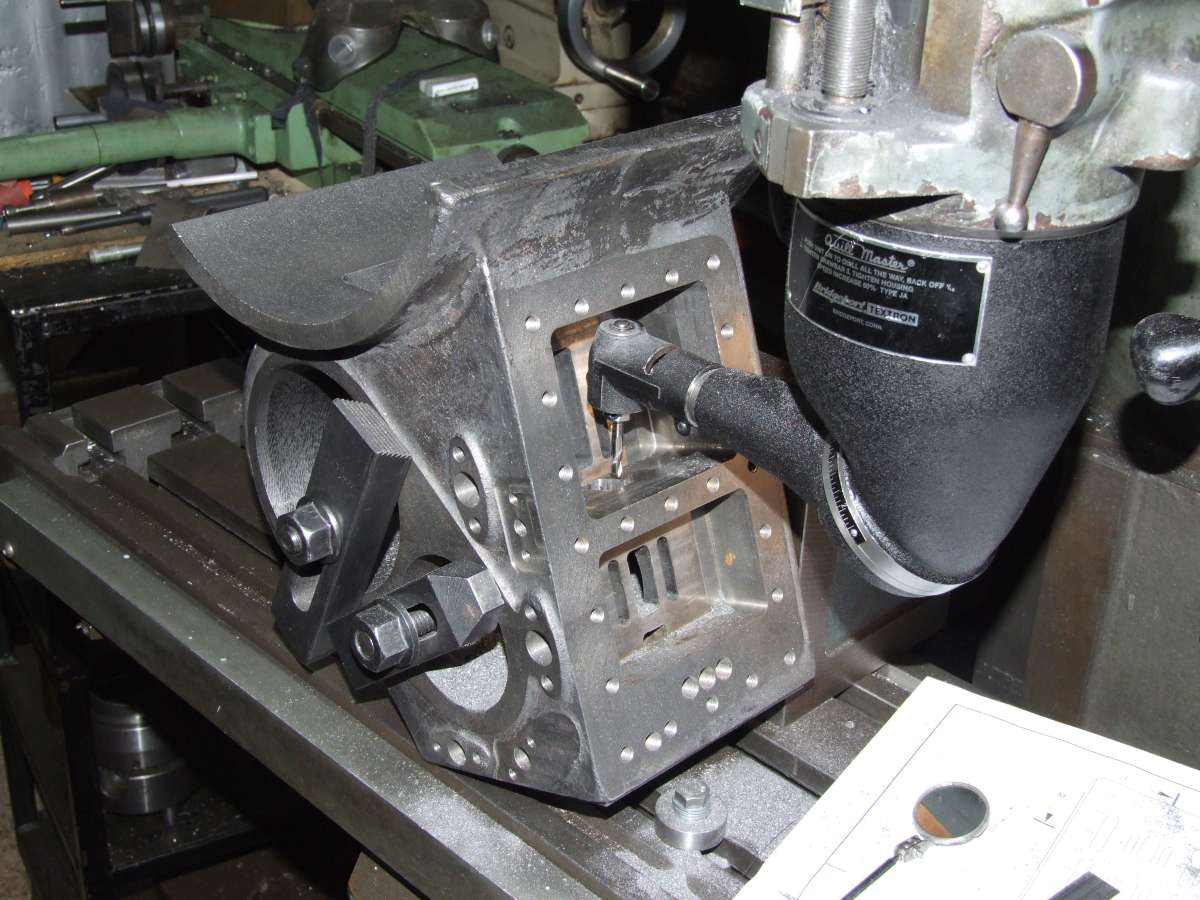
                          • A little mentioned advantage of an industrial machine tool is that accessories are available that simply don’t exist for machines aimed at the hobby market. For instance I have a slotting head on the back of the ram on my Bridgeport, and some accessories come in useful for those awkward jobs:

                          2021_10070004

                          If space is available and power requirements can be met I’d go for a Bridgeport over a Warco.

                          Julie

                          #824608
                          Clive Foster
                          Participant
                            @clivefoster55965

                            As Dave says the short, pancake, motors don’t like static phase converters. Given sufficient tweaking and tuning they can be made to run OK ish but voltage and phase balance is very poor. Balance is extremely load sensitive. Simply connecting a commercial static converter and relying on the pre-set switches will almost certainly burn out the motor in short order unless you are dead lucky and happen to match your usual load to the converter settings. Unlike Dave I’ve not experienced the sit and hum situation.

                            My experience is that turning a static converter into a crypto rotary with a pilot motor as per Transwave suggestions works fine unless your load is close to the converter maximum. In my view adding pilot motor as soon as funds permit its almost mandatory to get the best out of a static converter unless it can be tightly tuned to a specific load. The real thing is better but good enuf and affordable often has to do.

                            VFD on the Bridgeport spindle only as Robert advises is fine as the transformer inside can be fed form standard mains to give the 110 volts the Erskine powered drive needs and I can confirm the Steinmetz capacitor trick is fine on coolant pumps. I doubt if anyone in the home shop uses the standard coolant pump. The one I did for a friend was tested and promptly turned off for ever as being way too messy.

                            At today’s prices you need somewhere between 6 and 10 machines, depending on power, before individual VFD boxes  become more costly than a rotary converter or the Drives Direct whole shop plug’n play system I have. But individual boxes take more wiring in and setting up. I gather the import 380 volt output VFD boxes have generally been found pretty satisfactory by most users.

                            Clive

                            #824616
                            Chris Gunn
                            Participant
                              @chrisgunn36534

                              My Bridgeport has a single speed head, and using the Transpower converter could not have been easier. I bought the converter and put it on a shelf, put a matching plug on the end of the Bridgeport power cable, and I was up and running. If you go in this direction, see if you can get one with a raising block in it and a horizontal spindle attachment. I know the raising block makes it higher, but it really helps if you are building a big traction engine, or need holes in the end of long stuff. The extra headroom is really useful. Mine cost me about £1,500 25 years ago, the bed had a few marks in it, and it had been worked hard, and is probably a bit worn, but for versatile hobby use it cannot be beaten in my opinion. It is still very accurate with DRO fitted. Today you can pick one up for less than £1,000. If you have the room i would get one.

                              Chris Gunn

                              #824620
                              Diogenes
                              Participant
                                @diogenes

                                Happy to ‘stand-down’ my comments and be corrected in the face of some of these arguments from user’s..

                                Can you really get a good one for a grand? I might be tempted..

                                #824622
                                Dave Halford
                                Participant
                                  @davehalford22513
                                  On Diogenes Said:

                                  Happy to ‘stand-down’ my comments and be corrected in the face of some of these arguments from user’s..

                                  Can you really get a good one for a grand? I might be tempted..

                                  It’s the size that bites, if you have a 1930’s semi, at 7foot tall the drawbar is up in the garage rafters and garden sheds are a non starter for most.

                                  Hence they can be cheap.

                                  #824704
                                  grubscrew
                                  Participant
                                    @grubscrew
                                    On Hollowpoint Said:Whatever mill you go for, I would go with 3 phase. I bought my VMC in single phase as that is all they had in stock at the time. There’s hardly a day goes by that I don’t wish I had gone 3 phase with a VFD!
                                    At the risk of hijacking this thread, could someone please enlighten me on the pros of three phase machinery?
                                    I run three phase at my commercial workshop and single phase in my home hobby shop and can see no particular gain with either………..but then, i’m a vehicle tech, not an electrician.


                                    #824725
                                    Hollowpoint
                                    Participant
                                      @hollowpoint
                                      On grubscrew Said:
                                      On Hollowpoint Said:Whatever mill you go for, I would go with 3 phase. I bought my VMC in single phase as that is all they had in stock at the time. There’s hardly a day goes by that I don’t wish I had gone 3 phase with a VFD!
                                      At the risk of hijacking this thread, could someone please enlighten me on the pros of three phase machinery?
                                      I run three phase at my commercial workshop and single phase in my home hobby shop and can see no particular gain with either………..but then, i’m a vehicle tech, not an electrician.


                                      3 phase motors are generally smoother running, but the biggest advantage for me is the ability to control the speed at the touch of a button. Changing belt positions on my VMC isn’t exactly fun. A VFD will also give you very low speeds, lower than what can be achieved normally, which is useful for tapping. Soft start is a nice luxury to have too.

                                      #824744
                                      Julie Ann
                                      Participant
                                        @julieann

                                        The question about 3-phase and VFDs are seperate issues.

                                        Electrical power is universally distributed worldwide by 3-phase systems. Significantly more power can be transferred with 3-phase over single phase with less than three times the conductors needed. The overall power transmitted is constant rather than pulsating as in a single phase system. In a balanced 3-phase system the neutral current is zero so a neutral conductor for transmission can be much smaller than the phase conductors or even omitted entirely.

                                        For commercial operation 3-phase allows much higher power to be delivered to the premises than could be done using single phase.

                                        Looking at induction motors 3-phase induction motors have significant advantages over single phase induction motors. In a 3-phase motor the poles produce a constant amplitude rotating magnetic field. So a 3-phase motor is inherently self-starting, has high starting torque and, in theory at least, has zero torque ripple. In other words 3-phase motors are smoother running.

                                        In a single phase induction motor the magnetic field is stationary and pulsating so an extra winding is needed to give the motor a ‘kick’ to get it started. Hence the need for external capacitors, centrifugal switches and the like. Starting torque is also poor. Generally single phase motors are less efficient than 3-phase motors and are less reliable.

                                        A VFD has advantages in offering soft start and motor protection features and of course variable speed. I have two VFDs in my workshop both on the CNC mill. One runs the main motor and the other the additional high speed spindle. The VFD on the main spindle allows the main motor speed to be controlled via the G-code.

                                        All my other machine tools are industrial and run directly from a 3-phase supply. This allows me to use features such as two speed and pole switching motors and, on the repetition lathe, instant speed and direction change by flipping two switches with no need to stop the motor first.

                                        On my manual machine tools I prefer to use gearbox/belt speed changes as these are constant power, ie, increased torque as speed decreases. With a VFD, below the base speed of the motor, a reduction of speed leads to a reduction of power as the torque stays constant.

                                        Julie

                                        #824750
                                        Fulmen
                                        Participant
                                          @fulmen

                                          The starting torque of a 3ph motor can also be useful for quick reversing when tapping or threading. With a 1ph you need to come to a stop before reversing.

                                          I run my bridgeport on a VFD, but I only use the original speed drive as I worry about uneven wear. I still get the benefits of soft start and current limiting of course.

                                          #824751
                                          Dave Wootton
                                          Participant
                                            @davewootton

                                            There’s a Bridgeport with tooling for sale in the classifieds on this very site for£775…. Just saying!!

                                            #825176
                                            cejm78
                                            Participant
                                              @cejm78

                                              Thank you for all your replies. I need a bit of time to have a read through them and get back to you. I have been going to work at 3:30am this week so not the clearest head to take it all in.

                                              #825405
                                              cejm78
                                              Participant
                                                @cejm78

                                                Apologies for not addressing each individual post. I am hoping to cover most points raised in this post.

                                                Last year my workshop burned down and it is now time to start replacing what was lost in the fire. I have the occasional need for a milling machine. From making specialised tools, to using it as a poor man’s line borer. The plan is to have it replace the pillar drill. Hence, why I bit of knee travel is required. For the extra large bits, I will be using my magnetic drill.

                                                Budget for a mill would be around the £3k-£4k. Last time I used a mill is about 30 years ago, so it will be a steep learning curve.

                                                For my needs, I don’t need a very large machine. However, if possible, I would like to future proof as much as possible within my budget.

                                                I have been looking at a new Warco GH Universal, a used Warco VMC or a used Bridgeport. Both the Warco machines are single phase and the Bridgeport is three phase. Getting three phase to our property is prohibitively expensive. So a three phase machine will either have to run on a vfd or an inverter.

                                                My Warco GH1330 lathe is a three phase machine which will be fitted with a (good quality) vfd.

                                                The GH Universal has 415mm of knee travel, the VMC has 310mm and the Bridgeport BR2J2 has 405mm.

                                                Truth to be told, I know very little about buying a second hand mill. Hence, why I am tempted to buy the GH universal. My dealings with Warco have always been positive and the machine comes with warranty.

                                                Hopefully this clarifies my position a bit better. My closest used machinery dealer is Tracey Machinery, they have a whole bath of Bridgeport mills available. However, I don’t know if that is fair price for a reasonable machine.

                                                https://www.traceymachinery.co.uk


                                                #825408
                                                Julie Ann
                                                Participant
                                                  @julieann

                                                  I’d say the Bridgeport advertised by Tracey is a little overpriced, but it depends on condition and requirements.

                                                  Plus points:

                                                  • Table looks undamaged so the machine might have had a protected life in a research lab or similar
                                                  • Electrical power feed on X-axis as opposed to the heavy mechanical feed
                                                  • Latest head with the 2hp motor
                                                  • Slotting head – assuming it is needed, I have one and do use it
                                                  • Rare Y-axis power feed – assuming it is needed, I don’t have one and while it would be useful once in a blue moon I don’t miss not having it

                                                  Minus points:

                                                  • 42″ table – Mine has the 48″ table and I am often at the limit, or beyond

                                                  I paid £2k for my Bridgeport, without any accessories, albeit nearly 25 years ago.

                                                  Julie

                                                  #825431
                                                  peterhod
                                                  Participant
                                                    @peterhod

                                                    I’ve got the GH Warco. Mine is branded Lux.

                                                    This machine has a big capacity for it’s size, big table, good gap to table. I have a vice at one end and set stuff up at the other end as and when. The gearbox is crude but effective very quick to change gear. The machine is very light for it’s size and weighs only 300kg which means it will go in the back of a hatchback and can be moved easily with an engine hoist.

                                                    It’s not very rigid but neither is a Bridgeport. I would like a Bridgeport but moving one is daunting and expensive and a lot of them are worn.

                                                    Keep thinking about upgrading my GH as it is crude. The problem is, it’s crude but effective, easy to move and doesn’t take up very much room, so, I’m sticking with it.


                                                    Pete

                                                    #825434
                                                    cejm78
                                                    Participant
                                                      @cejm78

                                                      Thank you Julie. The slotting head would be useful but it is not the deciding factor. With a Z-axis travel of 310mm do you not come close to capacity?

                                                      Thank you Pete. That is good to hear. I know this might sound daft but in which way do you notice its lack of rigidity?

                                                      I read on another forum that people buy a VMC as it is more rigid and then make a block extension to increase the gap to table. Only needs a 105mm block to get the same gap to bed as the GH.

                                                    Viewing 25 posts - 1 through 25 (of 32 total)
                                                    • Please log in to reply to this topic. Registering is free and easy using the links on the menu at the top of this page.

                                                    Latest Replies

                                                    Viewing 25 topics - 1 through 25 (of 25 total)
                                                    Viewing 25 topics - 1 through 25 (of 25 total)

                                                    View full reply list.