Sieg SC4 Carriage travel limited by collision with splash shield

Sieg SC4 Carriage travel limited by collision with splash shield

Home Forums Beginners questions Sieg SC4 Carriage travel limited by collision with splash shield

Viewing 16 posts - 1 through 16 (of 16 total)
  • Author
    Posts
  • #488737
    James Hall 3
    Participant
      @jameshall3

      A second newby question:

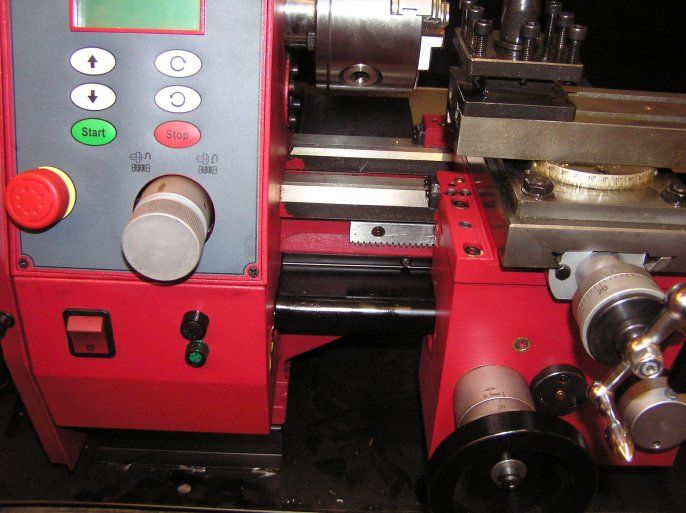
      The carriage on my brand new SC4 will not travel all the way toward the headstock but comes to a premature halt with a resounding hollow clunk (see first pic for amount of 'untravelled rack).

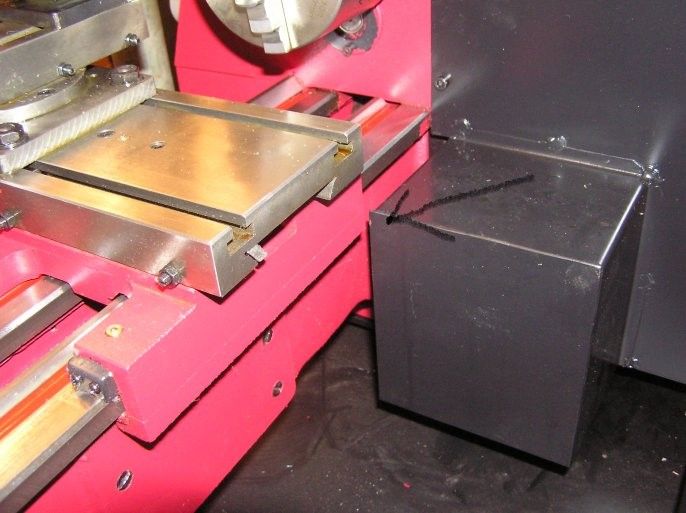
      The reason is obvious – the rear left corner of the carriage collides with the 'box' built in to the splash guard to shield the motor(?). Arrowed in second pic.

      There's an obvious fix – thirty seconds with an angle grinder and metal cutting disc would cut out about a 6x6x6mm corner of the box to allow the carriage past. Ah! but what would this surgery do to my warranty I ask myself.

      Any comments/suggestions please.

      p8020001.jpgp8020002.jpg

      #10359
      James Hall 3
      Participant
        @jameshall3
        #488739
        Hopper
        Participant
          @hopper

          I would talk to the guys at ArcEuro about that. If you cut that box open it will let swarf into the motor area inside which probably is not a good thing. You might be bettor off to elongate the cover's mouinting screw holes and slide the whole cover back that 6mm if you can, without opening up gaps for the swarf to go through.

          #488751
          not done it yet
          Participant
            @notdoneityet

            My reply is the same as on your other thread – I agree with Hopper’s first suggestion, but would not advise the latter suggestion before the former.

            #488760
            SillyOldDuffer
            Moderator
              @sillyoldduffer

              Is this stopping you from doing something in the real world, or just an observation?

              Faceplate work is my main reason for wanting to get the tool-post up close and personal with the headstock. In my workshop this is rare, in fact I've not used a faceplate since moving up from my old mini-lathe. Roughly I do 90% of jobs in a 3 jaw, 9% in a 4-jaw and 1% in a collet chuck, none of which would be inconvenienced by your motor guard.

              All machines have practical limitations. On my WM280 the saddle clears the motor guard, but collides instead with the telescopic swarf guard on the lead-screw. Could be removed if I needed the extra travel, but so far it's never happened. And the value of a clean lead-screw is considerable!

              Tempting I know for beginners to plunge into a detailed examination of a new tool, with some going so far as a full strip down. Ill advised in my opinion. Far better to detect issues by using the machine. Real faults can be tricky enough to pin down without chasing chimera. My advice, don't fret unless it matters! What are you planning to make with the lathe?

              Dave


              Edited By SillyOldDuffer on 02/08/2020 09:37:04

              #488857
              old mart
              Participant
                @oldmart

                You need to remove the splash shield and find out if there is a possibility of modifying it for the clearance required. It certainly looks like a small chamfer would do the trick, which could be sealed with a welded on plate, or even glued on.

                Edited By old mart on 02/08/2020 15:42:26

                #488864
                jimmy b
                Participant
                  @jimmyb

                  I've just a look at my SC4 and it clears the guard.

                  Jim

                  #488866
                  James Hall 3
                  Participant
                    @jameshall3

                    Thanks also for the responses here – there's some reaction I've put on my other (SC4 Cleanup) thread.

                    Hopper: elongating the holes would be a better way – though funnily enough the whole side of the 'box' facing the chuck – where you'd expect the swarf to be coming from – is completely open (ventilation for motor?) so the cut-a-bit-away solution would make little difference to possible muck on the motor.

                    SoD: will start – once I've learned to drive it – by making some fitments for my wood lathe. Always good to increase your repertoire on making/mending in any case. If I ever get good enough will hopefully start on some simple model making.

                    #488868
                    old mart
                    Participant
                      @oldmart

                      The guard might have enough internal clearance to just allow it to be moved rearwards the small amount necessary. I'm certain any sensible modifications would be allowed by ARC, they are a very good company. Phone them up and put them in the picture first.

                      #488869
                      john halfpenny
                      Participant
                        @johnhalfpenny52803

                        James, probably not an immediate issue, but make a plan to fix it – otherwise it will get in the way when you least need a problem

                        #488886
                        James Hall 3
                        Participant
                          @jameshall3

                          Jimmy B: Thanks, you confirm what is fairly obvious – that the carriage and 'box' should not foul each other. I'll see what arc say about it tomorrow.

                          Thanks for the link to the supplementary manual – the one provided really is unduly minimal.

                          #488892
                          Gary Wooding
                          Participant
                            @garywooding25363

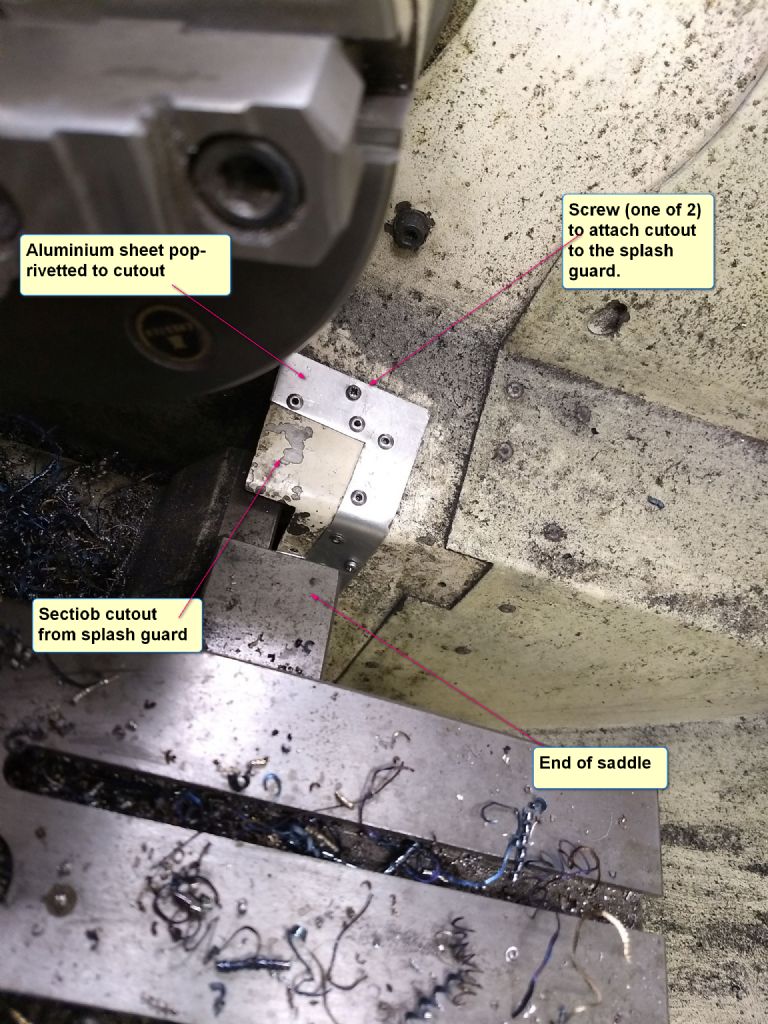
                            I had exactly the same problem with my 12×36 Geared head lathe. I needed to machine a backplate for an ER 30 chuck and the saddle was blocked by the splash guard. It was a big problem to remove the splash guard 'cos the lathe is right up against a pillar. When I eventually removed it I decided that I didn't want to repeat the effort ever again, so I cut a 'trap-door' out of the splash guard and shaped a bit of ally sheet suitable to pop-rivet to the cut-out trapdoor which could then be screwed to the splash guard. I can now easily remove the trap-door f I need to move the saddle close to the headstock.

                            splash panel cutout2.jpg

                            #489013
                            Howard Lewis
                            Participant
                              @howardlewis46836

                              As long as it does not encourage swarf to go where it it shouldn't, can the splashback be spaced away a little further?

                              A first job for the new lathe, making up the spacers, possibly only 6 or 8 mm thick, but increasing the versatility of the machine.

                              On my lathe, I had to cut and sleeve the shaft (operates a microswitch preventing running with the guard open ) carrying the chuck guard, When ER collet chucks are in use, the guard has to be removed to allow the Saddle to move to where tools can be used close to the collet chuck.

                              Howard

                              #489023
                              Gary Wooding
                              Participant
                                @garywooding25363
                                Posted by Howard Lewis on 03/08/2020 14:30:05:

                                As long as it does not encourage swarf to go where it it shouldn't, can the splashback be spaced away a little further?

                                In my case, no. The motor is right behind the splash shield. As you can see in the photo, I've already extended the guard away from the bed (to the right in the photo) in order to accommodate the DRO Z-axis.

                                #489027
                                James Hall 3
                                Participant
                                  @jameshall3

                                  PROBLEM SOLVED.

                                  First thing this morning a phone call from Ian at ArcEuro saying that he'd seen my post here and would help sort out the problem.

                                  An exchange of photosand some discussion produced a simple solution: as suggested by Hopper above, elongating the fixing holes in the guard with a file provided enough clearance to do the job.

                                  Great thanks to Ian and ArcEuro – it's a real and unusual treat in this day and age to receive such first-class, immediate, helpful and friendly customer service.

                                  And thanks to all here who responded helpfully to my appeal for help.

                                  #489029
                                  Howard Lewis
                                  Participant
                                    @howardlewis46836

                                    Good that you have it fixed.

                                    So now you have a more versatile lathe.

                                    Good on yer, and Arc Euro!

                                    This may help others with a similar problem.

                                    Howard

                                  Viewing 16 posts - 1 through 16 (of 16 total)
                                  • Please log in to reply to this topic. Registering is free and easy using the links on the menu at the top of this page.

                                  Latest Replies

                                  Home Forums Beginners questions Topics

                                  Viewing 25 topics - 1 through 25 (of 25 total)
                                  Viewing 25 topics - 1 through 25 (of 25 total)

                                  View full reply list.