Maybe some people can add some notes about Tom’s lathe

Maybe some people can add some notes about Tom’s lathe

Home Forums Beginners questions Maybe some people can add some notes about Tom’s lathe

Viewing 12 posts - 26 through 37 (of 37 total)
  • Author
    Posts
  • #209847
    mechman48
    Participant
      @mechman48
      Posted by Tom Findlay on 30/10/2015 01:53:07:

      To all …

      With my favoured target at this moment being the Warco WM250V lathe, do any of you experienced fellows have anything to say about that machine in comparison to the SP2129 lathe from SPG Tools?

      Thanks for the additional comments since my last reply.

      Tom.

      IMO to all intents & purposes it is the same machine as the Warco 290V-F, recoloured & rebadged for SPG, with a few alterations… 38mm spindle bore as opposed to 26mm, motor etc… I'm sure that 290 owners could clarify better, in either case you get a decent machine, its just a case of pick your colour, pays your money… I have the 250V-F of which I am quite satisfied to date.

      George.

      #209852
      Bazyle
      Participant
        @bazyle

        Quick response: Significant differences – this is where you need to get all the info into a spreadsheet to avoid flipping around several web pages. spindle bore and tapers, centre height etc. The Warcos have inverter drive owing to years of bad comments about DC drives I think which nudges the price up but is money well spent.
        There is also the 280 size and …V and …. not V not usre what the differences are there.

        When you have gone over the basic specs get detailed info on the screwcutting. They do not have the same levers and there are going to be some nasty surprises here if you can remember my post on a previous thread.

        #209862
        Ajohnw
        Participant
          @ajohnw51620

          There is a big and not that unusual comment on the SPG's page – reserve the right to change without notice. I sometimes wonder if they phone china and say what have you got cheap at the moment. Joke but why don't sites like that keep their web pages up to date.

          I'd 2nd Bazyle's comment about inverter drive. Also note that min speed on the SPG is 80 rpm. It probably has a brushed dc motor and driver built into it. Others will be brushless which shouldn't do anything with torque unless the motor hp is increased but probably does give better speed control at low speeds. The larger spindle bore on the SPG is an improvement and they have even knocked the top speed down bit to account for increased bearing size. The spg has a 3morse tail stock allowing bigger drills and reamers to be fitted. If you read the thread I posted a link to you should note that sometimes rather wild claims are made about motor power.

          The details on the warco suggest it has a low speed pulley setting which I feel is a good idea.

          In respect to the size of the spg lathe I suspect I would be seriously considering this one

          **LINK**

          That one is out of the hobby lathe range. In fact I decided some time ago that if I ever changed from my boxford it would be to one of these or a similar model. Being a gear head it should have adequate power for a lathe of this size – rather a lot more than the variable speed ones. I'd also expect it to be up to industrial standards but don't know if it is. This one would have the torque to handle things like 3 morse drills. I have my doubts about the SPG one. Being able to hold a big drill is one thing, having the power there to use it is another. Even the gear head would probably have to get up there in steps.

          John

          Edited By John W1 on 30/10/2015 11:42:18

          #209936
          Tom Findlay
          Participant
            @tomfindlay86659

            Thanks again, chaps …

            mechman48 (George): I've reached the stage where I think you're absolutely correct .. ye makes yer choice, pays yer money, and ye takes yer chance! One thing I've learned here is, as a beginner in all of this, I shouldn't set expectations of myself that are realistically out of reach at this time. It seems to me that the machines discussed here as potential solutions in my quest for a first lathe, all have their individual pluses and minuses, and that most of them, with the appropriate learning on my part, would serve the function I have in mind, very well. Expansion and refinement can be something to consider in the future.

            Bazyle: Thanks … I see the logic in using a spreadsheet to compare machine specifications, but to be honest, my organised notes are serving me well in that same purpose. The inverter drive, to my mind, is the way to go; I believe that type of prime-mover and its control system will support my needs very well. In terms of screw-cutting, I do not see myself doing an unusually large amount of that. However, the type of screw-cutting I do see myself doing — hopefully with frequent success — will predominantly be in metric sizes, and restricted to the smaller end of the thread, diameter, and length scales. This impression I have fits with the scale of fabrication and the odd repair job that I've been involved with up till now. I will, however, want to do other things, of course. But those things, if I do need help, would be the subjects of forum posts, further down the electricity bill.

            John W: The SPG website, yes … I did note their lack of information, which of course allows for sales and marketing wriggle room later on. I've seen these things many times before. Good point about the speed differences, and I agree with your conclusions on that. I also note the other things you commented on so, thank you. What I have done in the meantime is, I have dropped a note to both Warco and SPG, asking them to comment on each others products, the WM250V and the SP2129. I got a reply from SPG, but I'm still waiting for one from Warco. Here is what I got back from "Brian" at SPG … (comments welcome) …

            Thank you for your interest, you are not able to compare the WM250V machine with the SP2129 as SP2129 is a much larger spec, the machine we sell near to the WM250V is the SP2124 lathe @ £960 delivered.
            We leave you to choose the machine you buy, all machines from China are O.K if they are prepared for you, it is just a matter of who you decide to trust with your purchase. The difference between WARCO & SPG TOOLS is the price you pay.

            As to your link to the Warco GH550 lathe, it looks just great, and I wish I understood the implications of what differences a Gear Head Lathe brings to this party — I'm beginning to feel some heat so, is this another fanning of my flames, I wonder? I'm just not in the position to judge the GH550 at the minute, but I am now very interested.

            A couple of last things to mention …

            To all who have contributed in answer to my original plea, I wish to assure you that I have indeed read all of your contributions, and where recommendations have been made, including personal items of operating advice, I have looked into all of those.

            I'm going away for a few days, maybe more, so I won't be around. No doubt I'll have something to say soon after I get back, though.

            Cheers to all … Tom.

            #209958
            Ajohnw
            Participant
              @ajohnw51620

              The thing that would drive me up the wall on the GH550 is that feeds can't be changed quickly – change wheels have to be swapped around. It's something I can do very easily on my current lathe over a very wide range just by moving a lever and it's something I often do. As gear heads go the wabeco one is pretty unique. You could find ones without this limitation but price, weight and size go up.

              Gear heads and belt drive lathes have the advantage that cutting torque increases as the speed is reduced. Variable speed lathes don't offer that. Warco don't provide manuals for download but I would suspect that the WM250V has a substantial speed reduction available by changing a belt setting. That will increase the torque that's available. HP or watts is rpm * torque. Torque tends to remain constant on variable speed lathes so the watts drop as speed is reduced. It doesn't on gear heads. This may be why the gear head is heavier than the 250V, it will need the extra rigidity. It also appears to have a more complicated screw cutting gauge but the 250V may do that by changing the gears on it. Some lathes supply more than on indicator and they are easy to switch over either way. This isn't a problem on purely imperial lathes – one indicator can cut many pitches.

              The bigger SPG lathe has a bigger spindle bore, a plus for some but 25mm is generally regarded as a useful minimum. I suspect it uses a DC brushed motor. Both of the warco lathes use conventional ac motors. These will run at the same speed even when reversed if needed for screw cutting. The brushed motor speed is often reduced when they are run in reverse. AC motors usually last for a very long time. Easier to replace as are inverters if that fails.

              I linked to the gear head because if your interested in the larger spg then I feel that it offers a better balance all round but lacks the quick feed change feature which the 250V has. The induction motor and inverter will have increased the cost over brushed motor versions. There may be brushless motor versions around as well but I'm not aware of any at these sizes.

              Personally I'd ask for electronic copies of the manuals on any lathe you consider buying. I'd also ask if they are true metric lathes if that is what you want.

              John

              #210044
              Tom Findlay
              Participant
                @tomfindlay86659

                Okay, John … I really appreciate the time that you and others have taken to outline your views from your own experience, all of which have helped very much in my decision-making process. Also, from within all of this, it was *you* who sent me down the route I now find myself on, where I am able to come to a final decision. Therefore, as things stand, the timing being dependent on some other outside schedules, I am going to purchase a Warco WM250V lathe, together with some of its main accessories, these being the bits n bobs which I am also now having some help to decide upon.

                I've heard and read enough now about the Warco GH550 for me to put that to the side at this time. Everything considered, I do not feel that a more beefy solution such as this would be the best for us to have here.

                And finally, I have indeed requested from Warco more information on the WM250V, and I am waiting to receive that. The question of it being a 'true metric lathe' is one I will take up with my experienced friends up here in this currently windy and wet, but rather bright area of the Scottish lowlands!

                Thanks all, again …

                Tom.

                #210051
                Michael Gilligan
                Participant
                  @michaelgilligan61133

                  Tom,

                  I am not familiar with the Warco model designations, but hopefully some of this long term review will be of interest.

                  … I have linked to the ScrewCutting page, but there is much more.

                  MichaelG.

                  .

                  Start here: http://journeymans-workshop.uk/lathe2.php

                  Edited By Michael Gilligan on 31/10/2015 14:58:18

                  #210055
                  Tom Findlay
                  Participant
                    @tomfindlay86659

                    Actually, Michael, I've had this review pointed out to me before, by user 'ega', before all the stuff about Skodas crept into this thread. I read through it, learned some things from it, and made a few notes for myself, where as a result, that experience contributed to my current decision to buy that particular Warco lathe.

                    I really appreciate your input … thank you.

                    Tom.

                    #210057
                    Michael Gilligan
                    Participant
                      @michaelgilligan61133
                      Posted by Tom Findlay on 31/10/2015 16:08:30:

                      Actually, Michael, I've had this review pointed out to me before, by user 'ega'

                      .

                      Apologies to you both for the duplication … I usually try to avoid doing that blush

                      MichaelG.

                      #210061
                      Ajohnw
                      Participant
                        @ajohnw51620

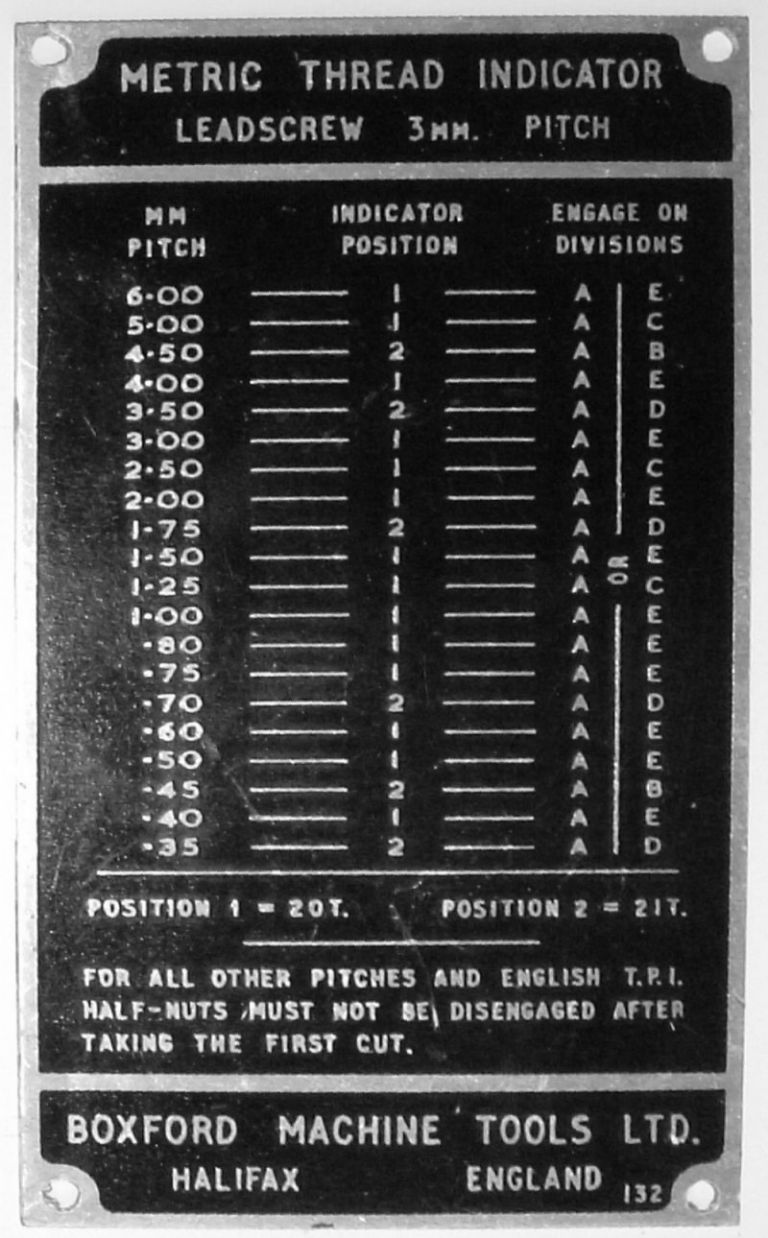
                        That sort of limitation on the screw cutting indicator on metric lathes isn't that unusual although I believe some of the mini lathes come with 2. As it has a 3mm pitch lead screw it is a true metric lathe. There has been some variation in that aspect at times. Even by Myford.

                        They are useful for other reasons. The half nuts should align with the lead screw when the marks on the dial line up. Some can be adjusted to do that by moving it slightly nearer or further away from the nuts. This saves trying to force the nut to engage with the tips of the thread in it rubbing on the outside of the lead screw rapidly wearing it out. I looked at a modern ex school boxford last weekend that I strongly suspect had suffered from doing that – it's not good for the nut. When I engaged the nut and put a bit of force on it using the saddle wheel it just jumped out. Ham fisted use and probably hardly any thread left in the nut. Other factors put me off but I would have wanted to look at the lead screw as well.

                        They can still be used for pitches they don't cater for. You'll think this is difficult but in practice it's easy. Start the cut by engaging the nut on an indicator mark. At the end of the cut disengage the screw cutting and turn the lathe off. Wind the tool out. Select reverse and when the same indicator line mark aligns re engage the screw cutting and run back to say 1/2" past the start. Set the next cut, select forwards and so on. The indicator will only turn a little when while the lathe is being stopped. It's far easier to work up close to shoulders etc done this way.

                        The indicator is essentially showing what are usually called repeat or sync distances – when n times the pitch being cut equals some integer number of lead screw pitches. This is what Boxford do but the marks on the dial aren't evenly space.

                        metric+thread+dial+chart.jpg

                        As usual they fail to mention using the indicator and reversing the lathe. That works because the indicator would have to turn a fair amount to loose synchronisation after the nut is disengaged and the lathe actually stops – a complete revolution at least.

                        John

                        #210064
                        ega
                        Participant
                          @ega

                          Michael Gilligan:

                          No apology needed and, indeed, I have to thank you for reminding me to look again at the screwcutting capabilities of this lathe.

                          #210079
                          Tom Findlay
                          Participant
                            @tomfindlay86659

                            Aye, nae problem whit sae ever, Michael … in fact, I thank you again for your interest and willingness to chip in yes

                            Tom.

                          Viewing 12 posts - 26 through 37 (of 37 total)
                          • Please log in to reply to this topic. Registering is free and easy using the links on the menu at the top of this page.

                          Latest Replies

                          Home Forums Beginners questions Topics

                          Viewing 25 topics - 1 through 25 (of 25 total)
                          Viewing 25 topics - 1 through 25 (of 25 total)

                          View full reply list.