Fundamental limit on timing resolution?

Fundamental limit on timing resolution?

Home Forums Clocks and Scientific Instruments Fundamental limit on timing resolution?

Viewing 25 posts - 1 through 25 (of 57 total)
  • Author
    Posts
  • #837932
    S K
    Participant
      @sk20060

      If an opto-interrupter uses IR light (say 1 um wavelength), and a pendulum’s velocity at bottom dead center is say 0.1 m/s, then a fundamental limitation on temporal resolution would be (simplistically) 1e-6/0.1=10 us.

      My last arduino-based timer had 200 ns resolution, or 50 times higher than the above. Using say a 405 nm laser improves resolution by a factor of 2.5 to ~4 us, which is still 20 times worse. And then there are FPGA’s, etc., for even faster timing and even more of a miss-match.

      Given all this, what benefits remain for very high speed timing resolution for measuring a pendulum’s (individual) periods?

      My answer? Use a relativistic electron beam, which can easily provide a million times higher resolution. 😉


      #837936
      Andrew Tinsley
      Participant
        @andrewtinsley63637

        Unfortunately your idea is impractical to implement!

        Andrew.

        #837937
        Bazyle
        Participant
          @bazyle

          The first option is to average – take the time over multiple passes. But I suspect you are trying to measure individual events to determine variations so the corollary is multiple detectors.

          Another angle might be to illuminate the target with a laser, mix the reflection with the incident beam to show the actual movement / position to say 1/4 wavelength. You then know what it is doing so can calculate when it is passing your (now virtual) interrupter point. and with advantage when all its motion deviates from expected theory, average, or last cycle.

          #837944
          Robert Atkinson 2
          Participant
            @robertatkinson2

            The wavelength of the light has no practical impact on the timing of a slotted opto sensor. Nor is it related to the speed of the object.
            The critical parameter is the frequency response of the sensor (assuming the rest of the system is at least s fast.).  A typical slotted opto with a transistor output does have a response time of around 10uS, but not for the reasons you state. The wavelength  limited response time would be much shorter a 1um wave length is a  frequency of 300THz or a period of about 3^-15 many orders of magnitude higher.
            Optical sensing at 10 MHz or 0.1uS is fairly simple. And for timing a pendulum constency is more important than absolute accuracy. A sensor that was always 569.5us slow (even if you don’t know how slow it is) is better than one accurate to 1us for this application.

            Robert.

            #837954
            S K
            Participant
              @sk20060

              Yes, I’m excluding averaging, and am questioning whether there’s a fundamental resolution limit when measuring a single swing.

              And yes, of course there are many factors at play in the use of optointerrupters. However, I don’t agree that the wavelength has “no practical impact,” at least unless you are saying that those other factors swamp it (which they quite possibly do).

              The wavelength of light directly affects spatial resolution. For example, if a typical microscope used 1 um light, it would provide only ~5 um of spatial resolution. Then you basically can’t measure anything finer than that, or half that anyway. So if you use a microscope to measure the crossing, you can’t tell where it is better than a certain limit due to the wavelength of light. Then, since you don’t know where it is, you can’t say when it was there!

              Once spatial resolution is limited, the speed of the object (flag in this case) is relevant, since with a given wavelength and hence a spatial resolution limit (e.g. 1 um*), time_resolution=spatial_resolution/flag_speed becomes relevant, so for example higher speeds affords higher time resolution.

              The accuracy of interferometry would also be limited by the wavelength of light used, wouldn’t it? After all, if the wavelength is much longer than the intended resolution, say 1m, you will have great difficulty observing any change in the interference pattern (unless you are LIGO, anyway). But still, with 1 um light and 0.1 m/s, you would count one full wavelength (fringe) every 10 us at/around bottom dead center, which by itself is not difficult to do. Then, smaller wavelengths would produce counts faster and hence would have higher timing resolution.

              I was joking about the electron beam, but it would be cool. 🙂

              * 1/lambda as spatial resolution is just a crude but pertinent approximation. The reality when using an opto is almost certainly much worse.

              #837960
              Michael Gilligan
              Participant
                @michaelgilligan61133

                I concur with your general point, SK

                … in simple terms, the wavelength of the light is equivalent to “the thickness of the pencil” when you are plotting a graph !

                MichaelG.

                #837981
                Robert Atkinson 2
                Participant
                  @robertatkinson2

                  But you are not measuring distance with a slotted opto, you are measuring light level.
                  Even with distance you can measure less than a wavewlength. For eample the Renshaw machine measurement systems have a resolution of 1nm using a 632nm (red) laser. And that is on a target moving at 4m/s.
                  I’ve used the Renishaw system professionally and have some experience of the earler Hewlett Packard systems.

                  Robert.

                  #837986
                  Michael Gilligan
                  Participant
                    @michaelgilligan61133
                    On Robert Atkinson 2 Said:

                    But you are not measuring distance with a slotted opto, you are measuring light level.
                    Even with distance you can measure less than a wavewlength. For eample the Renshaw machine measurement systems have a resolution of 1nm using a 632nm (red) laser. And that is on a target moving at 4m/s.

                    […]

                    I guess that’s why Renishaw has achieved near “world domination” in this field.

                    MichaelG.

                    #838006
                    SillyOldDuffer
                    Moderator
                      @sillyoldduffer

                      SK’s example may not be ideal, but opto-sensors do have limitations.  In a pendulum clock, they are much faster and less intrusive than a mechanical escapement, so taking measurements with doesn’t disturb the bob, and tiny variations of period are detected.

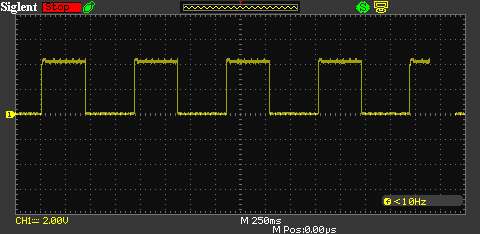
                      What causes tiny variations is quite interesting. Temperature, air-pressure, draughts, circular error, impulse disturbances, vibration, gravity, turbulence and others.  The accuracy, or rather speed and repeatability of the photo-sensor becomes relevant.   I’m using a Sharp GP1A53HRJ00F, typical rise time 0.01uS, fall time 0.005uS.  The device outputs a 5V logic signal:

                      mk2sqwave

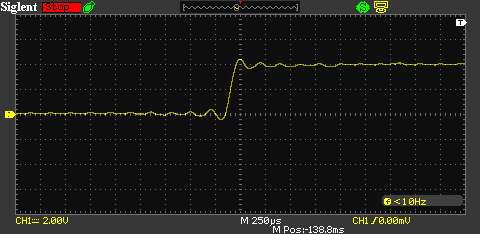
                      Rise and fall look steep with the oscilloscope sweeping at 250mS, but zooming in at 250uS shows it takes 210uS to get from zero to 5V.

                      mk2sqwavezoom

                      The Sharp triggers at 1/3 supply voltage, so about 100uS late.  As Robert says doesn’t matter as long as the switch point is consistent.  But various things move the switching point slightly, causing noise, which SK’s 200nS system will see.  They include:

                      • variations in supply voltage (regulate and decouple)
                      • ambient light changes the sensitivity of the sensor, moving the slope (shield the sensor from light)
                      • temperature might move the slope, electronically, or by expanding and contracting the sensor’s mount so it moves.  (thermostatic control)
                      • the output of the IR LED declines slowly over time, probably causing a slow phase shift.

                      SK has achieved 200nS, which is good.  100nS is reliable with a OCXO clocked picPET, and 62.5nS less reliably with an Arduino 2560, and maybe better with a faster microcontroller.  I’m pushing for 30ns at the moment with GPS timestamps, but they jitter.  However it’s measured my pendulum’s period is surprisingly noisy – known faults, but some of it may be sensor related.   John Haine has suggested moving away from the GP1A53HRJ00F…

                      This stuff is addictive.  The closer you look at pendula, the more you find!   SK asked “Given all this, what benefits remain for very high speed timing resolution for measuring a pendulum’s (individual) periods?”, resulting in me adding yet another problem to by TODO list.

                      Averaging is good in ordinary clocks because most variations cluster equally around a resonant point and balance each other out.  Great until you try and build a pendulum clock that keeps time to better than 1 second per year, which requires very careful attention to what’s causing tiny errors.  Then averaging becomes the enemy, because it hides problems.

                      Dave


                      #838037
                      S K
                      Participant
                        @sk20060

                        It is absolutely possible to measure distances smaller than the wavelength of the light via interferometry. LIGO does so using ~1 um light, to an incredible degree, often portrayed as “a thousandth of the diameter of a proton.” That’s small! They use fancy techniques such as “squeezed light”, etc., but the basic method is that they don’t count fringes (way too big), they detect tiny changes in interference after amplification by the enormous arm lengths (4km) and increasing that again by bouncing the light back and forth many times.

                        As pointed out, even on a table-top you can get better than the wavelength of the light. But the resolution is still dependent on the wavelength, as sensitivity becomes worse with longer wavelengths vs. shorter ones.

                        The microscope example (a perfectly valid method) should make it clear that the wavelength can limit measurements. You can’t see where the flag is better than the wavelength-dependent limit, and hence you can’t measure the time that it crosses BDC to better than that precision (or half that, anyway).

                        For the opto case, imagine a single-photon example: you are now trying to detect whether a single photon has interacted with the flag (hit it or missed it). You again can’t do this to better than the wavelength of the light, because the photon is not a tiny solid ball that cleanly passes the flag or not, its position is fundamentally uncertain to the same degree as in the microscope case.

                        Furthermore, the flag and optics introduces diffraction, which occurs in both the single-photon case and the flood-of-photons case. Hence the Rayleigh criteria (d=1.22*lambda/NA) means that longer wavelengths causes a larger spot size d. This means that the edge that the opto is trying to detect cannot be sharper than a limit set by the wavelength, adding essentially the same uncertainty limited again by the wavelength. (The opto will have an utterly miserable NA, too.)

                        I am not completely convinced, though. I’m really asking for confirmations or rebuttals. The transition that an opto tries to detect is fundamentally fuzzy, but what’s nagging me is whether this can this be overcome by averaging over many photons? I don’t think so, just as more light doesn’t improve the microscope case past the wavelength-limit, but I’m not certain.

                        (An aside: Picpet’s least count is 400ns, not 100ns.)


                        #838072
                        John Haine
                        Participant
                          @johnhaine32865

                          Dave mentioned my reservations about the GP1A… device.  I’ve used that a few times, my “Arduinome” clock has two, one sensing the pendulum.  I had a lot of problems with ambient light sensitivity and in the end I had to hide the sensor and bob away by blocking off some of the window in the door.  The sensor that I’m working with at the moment is home-made, it has IR LEDs and IR avalanche photodiodes mounted on little PCBs embedded in a brass block.  Both types of diode are recessed into the block surface (5mm home) and fire through a 3mm aperture.  There’s a 3mm slot for the sensing vane which closes off the light paths completely except for a narrow slot that uncovers the appropriate light path.  There are 3 paths, one for the BDC sensor, one for “phase”, the third for amplitude.  I’m amazed at the sensitivity of modern LEDs and PDs – 10 mA current in the LED firing straight into a PD through the apertures and the gap can produce 5mA photocurrent in the PD.  This is sensed by a 10k resistor, so the PD fully saturates, and there is also a Schmitt trigger buffer to further square up the pulse.

                          This design seems to be much more immune to ambient light.  The PDs incorporate IR filtering (black plastic encapsulation), the vane hides all the PDs except the one you want to trigger, the block is mounted so the light paths are vertical, and the slot horizontal with the vane swinging in a horizontal plane sticking out from the pendulum.  Finally since ambient light is likely to be coming from above the LEDs are mounted below shining up into the PDs, so it is very hard for direct ambient light to to illuminate the PDs.  The inside of the slot is painted black.  One downside is that aligning the vane to swing with minimal clearance from the top, bottom and back of the slot is a pig!

                          I do wonder about just how precisely we need to measure pendulum times.  When Shortt and Fedchenko were setting records for mechanical clocks they had to use transit circles and the like.  Now we can measure to a fraction of a microsecond and fret about whether that’s good enough to match the performance they achieved!  Is the reason for this obsession with resolution simply that we can?  At the end of the day I just want to make a clock with a dial that always shows the right time as far as I can tell by eye, and just occasionally I’ll check it and perhaps make a small correction.  There is a connection between the “micro” variations of timing and the long-term average that you see on the dial but it isn’t altogether clear what it is and what precision we really need.

                          (An aside, I have another GP1A sensing my lathe spindle for screwcutting, it’s fine there as hidden away under the change wheel cover.)

                          #838092
                          S K
                          Participant
                            @sk20060

                            Here I was, waiting for John to step in and definitively clear up the question, and he dodged it! 😉

                            I had the same experience with my own home-made optointerrupter (discussed in a thread here long ago). It also used IR light. I had added an op-amp for amplification, and then found that the (invisible) light was so bright, and the detector so sensitive, that it quickly saturated without the need for any amplification – a Schmitt trigger will do just fine, as John found.

                            My question – is there a fundamental limit, and what would it be – is related to the “how much precision is needed” issue. It can be rephrased as “are we fooling ourselves with too much empty precision?” I had contemplated using an FPGA instead of an Arduino, as one could easily get 10 ns time resolution or better. But would it actually provide any meaningful improvement? It would seem not at all if limited by the wavelength of light, and perhaps even the Arduino approaches might have “too much” resolution.

                            What, in people’s experience, seems to be about the lowest swing-to-swing noise found in a clock pendulum?

                            #838200
                            John Haine
                            Participant
                              @johnhaine32865

                              Sorry to disappoint SK!

                              I think we might reverse the question and ask “what might be causing clock phase noise and what is the likely magnitude?”

                              I think there are 3 main contenders: barometric variations, noise injection from the environment and the clock itself, and gravity changes.  Certainly the first and last of these can be characterised knowing environment data.

                              Then, how would we characterise them?  One measure would be Allan Variance – so we would want the AV curve for the measurement system to be well below (an order of magnitude at least) that from the above causes for the tau span of interest.  Again, the first and last can be characterised.

                              Then I think we could characterise the measurement system.  One approach with slotted optos might be to drive the LED with a clean pulse stream (e.g. the PPS output from a GPS) and look at the PD output with your measurement system for various levels of e.g. ambient light etc.  This wouldn’t of course emulate any “diffraction” effects.  But if the resulting AV curve was well below the expected system curve we might ignore these. It might also be possible to drive a vane at a constant speed of 60 rpm with a slot to interrupt the opto path?  Actually it doesn’t need to be at a specific speed, but a constant one.  How could we do that….?


                              #838241
                              S K
                              Participant
                                @sk20060

                                I had looked at optos using clocked light sources earlier.

                                The popular Sharp unit had 9 us latency (time between light turning on/off to the output on/off) and 22ns jitter in the falling direction, chosen since it has a much faster transition than the rising one.

                                My custom one had 280 ns latency and ~550 ps jitter. This was after an op-amp, which would be quite a bit slower than the Schmitt trigger that would suffice instead.

                                I suggest that the jitter in the custom case is too minimal to have any noticeable effect on measuring the pendulum.

                                The Sharp case is about 40x higher but the jitter is still probably too small to be readily noticeable, as it’s a fraction of the least count of ~200-400 ns or so that people are using. If stable (and in this test it seems so), the latency of the Sharp may not matter either, but it is long enough to at least be watched as a concern.

                                I don’t think these measurements accurately reflect the job that the opto is doing, though, as it’s too ideal. For one, the optics will hardly matter, since the light source is centered, etc., and the change in light intensity takes perhaps 10 ns since it’s electronic vs. mechanical.

                                The pendulum case has a moving flag, which shapes and presents the light in a very different fashion. The light, e.g. through a slit, is diffracted and spread out, causing a slower ramp of the light reaching the sensor, e.g. in a Gaussian fashion. It also crosses a sensor with a certain finite size, orientation and shape, rather than a point, which further shapes the charge that is accumulated.

                                I’ve speculated about various ways that timing can be improved. One thought was to use as small a pinhole as possible over the sensor. This would reduce the impact of the shape of the sensor. It would not reduce the impact of the light’s own shape (e.g. due to diffraction). Using blue light instead of IR would improve the latter by a factor of 2.5 or so, though I’m uncertain about how important diffraction may be.

                                #838246
                                S K
                                Participant
                                  @sk20060

                                  I did a little math on the diffraction question for John’s case of using a slit. The result depends heavily on the slit width and the space between the slit and the sensor, and all cases are much different than turning the light on and off electronically.

                                  With 1 um light, a 10 um slit (probably smaller than John’s, but readily available for purchase), and a sensor 3 mm away, the approximate width of the diffraction pattern would be 120 um. At 0.1 m/s, it would take the flag 600 us to cross one half of this width (i.e., the time from darkness to peak brightness). This is certainly long enough to be a concern.

                                  With a 100 um slit, the diffraction pattern would be much smaller, at maybe 6 um on each side, with the center 100 um being relatively flat. At 0.1 m/s, the edge diffraction would be passed in 60 us. This is still hundreds of counts at 200-400 ns per count, and therefore deserves some consideration.

                                  For the case of a single edge, diffraction still occurs, but not interference (no light and dark bands, just a blurred edge). The math is about the same as the 100 um slit case, so it would also take ~60 us to cross the single blurred edge.

                                  A thought or two: using a narrow slit appears worse than a single edge, and a wide one is little different than a single edge. Using blue light, e.g. from a 405 nm laser, would improve the numbers by about a factor of 2.5.


                                  #838278
                                  SillyOldDuffer
                                  Moderator
                                    @sillyoldduffer

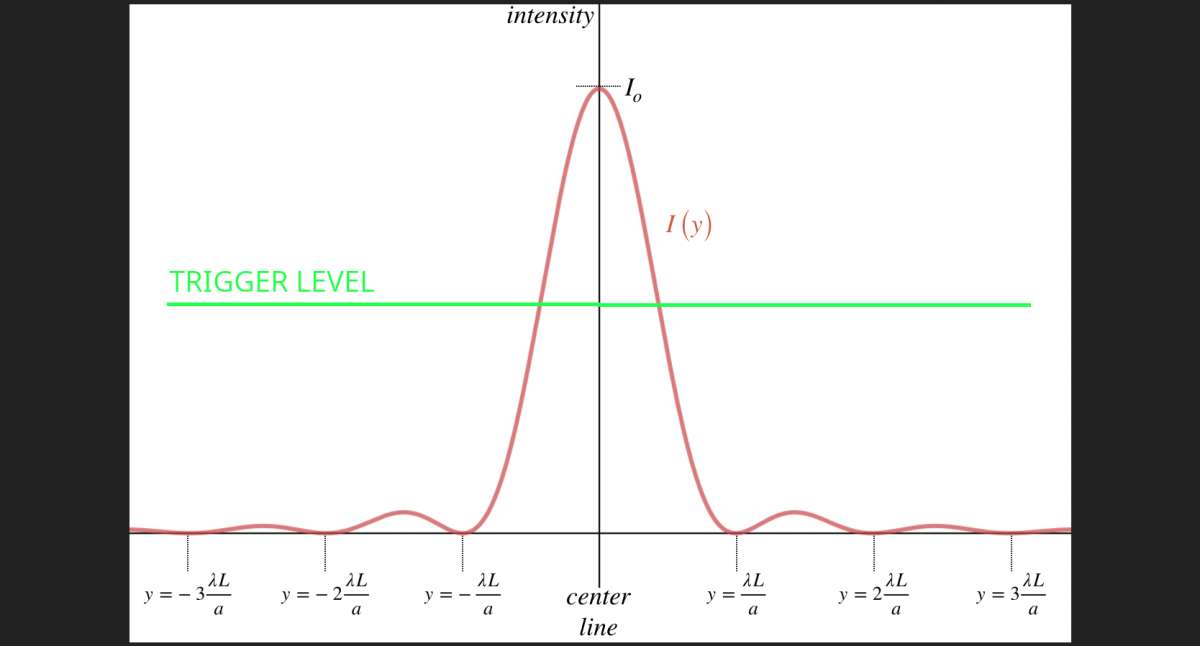
                                    Though SK has me worried, I’ve never noticed anything in my experiments suggesting error due to diffraction patterns.  Is this because the electronics (comparator or Schmitt Trigger) react at a level well above the diffraction side-lobe intensity?   The sensor simply doesn’t see them, cos it’s as blind as a bat!

                                    Screenshot 2026-02-18 at 16-58-38 single_slit_intensity.png (PNG Image 1309 × 888 pixels)

                                    Trigger level normally set at 1/3rd or 1/2 supply setting, which is a strong anti-noise filter, whatever the cause.   Then the detector fires more-or-less reliably at the same point as the main lobe rises in intensity.

                                    OMG though, Schmitt triggers are affected by noise on the supply and aren’t linear.  Is a comparator better for high-precision measurements?  I don’t know.

                                    Aargh!

                                    Dave


                                    #838316
                                    S K
                                    Participant
                                      @sk20060

                                      Your mathematically-perfect plot makes things look too easy.

                                      For the diffraction with interference case, the side-lobes are lower than your threshold as you show it, which shouldn’t be difficult to dodge. For the diffraction without interference case, you will only have something similar to the central portion, the pertinent part of which would be S-shaped when using a single edge or a wide slit.

                                      Either way, it’s largely the slope of the side of the center lobe that is the concern. The problem is that crossing the width of the left half of it can take upwards of 60-600 us (with 3 mm gap), which is 300 to 3000 counts at 200 ns per count. With say a 1V signal, that’s about 0.3 to 3 mV per count. That isn’t exactly horrible, but at the very least you would want the noise of your sensor and electronics to be lower than that.

                                      Also, there are many other real-world issues:

                                      * Is the threshold really set at an ideal position?

                                      * Is the gap larger? The problem scales with that.

                                      * Is the light columnated? If not, you will have further blurring just due to light entering the slit from different angles, which could dominate diffraction if the LED’s emitter is more extended in area.

                                      * The sensor is not a point either, and its size, shape and orientation will impact measurements too. It could easily be a bigger problem than diffraction, as few sensors are likely to be smaller than a mm or two in width. This means that even if the light was perfectly and uniformly columnated (but intensity is typically Gaussian), without diffraction, there would be a ramp in the current provided by the sensor as the flag moves past. Even a 1 mm ramp would take 0.1 second to cross, or 500,000 counts at 200 ns per count! With the same 1V signal, that’s 2 uV per count, and your noise problem just got 1,000 times worse.

                                      * Even using a slit instead of a flag, the sensor-size and orientation can be a problem. If square and tilted compared to the slit, you will get another ramp just due to the tilt, with similarly-bad looking numbers. If round, the situation is more complicated. This is why I tried using a pinhole over the sensor – to make it function closer to that of a point sensor.

                                      … and probably lots more …

                                      Maybe the math will work out such that there isn’t much to worry about after all, but it’s interesting and probably worth the effort to think more about this and ways that things can be improved, such as:

                                      * Use a single-edge or relatively broad slit, as a very narrow slit causes too much diffraction.

                                      * Use columnated blue light.

                                      * Even better, focus the light to a point right at the flag. Then the light that the sensor receives would be all or nothing. This sounds like an excellent solution to most or all of the above concerns, except that it would probably be quite difficult to implement in practice.

                                      etc…

                                      #838322
                                      Julie Ann
                                      Participant
                                        @julieann
                                        On SillyOldDuffer Said:

                                        …..Schmitt triggers are affected by noise on the supply and aren’t linear.  Is a comparator better for high-precision measurements?

                                        A Schmitt trigger is a comparator albeit with hysteresis. By definition neither a Schmitt trigger nor a comparator are linear.

                                        Most common logic families expect an input signal to move from one level to the other level smoothly and quickly. Datasheets will specify a maximum transition time. If an input signal sits in the middle of the voltage range, neither zero or one, then it is possible for excess current to be drawn, and the circuit might oscillate or even destroy itself.

                                        For a circuit where the output cannot be guaranteed to switch quickly, like an optocoupler, then for convenience a Schmitt trigger is added to simplify driving further logic circuits.

                                        Julie

                                        #838347
                                        S K
                                        Participant
                                          @sk20060

                                          I’m sure Duffer meant a high precision analog comparator with an externally-adjustable threshold.

                                          The threshold (two, actually) of a Schmitt trigger, which is just a slightly fancier inverter, is defined inaccurately by certain transistor parameters that you can’t change. It’s only useful in this application if the sensor already very quickly saturates to essentially digital levels.

                                          #838367
                                          Robert Atkinson 2
                                          Participant
                                            @robertatkinson2

                                            A Schmitt  triger is not always a logic IC with fixed levels.

                                            All this talk of diffraction patterns etc is irrelevent unless they change during operation.
                                            For this application we daon’t care, within limits, how fast or precise the sensor is. What matters is how stable / repeatable it is.
                                            Light levels, flag position, supply voltage, temperature variation are likely to be more significant.

                                            Robert.

                                            #838451
                                            Julie Ann
                                            Participant
                                              @julieann

                                              The Schmitt trigger was invented in 1934 before logic circuits as we know them existed, and before Shannon codified the design of logic circuits using Boolean algebra.

                                              There is no doubt that a Schmitt trigger is a comparator with hysteresis. Of course a Schmitt trigger as implemented in a logic IC, or an optocoupler, is not as well defined as a discrete circuit designed with a comparator IC, but they essentially do the same thing.

                                              Julie

                                              #838493
                                              S K
                                              Participant
                                                @sk20060

                                                I think there has been a long-standing baseline presumption that “it’s optical, therefore virtually perfect, or at least certainly good enough for this application,” without looking too much deeper.

                                                But “unless it changes” is what “all this talk” is about. If, as in the microscope case, it’s clear that the wavelength of light does limit spatial resolution, and does so to of order ~1 um, then it’s also clear that it introduces fundamentally-irreducible noise in timing measurements. If, in the microscope case, it’s actually 2.5-5 um, or even if it’s 1 um, and if the same applies to optos, then it sounds serious enough to investigate. We could be fooling ourselves about the resolution required, or even if the swing-to-swing noise we measure is actually from the pendulum’s own motion.*

                                                The finer details of the opto-coupler and how to best use one are also worthy of exploration. Is using a slit like John’s latest better or worse than a flag? Should it be a narrow or wide slit? Is the distance between the flag and emitter or sensor important for more than just stray light issues? Does the wavelength matter? Does the light emitter or sensor size and orientation matter? Would tweaks like focusing optics or pinholes, etc., help?

                                                Also, the question keeps getting raised: Just what is the level of timing precision that is required for this application? And, related: what is the floor on measured per-swing timing variation that people have found?

                                                * I’d naively believe that a free pendulum in a near-ideal environment (vacuum, etc.), should have incredibly low swing-to-swing noise, far lower than the numbers I’ve seen here and elsewhere.

                                                #838496
                                                SillyOldDuffer
                                                Moderator
                                                  @sillyoldduffer
                                                  On Julie Ann Said:

                                                  There is no doubt that a Schmitt trigger is a comparator with hysteresis. Of course a Schmitt trigger as implemented in a logic IC, or an optocoupler, is not as well defined as a discrete circuit designed with a comparator IC, but they essentially do the same thing.

                                                  Julie

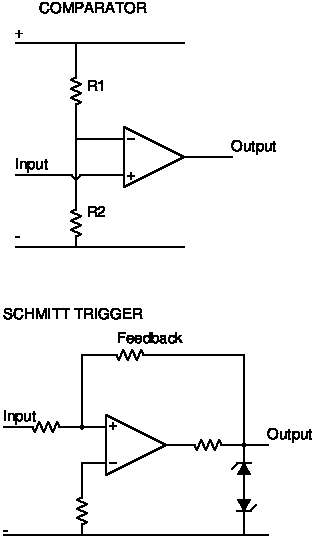
                                                  Do the same thing?  Not as I understand it.  Although both are based on comparators, the circuits are different and so is how they behave:

                                                  compschmitt

                                                  A plain comparator switches when the input signal passes the reference voltage set by R1:R2, which can be controlled accurately by the designer.   Great, unless the input wobbles noisily around the reference voltage causing the comparator to switch wildly in response.  Though the circuit responds well to clean input it has poor noise immunity.

                                                  A Schmitt trigger increases noise immunity with feedback. When the input passes the up or down reference voltages (two references, not one), output is added to the input, forcing it past the switching points even if the actual input is wobbling.  Good noise immunity, but I believe the cost is reduced time precision – the detect point is less repeatable.

                                                  Question is does hysteresis improve or degrade the detection accuracy of a swinging pendulum?

                                                  I think the answer depends on the noise level. My Mk1 clock suffered badly from what turned out to be internal reflections.   IR from the LED was bouncing off the shiny metal structure of the clock and from the moving bob.  Though I didn’t prove it, I’m fairly sure my comparator detector was confused.  Cure was to reduce the power of the LED, fit slits, put up blackened internal shields,  and blacken the shiny surfaces.

                                                  I did prove ambient light is a major problem in that it moves the trigger point by desensitising the sensor.  Cured by enclosing the pendulum so it swings in the dark. I used a 4mm thick black PVC soil pipe, which should absorb most IR, except it warms up and re-radiates inside.  I guess the consequence is heating of the internal structure rather than disturbing the sensor, but I don’t know!

                                                  Plan A was to wrap the pipe in Aluminised bubble-wrap, but I’ve gone off PVC for other reasons.

                                                  The Mk2 clock uses a Sharp Opto interrupter.  Works well except I’m not convinced it out-performs my original comparator running in the dark.  A comparator may be better when the noise level is low.

                                                  Measuring a pendulum accurately and precisely is surprisingly difficult.  Stuff that normally doesn’t matter requires attention when working in nanoseconds or less.  In this application I don’t know how to choose between a precision comparator and a Schmitt Trigger.  Be delighted if Julie or anyone else can explain the pros and cons.

                                                  Dave

                                                  #838520
                                                  Michael Gilligan
                                                  Participant
                                                    @michaelgilligan61133

                                                    … Meanwhile, for prep.

                                                    https://www.ti.com/lit/ab/scea046b/scea046b.pdf

                                                    MichaelG.

                                                    #838551
                                                    Julie Ann
                                                    Participant
                                                      @julieann
                                                      On SillyOldDuffer Said:
                                                      On Julie Ann Said:

                                                      There is no doubt that a Schmitt trigger is a comparator with hysteresis. Of course a Schmitt trigger as implemented in a logic IC, or an optocoupler, is not as well defined as a discrete circuit designed with a comparator IC, but they essentially do the same thing.

                                                      Julie

                                                      Do the same thing?  Not as I understand it.  Although both are based on comparators, the circuits are different……

                                                      SoD: As you earnestly commented recently in another thread, please read my post carefully before commenting.

                                                      I clearly said that a Schmitt trigger is a comparator with hysteresis, yet you have drawn a Schmitt trigger and a comparator without hysteresis.

                                                      In my experience it is rare to use a comparator without some hysteresis. Even a few millivolts helps to prevent spurious output transitions due to noise. Of course Schmitt triggers, as used in optocouplers, often use significantly more.

                                                      Julie

                                                    Viewing 25 posts - 1 through 25 (of 57 total)
                                                    • Please log in to reply to this topic. Registering is free and easy using the links on the menu at the top of this page.

                                                    Latest Replies

                                                    Viewing 25 topics - 1 through 25 (of 25 total)
                                                    Viewing 25 topics - 1 through 25 (of 25 total)

                                                    View full reply list.