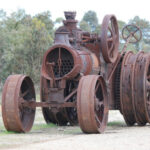
Emma Victoria boiler end of the road

Emma Victoria boiler end of the road

Home Forums Locomotives Emma Victoria boiler end of the road

Viewing 13 posts - 26 through 38 (of 38 total)
  • Author
    Posts
  • #841048
    Bill Dawes
    Participant
      @billdawes

      Good point Rick, I will check dimensions, maybe I used figures for a static seal rather than a moving one but I see the logic you make, I guess the compression from an O ring could be more than that from rings.

      Best regards

      Bill D.

      #841063
      Nigel Graham 2
      Participant
        @nigelgraham2

        O-rings are made for sliding, rotating or static sealing and likely, never the trio may meet.

        So you need the appropriate type for the duty then make the groove to the recommended specifications for that. Not just pick up rings the right diameter and sort of guess the groove profile, or use specifications likely for a different task.

        #841065
        duncan webster 1
        Participant
          @duncanwebster1

          There are also X rings

          https://eriks.com/en/know-how-hub/blogs/when-do-you-use-an-x-ring/

          Which are claimed to be better than O rings in piston sealing. Anyone tried them in a steam engine?

          #841116
          Rick Hann
          Participant
            @rickhann79631

            If you want to go down this “rabbit hole”, I suggest you Google “HMEM Model Engine O-Ring”.  There are several lengthy threads where posters have discussed the pros and cons of using O-Rings for model engines, both steam and combustion as well as how they machine the grooves.  There are those who recommend following manufacturers specifications (I doubt that they have ever followed their own advice and successfully constructed an engine using published groove dimensions).  Most report success using a O-Ring “squeeze” of 5% or less.  I try for 2% to 3%.  I find it interesting that no-one has mentioned the importance of measuring (knowing) the actual bore dimension.  I guess that most of you are better machinists than me because my bores are often 2-3 Thousandths larger or smaller than planned when I get done boring and lapping the bore.  Knowing the actual bore diameter (piston diameter, not so much) when calculating the groove depth needed to get the required squeeze (compression).  I have also found that measuring the actual O-ring diameter is also helpful when calculating groove depth.  A few thou can make a difference!  Nuff said!  Rick

            #841210
            Bill Dawes
            Participant
              @billdawes

              Talking to a guy the other day, he is an ex car mechanic and he asked why I cant use copper nickel brake piping for steam lines as it is so easy to bend, couldn’t think of a logical reason why not, it’s not strength presumably as it has to withstand much higher pressures than we are dealing with and presumably highly rust resistant. Any ideas guys?

              Bill D.

              #841218
              noel shelley
              Participant
                @noelshelley55608

                He would be talking about Kunifer 10 in 4.75mm OD, there are other sizes. He has presumably not used copper pipe or he would know it is easier to bend copper. Kunifer 10 is resistant to corrosion and good for over 1000 PSI but will be more costly. Noel.

                #844615
                Bill Dawes
                Participant
                  @billdawes

                  Hi guys, had exciting phone call today from Western Steam, my boiler is finished so raiding my Swiss bank account to pay for it and collect.

                  Now having to seriously sort out plumbing etc. Pondering on flexible pipe(s) from tender, any advice on tubing type and connectors, normal nut and cone with tail to fit tubing or some form of twist fit connector?

                  Regards

                  Bill D.

                  #844626
                  Nigel Graham 2
                  Participant
                    @nigelgraham2

                    Congratulations!


                    I’d  use a twist-fit connector designed for repeated connection and disconnection. A union is intended to be connected and stay connected.

                    I don’t know your particular locomotive but miniature locomotives typically have three connections from the tender:

                    1) To the axle-pump (if fitted. Some use two injectors instead.)

                    2) Injector(s)

                    3) Delivery from a hand-pump in the tank.

                    Of these only the hand-pump connection takes any significant pressure (above boiler pressure in fact), and that’s where you’d use the twist-fit or similar clip action.

                    Alerternatively, you can use a repeat-use type screwed connector, often one that seals by a small O-ring or flat rubber washer between two flat faces, the ring washer surrounding a hollow spigot on the upstream side that mates with a counterbore in the downstream flange. Rather as on small cartridge-gas tools like picnic-stoves. I have not seen connectors of this type made for model locomotives but there is no reason you could not design and make your own.

                    The axle-pump and injector feeds are partly gravity, partly suction. It is common to use here, simple silicon-rubber hose pushed onto smooth pipe stubs an inch or so long. Give the stubs nicely rounded end edges to avoid scraping the hose wall.


                    That feeding the injector does need be air-tight though, as even a tiny air-leak into the water line under the suction created by the injector, will prevent the device from working properly. The most likely place for such a leak is a push-on hose connection; but a silicone-rubber tube of appropriate size on a pipe tail of good cylindricity and surface finish is usually reliable.


                    Clues that air is being drawn into the injector are difficulty adjusting the water and steam valves to get it to work at all, and irregular running. Also, the injector may chirrup like an excited guinea-pig when it does manage to overcome the air-leak. It should be practically silent.

                    The first two can also inidcate over-warm feed-water, partial blockages including scale in the cones, or the injector’s internal, non-return, starting valve not seating fully.

                    #844630
                    noel shelley
                    Participant
                      @noelshelley55608

                      Gates reinforced fuel hose will work for your water connections, it is available in 3-4-5-6-8-10 mm. There are stainless miniature jubilee type hose clips that will seal this type of pipe well or use O clips and close with wire cutters (carefully ). There is an MPD branch in Weymouth I believe. Make brass strainers for the intakes.   Noel.

                      #844639
                      duncan webster 1
                      Participant
                        @duncanwebster1

                        <p style=”text-align: left;”>If you have an axle pump you’ll need a bypass return as well. For the hand pump I used polyurethane pneumatic tube, 4mm OD,  plenty big enough for a hand pump, and a lot more flexible than the usual nylon stuff. Mine is yellow, but it looks as though it comes in a range of colours.</p>

                        #844710
                        Nigel Graham 2
                        Participant
                          @nigelgraham2

                          Noel –

                          The important point here is easy connection and disconnection, and reliable connections, on two vehicles usually separated for transport between track and home.


                          Worm-drive or crimped clips are fine on one end, but are “permanent” so not best on both ends when the hoses are connecting a tender and locomotive to be separable for transport.

                          To give our own club’s example:

                          Our 7¼” g. “Wren” is operated with a driving-truck holding a water-tank to augment the engine’s own saddle-tank and to feed the injector. (Water in a saddle-tank on a hot Summer’s day can become too warm for a small injector.)

                          It has a polythene or silicone hose for the 3/16″ o.d. pipe used for the vacuum-brake connection. The train vacuum-connectors are push-fit clip types.


                          The injector connection is as I described above: silicone-rubber hose pushed onto a pipe end. The pipe has a smoothly-rounded end. It seems to work fine, but injectors appear to be able to draw air through a leak-path that won’t admit water under only a few inches of head, when the water-valve is opened.

                          This is where rubber is better than polythene because it closes onto the metal tube a lot more reliably, repeatably – we did find this by experience.

                          Polythene seems to become more rigid and to lose its already low elasticity over time, and takes on a set that is inimical to reliable connection by simply pushing onto a pipe stub.

                          I would suggest reinforced polythene tube is potentially the worst choice for a repeated re-connection by merely pushing onto a metal pipe. Even new, it is not very flexible and elastic: it is intended for permanently fitting a closely-matched diameter. It can be used if the connector itself is of a union or clip type.


                          I am presently moving the hand-pump from the loco to the driving-truck and its tank, and that will use one of the push-fit hoses supplied by Blackgates.

                          #844723
                          Dave Halford
                          Participant
                            @davehalford22513

                            What about using small airline connectors?

                            #844785
                            Nigel Graham 2
                            Participant
                              @nigelgraham2

                              That’s a thought. We use something like that as vacuum-brake connectors on our passenger-truck. Are they rustless though?

                            Viewing 13 posts - 26 through 38 (of 38 total)
                            • Please log in to reply to this topic. Registering is free and easy using the links on the menu at the top of this page.

                            Latest Replies

                            Home Forums Locomotives Topics

                            Viewing 25 topics - 1 through 25 (of 25 total)
                            Viewing 25 topics - 1 through 25 (of 25 total)

                            View full reply list.