Dynamic Lathe Chuck Balancing

Dynamic Lathe Chuck Balancing

Home Forums Workshop Tools and Tooling Dynamic Lathe Chuck Balancing

Viewing 13 posts - 1 through 13 (of 13 total)
  • Author
    Posts
  • #848082
    Pete
    Participant
      @pete41194

      Possibly this has already been linked to in older threads I’ve missed. But there has been past threads and posts at times about members having out of balance lathe chucks. I just ran across a fairly simple but likely time consuming method. To be clear I haven’t actually tried it myself.

      Part 1 video here, https://www.youtube.com/watch?v=HktQcm9tcu0

      Part 2 here, https://www.youtube.com/watch?v=repylWYf-8s

      And the link to the dynamic balancing website here. https://www.emachineshop.com/dynamic-flywheel-balancing/

      The end result appears to have worked very well.

      #848098
      Mark Rand
      Participant
        @markrand96270

        A bit of geometry or vector arithmetic would have allowed fewer/smaller holes, but I assume that the poster didn’t know that.

        I’ve done balancing that way, but usually used two axes rather than three for the simpler arithmetic. 🙂

        #848101
        howardb
        Participant
          @howardb

          I can honestly say that I have never experienced an an out-of-balance lathe chuck on any lathe, of any size or manufacture, in any workshop that I have worked in during my engineering career.

          Out of balance management – yes several times. but lathe chucks, never.

          #848110
          JasonB
          Moderator
            @jasonb

            As he said he mostly had the problem on the 4-jaw I don’t think I would have bothered as 95% of the time I use mine to hold irregular work or even if it is a “round” part like a flywheel casting that will not be perfectly balanced

            #848113
            alecs
            Participant
              @alecs
              On JasonB Said:

              As he said he mostly had the problem on the 4-jaw I don’t think I would have bothered as 95% of the time I use mine to hold irregular work or even if it is a “round” part like a flywheel casting that will not be perfectly balanced

              You could even mark the heavy side of the chuck and use it to advantage when holding offset or odd shaped jobs that could use a bit of counterbalancing.

              And I should think static balancing would be well enough for a lathe chuck if one  desperately wanted to balance it. That’s all that is ever used on faceplate jobs, and I haven’t had a shaky lathe yet.

              Still, an interesting exercise in itself.

              #848120
              JasonB
              Moderator
                @jasonb

                I got curious. As my lathe is not fixed to the wooden floor I did not have to unbolt it. The 125mm 5C which was a Customer reject picked up for about £20 was already mounted so I gave that a go. Then I put the larger 160mm 4-jaw chuck on and took that for a spin.

                Quite happy with the results and can see why the 20yr old Green Dragon keeps knocking out working engines😉😉😉


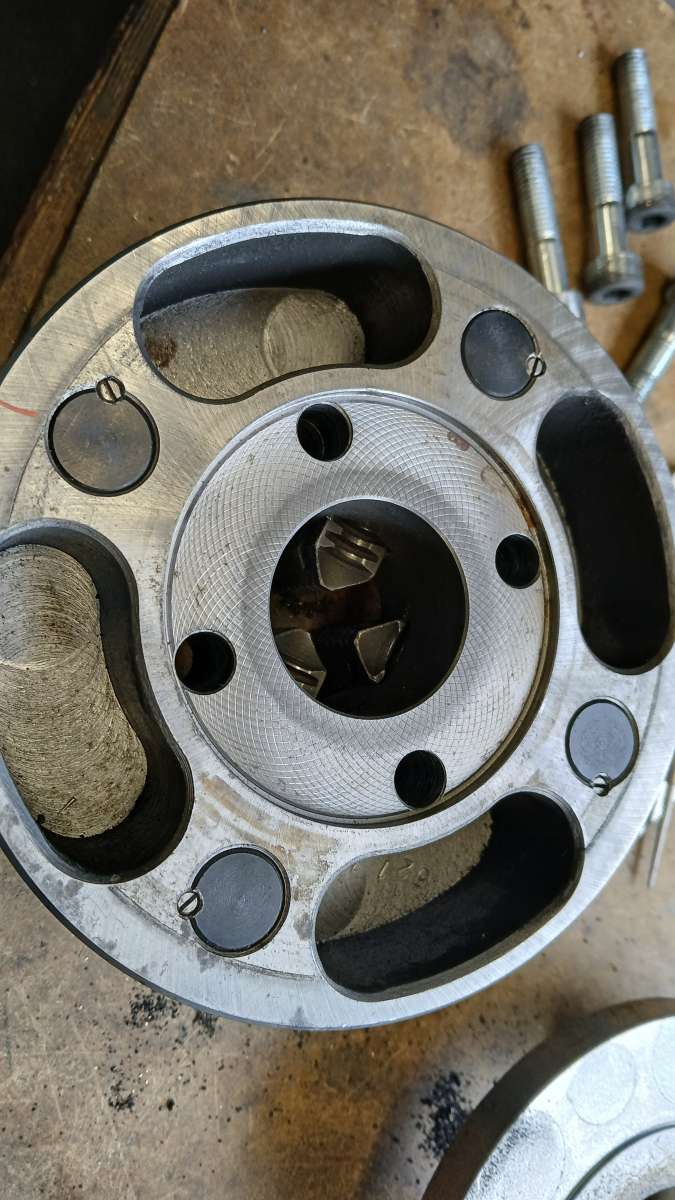
                The guy in the video does mention cheaper chucks. I suppose as most 4-jaws of that size and larger tend to have hollow pockets in the back that the very cheap ones may leave these pockets “as cast” which could result in a balance issue. As you can see my 2nd hand Bison has these pockets machined.

                20260514_090730

                #848141
                Howard Lewis
                Participant
                  @howardlewis46836

                  As Jason says, the 4 jaw independent is intended to hold irregular work, and so will be out of balance, for most work.

                  It might well be out of balance; especially if used to hold irregular work, since at least one of the jaws will deliberately be set off centre.

                  I have never been concerned about a self centering 3 jaw being out of balance since the components are symmetitrical.

                  Where vibration does become apparent at higher speeds, on my lathe, is because of the out of balance of the bull wheel caused by the off centre spring loaded pin which locks (or not) the bull wheel to the spindle, (for use of back gear)

                  This is more likely to produce vibration than a slightly out of balance 3 jaw.

                  The problem might well lie elsewhere than the chuck!

                  Howard

                  #848169
                  Pete
                  Participant
                    @pete41194

                    No doubt the issue would tend to show up on the cheaper chucks. But personally I would have separated the back plate from the chuck and investigated why it was that far out of balance. A bit of internal clean up machining might have been all that was needed. But it’s certainly a method I’d never seen before.

                    #848406
                    Dave Halford
                    Participant
                      @davehalford22513
                      On JasonB Said:

                      I got curious. As my lathe is not fixed to the wooden floor I did not have to unbolt it. The 125mm 5C which was a Customer reject picked up for about £20 was already mounted so I gave that a go. Then I put the larger 160mm 4-jaw chuck on and took that for a spin.

                      Quite happy with the results and can see why the 20yr old Green Dragon keeps knocking out working engines😉😉😉


                      The guy in the video does mention cheaper chucks. I suppose as most 4-jaws of that size and larger tend to have hollow pockets in the back that the very cheap ones may leave these pockets “as cast” which could result in a balance issue. As you can see my 2nd hand Bison has these pockets machined.

                      20260514_090730

                      I understood these are ‘lightweight’ chucks for smaller lathes with less starting torque. They can’t be materially cheaper enough to warrant the extra machining and labour costs, can they?

                      #848429
                      not done it yet
                      Participant
                        @notdoneityet

                        Personally, I think static balancing for larger chucked items is adequate as they will not be rotating that fast and the balance will change as machining progresses.

                        If a small chuck, that is what I would likely do with it – chuck it!

                        #848432
                        David Ambrose
                        Participant
                          @davidambrose86182

                          If chucks are bolted to a backplate, the backplate can be out of balance, as it is drilled to accept both three studs and four, with one shared hole.  The holes are therefore not symmetrical.

                          #848548
                          Pete Rimmer
                          Participant
                            @peterimmer30576

                            I have a Burnerd 8″ lightweight 4-jaw that is very unbalanced. You can see the variable thickness of the cast iron webs on the rear where the pockets are cast. I have a pair of these and the other one is just fine. I keep one witht he jaws set inside and the un-balanced one with the jaws set outside because it’s quicker to swap out the camlock chuck than reverse the jaws (copyright J Stevenson).

                            The out of balance one will shake my lathe (Monarch 10EE) if I wind the speed up past about 500rpm.

                            #848667
                            old mart
                            Participant
                              @oldmart

                              At the museum, we have several sizes of four jaw independant chucks, some of which have been drilled and tapped on their front faces to carry balance weights which reduce the out of balance forces when holding odd shaped work. This is as far as can be managed and certainly not dynamic balancing, but does help a little. I had to hold a very assymetric part on a faceplate of the Atlas 12 x 24 as it has a bigger swing than the Smart & Brown model A, 9 x 20, and even with compensating mass balancing, had to use backgear at about 50 rpm.

                              With an out of balance chuck with cast lightening holes, it might benifit from careful removal of metal from the heavy  cavities. Our 6″ lightweight Toolmex four jaw independent is made form a solid piece of SG iron and fully machined so is perfectly balanced when holding round, square or rectangular material on their axes.

                            Viewing 13 posts - 1 through 13 (of 13 total)
                            • Please log in to reply to this topic. Registering is free and easy using the links on the menu at the top of this page.

                            Latest Replies

                            Viewing 25 topics - 1 through 25 (of 25 total)
                            Viewing 25 topics - 1 through 25 (of 25 total)

                            View full reply list.