Dividing heads and dividing by 12…

Dividing heads and dividing by 12…

Home Forums Workshop Tools and Tooling Dividing heads and dividing by 12…

Viewing 25 posts - 1 through 25 (of 29 total)
  • Author
    Posts
  • #846370
    timdotd
    Participant
      @timdotd

      So this may turn out to be a very embarrassing maths fail on my part, but…

      I recently acquired a second-hand dividing head, because I need to… divide some things.  One of those things needs to be divided 96 times.

      The machine came with 3 indexing disks:

      15, 16, 17, 18, 19, 20
      21, 23, 27, 29, 31, 33
      37, 39, 41, 43, 47, 49

      If I’ve figured out the maths correctly given that it’s a 40:1 head, that gives me a wide range of divisions with a few exceptions: one of which is anything divisible by 12.

      That set seems to be fairly standard, which is leaving me wondering what do the manufacturers have against factor 12? It seems quite important, what with 12 hours in the day and 12 pence to the shilling and so on.

      Discs that ARE divisible by 12 seem to be somewhat rare – in fact the only sources I’ve found are the dingier corners of Aliexpress.

      This all seems a bit strange – so am I missing something fundamental with the calculations, or overlooking some obvious sources of where factor 12 discs can be found…?

      #846375
      John Purdy
      Participant
        @johnpurdy78347

        According to my Excel calculator and Harold Hall’s “Metalworkers Data Book” 96 can’t be done with those plates, but there are 8 combinations that will give 12 divisions. Three hole turns, plate 15 +5 holes, 18 +6, 21 +7,27 +9, 33+11, 39 +15, 51 +17. If you pm me your e-mail address I can send you the Excel calculator.

        John

        #846376
        Peter Cook 6
        Participant
          @petercook6

          I find an online calculator like this one useful.

          It suggests that your plates will do 12,24,36,48,60,72, 84,108,120 but not 96! So its not all factors of 12 just (as murphy’s law requires) not the one you want.

          The calculator suggest that a 12 (24, 36 or 48) hole plate would work, and you already have the plates necessary to make one. For a one off job I would be tempted to 3D print a plate with the necessary number of holes.

          PS Edit – You could of course consider replacing the handle and index plates with a stepper motor and controller, then all these mathematical issues go away.

          #846379
          DC31k
          Participant
            @dc31k
            On John Purdy Said:

            …Three hole turns

            In the context of dividing heads, that typo. is particularly unfortunate.

            Best perhaps to write ‘three complete turns’ thus avoiding the danger.

            A 40:1 dividing head is the same as the classic Brown & Sharpe version. It would be wise for the OP to obtain a copy of their ‘Treatise on milling’ from the Internet Archive, which would list all divisions possible with standard plates.

            96 divisions requires (5 holes in) a 12 hole plate (40/96 reduced to its lowest form).

            You can produce a 12 hole plate using the above-listed plates. You could also 3D print one. You could also do it using a bolt circle program on a mill. You could also do it by geometry, drawing a hexagon and bisecting the angles. Any inaccuracies in your drilling will be reduced by a factor of 40 when the plate is used. GHT’s book covering his versatile dividing head covers other techniques for plate production.

            #846383
            John Purdy
            Participant
              @johnpurdy78347

              Sorry about the typo! That’s what happens when you proof read your own work!

              As has been said above the easiest way would be to make a special 12 hole plate.

              John

              #846407
              Bazyle
              Participant
                @bazyle

                If using tables do check the maths too. I know there is a mistake in the Elliott tables – just can’t remember now what it is though I think I have posted a warning here before. Interestingly I don’t think 63 is available but that probably wasn’t much needed before Napoleon’s day when the plates were selected.

                #846416
                Julie Ann
                Participant
                  @julieann
                  On Bazyle Said:

                  ….I don’t think 63 is available….

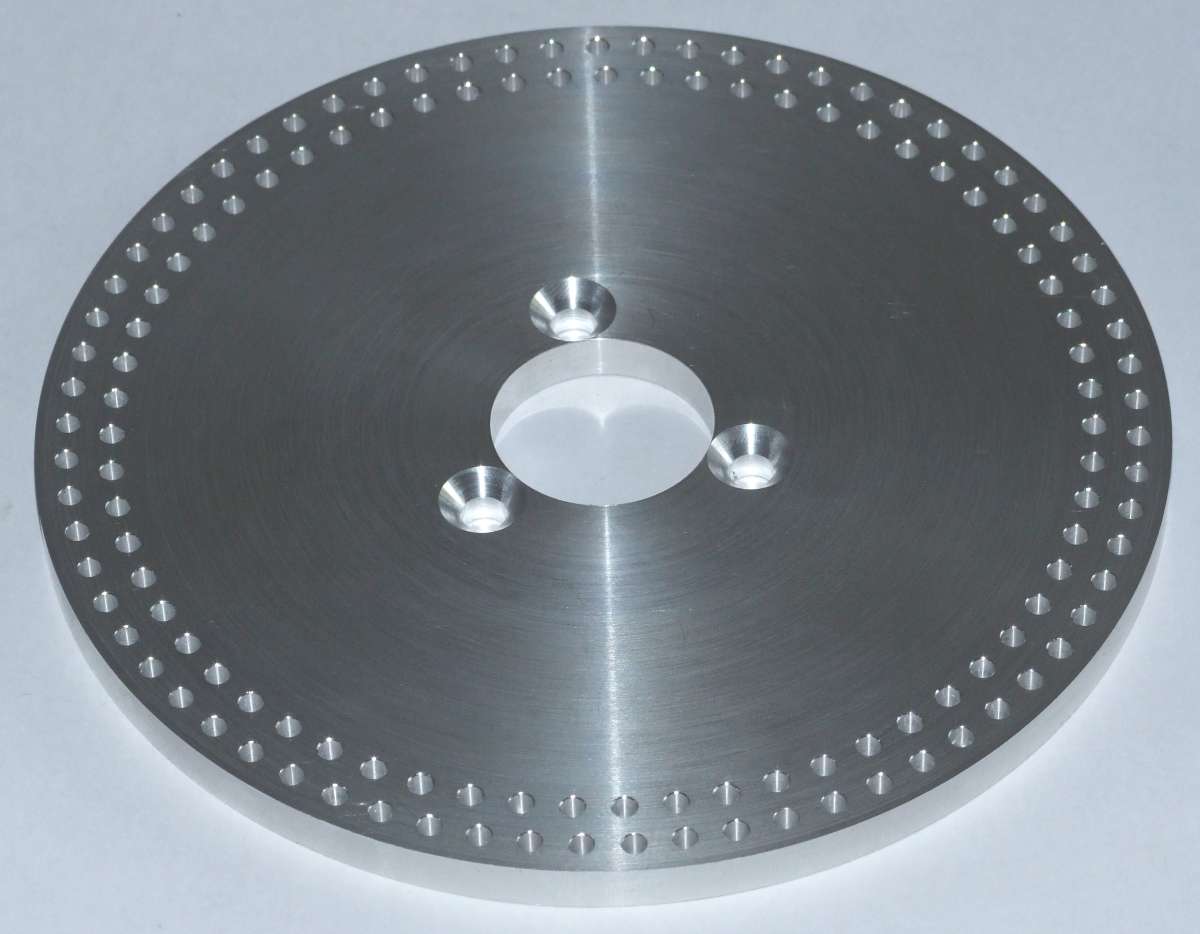
                  Neither 63 nor 69 is available which annoyingly happened to be the tooth counts for the second shaft gears on my traction engines. Although I have a universal dividing head the easiest solution was to make my own dividing plate:

                  Dividing Plate

                  Julie

                  #846419
                  timdotd
                  Participant
                    @timdotd

                    Sometimes all it takes to find the answer is to ask a daft question in public.

                    The answer is – of course – to just print a disk of the right size. It’s not in any way load-bearing, and if I’m honest about things, my 3D printer works to tighter tolerances than I can anyway.

                    Thank you all for the responses – and while a controller and a stepper motor is a great idea, I’ve already spent more time building tools to build the thing than I have building the thing itself, so I probably need to fight that rather in inviting distraction…

                    #846422
                    old mart
                    Participant
                      @oldmart

                      I wanted to get 118 for a scale conversion between 3mm and 1/8″ and ended up getting a spreadsheet with degrees and minutes printed out by Dick who is another volunteer at the museum.

                      Our Atlas 12 x 24 lathe has 60 holes in the bull gear which can be used for simple indexing and it divides by 5 to get twelve positions. 60 is a very useful number to have on a plate, I don’t remember if the three that I have have that count.

                      #846425
                      Andrew Crow
                      Participant
                        @andrewcrow91475
                        On John Purdy Said:

                        Sorry about the typo! That’s what happens when you proof read your own work!

                        As has been said above the easiest way would be to make a special 12 hole plate.

                        John

                        A 24, 36 or preferably a 48 hole circle would be much more useful.

                        Andy


                        #846456
                        Bazyle
                        Participant
                          @bazyle

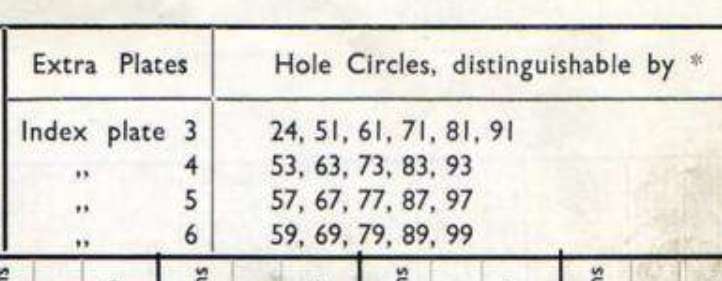
                          Some dividing heads have a direct indexing feature with eg 24 holes in the chuck backplate. Victoria did 4 extra plates if you didn’t want to go to differential indexing and included them in their tables.

                          Screenshot 2026-05-01 001249

                          If you have a 3D printer then on thingiverse there is an openscad utility that creates any count(s) complete with mounting holes etc to fit your dividing head.  https://www.thingiverse.com/thing:1908993

                          I showed an sample I did for 73 holes about 5 years ago.

                          #846459
                          DC31k
                          Participant
                            @dc31k
                            On Andrew Crow Said:

                            A 24, 36 or preferably a 48 hole circle would be much more useful.


                            Why is that? Please say what divisions below the required 96 those plates provide.

                            Sure, they will enable divisions above 96, but how often are they needed?

                            OK, to answer my own question, a 24 hole plate gives 64, 320, 480, 960 divisions over and above a 12 hole plate.

                            #846463
                            DC31k
                            Participant
                              @dc31k
                              On timdotd Said:

                              Sometimes all it takes to find the answer is to ask a daft question in public.


                              It is not a daft question. The 3DP idea is just a modern take on other older ideas.

                              It could be worth printing a (smaller) one hole plate as a test just to refine the indexing pin hole diameter.

                              #846469
                              Julie Ann
                              Participant
                                @julieann
                                On Bazyle Said:

                                …Some dividing heads have a direct indexing feature with eg 24 holes in the chuck backplate…

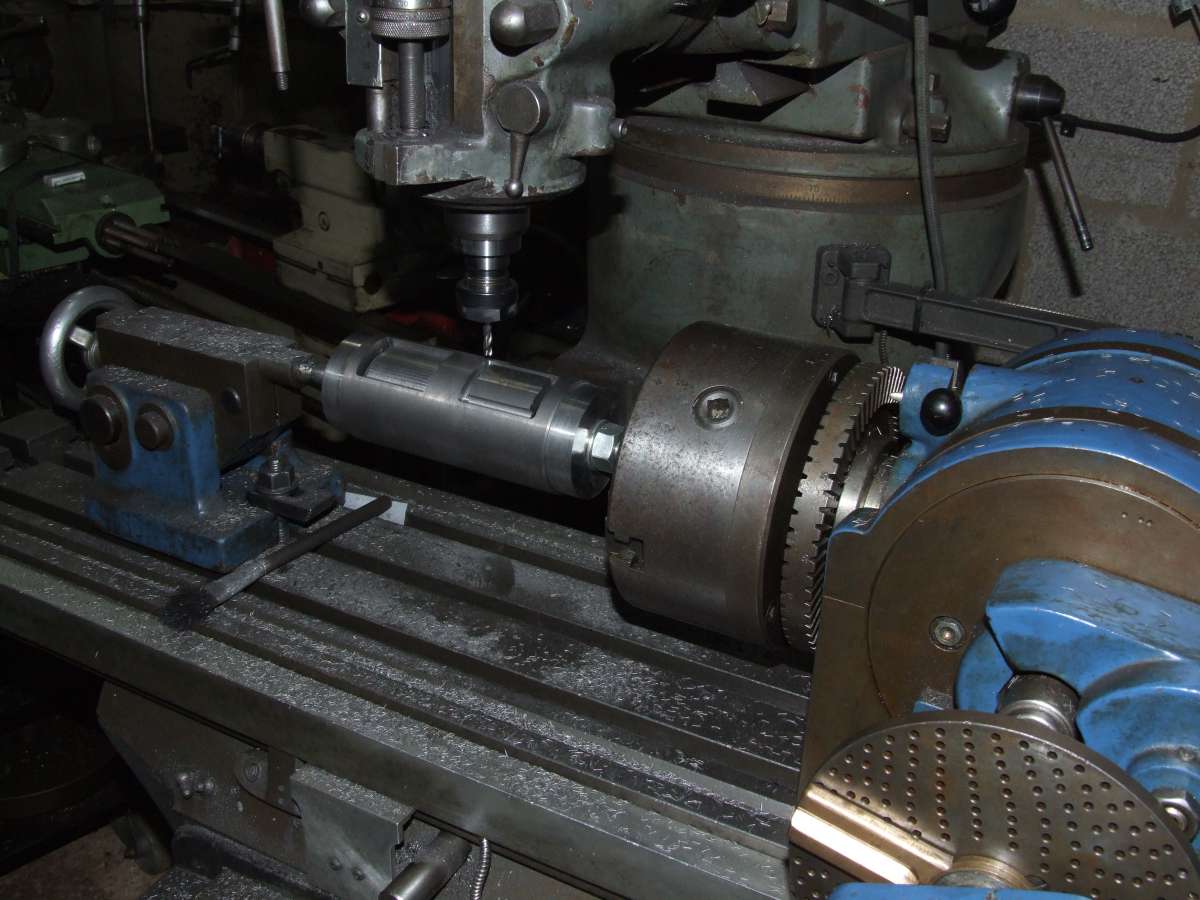
                                My Elliott dividing head has a rather useful double sided plate behind the chuck for direct indexing; 60 slots on one side and 56 slots on the other side. Can be seen here, centre  and slightly to the right:


                                2021_10010016

                                Julie

                                #846472
                                Pete Rimmer
                                Participant
                                  @peterimmer30576

                                  Just a note here for anyone making their own plates – the biggest (and most common) issue I have found on the few home-made plates I have found is not the hole spacing but the concentricity between the centre hole and the index hole circle. It’s very important that these are concentric. If they are not then the holes on one side of the index hole circle will lag and the other side will lead their true index locations. Also the pin will not seat in some of the holes properly.

                                  #846481
                                  Michael Gilligan
                                  Participant
                                    @michaelgilligan61133

                                    FWIW


                                    Those three plates are quickly identifiable as a standard Brown & Sharpe set

                                    [as cloned by many] and the surprising omissions would be accommodated by ‘differential indexing’

                                    That  black-art is explained here …

                                    https://youtu.be/tQBhHjNO69s?si=aN4f0F4wFjyXPNf8

                                    and here …


                                    MichaelG.

                                    .

                                    Edit: __ No, I have no idea why only one of those videos embedded 🙁

                                    #846499
                                    Bazyle
                                    Participant
                                      @bazyle

                                      Good advice about checking index hole size and concentricity.

                                      Although Julie referred to direct indexing there are a few (Elliotts being one mfr) that cater for a double sided index plate in the regular position for compound rather than differential indexing. I’ve not tried it as I don’t have a suitable plate but must now check whether I can print one.

                                      #846514
                                      Howard Lewis
                                      Participant
                                        @howardlewis46836

                                        Maybe I am a bit simple, but a 40:1 ratio means that one complete turn of the handle, rotates the head by 9 degrees, so 3 complete turns of the handle rotate the head by 27 degrees.

                                        For 12 divisions, the head needs to rotate by 30 degrees, so you need 3 complete turns of the handle plus another one third of a turn of the head.

                                        The one third of a head rotation can be obtained by various methods, using the division plates available

                                        13 holes on a 39 hole circle equates to 1/3 of a head rotation, = 3 degrees.

                                        So will 11 holes on a 33 hole plate, 6 holes on a 18 hole plate, 5 holes on a 15 hole plate, or 7 holes on a 21 hole plate.

                                        Just set the fingers to give the required hole spacing

                                        Or is my brain running too fast to be accurate?

                                        Howard

                                        #846517
                                        Howard Lewis
                                        Participant
                                          @howardlewis46836

                                          I missed 9 holes on a 27 hole plate!

                                          By using using the various hole spacings, various subdivisions of a turn can be produced

                                          To see what divisions can be produced, using the Division Plates (Hence their name) take a look at the chart that I made for my 90:1 ratio Vertex HV6 Rotary rable, to correct errors in the one supplied with the device. I have used it to cut gears with tooth counts varying between 13 and 80, and to graduate dials (Usually 25 divisions to suit 10 tpi or 40 tpi threads)

                                          You can make your own chart to suit your 40:1 device, (See below).

                                          It does not cover every possibility between 1 and 100. (I ought to make up an extra plate or two to cover the missing divisions. (A TOMORROW job on the Round Tuit!)

                                          The spreadsheet showing the formulae used, is also available.

                                          No doubt, Neil Wyatt will be able to point you in the right direction to find it.

                                          The calculations are the same except for the the ratio, in the formulae, needing to be changed from 90 to 40, to suit your device.

                                          Howard

                                          #846523
                                          John Purdy
                                          Participant
                                            @johnpurdy78347

                                            Howard

                                            You are definitely not simple, you are totally correct! Besides the typo I also missed out some very important words. It should have read:

                                            “three whole turns plus on any one the the following plates,15 plus 5 holes, etc —-”

                                            Sorry for the confusion, must have been still asleep when I wrote it.

                                            John

                                            #846528
                                            JasonB
                                            Moderator
                                              @jasonb

                                              The OP wants 96 divisions not 12! A 12 hole plate would give the required 96 as 5/12 = 0.4.1666 x one turn of 9deg = 3.75deg.

                                              96 x 3.75 =360

                                              #846544
                                              Michael Gilligan
                                              Participant
                                                @michaelgilligan61133
                                                On JasonB Said:

                                                The OP wants 96 divisions not 12 […]

                                                But let’s not allow the facts to get in the way of a good discussion 🙂

                                                MichaelG.

                                                #846574
                                                Howard Lewis
                                                Participant
                                                  @howardlewis46836

                                                  So 96 divisions means a division spacing of 3.75 dgrees, which requires 150 degrees rotation of the handle on a 40:1 machine. This is 0.4166′ of a turn of the handle.

                                                  Sadly, none of the division plates will give a 150 degrees rotation of the handle with an exact number of holes, so it will mean making a plate to provide this.

                                                  But 10 holes on a 24 hole plate will! (15 holes on a 36 hole plate, or 20 holes on a 48 hole plate)

                                                  All of these could be made on  plate of the same dimensions as the existing ones.

                                                  So now you need to find the Turns/holes combination to make 24, 36 or 48 divisions.  This might mean that you have to make a plate to make the required plate!

                                                  This could be fairly straightforward with a 90:1 ratio machine, but a 40:1 results, each time, in a non integer hole count. Which exchanges one problem for another! I had hoped that either the 16 or 20 hole plates, being divisible by 4, would have been the means. But not so!


                                                  #846598
                                                  Howard Lewis
                                                  Participant
                                                    @howardlewis46836

                                                    Since we are looking for 96 divisions, we need a number that is divisible by 6. The only available plate that has this is the 18 hole plate.

                                                    96 divisions requires the head to rotate by 3.75 degrees. So, with a 40:1 ratio, the handle will need to rotate by (3.75 x 40) = 150 degrees. This is less than half a turn of the handle, 0.416666′ of a turn. 7.5 holes!

                                                    But 15 holes on a 18 hole plate is 0.8333333′ of a turn, so these 15 holes on the plate represent (15/18 x 360 = 300 degrees rotation of the handle, / by 40 for 7.5 degrees of the head.)

                                                    So a 18 hole plate can be used to make a 24 hole plate (18/24 = 0.8333333′ or 299.9999998 degrees, spacing; lets call that 300 degrees)

                                                    360 / 24 = 15 degrees per hole, so with a 40:1 ratio, each hole on a 24 hole plate rotates the head by  15/40 = 0.375 degrees.

                                                    So 10 holes on a 24 hole plate should rotate the head by 3.75 degrees; (0.416666666′ of a turn) which is what we want.

                                                    So use the 18 hole plate to make a 24 hole plate, and use that one to give your 96 divisions!

                                                    Howard


                                                    #846612
                                                    DC31k
                                                    Participant
                                                      @dc31k
                                                      On Howard Lewis Said:

                                                      So use the 18 hole plate to make a 24 hole plate, and use that one to give your 96 divisions!

                                                      It would be very useful to all of us if you would read the thread from the beginning and give your mind time to digest the previous responses before rattling the old typewriter.

                                                      Right now the thread has turned into Howard’s stream of conciousness – direct from brain to keyboard with no filter.

                                                      Please say what additional useful features are provided by a 24 hole plate that are not provided by a 12 hole plate. Why index and drill more holes than are necessary to achieve the aim?

                                                    Viewing 25 posts - 1 through 25 (of 29 total)
                                                    • Please log in to reply to this topic. Registering is free and easy using the links on the menu at the top of this page.

                                                    Latest Replies

                                                    Viewing 25 topics - 1 through 25 (of 25 total)
                                                    Viewing 25 topics - 1 through 25 (of 25 total)

                                                    View full reply list.