Correct VFD and cables?

Correct VFD and cables?

Home Forums General Questions Correct VFD and cables?

Viewing 25 posts - 26 through 50 (of 52 total)
  • Author
    Posts
  • #831173
    jimmy b
    Participant
      @jimmyb
      On andy198712 Said:

      The package route did cross my mind, trouble is I paid a couple hundred quid for the lathe. If I went with a top quality setup it just wouldn’t make sense here so trying to keep the swap about £200 as that’s what a new control board would be (looking on Ali there £330!)


      also I was toying with a new bigger lathe (sc4/wm250 or 280 size) so looking to keep the budget smaller for this. As think I’ll upgrade in a year or two maybe.


      “maybe” as this lathe cuts nice, fits the space I have (could maybe stretch to bigger) I fitted angular contact bearings and brass gibs….bearings in the controls
      Its basically worth more to me as a nice small lathe then it’s worth in money if that makes sense?

      were this a bigger more expensive lathe I would absolutely go your route

      I agree!

      My SC4 was an excellent upgrade to a mini lathe, 18 years on and it’s still never had a problem with any electrics! (got a lot of bed wear as its been used for making stainless screws, done about 20,000 in that time!)

      I swapped the motor for a VFD on my Chester Crusader due to endless capacitor issues and the wife getting fed up with the lights dipping when the motor started…..


      Jimb

      #831183
      Robert Atkinson 2
      Participant
        @robertatkinson2
        On SillyOldDuffer Said:

        <SNIP>

        thanks I do have both those cables but fancy a nice suple flex maybe?! My cables are solid core so might just order a couple meters or source it 🙂

        Yes, use flexible cable rather than solid core when vibration is present because solid cores are prone to metal fatigue.

        You might consider armoured cable colour coded Brown/Black/Grey to indicate 3-phase.   (Not expensive.)

        Please don’t wire the motor Brown/Blue/Green-Yellow with ordinary flex.  You can strip the flex and wire it all Brown, or all Blue, just not the standard single phase colour scheme because that’s liable to confuse an electrician or future owner.  Or yourself!

        Make sure all 3 wires are connected firmly at both ends before powering up.   If an end is left floating, the motor winding is liable to behave like a car-ignition coil, creating giant sparks that damage the motor and electronics.  No danger if all is secure, but sloppy wiring is punished!

        Dave


        IMPORTANT!! the SWA cable as linked to by Dave is NOT SUITABLE for connecting a motor on a machine tool. This is because it is not flexible and is subject to fracture from vibration which can result in a fire. The same applies to domestic installation cable like “2.5 T&E”. SWA (steel wire armoured) 3 core cable has an additional issue that it uses the armour as the protective ground. This requires the use of special glands for termination.

        The correct cable to use is 4 core SY protected flexible cble. It is also readily available in cut lengths

        https://www.tlc-direct.co.uk/Products/MF1dot5slash3slash1.html

        If interference is an issue then CY cable (copper rather than steel brading) can be used.  Un-protected “Y” type cable could be used but is not as common and often more expensive.

        Robert.


        #831200
        Julie Ann
        Participant
          @julieann
          On andy198712 Said:

          …the way I read it kind of suprised me, it still had very high torque at low rpm. Surely the HP number is partially irrelevant as torque is the force that the motor can produce rotating where as HP is more a number calculated from it against an RPM?!

          I am afraid you have a totally incorrect understanding of the physical concepts and the process of cutting metal on a lathe. Let me see if I can explain further without being a smarty knickers.

          First, let’s look at the cutting process, which is shearing. Think about pulling a knife along the top of a lump of butter with the knife vertical. The knife will shear a layer of butter rather than cut in the sense of pushing the knife vertically into the butter. This is what happens when cutting on a lathe; it is a shearing process not cleaving.

          To shear the metal the work needs to be pushed down onto the cutting tool and the force needed to do this is what causes the metal to shear.

          Second, let’s revise some basic physics. Power is a calculated unit rather than a base unit, but is nevertheless useful and represents the rate at which work is done with respect to time. The rate at which metal can be removed is determined by the force needed to push the work past the cutting tool, and the velocity at which the work passes the cutting tool. The force is generated by the applied torque. But torque is not a force but is a moment. Torque is the product of length and force. For a constant value of torque the force is dependent upon the radius at which is it measured. Double the distance and the force halves.

          The last sentence is the key to understanding the cutting process. Now let’s look at a practical example. Suppose we have a torque of 10Nm across the speed range of the motor. If we turn steel of 20mm diameter (10mm radius) at 1000rpm we will have a force at the cutting tool of 1000N available for shearing metal. The force needed will be determined by the material, the depth of cut and the width of cut, ie, the feedrate per revolution. Now suppose we want to turn steel of 200mm diameter (100mm radius). We need the same surface speed for cutting, so the work rpm will drop to 100rpm. Instead of cutting at a radius of 10mm we are now cutting at a radius of 100mm. The torque remains at 10Nm so the force at the cutting tool will now be 100N, ie, a reduction of ten. So the depth of cut and/or the feedrate will need to be reduced. Consequently less metal will be removed per unit time.

          If we want to maintain the metal removal rate across a range of spindle speeds we need constant power at the spindle, not constant torque. Constant power is what is provided by a gear or belt driven spindle. As the speed decreases the torque increases in proportion so the power at the cutting tool stays constant. Thus the rate of metal removal stays constant.

          Julie

          #831205
          noel shelley
          Participant
            @noelshelley55608

            I like Julies description, simple and to the point – you won’t find it in the VFD advertising brochure. Noel.

            #831211
            Robert Atkinson 2
            Participant
              @robertatkinson2

              One thing that is often missed by people retrofitting VFDs is that they can INCREASE the speed of the motor while maintaining power. This allows the use of higher gearing for the same speed which helps maintain avilable torque at lower speeds.
              For those of in the UK even a basic 3 phase motor not specifically designed foe use with a VFD is likely to be rated at both 50 Hz and 60 Hz so a increase in speed of 20% is available without exceeding the motor ratings. Many modern motors can run much faster, check the datasheet.
              So if keeping the same 3 phase motor consider changing the pulley(s) to increase the pulley speed reduction ratio so the motor can be run faster than nominal while maintaing torque at the workpiece at the same maximum speed without the VFD. Thus turque at the workpiece is higher at lower speeds set on the VFD This assumes you want to turn large parts in tough materials. If you are mostly turning small parts in light alloy keep the ratio the same and enjoy the extra speed. Make sure the bearings are OK with the speed and load.

              When looking at replacing the single phase motor on my Myford ML7 I actually chose a slower 6 pole motor rather than the more common 4 pole. Used with a VFD this nominally 920 RPM motor can run at 1700 RPM at the same power. The current and thus torque is reduced due to the higher back EMF. You can deduce the motor should be OK at this speed as it has the same frame size, bearings and fan as the 60Hz rated 4 pole model. This is confirmed by the datasheet.
              I chose to decrease the pulley speed reduction ratio (bigger motor pulley) to provide more torque at speeds comparable to the faster single phase motor. as well as higher speeds (for short periods at low loads to protect the bearings) for small aluminum alloy parts. This also improves the belt stress and losses which are higher with smaller pulleys.

              Robert.

              #831229
              old mart
              Participant
                @oldmart

                For anyone thinking of getting a VFD to run from single phase domestic supply, I always recommend “the inverter drive supermarket”. Many of the inverters they sell in the lower powers have the free IDS “quickstart guides” which you can download and print which are worth their weight in gold, so easy to understand and program and the switchgear and wiring made easy which is something you don’t get with the cheap Chinese inverters.

                #831244
                andy198712
                Participant
                  @andy198712
                  On old mart Said:

                  For anyone thinking of getting a VFD to run from single phase domestic supply, I always recommend “the inverter drive supermarket”. Many of the inverters they sell in the lower powers have the free IDS “quickstart guides” which you can download and print which are worth their weight in gold, so easy to understand and program and the switchgear and wiring made easy which is something you don’t get with the cheap Chinese inverters.

                  They’ve been on the top of my list for shoping yes. One of the main points you made about the instructions is a major factor for me.


                  #831247
                  andy198712
                  Participant
                    @andy198712
                    On Robert Atkinson 2 Said:
                    On SillyOldDuffer Said:

                    <SNIP>

                    thanks I do have both those cables but fancy a nice suple flex maybe?! My cables are solid core so might just order a couple meters or source it 🙂

                    Yes, use flexible cable rather than solid core when vibration is present because solid cores are prone to metal fatigue.

                    You might consider armoured cable colour coded Brown/Black/Grey to indicate 3-phase.   (Not expensive.)

                    Please don’t wire the motor Brown/Blue/Green-Yellow with ordinary flex.  You can strip the flex and wire it all Brown, or all Blue, just not the standard single phase colour scheme because that’s liable to confuse an electrician or future owner.  Or yourself!

                    Make sure all 3 wires are connected firmly at both ends before powering up.   If an end is left floating, the motor winding is liable to behave like a car-ignition coil, creating giant sparks that damage the motor and electronics.  No danger if all is secure, but sloppy wiring is punished!

                    Dave


                    IMPORTANT!! the SWA cable as linked to by Dave is NOT SUITABLE for connecting a motor on a machine tool. This is because it is not flexible and is subject to fracture from vibration which can result in a fire. The same applies to domestic installation cable like “2.5 T&E”. SWA (steel wire armoured) 3 core cable has an additional issue that it uses the armour as the protective ground. This requires the use of special glands for termination.

                    The correct cable to use is 4 core SY protected flexible cble. It is also readily available in cut lengths

                    https://www.tlc-direct.co.uk/Products/MF1dot5slash3slash1.html

                    If interference is an issue then CY cable (copper rather than steel brading) can be used.  Un-protected “Y” type cable could be used but is not as common and often more expensive.

                    Robert.


                    Cheers Robert,

                    I’ll go with that cable when the time comes.

                    also my motor is rated at continuous 3822rpm at 70hz should it be needed which is something I could play with to get the motor up to speed in my desired working ranges at the cost of some top end speed that wouldn’t be used.

                    this is feeling a lot like a motorbike analogy about getting it in the power band with the the gearing…. Love it!


                    also another point you made about EMC got me looking into the classes of that, C1,C2,C3 I need C1 ideally which my choosen one was not but this one is

                    https://inverterdrive.com/group/AC-Inverter-Drives-230V/Invertek-Optidrive-E3-750W-1ph-3ph-IP20/


                    and made in the U.K. and has a nice remote key pad available should I go that route. Might well go for this model.

                    #831249
                    andy198712
                    Participant
                      @andy198712


                      Thanks Julie I appreciate the time spent on that, I’m always happy to learn! and it got me looking at it correctly. I understand the torque equation but I was looking at it almost backwards I think.

                      #831304
                      Robert Atkinson 2
                      Participant
                        @robertatkinson2

                        Hi Andy,

                        That Invertek VFD looks a good choice.
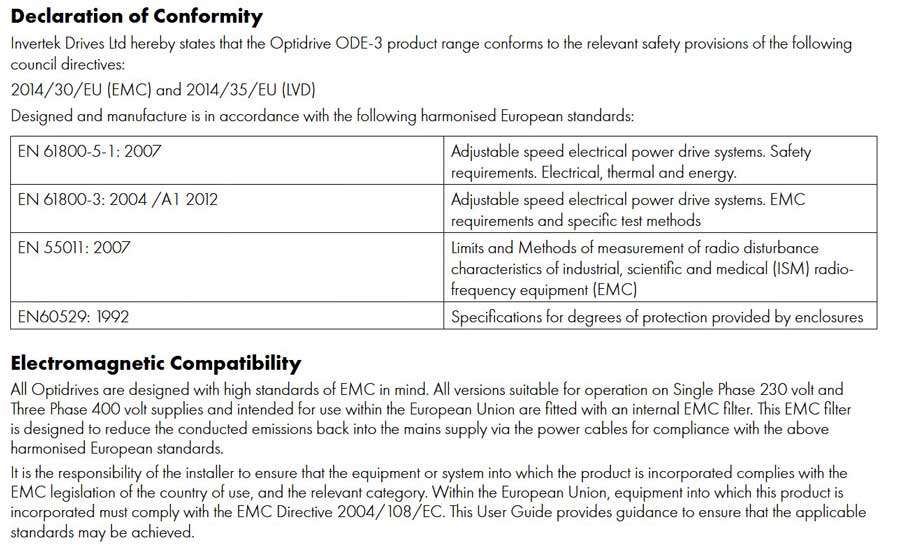
                        I see they claim CE compliance but this is limited not including the Machinery Directive and saying the equipment it is fitted to must comply on it’s own.

                        Invertec-VFD-EMCsml

                        It also state that the drive is only suitable for Pollution Degree 1 envronments This is defined as:
                        “No pollution or only dry, non-conductive pollution occurs. The pollution has no influence.”
                        A typical workshop won’t meet this so the VFD must be in an enclosure.

                        Robert.

                        #831312
                        andy198712
                        Participant
                          @andy198712
                          On Robert Atkinson 2 Said:

                          Hi Andy,

                          That Invertek VFD looks a good choice.
                          I see they claim CE compliance but this is limited not including the Machinery Directive and saying the equipment it is fitted to must comply on it’s own.

                          Invertec-VFD-EMCsml

                          It also state that the drive is only suitable for Pollution Degree 1 envronments This is defined as:
                          “No pollution or only dry, non-conductive pollution occurs. The pollution has no influence.”
                          A typical workshop won’t meet this so the VFD must be in an enclosure.

                          Robert.

                          Yeah their talking about gas and certain dust being non conductive aren’t they.
                          Not swarf ect. I’ll get that one ordered once I’ve got the motor mounted up and I’ll source a suitable enclosure as per their specs for clearance/ventalation

                          #831324
                          Emgee
                          Participant
                            @emgee

                            IMPORTANT!! the SWA cable as linked to by Dave is NOT SUITABLE for connecting a motor on a machine tool. This is because it is not flexible and is subject to fracture from vibration which can result in a fire. The same applies to domestic installation cable like “2.5 T&E”. SWA (steel wire armoured) 3 core cable has an additional issue that it uses the armour as the protective ground. This requires the use of special glands for termination. The correct cable to use is 4 core SY protected flexible cble. It is also readily available in cut lengths
                            https://www.tlc-direct.co.uk/Products/MF1dot5slash3slash1.html

                            If interference is an issue then CY cable (copper rather than steel brading) can be used.  Un-protected “Y” type cable could be used but is not as common and often more expensive.  Robert.


                            The SWA cable linked to by SOD is perfectly OK to connect to any fixed machine provided the multi-strand conductor type is used with a small loop in the SWA before terminating into the motor terminal box using the correct gland, I would suggest a 4 core cable is used to provide the 3 motor cores and a separate cpc to the motor frame.
                            At the VFD end the cable should be terminated to a fixed earthed metal plate or enclosure using the correct gland, the core used for the cpc should be connected to the incoming earth terminal at the VFD.
                            The cable shall be supported by clips for the total length.

                            Although there is a good deal of SY and CY cable used for various purposes in industry there is a lot of debate in the electrical industry at present and it is frowned upon for use in fixed installations.

                            The VFD linked to has IP20 protection and should be mounted clear of any dust, chips or swarf using a remote
                            stop/start with speed pot easily accessable from the machine operators position, similar to the installation described earlier in the thread by another user. (Russell)

                            Emgee


                            #831332
                            Robert Atkinson 2
                            Participant
                              @robertatkinson2
                              On Robert Atkinson 2 Said:
                              On SillyOldDuffer Said:

                              <SNIP>

                              thanks I do have both those cables but fancy a nice suple flex maybe?! My cables are solid core so might just order a couple meters or source it 🙂

                              Yes, use flexible cable rather than solid core when vibration is present because solid cores are prone to metal fatigue.

                              You might consider armoured cable colour coded Brown/Black/Grey to indicate 3-phase.   (Not expensive.)

                              Please don’t wire the motor Brown/Blue/Green-Yellow with ordinary flex.  You can strip the flex and wire it all Brown, or all Blue, just not the standard single phase colour scheme because that’s liable to confuse an electrician or future owner.  Or yourself!

                              Make sure all 3 wires are connected firmly at both ends before powering up.   If an end is left floating, the motor winding is liable to behave like a car-ignition coil, creating giant sparks that damage the motor and electronics.  No danger if all is secure, but sloppy wiring is punished!

                              Dave


                              IMPORTANT!! the SWA cable as linked to by Dave is NOT SUITABLE for connecting a motor on a machine tool. This is because it is not flexible and is subject to fracture from vibration which can result in a fire. The same applies to domestic installation cable like “2.5 T&E”. SWA (steel wire armoured) 3 core cable has an additional issue that it uses the armour as the protective ground. This requires the use of special glands for termination.

                              The correct cable to use is 4 core SY protected flexible cble. It is also readily available in cut lengths

                              https://www.tlc-direct.co.uk/Products/MF1dot5slash3slash1.html

                              If interference is an issue then CY cable (copper rather than steel brading) can be used.  Un-protected “Y” type cable could be used but is not as common and often more expensive.

                              Robert.


                              Oh dear, somehow I put the wrong link. The correct link for 4 core (3 plus protective earth) is :

                              https://www.tlc-direct.co.uk/Products/MF1dot5slash4slash1.html

                              If one of the moderators could change the original post I’d appreciate it.

                              Robert.

                              #831334
                              old mart
                              Participant
                                @oldmart

                                For the VFD and motor I got to run the Tom Senior light vertical, all cabling was flexible and shielded and the remote box for the VFD was also steel and lockable. The VFD has C2 EMC filtering as this enviroment is not domestic and has not tripped the 10mA ELCBS, a worry as they are moresensitive than the domestic standard 40mA ones. Every joint has crimped connections and the system was checked by one of our volunteers who is an electrician by trade.

                                #831365
                                andy198712
                                Participant
                                  @andy198712

                                  Thanks for the help, i appreciate it

                                  does the enclosure need to be metal or can it be plastic?

                                  #831373
                                  Robert Atkinson 2
                                  Participant
                                    @robertatkinson2
                                    On Emgee Said:

                                    IMPORTANT!! the SWA cable as linked to by Dave is NOT SUITABLE for connecting a motor on a machine tool. This is because it is not flexible and is subject to fracture from vibration which can result in a fire. The same applies to domestic installation cable like “2.5 T&E”. SWA (steel wire armoured) 3 core cable has an additional issue that it uses the armour as the protective ground. This requires the use of special glands for termination. The correct cable to use is 4 core SY protected flexible cble. It is also readily available in cut lengths
                                    https://www.tlc-direct.co.uk/Products/MF1dot5slash3slash1.html

                                    If interference is an issue then CY cable (copper rather than steel brading) can be used.  Un-protected “Y” type cable could be used but is not as common and often more expensive.  Robert.


                                    The SWA cable linked to by SOD is perfectly OK to connect to any fixed machine provided the multi-strand conductor type is used with a small loop in the SWA before terminating into the motor terminal box using the correct gland, I would suggest a 4 core cable is used to provide the 3 motor cores and a separate cpc to the motor frame.
                                    At the VFD end the cable should be terminated to a fixed earthed metal plate or enclosure using the correct gland, the core used for the cpc should be connected to the incoming earth terminal at the VFD.
                                    The cable shall be supported by clips for the total length.

                                    Although there is a good deal of SY and CY cable used for various purposes in industry there is a lot of debate in the electrical industry at present and it is frowned upon for use in fixed installations.

                                    The VFD linked to has IP20 protection and should be mounted clear of any dust, chips or swarf using a remote
                                    stop/start with speed pot easily accessable from the machine operators position, similar to the installation described earlier in the thread by another user. (Russell)

                                    Emgee


                                    Hi Emgee,
                                    What do you mean by a fixed machine? I would not consider any machine of the size used in a home workshop as “fixed” even a big Harrison. They all vibrate and move to some degree. SWA cable is for “installed” fixed wiring. In industry SWA will come to an isolator on the wall with a EN 60309 “CEE” / “Commando” socket and a SY cable with plug to the machine or sometimes just a switch and gland to SY.
                                    SWA cable is not flexible. It has another disadvantage that the armour is used for the protective conductor “earth” this means that the gland and fittings must also be conductive and vidration resistant. These are often too big to fit in a typical motor terminal box even without considering the need to stransition to stranded wire as you suggest.
                                    SY or CY cable is flexible, compact, designed for the apllication, comes with a separate earth conductor, is easier to handle and is cost effective. There is no reason not to use the correct cable.
                                    SY / CY cable is not suitable for fixed installations, outside or buried use for exactly the same reasons ordinary flex isn’t – the materials are not durable enough and it needs regular inspection.

                                    Robert.

                                    #831390
                                    Emgee
                                    Participant
                                      @emgee

                                      Robert

                                      You clearly have very little or no experience of wiring to electric motors in an industrial environment or you wouldn’t make such statements reference the use of SWA cable.

                                      I have suggested the SWA armour is connected at the VFD as recommended by most VFD manufacturers to assist with reduction of any RF emissions, the cpc is the 4th conductor in the 4 core cable, something you overlooked when first specifying the cable to the motor.

                                      Emgee


                                      #831401
                                      Robert Atkinson 2
                                      Participant
                                        @robertatkinson2

                                        HI Emgee,

                                        What country are you in? If not the UK you may have different practices.
                                        Standard 4 core SWA cable does not have a green/yellow CPC (earth) conductor. It has 3 phases and neutral. It is not acceptable to use the neutral conductor, normally blue, as a CPC. You have to go to 5 core to get a separate CPC in 3 phase SWA.
                                        Remember we are talking small machine tools here. They are running off a 13A outlet.

                                        You say “provided the multi-strand conductor type is used”  While SWA conductors may be stranded, e.g. BS5467 XLPE, they are NOT flexible with a typical construction of 7 x 0.53mm for a 1.5mm2 SWA compared to 30 x 0.25mm for 1.5 mm2 SY.

                                        Do you have any reasons why SY cable should not be used to make the connection beween a VFD (or local control gear) and a motor?

                                        I made a mistake with a weblink, not mis-specification of SY cable. You could of course use smaller SY cable for VFD to motor connections for motors below 2.2 kW assumid the input to the VFD has a suitable fuse. For example 1mm2 is OK up to 2 kW with a 10 A fuse on input and 0.5mm is OK up to 1kW with a 5 A fuse on the VFD input. This assumes a (unlikely) fault where the VFD input voltage is connected to an overload on the output. SWA is not availble in these sizes. Using 1.5mm2 cable is a simple safe choice requiring no calculations for any system run from a 13A fused plug or 16A fused outlet.

                                        Robert.


                                        #831714
                                        andy198712
                                        Participant
                                          @andy198712

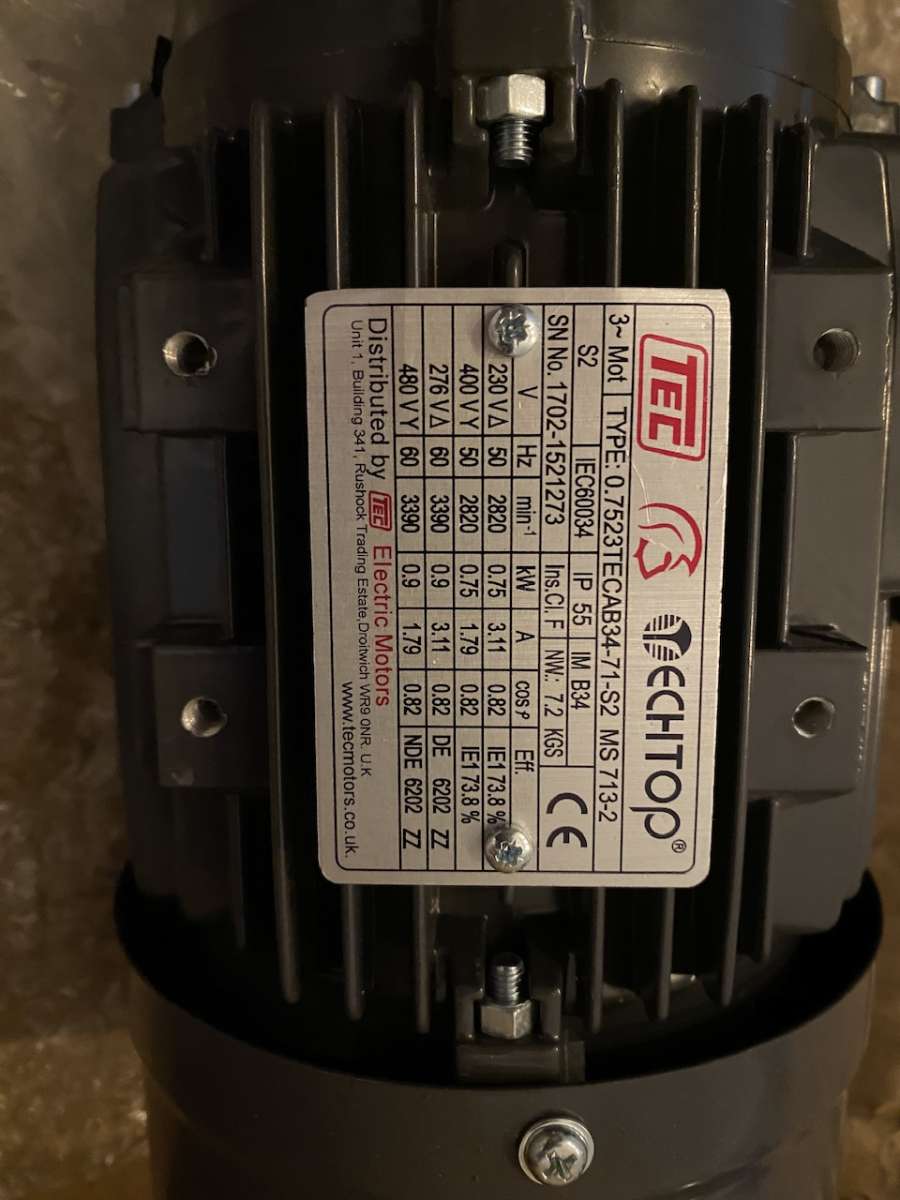
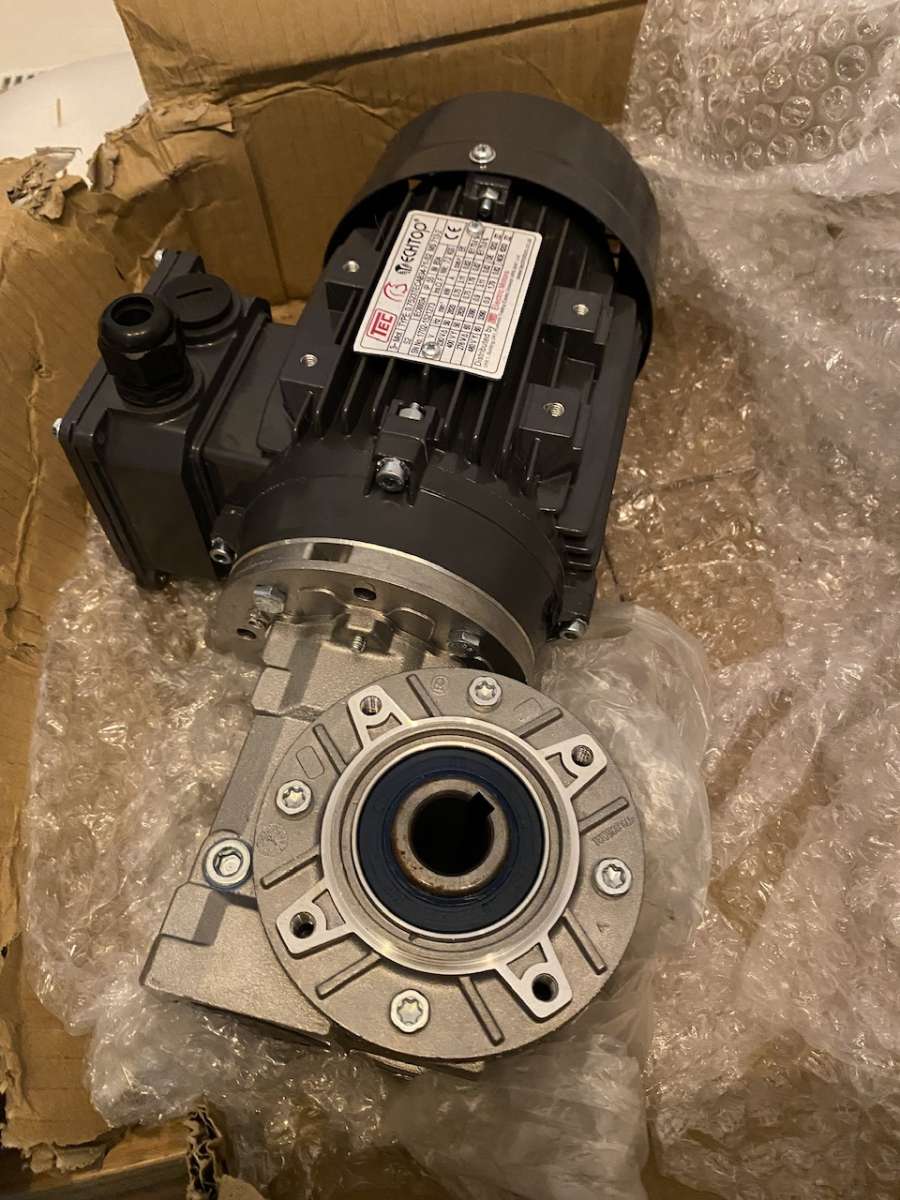
                                          Motor arrived! Really pleased to get a new motor for £49!
                                          has a 7-1 reduction gearbox should I ever want!

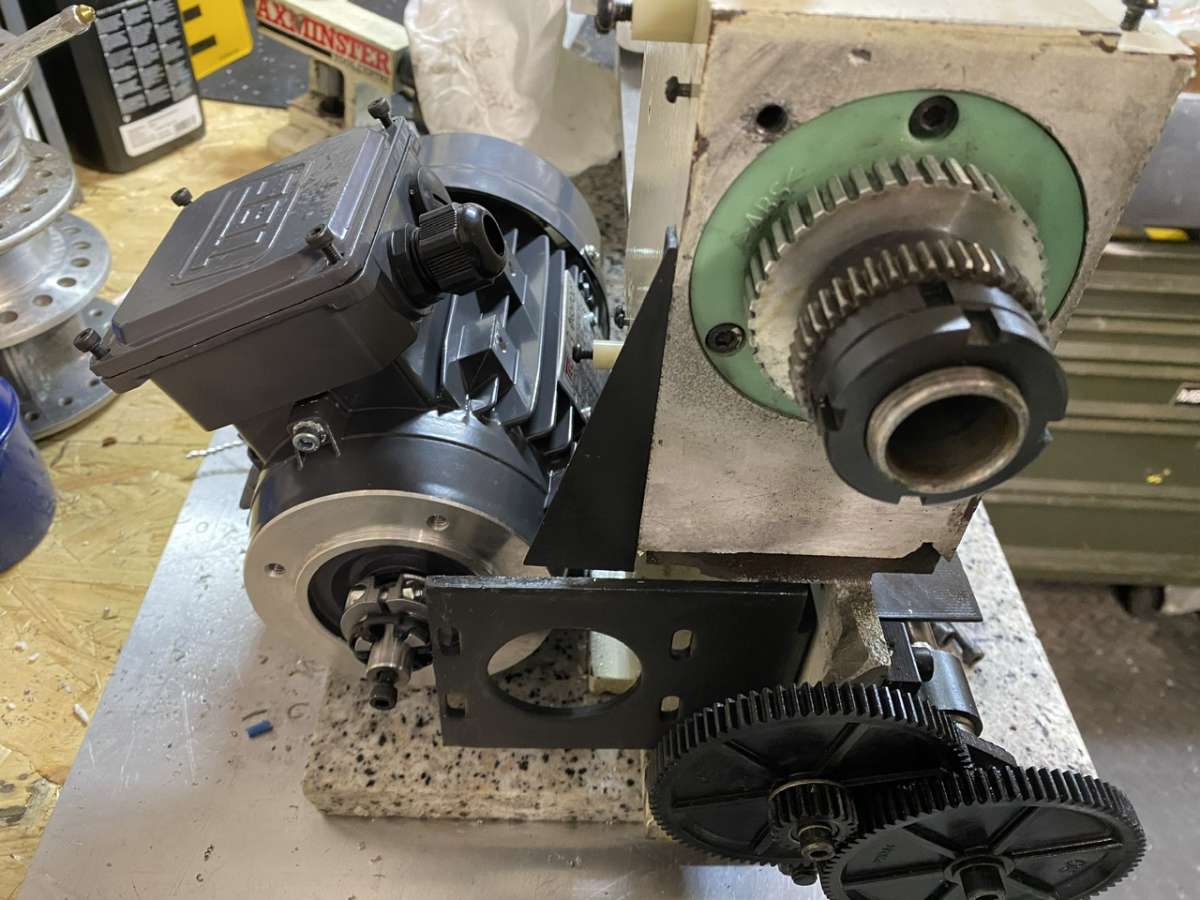
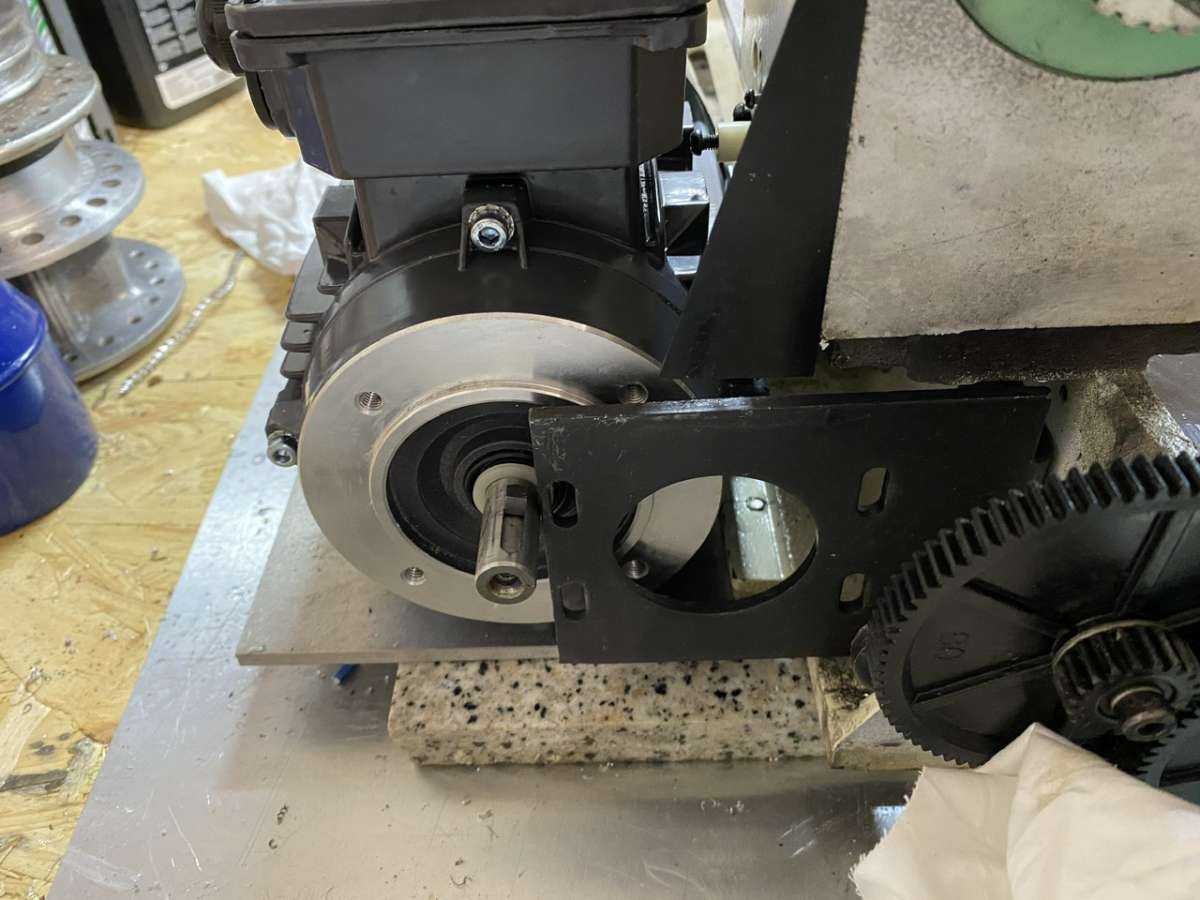
                                          Looks like fitment won’t be as bad as I thought, I’ll need to reshape the housing a bit on the change gear lever area and move the locator round 90* but should be okay I’m going to get some steel today to make a new mount.
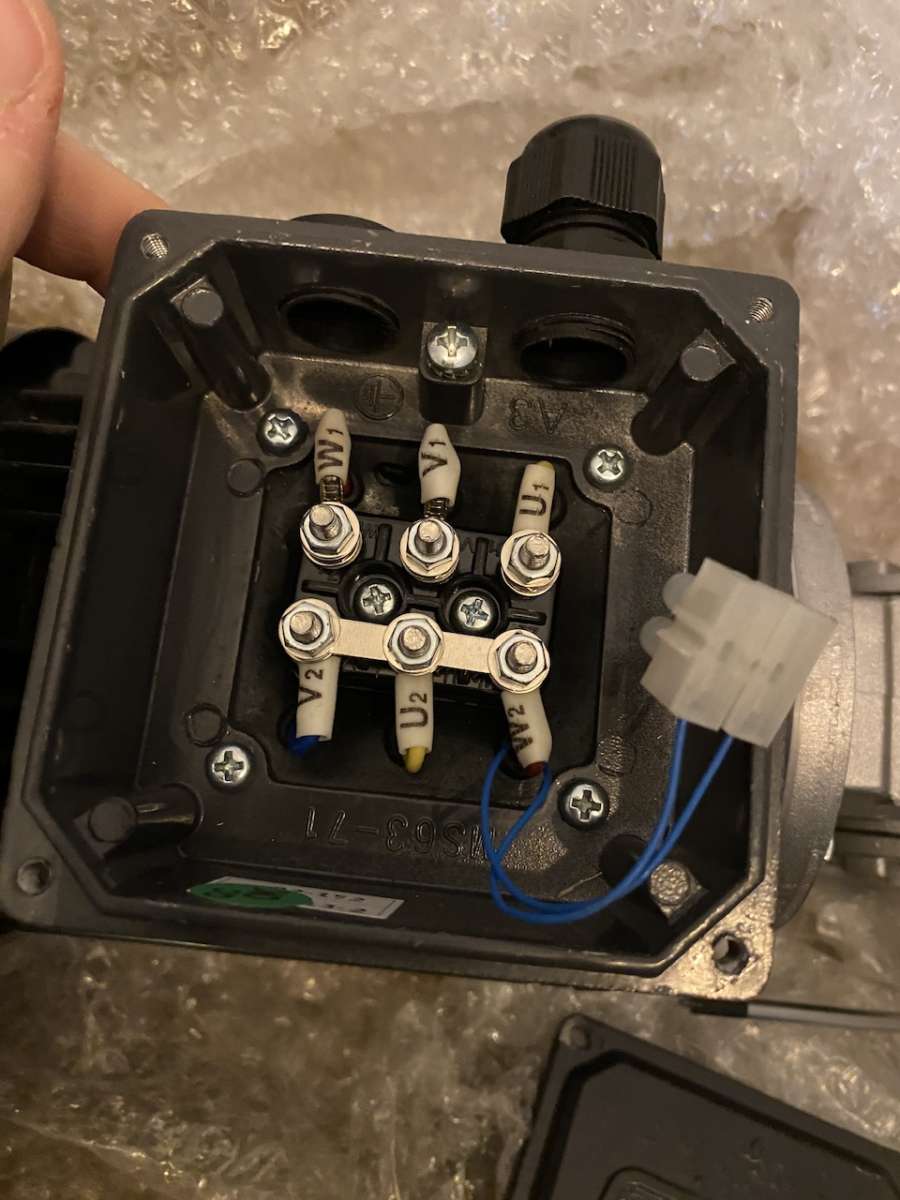
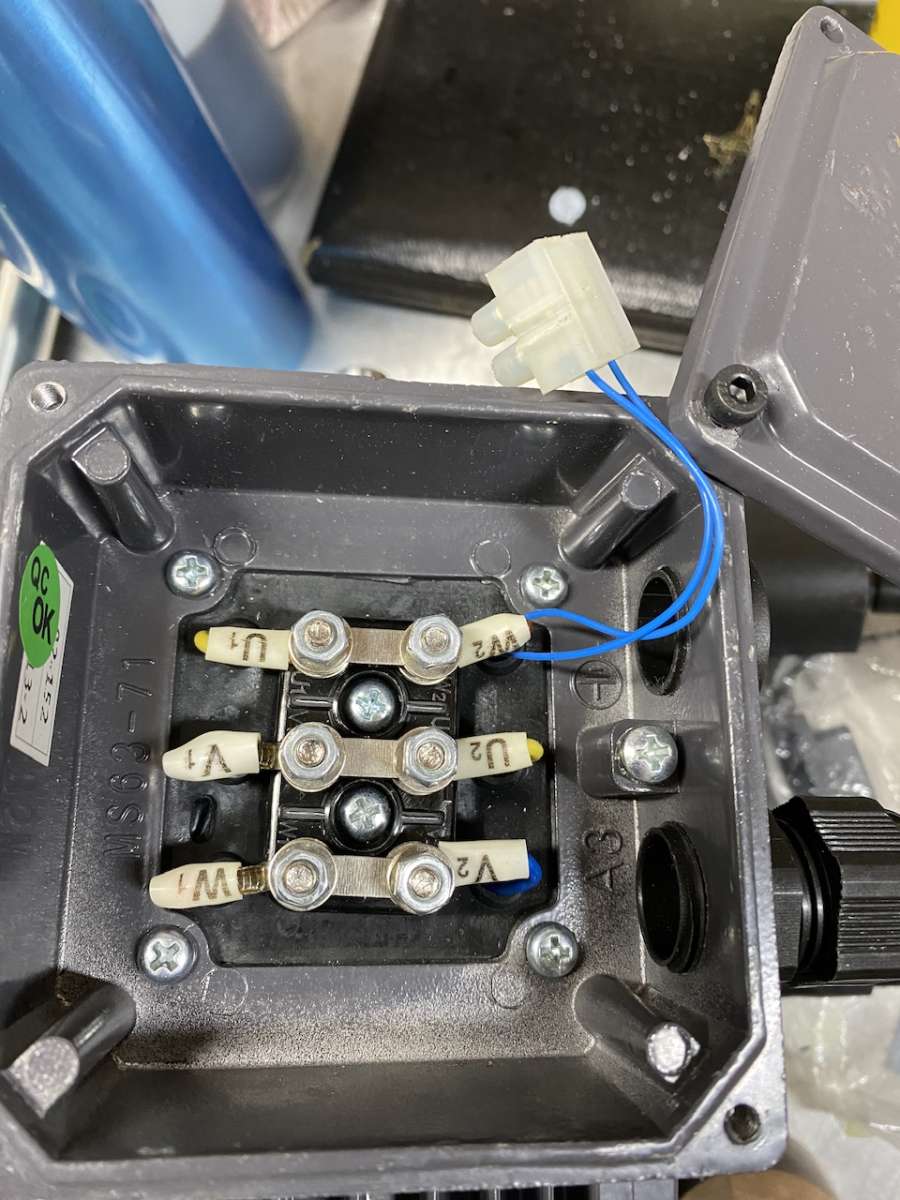
                                          As you can see I changed the wiring over.

                                          IMG_3652IMG_3654IMG_3655IMG_3658IMG_3653IMG_3657

                                          #831717
                                          andy198712
                                          Participant
                                            @andy198712

                                            Oh yes and the teeth count is 20 on the motor end and 40 on the lathe end so should work out quite nicely.

                                            #831722
                                            Robert Atkinson 2
                                            Participant
                                              @robertatkinson2

                                              Looks like an nice motor, Glad the gearbox came off OK. Sometimes the worm can be hard to remove or even part of the shaft.
                                              The rating plate confirms it can run at 60 HZ and 3390 RPM at full power.
                                              The blue wires are a temperature sensor. The invertek VFD supports this but its not really needed on such a low duty application.

                                              Robert.

                                              #831742
                                              andy198712
                                              Participant
                                                @andy198712

                                                Yeah that was a worry when it arrived if the worm was part of the shaft but it slid off easy and so do the cush type pulley/drive part.
                                                and my Sieg pulley fits snuggly on the shaft and same size key way.

                                                got some steel today to make up a mount and base ect


                                                Thanks for your help !

                                                #834948
                                                andy198712
                                                Participant
                                                  @andy198712

                                                  Having ordered my VFD from inverter supermarket and the cable above (thanks)


                                                  what does the enclosure need to be made from? Plastic or metal? In my head plastic feels safer but ?

                                                  #835005
                                                  Robert Atkinson 2
                                                  Participant
                                                    @robertatkinson2

                                                    Hi Andy,

                                                    I prefer metal but palstic is OK, If you have any external EMC filters or more than one VFD you should have a metal plate in the box with all the electrical bita bolted to it. This helps with any possible interference. Don’t forget to earth the plate.

                                                    Robert.

                                                    #835030
                                                    Hollowpoint
                                                    Participant
                                                      @hollowpoint

                                                      I don’t know all the maths behind the low speed low torque debate, but my inverter has some sort of low speed torque boost or compensation. Even at crawling speed it would rip your arm off if you were stupid enough to try to stop it. And that’s only a 550w motor.

                                                      I have the Invertek e3 by the way. Well Ive had 3 of them since they have proven reliable. I am actually fitting one to a Boxford right now!

                                                    Viewing 25 posts - 26 through 50 (of 52 total)
                                                    • Please log in to reply to this topic. Registering is free and easy using the links on the menu at the top of this page.

                                                    Latest Replies

                                                    Home Forums General Questions Topics

                                                    Viewing 25 topics - 1 through 25 (of 25 total)
                                                    Viewing 25 topics - 1 through 25 (of 25 total)

                                                    View full reply list.