Blacking

Blacking

Home Forums Beginners questions Blacking

Viewing 22 posts - 26 through 47 (of 47 total)
  • Author
    Posts
  • #81106
    Nicholas Farr
    Participant
      @nicholasfarr14254

      Posted by Jim Greethead on 02/01/2012 21:30:01:

      I prefer to avoid heating the object but if anybody wants some suitably dirty oil from a Fergie, I am prepared to swap a sump full for some clean stuff.
       
      Jim
       

      Hi Jim, that must be a fair trade for someone.

       
      Regards Nick
      #81108
      Wolfie
      Participant
        @wolfie

        If I heat up some steel and then quench it in oil, is this not the same as the hardening process. Would I then have to temper it again? Hardening and tempering is not something I have done as yet.

        #81110
        ANDY CAWLEY
        Participant
          @andycawley24921

          No, cos you are only heating to about 500 C to harden you have to go to above 750C. Long explanation could follow but I suggest you read it up when the time is appropriate..

          #81111
          Terryd
          Participant
            @terryd72465
            Hi Wolfie,
             
            You can only harden high carbon steels. If your part is made from mild steel you cannot harden it, but you can black it by that method. Do some experiments on scrap parts or odd bits of materials. That is how we learn.
             
            If you are using high carbon steels than that is a good way to harden it and then you need to temper it by heating to a lower temperature and quenching. Try a few samples.
             
            Regards
             
            Terry
            #81125
            Jon
            Participant
              @jon
              Another alternative for steels inc stainless is to heat up either by friction or with a blow lamp between 230 and 280 degrees, the colour spectrum. 265 ish looks quite nice but be quick heat rises cool quick.
               
               
              #81130
              Jim Greethead
              Participant
                @jimgreethead
                Incidentally, all the blacking on this engine: http://www.youtube.com/watch?v=o-zo52flDbI&feature=related
                was done with the Blackfast.
                 
                Jim
                 
                #81131
                Terry Lane
                Participant
                  @terrylane

                  There’s no need to run your piece up to red heat at all – just heat it until it reaches the colour you want, then quench in oil. As others have said, the type of oil is not too critical, you can even set the colour in water and then oil it, but it won’t be as long lasting.

                  #81134
                  Terryd
                  Participant
                    @terryd72465
                    Hi Jon,
                     
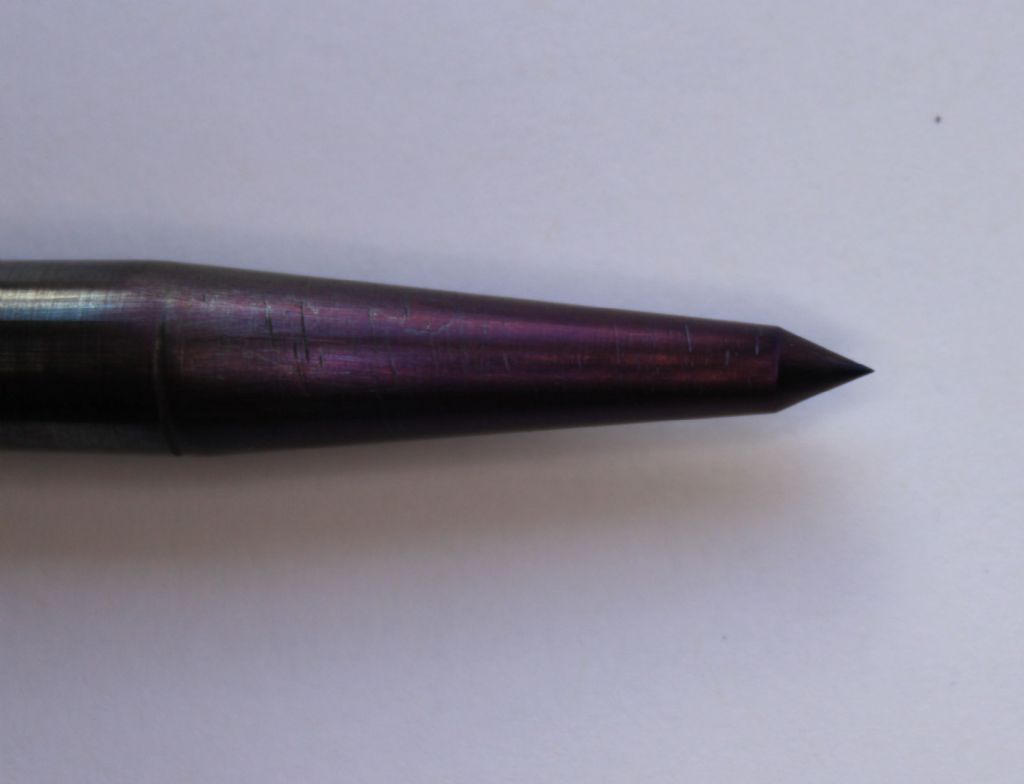
                    For smallish parts you can use a domestic oven for that. An electric one is best as the temperature is very constant. My own at home has a maximum temperature of just over 300º C. However teh temperature scale on the average control knob is not very accurate so some experimentation is necessary. if you have an oven thermometer that might help.
                     
                    Using an oven in this way is much more controllable than using a flame it is also easy to observe colour changes – which are much slower than with a flame – if the oven has a glass door.
                     
                    This tapered dot punch shows the consistency of the colour which is sometimes difficult to achieve on such a part with a torch
                     

                    Best regards
                    Terry

                    Edited By Terryd on 03/01/2012 07:22:11

                    #81184
                    Sub Mandrel
                    Participant
                      @submandrel
                      I find that the heat colours usually darken with age – a ‘dark straw’ becomes a real rich bronzy brown in time. If you get it right (and it can be done) you can get the lovely ‘blue steel’ colour.
                       
                      Neil
                      #81187
                      Jon
                      Participant
                        @jon
                        Yes Terry have tried it in a Bosch fan assisted oven and cant quite get there, translucent brown. This suggests around 230 degrees.
                         
                        Darkist blue would be 275 degrees prior to that purple. 280 degrees it out.
                        The trick is to let the part heat up slowwwww often revolving, its a lot more contollable then.
                        Best i ever did and took 13 attempts i went through the colour spectrum brown to light blue like a rainbow down the length of 18″ tubing, took some doing but used the lathe to revolve.
                        Most of the time i use a propane blow lamp but a brick or any method to induce heat will do the trick including friction.
                        Screws dead easy to do and add that hand made sort of look with pure quality.
                         
                        Terrys above not quite for a beginner, try something smaller to get the hang of it. Decent job by the way – blow lamp held vertical and part upright can tell where it tapers = less heat?
                        #81188
                        Terryd
                        Participant
                          @terryd72465
                          Posted by Stub Mandrel on 03/01/2012 21:27:30:

                          I find that the heat colours usually darken with age – a ‘dark straw’ becomes a real rich bronzy brown in time. If you get it right (and it can be done) you can get the lovely ‘blue steel’ colour.
                           
                          Neil
                           
                          Hi Neil,
                           
                          I quite agree with you, some lovely colours are possible. The real trick is getting the temperature right and letting the work soak for a considerable while which is why I suggest using a proper temperature controlled furnace, or failing that the domestic oven!! By doing it properly the rush to quench at the right time and the fluster etc involved with a torch is eliminated.
                           
                          Best regards
                           
                          Terry
                          #81192
                          Terryd
                          Participant
                            @terryd72465
                            Posted by Jon on 03/01/2012 21:48:48:

                            Yes Terry have tried it in a Bosch fan assisted oven and cant quite get there, translucent brown. This suggests around 230 degrees.
                             
                            Darkist blue would be 275 degrees prior to that purple. 280 degrees it out.
                            The trick is to let the part heat up slowwwww often revolving, its a lot more contollable then.
                            Best i ever did and took 13 attempts i went through the colour spectrum brown to light blue like a rainbow down the length of 18″ tubing, took some doing but used the lathe to revolve.
                            Most of the time i use a propane blow lamp but a brick or any method to induce heat will do the trick including friction.
                            Screws dead easy to do and add that hand made sort of look with pure quality.
                             
                            Terrys above not quite for a beginner, try something smaller to get the hang of it. Decent job by the way – blow lamp held vertical and part upright can tell where it tapers = less heat?
                             
                            Hi Jon,
                             
                            I wouldn’t achieve that easily with a blow torch, except by indirect heating on a plate, in sand bed or salt bath, but it was done easily in my domestic oven set at about 290º C
                            You are right though about using heat properly, it is a skill same as any other, and is also one of the secrets of successful silver soldering (and welding), it’s not just a case of simply using a great big heat supply , but more importantly knowing how to focus it correctly. It’s the mistake most folks make in the beginning.
                            Best regards
                            Terry
                            #81193
                            Jon
                            Participant
                              @jon
                              I love doing that sort of colouring, i’ll be doin a couple of screws tomorrow. Me and my photography wont show it though.
                               
                              An even colour that length would be very very hard to do, might take me two attempts with a lamp. Steady hand and watching the colour either side of the flame expecting it to rise.
                               
                              Stainless is weird you have to get it bordering red then it cools off to show purple to blue.
                               
                              Done some of the fittings on me M300 last year, the quill lock is done thats about 2 1/2″ up to the aluminium.

                              No other piccies sorry.

                               
                              Whilst on this heat colouring i would say its the preparation that counts, polish like chrome and it will have the depth just like a dark blue mirror. Might try bead blast and colour next time, see what that does.
                               
                              At work we used to back temper on a steel block that had been in the forge.

                              Edited By Jon on 03/01/2012 22:20:57

                              #81218
                              Gordon W
                              Participant
                                @gordonw
                                What is the Nevil Shute book where the hero makes toy eggs and colours them, all different, by heating ?
                                #81227
                                Terryd
                                Participant
                                  @terryd72465
                                  Posted by Gordon W on 04/01/2012 10:07:36:

                                  What is the Nevil Shute book where the hero makes toy eggs and colours them, all different, by heating ?
                                   
                                  Hi Gordon,
                                   
                                  He wrote a novel about the adventures of a mild mannered model engineer who also wrote articles for magazine concerned with model engineering (no prizes for correct guesses!). He had to collect a legacy from the South Seas when his sibling and wife were killed in a boating accident. It’s a while since I read it and can’t remember the ‘eggs’ but it could well have been in there as there are many references to model (and full size) engineering.
                                   
                                  The book was called “Trustee From The Toolroom”
                                   
                                  Nevil Shute Norway to give him his full name was also a distinguished Aeronautics engineer and I think he had something to do with airship design before the project was abandoned, if I recall correctly. He dropped the ‘Norway’ for his novel writing.
                                   
                                  Hope that helps, Best regards,
                                   
                                  Terry
                                  #81231
                                  Springbok
                                  Participant
                                    @springbok
                                    Thanks doug will use that method next time
                                     
                                    Bob
                                    #81251
                                    Gordon W
                                    Participant
                                      @gordonw
                                      That’s the one Terry. The eggs are at the beginning, when the young ward arrives, he also made a min. petrol engine with a generator, he took this with him on the trip. to impress the natives? All his books worth reading, this one has s*x in it ,so may not be suitable for the older reader.
                                      #81253
                                      Terryd
                                      Participant
                                        @terryd72465
                                        Posted by Gordon W on 04/01/2012 15:14:41:

                                        That’s the one Terry. The eggs are at the beginning, when the young ward arrives, he also made a min. petrol engine with a generator, he took this with him on the trip. to impress the natives? All his books worth reading, this one has s*x in it ,so may not be suitable for the older reader.
                                        Hi,
                                         
                                        Yes I remember now. I must have a re-read of the book, I recall that I really enjoyed it. Thanks for raising the memory. I did enjoy his writing style, sparse and clear, It was probably due to hi engineering background, it does tend to inspire clarity.
                                         
                                        Best regards
                                         
                                        Terry
                                        #81288
                                        Anonymous
                                          Posted by Terryd on 04/01/2012 10:29:59:

                                           
                                          Nevil Shute Norway to give him his full name was also a distinguished Aeronautics engineer and I think he had something to do with airship design before the project was abandoned, if I recall correctly. He dropped the ‘Norway’ for his novel writing.
                                           
                                          The ‘eggs’ are definitely in the book, and in a fair amount of detail.
                                           
                                          The airship reference is also correct. He was Chief Calculator for the R100, under the direction of Barnes Wallis. In 1931 he founded an aircraft company, Airspeeds. My grandfather joined Airspeeds in 1936, I think, as chief draughtsman, and thus knew Mr. Norway very well.
                                           
                                          Regards,
                                           
                                          Andrew
                                          #81298
                                          John McNamara
                                          Participant
                                            @johnmcnamara74883
                                            Hi All
                                             
                                            If you are looking for a good paper on the practical side of blackening and colouring metals; steel, brass etc, the following book(‘s) are well worth study. There is a large chapter on the subject it gives the formulas is great detail.
                                             
                                            I personally used the formula for the traditional bluing method. You apply many coats allow to rust between each coat and card off with a wire brush. I got a beautiful glossy blue/black. It was a while back and it was easier to buy potassium salts and chloride of mercury, also called corrosive sublimate (as poisonous as cyanide if not more so), then. There are alternative formulas for bluing Steel that do not use Mercury.
                                             
                                            Also a lot of formulas for colouring brass.
                                             
                                            Well out of print but should be available in larger local libraries. If you Google it you will find many references and sources.
                                             
                                            Although the focus is gun smithing the chapters on tool making are outstanding.
                                            Howe was the director of the Frankford arsenal (Makers of the Springfield rifle and many others) in the US.
                                             
                                            Google
                                             
                                            The modern gunsmith
                                            By James Virgil Howe
                                            2 Volumes
                                             
                                            Cheers
                                            John

                                            Edited By John McNamara on 05/01/2012 01:22:44

                                            #81306
                                            Ian S C
                                            Participant
                                              @iansc
                                              I,v been looking up one of my old books, and it suggests that; Heat the article slowly until blue, then let it go white again, and let it cool. then reheat until blue, In no case must you dip the articlein water before or after bluing, as it injures the colour, Give the articles a fine polibh, after which lay them in a sheet-iron pan, with some slaked lime. Place the pan over any place where the heat can be regulated and pay attention until you have obtained the right colour. If the steekl be a good article, they will take on a vivid blue. Ian S C
                                              #81443
                                              Sub Mandrel
                                              Participant
                                                @submandrel
                                                Neville Shute paid at least one visit to Percival Marshall. The character in Trustee from the Toolroom was based on Edgar T Westbury and the engine on one of his designs.
                                                 
                                                Neil
                                              Viewing 22 posts - 26 through 47 (of 47 total)
                                              • Please log in to reply to this topic. Registering is free and easy using the links on the menu at the top of this page.

                                              Latest Replies

                                              Home Forums Beginners questions Topics

                                              Viewing 25 topics - 1 through 25 (of 25 total)
                                              Viewing 25 topics - 1 through 25 (of 25 total)

                                              View full reply list.