Big End Lubrication

Big End Lubrication

Home Forums Stationary engines Big End Lubrication

Viewing 15 posts - 1 through 15 (of 15 total)
  • Author
    Posts
  • #93098
    Alan Worland 1
    Participant
      @alanworland1

      I have virtually completed my horizontal engine having fitted drip type oilers to the main bearings and crosshead for lubrication.

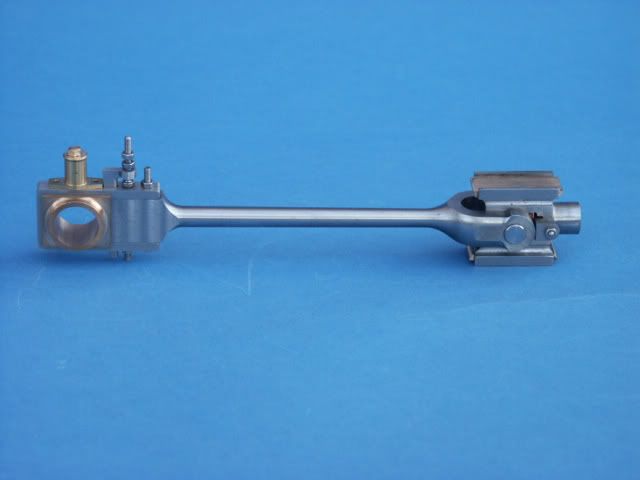
      The big end has a lubrication hole into which I apply oil which finds its way to the bearing by a small capillary hole. Not totally happy about this so I have found myself a suitably sized oiler with a screw cap which would be capable of retaining a more generous amount of oil.

      Would it be better filled with grease and given a part turn every so often?

      Big end is 5/8 dia by about 5/8 long, steel pin and gunmetal rod.

      Alan

      #3137
      Alan Worland 1
      Participant
        @alanworland1
        #93121
        Donhe7
        Participant
          @donhe7
          Posted by Alan Worland on 25/06/2012 22:10:37: a suitably sized oiler with a screw cap which would be capable of retaining a more generous amount of oil.

          Would it be better filled with grease and given a part turn every so often?

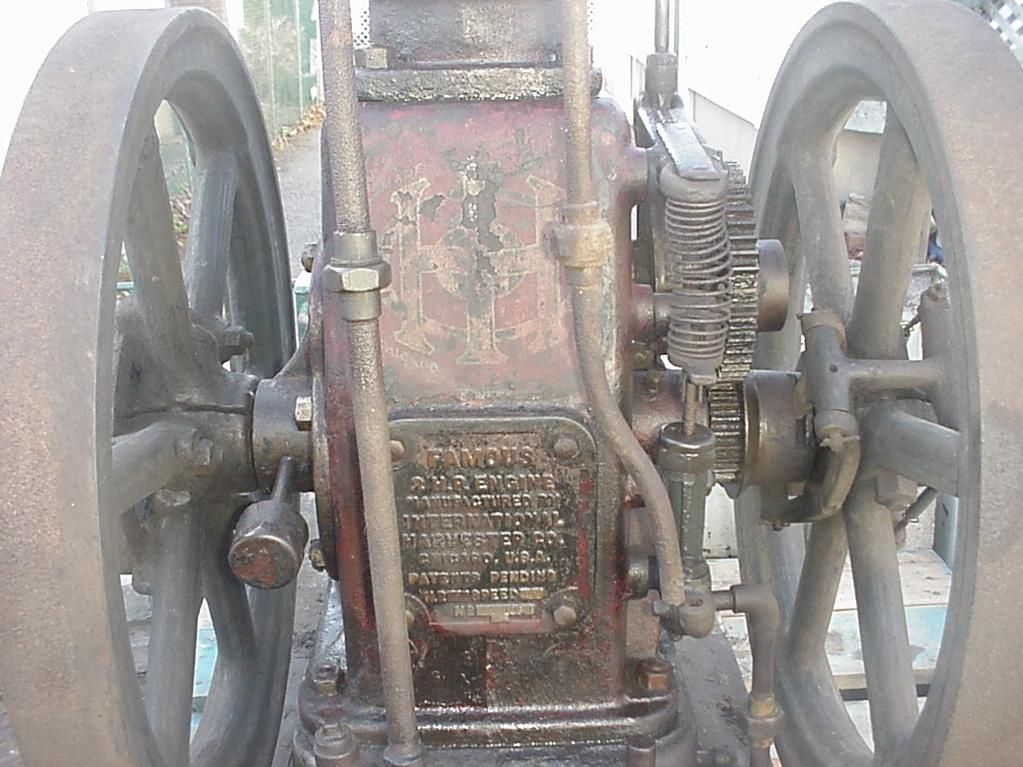
          This method was used in a full-sized stationary engine which was built by IHC in the 1920s, which used a deep "grease cup" on the end of the crankshaft, from whence the grease was forced through a passageway to the big end , a periodic "pat" on the end of the grease cup would keep things lubricated.

          The grease cup could be removed while the engine was running as required, by quickly spinning it between the hands faster than the slow-running engine was rotating, and replaced VERY carefully, after refilling.

          donhe7

          #93123
          Andyf
          Participant
            @andyf

            Would wick oilers, which use a sort of capillary siphon, be satisfactory? I have just made some tiny ones for the spindle of an old Perris lathe, and they seem to work well – see bottom of this page LINK

            Andy

            #93147
            Alan Worland 1
            Participant
              @alanworland1

              Thanks for that. I think what I have is a grease cup (it did have grease in it)

              I have fitted it to the con rod journal which has a very small feed hole into the bearing, I shall fill it with oil and run it on compressed air to see the quantity of oil used, I could fit it with a wick to slow feed rate down if it all flows through too quickly.

              I like the idea of the cup on the crank end, this could be used for all crank bearings I guess.

              In hindsight I think oil might be more suitable than grease?

              I think a lot of small steam engines seem to have lubricators for main bearings etc but the big end gets forgotten about!

              Alan

              #93166
              Ian S C
              Participant
                @iansc

                Alan, its not only models that have lub problems with the big end, I have a bit to do with a Ruston Hornsby 6HR single cylinder, horizontal oil engine, 28 hp/ 6ft flywheel. As its only used intermitantly for demonstration runs the oiling is unreliable. There is an oil cup on top of the big end with a wick, this is filled for starting, there is an oil slinger on the side of the crank, fed by the oil pump. The big end is white metal, and due to poor lub this has been redone twice in the last twenty years, fingers crossed, and hope I'v got everyone educated now. Ian S C

                #93173
                Donhe7
                Participant
                  @donhe7
                  Posted by Alan Worland on 26/06/2012 21:04:14:

                  Thanks for that. I think what I have is a grease cup (it did have grease in it)

                  I have fitted it to the con rod journal which has a very small feed hole into the bearing, I shall fill it with oil and run it on compressed air to see the quantity of oil used, I could fit it with a wick to slow feed rate down if it all flows through too quickly.

                  I like the idea of the cup on the crank end, this could be used for all crank bearings I guess.

                  In hindsight I think oil might be more suitable than grease?

                  I think a lot of small steam engines seem to have lubricators for main bearings etc but the big end gets forgotten about!

                  Alan

                  The IHC engine to which I referred, used a grease cup on each crankshaft bearing, and one on the "half-time shaft", besides the one on the crankshaft end, and used a drip-feed oiler to lubricate the cylinder (about 6-10 drops per minute), hopper-cooled, and was called a "kerosene engine", which we found would in fact, run very well on deiselene!!

                  donhe7

                  #93186
                  JasonB
                  Moderator
                    @jasonb

                    I've made miniature greasers for my model IHC screen cooled to lub the crank bearings, The big end is enclosed in an oil bath with a slinger. This shows one on a the full size version

                    ka21080a.jpg

                    For a steam engine I'd be more inclined to use an oil cup with a lid and fit a wick if needed, something like this

                    Edited By JasonB on 27/06/2012 16:42:02

                    #839912
                    terryfitz
                    Participant
                      @terryfitz

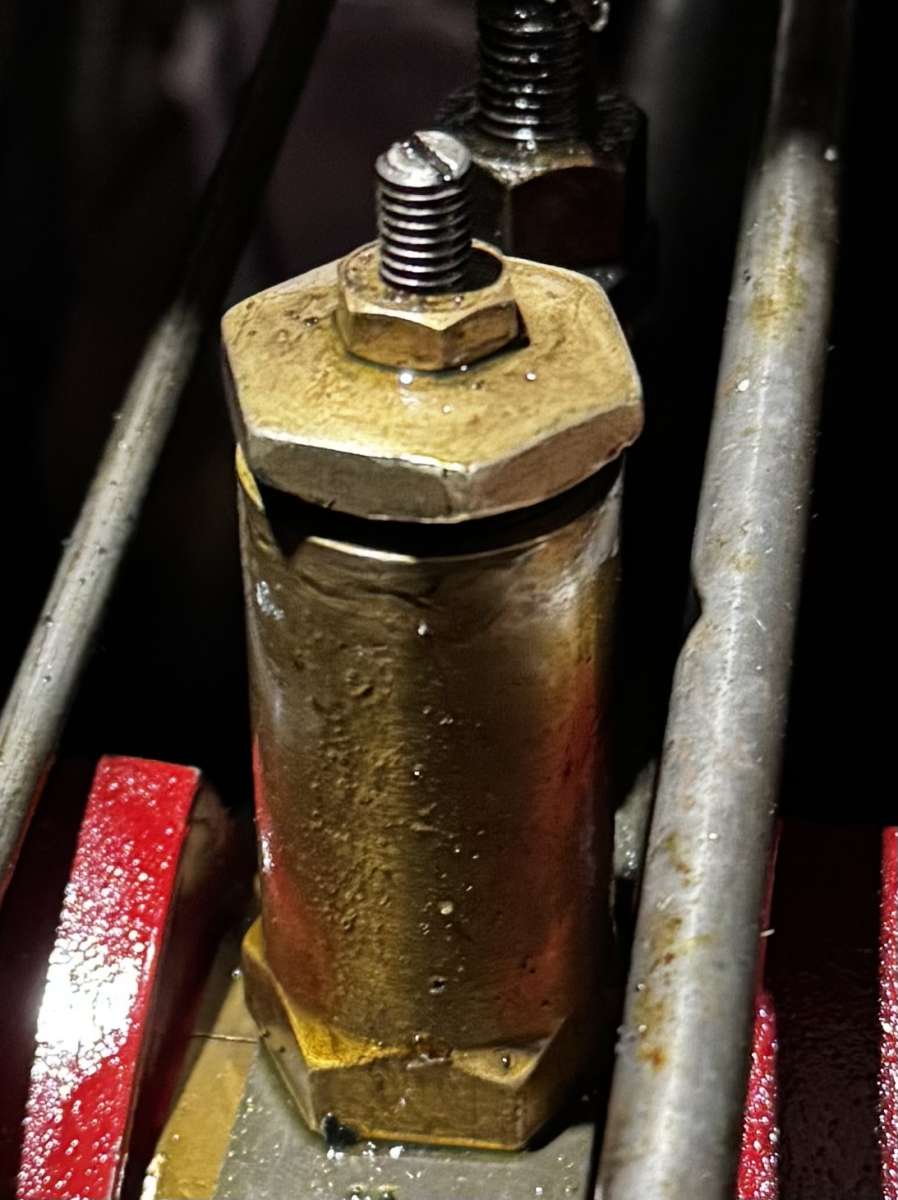
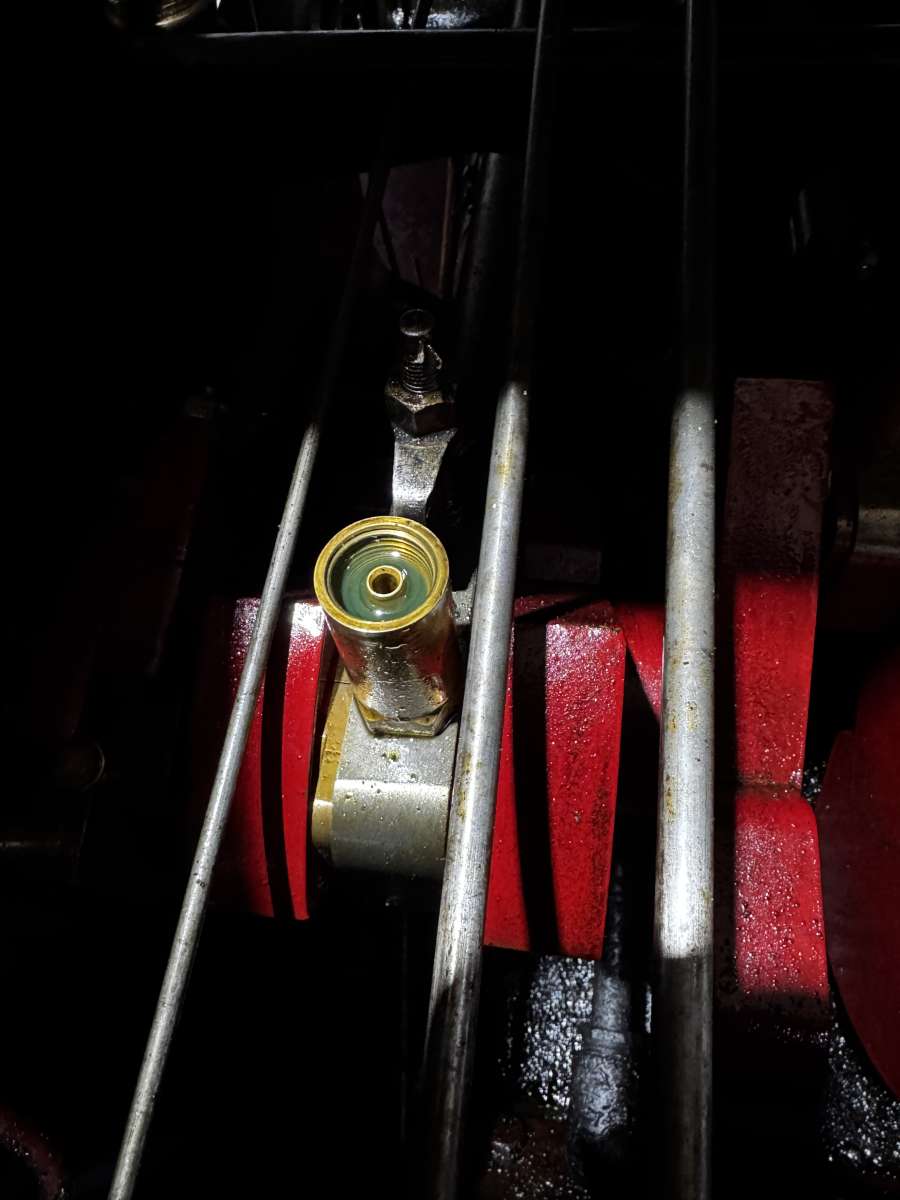
                      Hi. I have joined this forum. My brother just got a 6” Burrell traction engine and I want to check on the big end bearing lubrication. I suspect these are Syphon Wick Lubricators – is this correct?  If so I reckon I need wicks for these. Any idea where I might get these in the Uk?  I am new to steam engines so sorry if I am asking a stupid question or am getting this wrong. IMG_6534IMG_6535

                      #839956
                      noel shelley
                      Participant
                        @noelshelley55608

                        In locomotive practice what you refer to are the trimmings made of worstead thread, a common and one has to assume effective way to lube moving parts. The thread would lift the oil over the lip so it would then gravitate to where it was needed. A design I’m working on at the moment has a hollow crosshead pin, hollow conrod and the oil feeds the little end and the big end, this is a Stuart models twin 5a.

                        #839965
                        bernard towers
                        Participant
                          @bernardtowers37738

                          `dont forget a lot of it is down to the quality of the lubricant not just some old oil at the back of the garage thats been laying there for 20+ years. suggest you look for oils that have a high shear strength possibly castor based?

                          #839980
                          JasonB
                          Moderator
                            @jasonb

                            Heritage Steam Supplies sell the proper Worstead woll an dalso have a page on the fifferent ways to fold the wool to get the correct flow for the job

                            https://www.heritagesteamsupplies.co.uk/worsted-wool-lubricator-kit

                            #850251
                            Howard Lewis
                            Participant
                              @howardlewis46836

                              Mallard set the world speed record for steam loconotives, but lubrication of the middle big end was always marginal, so having set the record, limped into Peterborough station, to be taken off as a failure.

                              Locomotives ran millions of miles with oil being fed from the oil pot to the bearing by worsted trimmings which passed the oil over, by capilliary action, to bearing.

                              Mill engines had a “dish” mounted concentric with the crankshaft centreline, with a pipe leading to the crankpin and big end bearing. Oil was fed into this dish, from a staionary pipe / reservoir, and was centrifuged out to the big end assenbly.

                              Almost until the end of WW2, low power ICE engines often splash fed their big ends. A scoop on the big end cap, dipped into the oil in the sump and forced oil into the big end, (and probably into the main bearings also) and the excess splash ensured that the pistons and bores did not run dry.

                              As speeds, compression ratios, and power, increased, pressure fed oil became a necessity.

                              howard


                              #850353
                              Martin Johnson 1
                              Participant
                                @martinjohnson1

                                I think the type of set up shown in Terryfitz’s photos would have a pin similar to a  round wire nail down the central oil hole cut short so as not to touch the journal and with a head size that rests on the inner tube.  As the crank comes over the top it lifts off the seat letting a little oil flow.  The grubscrew in the filler cap is to limit the lift and hence regulate oil flow.

                                Worsted wicks are a red herring for this application in my opinion.

                                Martin

                                #850406
                                Paul Kemp
                                Participant
                                  @paulkemp46892

                                  +1 for Martin’s comment above.  If you must fit a trimming then it should be a plug trimming for this application.  You want a small constant flow of oil, the rotary motion will empty the reservoir in short order with an ordinary trimming, there needs to be a small breather hole somewhere in the set up too.  Typically full size use corks with a cane through the centre, the cane is porous and allows he reservoir to vent without chucking the oil out!  For my eccentric oilers I cut out a felt disc with a wad punch and placed in the bottom of the reservoir, big end is fitted with a worsted plug trimming.  I had an occurrence last weekend where on the Sunday night it was so hot the oil became really thin (460 bearing oil) that when I steamed up Monday morning all the oil had run out of the big end bearing!  I turned the engine over slow to clear the condensate before I had oiled up and there was a nasty knock!  Refilled the oiler and waited a minute or two for the oil to get into the bearing and it went away.  Clearance on the bearing was a bit big, stripped it down this weekend, no damage thankfully, readjusted with the cotter.  Moral, make sure your bearing clearance is not too large or you will use a lot of oil in hot weather, or consider if it’s hot switching to a heavier grade.

                                  Paul.

                                Viewing 15 posts - 1 through 15 (of 15 total)
                                • Please log in to reply to this topic. Registering is free and easy using the links on the menu at the top of this page.

                                Latest Replies

                                Home Forums Stationary engines Topics

                                Viewing 25 topics - 1 through 25 (of 25 total)
                                Viewing 25 topics - 1 through 25 (of 25 total)

                                View full reply list.