Another One Gone – When?

Another One Gone – When?

Home Forums The Tea Room Another One Gone – When?

Viewing 15 posts - 1 through 15 (of 15 total)
  • Author
    Posts
  • #816716
    Nigel Graham 2
    Participant
      @nigelgraham2

      Needing some gauge-plate I tried Mallard Metals.

      After some rather peculiar returns I found this on the Cylex business directory:

      Mallard Metal Packs Ltd

      53 Jasmin Croft, Kings Heath, Birmingham, West Midlands England, B14 5AX
      *Business is reported as closed.


      This is news to me but I realise it may have closed some while ago. A significant loss to us but it must be very hard to run a small retail business relying on a many small, individually-infrequent purchases of bits cut from the trade-lengths. My long list of hobby-supply “favourites” shows very few model-engineering materials sellers, though I have included some large general stockists like Metals4U.

      .

      As for the gauge-plate, I may have to choose an alternative material. It is for a pair of expansion-links for Stephenson’s Link Motion. Although unhardened gauge-plate (“ground flat stock”) seems the normal one in miniature engines the full-size links were likely mild-steel or cast-iron with cast-iron die-blocks, with or without bronze slippers or wear-adjusters. Cast-iron would not be suitable for a very small link, but mild-steel, or perhaps stainless-steel, with cast iron die-blocks, may well be perfectly satisfactory.

      #816718
      JasonB
      Moderator
        @jasonb

        Why are you having to choose an alternative material when it is still available from other sources? Give M-machine a go they stock a good range in short 9″ or 250mm lengths

        https://www.m-machine-metals.co.uk/downloads/Metals%20catalogue.pdf

        You could use SG iron to cut then from if you wanted to go the iron route, again bar and block available from M-machine.

        #816719
        Michael Gilligan
        Participant
          @michaelgilligan61133

          It’s not exactly difficult to answer your opening question, Nigel !

          https://find-and-update.company-information.service.gov.uk/company/04215562

          MichaelG.

          #816724
          David George 1
          Participant
            @davidgeorge1

            This is my go to supplier for gauge plate    Home – Coventry Grinders | Gauge Plate & Ground Flat Stock

            http://www.coventry-grinders.co.uk

            Very good priced and fast delivery sometimes next day and their grinding wheels are good as well.  have a look.

            David

            #816726
            Nicholas Farr
            Participant
              @nicholasfarr14254

              Hi, I agree with David, and have used them many times.

              Regards Nick.

              #816727
              Julie Ann
              Participant
                @julieann

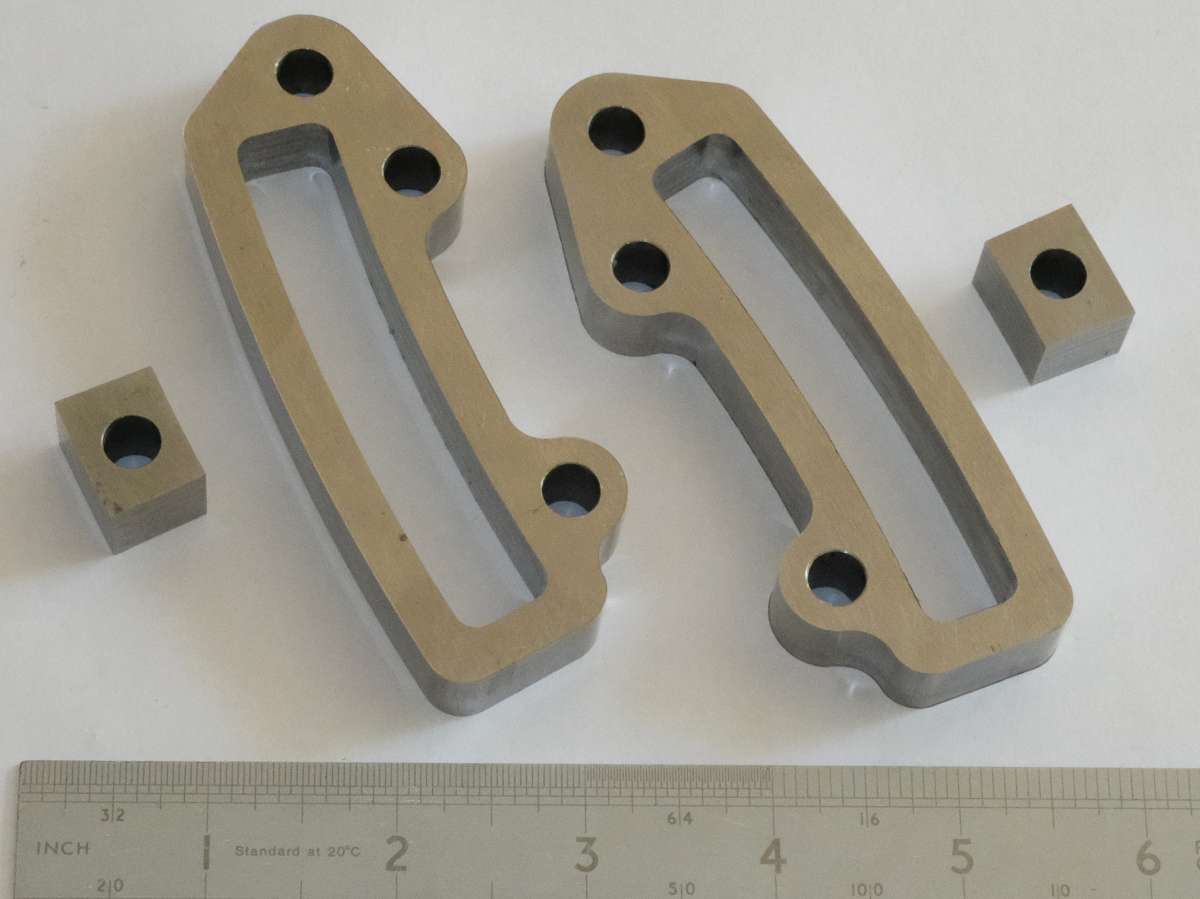
                I also buy gauge plate from M-Machine and Coventry Grinders. I made these last week:

                Embryo Expansion Links

                Julie

                #816728
                Charles Lamont
                Participant
                  @charleslamont71117

                  Red herring: Full-size locomotive die blocks I have seen are one-piece solid bronze.

                  #816729
                  Julie Ann
                  Participant
                    @julieann

                    I don’t think Nigel is building a locomotive.

                    Julie

                    #816770
                    derek hall 1
                    Participant
                      @derekhall1

                      I ordered some metal from M-machine yesterday and it arrived this morning!

                      They are always my “go to” for material, ferrous and non ferrous stuff.

                      On topic I agree about the state of some castings. I have some shapeless blobs of “castings” that I bought for the Lady Steph engine I am building. Most of the castings supplied could have been made from stock material…

                      Regards

                      Derek

                      #816829
                      Nigel Graham 2
                      Participant
                        @nigelgraham2

                        I did in fact look around at a few other suppliers and found them.


                        Julie- You’re right. I’m not. I’d still like to use appropriate materials though!

                        By coincidence the links I have drawn are the same shape as yours, though I think smaller. I’ll be amazed if mine match the quality you achieve, especially in all those curve transitions. Having drawn my version of the link I am worried that the tangent section from the suspension-point to the eccentric-rod eye, on mine at least, would foul the eccentric-rod clevis. I can either make them knowing I may have to cut that portion back, or cut back from the start. I have no drawings for my wagon, other than the rather rough ones I make of some individual parts as and when I need, so much of the work is rather speculative!


                        Back to the original question though, yes I can still buy GFS but I am sorry to see Mallard Metals disappear, it reduces the choice of suppliers, and they had very useful stands at the exhibitions.

                        #816881
                        Julie Ann
                        Participant
                          @julieann

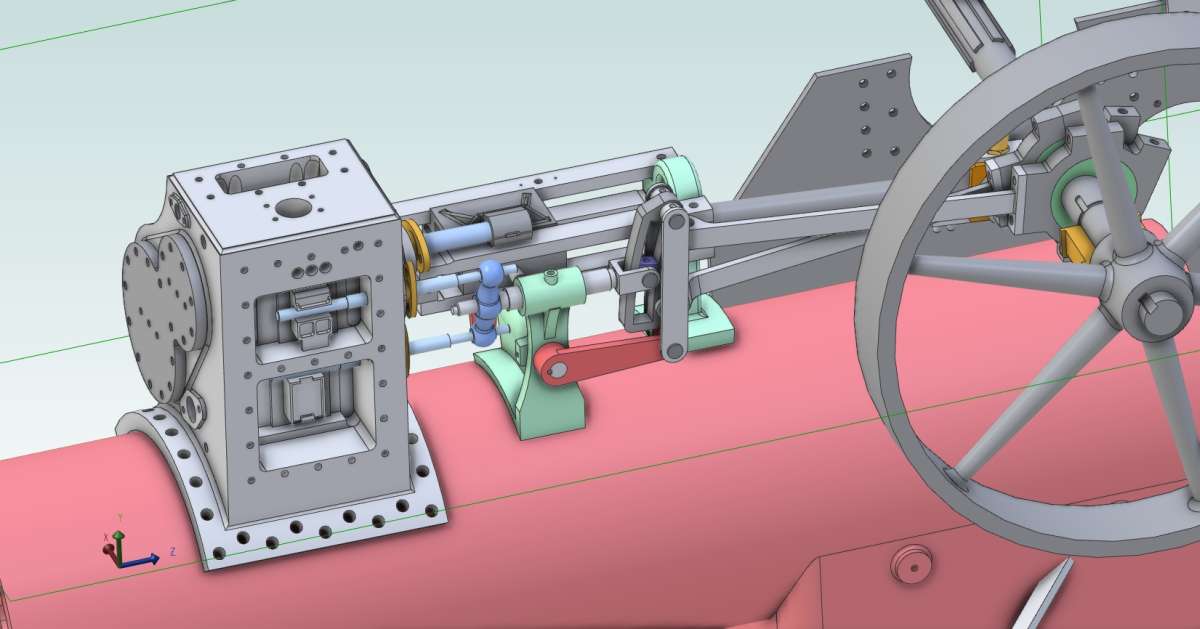
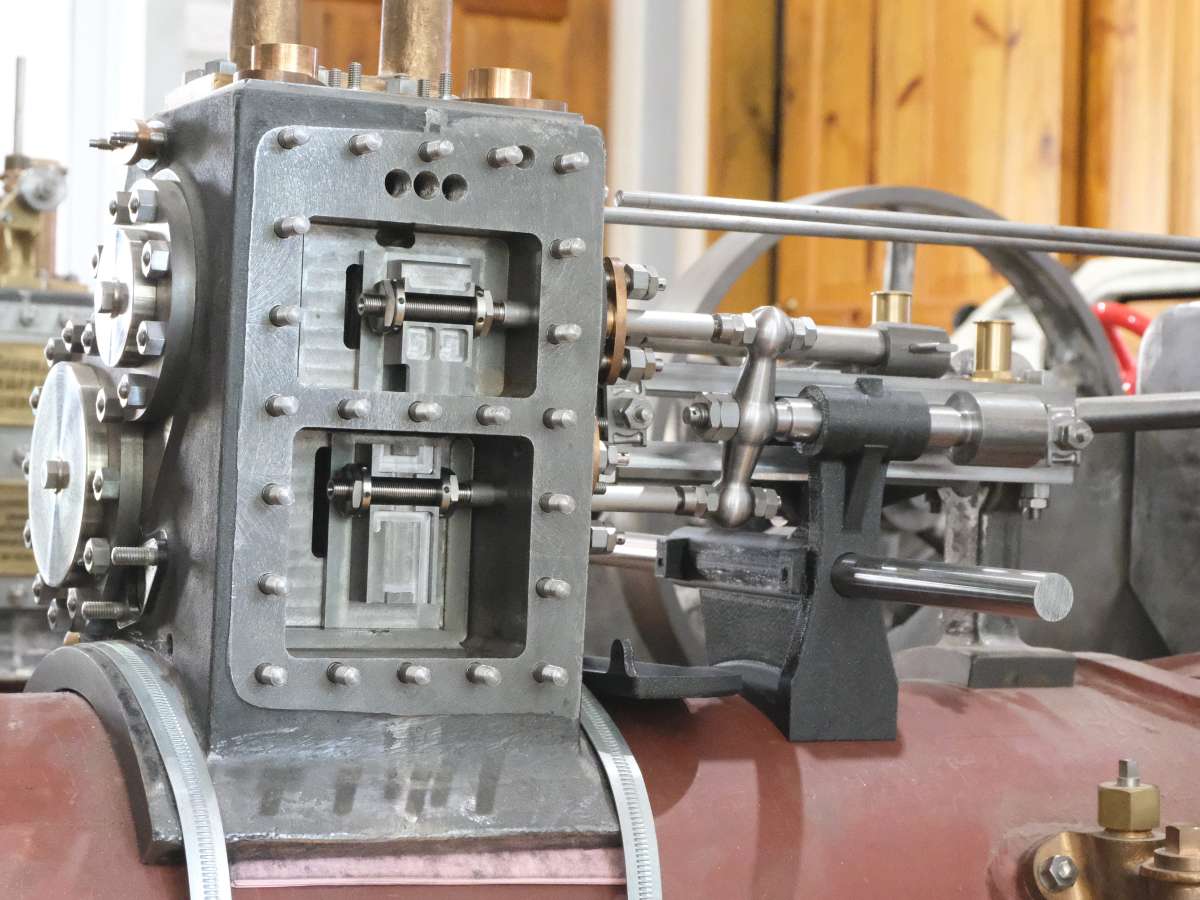
                          Since I changed all the steam flows and port sizes I had to design my valve gear from scratch. Anecdotal comments also indicated that the valve gear as originally designed didn’t notch up properly. I know it’s a sore point but I modelled my valve gear in 3D CAD:

                          Motion Work Assembly 21-9-2025

                          I then spent ages changing dimensions and measuring leads and cutoffs at various valve gear settings. I used to have a motion simulator for Alibre, but it seemed to get lost in the transfer to Geomagic and then back to Alibre. Mind you it didn’t work very well, so no great loss. I hope there won’t be any interferences in the design. I am currently machining the wayshaft support casting. A 3D print of the CAD model shows it fits:

                          Valve Gear - 3D Printed Wayshaft

                          Fingers crossed the machined casting will also fit.

                          I’ve had a bit of a search but can’t find any information regarding materials used for die blocks in full size. Certainly locomotive die blocks tend to be a more complex design with multiple parts and wear plates. I will stick with what I have made and will be not be hardening the expansion links and die blocks to avoid distortion.

                          Julie

                          #816883
                          Michael Gilligan
                          Participant
                            @michaelgilligan61133
                            On Nigel Graham 2 Said
                            […] Back to the original question though, […]

                            That’s strange ^^^ 

                            I read the original question as being “when ?”

                            MichaelG.

                            #817113
                            Nigel Graham 2
                            Participant
                              @nigelgraham2

                              It was, Michael, because I’d not known it had happened until I tried to contact the firm.

                              Julie –

                              I took a short cruise on the paddle-steamer ‘Waverley’ a couple of weeks ago. Her expansion-links and die-blocks are even more complicated than a locomotive’s, possibly for relatively easy maintenance as you can’t always just stop a ship in mid-ocean to repair the main engines! The link is double, with two parallel but side-by-side rather than fore-and-aft bars joined by bolts and spacers; and the die-blocks are flanged round the bar sides. Lots of bronze blocks and pads, too.

                              I think my far simpler engine will use gauge-plate or mild-steel expansion-links with either leaded-bronze or cast-iron die blocks.

                              I have used cast-iron for the split big-end journals, running on the mild-steel crankshaft. Well, I say mild-steel… it was heavy and rusty. It would not have been some exotic alloy certificated to the nth degree, neither is it free-cutting, but my source was a scrapped axle from a restored, narrow-gauge quarry tramway wagon of unknown make and age.

                              Though drawing my engine parts using Alibre, I can’t design the entire engine, or the rest of the steam-wagon, that way. I might be able to use TurboCAD in orthographic mode for plotting the valve-gear, as the 2D option is good for geometrical constructions. Otherwise I’d need do so by hand. TC in 2D is also good for General Arrangements, but even in its 3D model mode, I think the “Deluxe” edition at least, lacks the sort of animation feature built into Alibre Atom. (“Deluxe” is the name IMSI gives to its basic editions of TurboCAD!)

                              My design guide is K.N. Harris’ version of LBSC’s Stephenson’s Link Motion for his Maid of Kent 5″-gauge locomotive. I’ve also a copy of Martin Evans’ Manual of Model Steam Locomotive Construction, for some indication of port dimensions, etc.; and our club has a useful library of assorted full-size and model engineering text-books.

                              Although I had copied in Alibre, Harris’ expansion-link design, I realised the simpler end-suspended form with that end taking the fore-gear, as on a traction-engine, is appropriate, because road vehicles don’t run in reverse very much. I wonder if may even be slightly more efficient because the suspension-link is relatively a lot longer, reducing the lateral displacement. That redrawing was difficult because the original was dimensioned very awkwardly, needing plenty of arithmetic to untangle.

                              To be honest I don’t know what valve-gear my originals, by Hindley, used because the inverted-vertical engine is enclosed! So I can take some liberties with its design, and only you and I would know. However, one of the few archive photographs shows the rear of the engine had two curious little (pressed-steel?) excrescences on its “quickly detachable cover” (quoting the catalogue). By their positions I suspect these gave clearance for the ends of the expansion-links of Stephenson’s Link Motion.

                              #817190
                              Julie Ann
                              Participant
                                @julieann

                                I think that marine and locomotive applications are mostly much higher power and continuous running than traction engines. Hence the more complex die blocks. It is difficult to see the die block arrangement on the pictures I have of the full size single crank compound I am building as the lifting links are in the way. The best I could find online was this video:

                                https://www.youtube.com/watch?v=9_BlRD0tafI&t=1663s

                                which at around 2 minutes shows plain steel expansion links and die blocks, probably wire eroded.

                                On my engines I have split bronze bushes running on a SG iron cast crankshaft and a hardened silver steel bush running on an EN8 pin at the small end.

                                I have spent many months looking at the valve gear design. My references are the book by Don Ashton and reprints of contemporary books on valve gear design and diagrams, especially the Zeuner diagram. I have also corresponded with people who have already designed successful valve gears for traction engines.

                                It would be fair to say that the traction engine valve gear arrangement is poor, and always will be however one tweaks the valve gear. My design criteria were to aim for equal cutoff on forward and reverse strokes at 50% in forward gear and let reverse gear be whatever it is. As you say the engines will rarely run in reverse.

                                After much puzzling I think I understand the Ashton method. It gives good results but not quite perfect. I got slightly better results by making the lifting arm a little longer than suggested by Ashton. What does work well is the equation in Ashtons book to make the eccentric rods slightly longer than the nominal radius of the expansion link pins so as to give equal leads on the forward and reverse strokes. In my case the additional length was 4 thou on a nominal 12 inch rod. Doesn’t sound much but it made a huge difference.

                                This probably isn’t the place to get into the arcane details of valve gear design in case we get accused of going off topic.

                                Julie

                                #817194
                                Nigel Graham 2
                                Participant
                                  @nigelgraham2

                                  Ironically off-topic on my own question!

                                  I have just acquired a “simple” construction for part of Stephenson’s Link Motion but to be honest my projejct is highly speculative and I am forever making replacement parts, or modifying ones already long made.

                                Viewing 15 posts - 1 through 15 (of 15 total)
                                • Please log in to reply to this topic. Registering is free and easy using the links on the menu at the top of this page.

                                Latest Replies

                                Home Forums The Tea Room Topics

                                Viewing 25 topics - 1 through 25 (of 25 total)
                                Viewing 25 topics - 1 through 25 (of 25 total)

                                View full reply list.