A change of scale.

A change of scale.

Home Forums General Questions A change of scale.

Viewing 20 posts - 1 through 20 (of 20 total)
  • Author
    Posts
  • #447790
    Brian Abbott
    Participant
      @brianabbott67793

      If someone a little brighter could confirm for me.

      If I have a drawing that is scaled 1.5" to the foot and I want to make it 1" to the foot, do I simply.

      Multiply the 1.5" dimension by a value of 8

      then divide by 12?

      So.. 3/8(0.375) x 8 = 3 then div by 12 = 1/4(0.250)

      Thanks.

      #27088
      Brian Abbott
      Participant
        @brianabbott67793
        #447792
        roy entwistle
        Participant
          @royentwistle24699

          You could simply multiply by 2/3rds

          Roy

          On thinking about it that's what you said surprise

          #447796
          not done it yet
          Participant
            @notdoneityet

            Or divide by 3/2 – ie divide by 1.5. All the same thing, mathematically.

            #447798
            IanT
            Participant
              @iant

              On the face of it, multiplying by 0.66666 (recurring) will do it Brian – but your approach of multiplying by 8 and then dividing by 12 will avoid any very small rounding errors.

              My friend (who can 'do' fractional math in his head) would do it very simply – 8×3 = 24, 24/12 = 2 and 2/8 = 1/4

              Regards,

              IanT

              #447835
              SillyOldDuffer
              Moderator
                @sillyoldduffer

                Anyone got any suggestions as to how best do the conversion work? I think it depends on how many dimensions there are to do and how complicated the plan is.

                For a small number of dimensions and a simple plan, I'd incline to a paper pad and pocket calculator × 0.66666, double checking before cutting metal. (Error prone, but not as bad as pencil and paper.) If one is available, slide rules are excellent for this sort of conversion. After setting the slide to × 0.666, all the answers can be picked off by moving the cursor. (Disadvantage perhaps only good to 2 places of decimals, which I think is plenty good enough.)

                A lot more dimensions on a simple plan would have me tabulating them in a spreadsheet and applying ×12 ÷ 8 to the whole lot. (Less error prone, but have to know how to drive a spreadsheet. Another advantage is the figures are stored, can be checked by someone else, and corrected later if mistakes are found.)

                A complicated drawing would have me redrawing the plan in the original scale in a 2D CAD package. (I like QCAD, others available.) Then I'd rescale the whole drawing × 0.666666 in one go. This method highlights errors very effectively, including mistakes in the original drawing. Disadvantages are the time taken to re-draught the plan and needing to know a CAD package. But it is fun making an entire drawing change scale at the push of a button!

                As an ex-computer programmer I'd love to write code to do the job, but that's hard work for very little return in this case. Spreadsheets are a far better tool unless the number of dimensions to be converted is enormous (millions…)

                Dave

                #447842
                Michael Gilligan
                Participant
                  @michaelgilligan61133
                  Posted by SillyOldDuffer on 20/01/2020 18:07:27:

                  Anyone got any suggestions as to how best do the conversion work? I think it depends on how many dimensions there are to do and how complicated the plan is.

                  For a small number of dimensions and a simple plan, I'd incline to a paper pad and pocket calculator × 0.66666, double checking before cutting metal. (Error prone, but […]

                  .

                  I would probably just use a calculator that works in fractions

                  MichaelG.

                  #447844
                  Richard S2
                  Participant
                    @richards2

                    Hi Brian, Did all my calculations from 1.1/2" (1/8) to 1/12th using the option you suggested in your question.

                    x8 to full size and down to 1"- ft. Much of it long hand (keeps the brain active), otherwise calculator into thou.

                    Do I presume you are downsizing Alchin Dims for your Minnie as well ?. yes.

                    #447845
                    Nick Clarke 3
                    Participant
                      @nickclarke3

                      What is the drawing of?

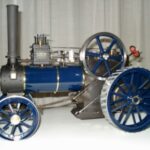
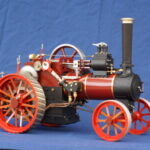
                      If it is a traction engine or an engineering model then 1" scale is used – but if it is a locomotive then 5" gauge is not always 1" to the foot – as Wikipedia says –

                      For standard gauge prototypes at 5 inch, the "official" scale is 1​116 inch per foot or approximately 1:11.3. Alternatively 1.1/8 inch per foot is adopted, allowing a scale of 3/32 inch per full size inch.

                      #447850
                      Bazyle
                      Participant
                        @bazyle

                        Another way is not to convert it as such but make yourself a new measuring stick with marks made at 1.5 in intervals. Then subdivisions of fifths made by marking off every three tenths in real inches. Then put in the tenths by eye. Or do the same for fractions whatever you prefer.

                        #447853
                        JasonB
                        Moderator
                          @jasonb
                          Posted by SillyOldDuffer on 20/01/2020 18:07:27:


                          A lot more dimensions on a simple plan would have me tabulating them in a spreadsheet and applying ×12 ÷ 8 to the whole lot. (Less error prone, but have to know how to drive a spreadsheet. Another advantage is the figures are stored, can be checked by someone else, and corrected later if mistakes are found.)

                          Not sure if that is less error prone Dave as x 12 divided by 8 would give a bigger modelblush

                          I usually use the 0.666 method but more often than not it is not such a simple figure if you are scaling from say a photo and using something like cylinder bore or flywheel diameter as one side of the equation and length scaled off a photo for the other. Another example would be making a 5cc engine from an original 2.5cc wher lengths only increase by about 1.2 yet the capacity is double.

                          As for a fractional calculator that does not work all the time if the original was in imperial and you want your version in metric which is again something I often want.

                          Edited By JasonB on 20/01/2020 19:06:58

                          #447854
                          Former Member
                          Participant
                            @formermember19781

                            [This posting has been removed]

                            #447857
                            Michael Gilligan
                            Participant
                              @michaelgilligan61133
                              Posted by JasonB on 20/01/2020 19:03:24:

                              As for a fractional calculator that does not work all the time if the original was in imperial and you want your version in metric which is again something I often want.

                              .

                              My comment was, of course, made in the context of the opening question.

                              MichaelG.

                              #447861
                              JasonB
                              Moderator
                                @jasonb

                                Yes I assumed it was Michael

                                Even then a fractional calculator won't always work as you get those sizes that don't suit such as 5/16" which would not easily convert down to a fraction. In cases like this decimal is better and depending on what th dimension refered to may need to stay as that or be adjusted to suit nearest available stock diameter as no body really wants to turn long shafts down to 0.208" as it's often better to opt for 7/32" stock.

                                I do also know of people who like to express all the imperial measurements on an old imperial drawing in metric so in brian's example that 0.375" on a smaller version of the model would be written as 6.35mm and that is the size they would work to, still 1/12th scale.

                                #447864
                                Chris Gunn
                                Participant
                                  @chrisgunn36534

                                  From a practical standpoint, in the absence of CAD and the time to do it that way, I usually copy the drawings in question, then use a fine point correcting pen to white out the original dimensions and then overwrite with the new ones. This saves dobbing back and forth from drawing to spreadsheet, and inadvertently looking at the wrong line on the spreadsheet. You will still have the original drawings to check against if required. As Jason says keep one eye on the results and amend to use standard size materials.

                                  This method works just as well when converting from imperial to metric or vice versa.

                                  Chris Gunn

                                  #447865
                                  SillyOldDuffer
                                  Moderator
                                    @sillyoldduffer
                                    Posted by JasonB on 20/01/2020 19:03:24:

                                    Posted by SillyOldDuffer on 20/01/2020 18:07:27:

                                    A lot more dimensions on a simple plan would have me tabulating them in a spreadsheet and applying ×12 ÷ 8 to the whole lot. (Less error prone, but have to know how to drive a spreadsheet. Another advantage is the figures are stored, can be checked by someone else, and corrected later if mistakes are found.)

                                    Not sure if that is less error prone Dave as x 12 divided by 8 would give a bigger modelblush

                                    Well that's embarrassing! Good job I said 'Another advantage is the figures are stored, can be checked by someone else, and corrected later if mistakes are found'.

                                    Thank god I don't do this stuff for a living!!!

                                    nocryingembarrassed

                                    #447867
                                    Michael Gilligan
                                    Participant
                                      @michaelgilligan61133
                                      Posted by JasonB on 20/01/2020 19:36:47:

                                      Yes I assumed it was Michael

                                      Even then a fractional calculator won't always work as you get those sizes that don't suit such as 5/16" which would not easily convert down to a fraction. […]

                                      .

                                      Not really sure what's difficult about 'five twenty-fourths' [a.k.a. 'two and a half twelfths'] when you're working at 1" to the foot … But each to his own: For me, any decimal conversion would come at the end of the process.

                                      MichaelG.

                                      #447868
                                      JasonB
                                      Moderator
                                        @jasonb

                                        Maybe I should have said practical fractions. Not many rules or drill bits made in those fractional sizes.

                                        Edited By JasonB on 20/01/2020 20:26:11

                                        #447900
                                        Paul Lousick
                                        Participant
                                          @paullousick59116

                                          Scaling a model to a different size is not only about scaling the dimensions. You also have to consider the size of available materials.

                                          Parts which are fabricated from sheet metal and plate or standard size round bar are probably not available in the new scaled size and a substitute size has to be used instead. Associated parts will then have to be modified to suit these items.

                                          Be aware that when the scale model drawings are first drawn, many of the features of the full size engine/machine were simplified or not included. Not a problem if you are scaling down the model drawings but could be if you are scaling up. In which case it is better to copy from the full size drawings.

                                          Paul.

                                          #447912
                                          Brian Abbott
                                          Participant
                                            @brianabbott67793

                                            Thanks all for taking the time to reply.

                                            Reason I ask, having recently found an article in an old copy of Model Engineer, the chap went on to show that he had added some extra items to his 1” Minnie taken from the drawings for the 1.5” Alchin ( spot on Richard ).

                                            He added a governor, displacement lubricator, cylinder blow down valves and a couple of other items, so thought I might try and do the same.

                                            So, again, thanks all.

                                            PS. the artical was in Volume 155 Number 3763

                                          Viewing 20 posts - 1 through 20 (of 20 total)
                                          • Please log in to reply to this topic. Registering is free and easy using the links on the menu at the top of this page.

                                          Latest Replies

                                          Home Forums General Questions Topics

                                          Viewing 25 topics - 1 through 25 (of 25 total)
                                          Viewing 25 topics - 1 through 25 (of 25 total)

                                          View full reply list.