3 ph motor conversion to VFD, any issues?

3 ph motor conversion to VFD, any issues?

Home Forums General Questions 3 ph motor conversion to VFD, any issues?

Viewing 23 posts - 1 through 23 (of 23 total)
  • Author
    Posts
  • #157609
    GoCreate
    Participant
      @gocreate

      Hi Everyone

      I bought an Elliott Victoria horizontal mill advertised on this forum, lovely machine.

      It has a 1 hp 3 ph 440v only motor (not dual voltage), I only have domestic single phase.

      The wire connections are buried in the motor winding, I assume that a motor rewind company could convert it to delta connection?

      My question is; if this motor is converted to delta would there be any issues running it from a 3ph 220v output Variable frequency drive? or would I be better off using a dual voltage rated motor.

      Appreciate any recommendation form though with electrical knowledge.

      Thanks

      Nigel

      #23402
      GoCreate
      Participant
        @gocreate

        Electric motor question for those with electrical experience.

        #157615
        Stuart Bridger
        Participant
          @stuartbridger82290

          No need to reconfigure the motor.

          If you set the inverter base frequency to 29Hz you can run a 440V motor from a 240V VFD.

          Colin Gibson @ Inverter Drive Supermarket (no connection other than a satisfied customer) has a good article on this. https://www.inverterdrive.com/HowTo/240V-Supply-to-a-400V-AC-Motor/

          I run my Colchester Chipmaster using this technique and it runs fine. Colin was also very helpful in helping me specify the kit required

          Stuart


          Clickable link added.

          Edited By John Stevenson on 12/07/2014 00:34:41

          #157618
          Michael Gilligan
          Participant
            @michaelgilligan61133

            Stuart,

            Thanks for posting that

            …Very useful indeed.

            I learn something new every day !!

            MichaelG.

            #157620
            Bob Brown 1
            Participant
              @bobbrown1

              You can also get 240 to 415 volt converters see **LINK**

              #157662
              _Paul_
              Participant
                @_paul_

                I have personally converted a quite a few 400/415v motors from Star to Delta by picking out the "Star points", and all work very well on 240 single to 240v 3 phase Teco inverters.

                If you feel qualified to do this yourself there are some good books on the subject in the Workshop Practice rage by Jim Cox, there is also in the same range a book by Graham Asterbury which again explains the process quite well.

                Please be aware though that these voltages can kill you, if unsure please consult a qualified electrician.

                Paul

                #157665
                Mike Poole
                Participant
                  @mikepoole82104

                  The 87Hz trick is also useful (But not for this problem)

                  **LINK**

                  Mike

                  Edited By Michael Poole on 12/07/2014 00:28:10

                  #157683
                  Les Jones 1
                  Participant
                    @lesjones1

                    Hi Mike,
                    I suspect Stuart's 29 Hz suggestion is based on the fact that at a lower frequency a lower voltage would be required. (As the reactance of the winding would be lower at a lower frequency.) I think this would mean that the motor would provide full torque at about 840 RPM. From 840 RPM up the inverter would supply the maximum voltage possible from the DC voltage available on the smoothing capacitors. It would mean that the inverter only started to reduce the voltage when the speed was less than about 840 RPM rather than 1450 RPM.

                    Les.

                    #157686
                    Bob Brown 1
                    Participant
                      @bobbrown1

                      In some instances it is better to supply the machine with a 415v 3 phase supply which can still be provided from a 240v single phase supply. If you go down the route of a motor conversion to delta you have to supply the motor directly from the 240v – 240v 3 phase converter and all the original controls and interlocks, safety stops etc become redundant. Also if the machine has the likes of a 415v 3 phase coolant pump then that can not be run from the same inverter/converter or if you do it's speed and thus its output will vary with the output from the inverter/converter. There are also machines like the Centec milling machine that has an independent 415v 3 phase motor driving the x axis which is not an easy motor to change.

                      Another machine that can not be run from a 240v 3 phase supply is one that has dual speed like some Colchester lathes amongst others or at least with out changing the motor.

                      So some consideration needs to be made it what you are trying to achieve.

                      #157703
                      Anonymous

                        I don't see why you cannot run a two speed motor from a 230V three phase inverter? It's only a question of the number of poles, and a possible change from star to delta. Of course, as Bob says, there may be control gear that requires 415V, but that's a different matter.

                        Andrew

                        #157704
                        Emgee
                        Participant
                          @emgee

                          It may not be possible to use a 230v inverter if the motor is wound in the Dahlander form. Emgee

                          #157709
                          Bob Brown 1
                          Participant
                            @bobbrown1

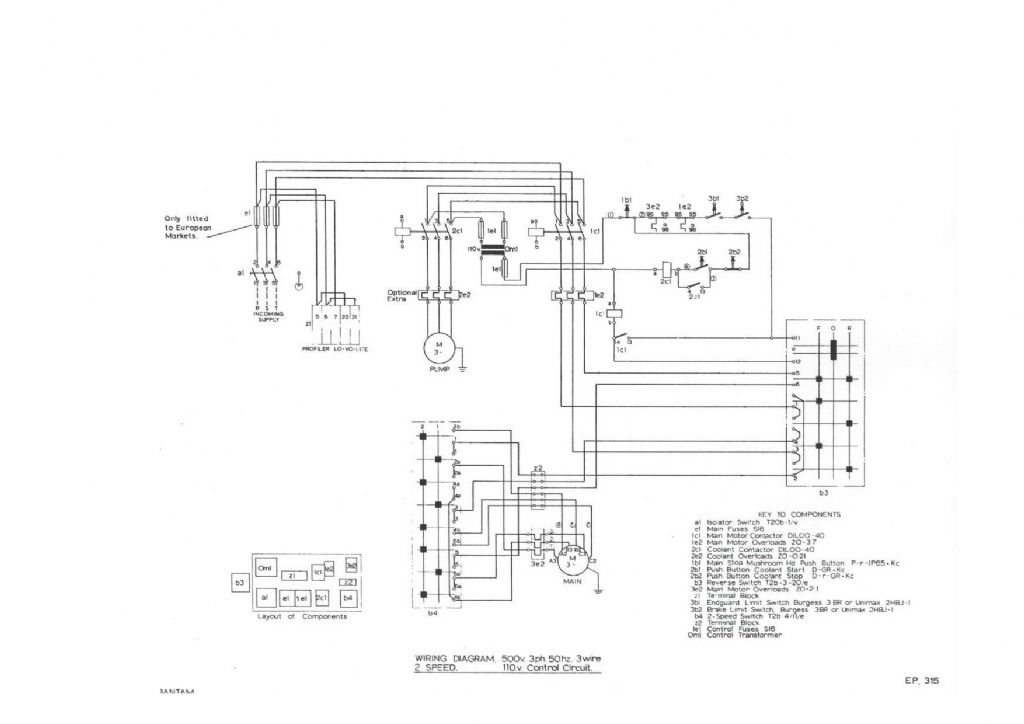
                            Here's the wiring diagram for a Colchester, just a tad complex

                            wiring1.jpg

                            #157727
                            Stuart Bridger
                            Participant
                              @stuartbridger82290

                              A bit more information on what I did with my Chipmaster.

                              I stripped out the original control gear, this was not necessary, but I wanted to retain the original lever FWD-OFF-REV control. The Inverter 3 phase outputs were wired directly to to the motor.

                              The control lever and interlock switches for the covers were wired into the DC control inputs on the VFD.

                              I was lucky that the Colchester suds pump was dual voltage, so this was re-set for 240V operation and wired into a fused outlet. via a new front mounted switch As it is a low power motor, I added a motor run capacitor to give the 3rd phase. No need to purchase an inverter for such a small motor.

                              The 29Hz technique I posted above will result in lower torque at higher speeds, but that is not an issue for me in my home workshop scenario.

                              BTW I retained the mechanical variator and also added a speed control pot to the inverter. this results in coarse and fine speed controls.

                              #157740
                              Anonymous
                                Posted by Emgee on 12/07/2014 12:22:06:

                                …………… if the motor is wound in the Dahlander form

                                Well, you learn something every day! It is interesting that most of the Google search results for Dahlander are academic or non-commercial. No doubt students of electrical engineering play with these motors in the lab, but does anyone know if they are used in real machine tools? I am pretty sure that both of my machines that have dual speed motors (horizontal mill and repetition lathe) have simple pole switching, and in the case of the horizontal mill star-delta switching as well.

                                I must be missing something, but the circuit diagram for the Colchester looks pretty straightforward to me?

                                Regards,

                                Andrew

                                #157744
                                Neil Wyatt
                                Moderator
                                  @neilwyatt

                                  Well I found a Spanish wikipedia page, and almost understood some of it – speed control by varying the number/arrangement of poles?

                                  Ah, this is better, I never got beyond ordering beer and antibiotic cream in Spanish.

                                  http://www.lmphotonics.com/InductionMotor/dahlander_motor.php

                                  Neil

                                  Edited By Neil Wyatt on 12/07/2014 21:31:13

                                  #157749
                                  Muzzer
                                  Participant
                                    @muzzer

                                    On my Colchester Bantam I had to swap out the original 2-speed motor so I could run it from 240V using an inverter. Although the 2-speed feature would still have worked (by switching numbers of poles), the thing was wound for 415V and couldn't be swapped from star to delta, at least not by me! No loss, as the inverter allows extra stuff like low speed torque boost and speed control from zero to twice speed in both directions. Obviously, if you need to max out the available power, you select the closest speed using the gearbox levers.

                                    If you are swapping the motor, you might as well increase the rated power by 50% or so. It will probably still be smaller than the original and will allow you to exploit modern developments such as carbide insert tooling which need higher surface speeds.

                                    Murray

                                    #157755
                                    Bob Brown 1
                                    Participant
                                      @bobbrown1

                                      There is a cost implication associated with changing the motor all be it not unreasonable and then there is the start loads.

                                      If you were to change the motor to single phase then all the switch gear etc needs to be changed to single phase.

                                      If you change the motor to a dual voltage motor you not only have the cost of the inverter you have just added in the cost of the motor and the cost of any associated kit like a coolant pump.

                                      If you increase the power by 50% you will waste more power, the system is not very efficient in the first place.

                                      I would have thought in the case of a two speed Colchester the speeds of 36, 58, 72, 86, 116, 139, 172, 206, 278, 334, 412, 510, 668, 800, 1020, 1600 rpm would be enough for most people.

                                      My view is that a solid state 240v to 415v three phase converter/inverter has its place in providing power to a dual speed motor or similar and with Nigel's mill it will allow him to run his mill with out any changes to the milling m/c supply.

                                      #157757
                                      GoCreate
                                      Participant
                                        @gocreate

                                        Hi Everyone

                                        Thanks for the fascinating and helpful information, it opens up some interesting options, and I have learnt a great deal form your responses.

                                        I took the motor apart but I could not confidently identify what internal wires to change to convert it to Delta, I will ask a motor rewind company what it will cost for them to do the job.

                                        I don't have any preference as to whether or not to keep the existing switch gear or do the extra work of changing it to suit a new set up. The main aim is to get the machine running using as much of what I already have as possible, hence the desire to use the existing motor. In this respect Stuart's information concerning the base frequency set to 29Hz is very attractive.

                                        However, a new development. I have been given an Inverter and motor, the motor is 1.1 kW dual voltage and the inverter in 230v 3ph output. Using this will involve boring out the pulley and putting in a new keyway and adding the control switches etc.

                                        At the moment my preference is to use the existing motor and either follow Stuarts suggestion or have it changed to delta configuration, I can use the gifted inverter for this. The gifted motor would however give more power though for my use I don't really see the need, I still have the belt change to use when higher torque is needed.

                                        Any further suggestion very welcome.

                                        Thanks again to everyone.

                                        Nigel

                                        #157760
                                        Bob Brown 1
                                        Participant
                                          @bobbrown1

                                          If you have another motor and inverter I would just change the motor/pulley even if it means making/getting a new one, I assume you have a lathe capable of machining the pulley. If you purchase a new pulley, not expensive, you should be able to match the pulley to the motor shaft and belt profile, this lot can supply them **LINK**

                                          If you locate the Inverter in a convenient place the all the controls are on the panel or at least they are on mine and they only addition I wired in was an emergency stop with a big red push mushroom stop button which was wired into the inverter.

                                          #157764
                                          Gary Wooding
                                          Participant
                                            @garywooding25363
                                            Posted by Bob Brown 1 on 13/07/2014 09:14:59:

                                            If you increase the power by 50% you will waste more power, the system is not very efficient in the first place.

                                            I

                                            It was my understanding that electric motors consumed power in proportion to their load, so a more powerful motor will only consume more power when it has a greater load. Power losses in the lathe itself bear little or no relationship to the motor used. If you instal a more powerful motor, you will only consume more power when you exceed the load of the previous motor.

                                            The same loading on different capacity motors will consume just about the same power.

                                            #157774
                                            Bob Brown 1
                                            Participant
                                              @bobbrown1

                                              Motors are usually only efficient when they are run above 50% load, take into the account that most motors are over rated in the first place (or were) by around 15 to 20% then by over sizing the motor means it will not run as efficiently as one that is correctly sized. If you start with a 1.5Kw motor and over rate it and fit a 2.2kw motor, assuming the motor is overrated in the first place and 1.5Kw was the nearest any way with the 2.2kw motor you could be running it at 40% of its rated load. It is more relevant in industry as a small saving in energy consumption equates over the year to a major saving.

                                              I try to reduce my electricity consumption not for any green reasons as I hate wind turbines and think they are a waste of space and a blot on the landscape but to reduce the size of the bill.

                                              It is also worth noting that modern motors are more efficient than older motors.

                                              #157781
                                              Russell Eberhardt
                                              Participant
                                                @russelleberhardt48058

                                                Posted by tractionengine42 on 13/07/2014 09:46:35:

                                                Stuart's information concerning the base frequency set to 29Hz is very attractive.

                                                Something to be aware of is that, although this method maintains the same torque, because the speed is reduced by 2/3 so is the power. So your 1 hp motor becomes a 2/3 hp motor. That may or may not worry you depending on what you intend to do with the lathe.

                                                Russell.

                                                #157793
                                                GoCreate
                                                Participant
                                                  @gocreate

                                                  Hi Everyone,

                                                  I have decided to change the motor on the mill to the one given to me by a friend complete with a VFD. Then their shouldn't be any power issues.

                                                  I have a Drummond model B lathe that I would like to get set up (some day). Now that I know I can run the old mill motor via a VFD with a base frequency set at 29Hz without modification, I will keep it for use on this lathe. Even running at reduces revs and possible lower power the old mill motor will be more than an acceptable match for the Drummond lathe.

                                                  I think this has turned out very well for my purpose.

                                                  Thanks again everyone that posted.

                                                  Nigel

                                                Viewing 23 posts - 1 through 23 (of 23 total)
                                                • Please log in to reply to this topic. Registering is free and easy using the links on the menu at the top of this page.

                                                Latest Replies

                                                Home Forums General Questions Topics

                                                Viewing 25 topics - 1 through 25 (of 25 total)
                                                Viewing 25 topics - 1 through 25 (of 25 total)

                                                View full reply list.