Turning very thin bar

Turning very thin bar

Home Forums Beginners questions Turning very thin bar

Viewing 25 posts - 1 through 25 (of 38 total)
  • Author
    Posts
  • #80788
    Wolfie
    Participant
      @wolfie
      I have some 3/32 stainless steel. My steam engine plan requires me to turn half an inch of one end down to 70 thou. Obviously the second I touch it with the tool it moves even though I only have a half inch sticking out the chuck.
       
      How do I do this??
      #5822
      Wolfie
      Participant
        @wolfie
        #80789
        JasonB
        Moderator
          @jasonb
          Sharpen your tool. Its likely to move a bit but with a sharp HSS tool and very light cuts (0.005″) should not be a problem.
           
          Run the tool along several times at the same setting as you get near the finished size to take the spring out.
           
          You can also do it in two goes, first with 1/4″ sticking out then slide it out another 1/4″ to turn the next section.
           
          If you are using standard indexable tools they will push teh work away which may be your problem.
           
          J

          Edited By JasonB on 29/12/2011 19:17:08

          #80791
          David Littlewood
          Participant
            @davidlittlewood51847
            70 thou – about 1.75 mm – should be feasible provided that you (a) have the minimum amount projecting and (b) use a tool which puts most of the cutting thrust axially – towards the headstock – rather than radially. This means using a knife tool with a very, very small radius at the business point. Take very small cuts and be prepared to traverse back and forth a few times at the same setting. If you still have trouble, start with it overlength and support the excess with the tailstock, then cut off afterwards.
             
            There are special tools you can use for turning very small diameters, but probably a bit OTT for a one-off.
             
            David
            #80793
            NJH
            Participant
              @njh
              Hi Wolfie
               
              I agree with all the above. If you have a need for much of this or, indeed, if you need to turn a long length then  these work well. ( Not too difficult to make such a tool yourself)
               
              Cheers
               
              Norman

              Edited By NJH on 29/12/2011 19:30:47

              #80794
              MICHAEL WILLIAMS
              Participant
                @michaelwilliams41215
                Before doing any more turning make sure your chuck is not too badly worn . Ordinary three jaw chucks are notorious for wearing bellmouthed shape and if this has happened you will never be able to turn your rod just by gripping in chuck .
                 
                Easiest solution is a throw away chucking bush . Other solutions need collets or new/repaired chuck .
                 
                MW
                #80800
                Sub Mandrel
                Participant
                  @submandrel
                  I just turned a 0.312″ spigot to a close running fit in a reamed hole. It wasn’t until I was shaving the last small cuts that there wasn’t a small difference between the two ends of the spigot due to flexing.
                   
                  A second pass at the same setting will usually sort things out tough.
                   
                  Neil
                  #80810
                  chris stephens
                  Participant
                    @chrisstephens63393
                    Hi Guys,
                    If there are any ‘elf’n paranoia bods reading this please look away now.
                     
                    If you want to turn fairly thin stock, you can use a piece of oil soaked leather as a steady .* With a little practice, you will be able to counteract the tendency for the stock to move and get good accuracy.
                    For thin turning a very sharp tool is needed, as has been said forget most carbide tips, personally I use a tangential tool. As a “lets see how thin and long I can turn” experiment, using the above, I was able to turn 1mm diameter by 25mm long. For any of you argumentative types, it had no practical purpose and is far too time consuming (an awful lot of very fine cuts), but where would we be if we didn’t push the limits occasionally.
                    chriStephens
                    * if you don’t like the idea don’t do it, and I am assuming the readers are of at the least average intelligence, although I do sometime wonder…….
                    Do take care that nothing will get caught and be aware of sharp edges, machinery can be dangerous you know.
                    Wouldn’t it be nice not to have to warn people about the dangers of machinery, or hot liquid in coffee cups or that wet floors are slippery, and that people really were of average intelligence. Oh, for the good old days, will they ever return?
                     
                    #80812
                    Wolfie
                    Participant
                      @wolfie
                      Thanks all will try again today.
                       
                      Haha Chris man after my own heart
                      #80813
                      Harold Hall 1
                      Participant
                        @haroldhall1

                        We all appear to be in agreement on this one. I would though add that the tool must not be above centre, not even a thou at such small diameters.

                        First facing the end of a piece of bar until it appears flat is not good enough as the tool can easily end up a few thou above centre. Set the tool below centre, face the end of a piece of material and keep raising it until there is just the very smallest sharp projection left. A thou of two below centre will be no problem, that is unless you are turning diameters of say 15 thou, which I have done, then things get tricky.

                        Having written this, it occurs to me that rather than using a standard form of knife tool, one is sharpened with a much larger front clearance, say 30 degrees, then the tool being above centre would be less of a problem. I must try it some time.

                        If your wonder what 15 thou diameter was required for, 128 nails for the boards inside a model Monmouth cart.

                        Harold

                        #80824
                        Bazyle
                        Participant
                          @bazyle
                          Small diameters are everyday requirements in horology. Do a search on Jacot Tool but as some results are a little misleading here is one link: http://www.davewestclocks.co.uk/making_a_jacot_tool.htm
                          Some versions are just holes in a plate rather than dimples.
                          In use you would make a starter section close to the chuck to support in the tool.
                          #80838
                          ChrisH
                          Participant
                            @chrish

                            Wouldn’t it be nice not to have to warn people about the dangers of machinery, or hot liquid in coffee cups or that wet floors are slippery, and that people really were of average intelligence. Oh, for the good old days, will they ever return? chrisStephens.
                             
                            Well yes, I remember those good old days too, but I’m getting to be an old Git now. And a moaning sarcastic one too – Victor Meldrew, eat your heart out. Trouble is, nowadays, they don’t teach ‘common sense’ and ‘thinking for yourself’ in schools any more, so the world is stuffed full of dimmo’s letting the nanny state and ‘elf ‘n safety do their thinking for them ‘cos they can’t. Go down to Lyme Regis, Cobb Quay there has notices that the top can get slippery when wet and there is danger of falling off because there are no handrails – gees, I’d have never thought of that myself in a million years………….

                            Edited By ChrisH on 30/12/2011 17:16:38

                            #80842
                            chris stephens
                            Participant
                              @chrisstephens63393
                              Hi Chris,
                              Know it very well, and walking along the top in strong winds does make you think that there should be handrails. On the other hand, Doctors recommend that the heart should be exercised and there is no better way of making it race than a windy walk to the aquarium or better still that pole at the very end.
                               
                              Since you brought up the subject of “common sense”, one wonders these days whether it could still be called “common”? I have my doubts about the “sense” bit too.
                               
                              Wouldn’t it be great if there were a “common sense” qualification. The ownership of which would completely out rank all other regulations especially those from Elf ‘n paranoia. As for it’s use in business and government, the possibilities are endless.
                              It’s coming up for the New Year, and one can always hope, even if the situation is dire, there is always hope. I hope.
                              chriStephens
                              #80847
                              bricky
                              Participant
                                @bricky
                                hello Woolfie
                                No one has mentioned the use of a home made running down cutter. 
                                I have a selection that I have made and used over the years.To make one for your job use some 3/16″ silver steel,drill No50 for the depth required ,then file four cutting faces ,stone to sharpness.Harden and temper job done.Hope this helps
                                Bricky 
                                #80848
                                bricky
                                Participant
                                  @bricky
                                  hello Woolfie
                                  No one has mentioned the use of a home made running down cutter. 
                                  I have a selection that I have made and used over the years.To make one for your job use some 3/16″ silver steel,drill No50 for the depth required ,then file four cutting faces ,stone to sharpness.Harden and temper job done.Hope this helps
                                  Bricky 
                                  #80852
                                  David Littlewood
                                  Participant
                                    @davidlittlewood51847
                                    Bricky,
                                     
                                    Yes, they were one of the “special tools” I mentioned (the other was the one Norman mentioned – I have one of those but have never found a need to use it) but didn’t describe as I assumed Wolfie would prefer to avoid making these for a one-off.
                                     
                                    Wolfie,
                                     
                                    You may find the running down bits Bricky mentioned are sometimes called rose bits.
                                     
                                    David
                                    #80853
                                    Wolfie
                                    Participant
                                      @wolfie

                                      Whats one of those Bricky?

                                      #80877
                                      1
                                      Participant
                                        @1
                                        Wolfie
                                         
                                        If you go to this forum homepage, scroll down to where you can take a digital edition of Model Engineer’s Workshop for a test drive and open up the edition currently on offer (August 1999) you will find a clear drawing at drawing 4 on page 20 amongst an article about the use of a travelling steady. The example drawn appears to have rather more cutting edges than suggested by Bricky but the principle is the same.
                                         
                                        Jim
                                        #80880
                                        mgj
                                        Participant
                                          @mgj
                                          I must admit, I always have an awful job getting something thin truly parallel along its length. Real pain.
                                           
                                          I’ve tried the tailstock support bit – even bought one of those nice centres with different sized points. They all help. So do the 55deg tools, as does a pointy bit of tool steel properly Quorned to shape. But at smaller dias, eventually it all gets untidy, and tools and centres tangle. And without a centre it wil probalby flex, and if its long and thin, even multiple runs will cause it to flex.
                                           
                                          So, being too idle to make hollow endmills, and finding the baby travelling steadies that you drill a hole in for size very awkward, I now leave a length well over size, and overlength. Centre drill, and turn down for a short length to below dia. This gives a clear working area. Then turn what you need down to actual dia, without getting tools and centres tangled. Lop off the excess at the end. A hollow centre is also good. You only need a 1/16 of excess to give working room to get a pointy tool into place with adequate run on.
                                           
                                          Its not foolproof and if very thin it can still flex, and the other methods have to be used, but mostly it works well.
                                           
                                          chris S – you have to rember, when seeking common sense, that half the world is of below average intelligence. One of those BGOs that crop up ocasionally, and one has to remember when people expect air to rise at one end of a boiler, but to rise and then descend against a flow at the other – despite being lighter than steam – so it can then get to the other end and then rise again!. Or a changed note from the safeties indicates air in a tilted boiler, when every “musical” intrument in the world will change pitch if the sound box volume is altered. Or someone comes up with the idea of energy neutral brakes.

                                          Edited By mgj on 30/12/2011 23:25:00

                                          #80888
                                          chris stephens
                                          Participant
                                            @chrisstephens63393
                                            What Ho MGJ,
                                            If only averages were that simple, it goes to show that you should never listen to “media” statistics as they are generally meaningless, if taken without true context.
                                            On the ‘average’ topic, take 100 people as you sample, now if 98 had IQ’s of 160 and one had 161 and the last 159, only 1% is below average. An unlikely situation I grant you but possible. What it does show is that standard deviation (“sigma” if I recall lectures from fifty plus years ago and not used since) and other statistical techniques can be more valid.
                                             
                                            Back on turning topics, have you tried the carbide stick yet?
                                            chriStephens
                                            #80895
                                            Terry Lane
                                            Participant
                                              @terrylane
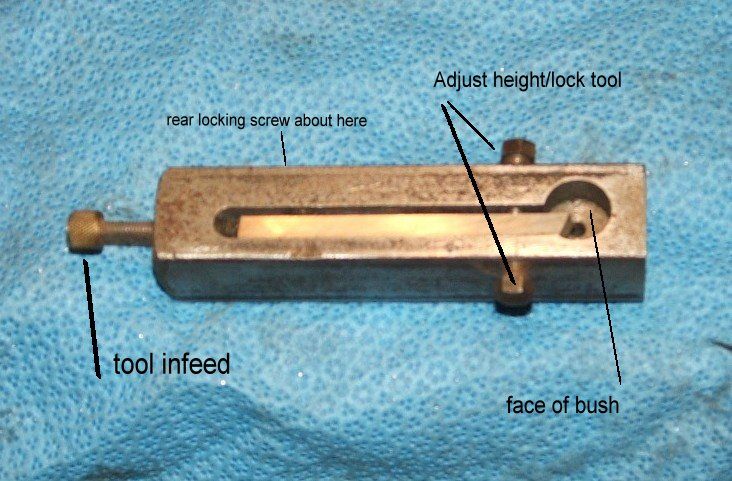
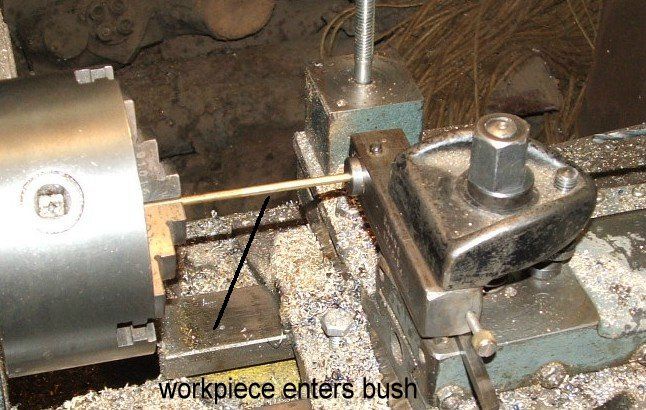
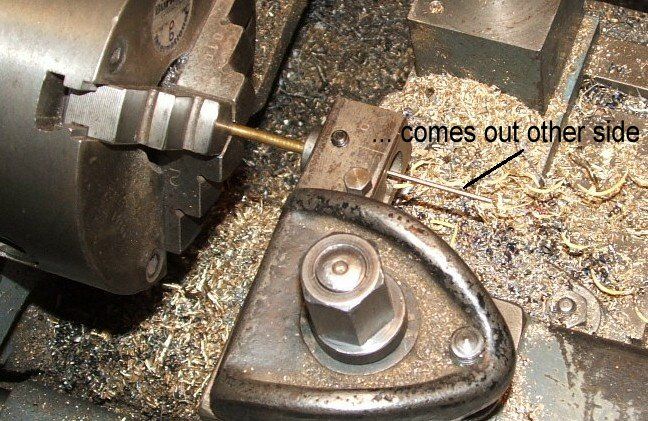
                                              You probably need to take a bit of time and make up a version of my handy-dandy box tool, along with a handful of guide buses for it – doesn’t get used often, but when it does it’s priceless!
                                               

                                              #80896
                                              Terry Lane
                                              Participant
                                                @terrylane
                                                 

                                                #80902
                                                mgj
                                                Participant
                                                  @mgj
                                                  Tel – yes I have a thing similar to that, but if you’ll forgive me saying, I find it a real pain to set up. Because before you can start cutting, if you need an accurate dimension, you need the tool infeed set accurately (and you cant use the cross slide.)
                                                   
                                                  And having taken a cut, the old bush won’t fit, so you have to make another bush.
                                                   
                                                  I’m not criticising particularly, just noting that the whole business of turning slender shafts by whatever means to an accurate dia is just plain awkward. (Perhaps it depends on how accurate)
                                                   
                                                  Chris – agreed, but then they always said that there are liars, damned liars and then come statisticians. After that you get model engineers, who seriously reckon you can reverse flow the steam into a boiler without carrying any oil back into said boiler (it comes out the chimney so it should go with the flow?) Yet there is no emulsion in the gauge glasses, no priming, no nasties on blowdown. Clever stuff this oil?
                                                   
                                                  Carbide – yes thank you . Excellent, and I have a green wheel to sharpen it, when the time comes

                                                  Edited By mgj on 31/12/2011 09:52:35

                                                  #80903
                                                  Terry Lane
                                                  Participant
                                                    @terrylane
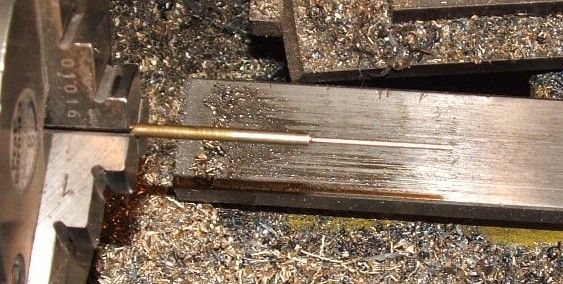
                                                    Yes, it does suffer from the defects you mention, however, as it is principally used as a single pass tool on stock material I have not found it much bother – the range of bushes you need will not be that great, and once you have ’em, you have ’em!
                                                     
                                                    What you see in the pics is a bit of 1/8″ brazing rod taken down to an accurate 1/16″ in a single pass. Now the beauty of it, of course, is that length, within reason, is no object – I would be pretty confident that I could turn 6 or 8 inches of 1/16″ with no trouble with that set-up.
                                                    #80905
                                                    Wolfie
                                                    Participant
                                                      @wolfie

                                                      Brilliant! and good pics too.

                                                    Viewing 25 posts - 1 through 25 (of 38 total)
                                                    • Please log in to reply to this topic. Registering is free and easy using the links on the menu at the top of this page.

                                                    Latest Replies

                                                    Home Forums Beginners questions Topics

                                                    Viewing 25 topics - 1 through 25 (of 25 total)
                                                    Viewing 25 topics - 1 through 25 (of 25 total)

                                                    View full reply list.