Clockmaking starter project?

Clockmaking starter project?

Home Forums Clocks and Scientific Instruments Clockmaking starter project?

Viewing 19 posts - 1 through 19 (of 19 total)
  • Author
    Posts
  • #651418
    Gman
    Participant
      @thomasgman46877

      Been a fan of Clickspring for a long time. Have always wanted to try my hand at a clock. Anyone have a suggestion on starter books, projects, resources?

      #4020
      Gman
      Participant
        @thomasgman46877

        Looking to try my hand at clockmaking

        #651420
        Michael Gilligan
        Participant
          @michaelgilligan61133

          The Franklin one-handed, three-wheel, clock … although a little weird, it was innovative, and might be a good starter project.

          Plans, write-ups, etc. are widely available, but here is a brief introduction:

          **LINK**

          https://founders.archives.gov/documents/Franklin/01-08-02-0060

          MichaelG.

          .

          Edit.  __ for the sake of pedantry, I must mention that the seconds hand and the pinions are commonly omitted from the descriptive name.

          Edited By Michael Gilligan on 09/07/2023 16:06:23

          #651422
          Gman
          Participant
            @thomasgman46877

            Wow thanks that is brilliant.

            #651426
            Martin Kyte
            Participant
              @martinkyte99762

              John Wilding is a good route to take. His 8 day wall clock was my introduction and the book is very comprehensive in describing the build as well as lots of wisdom on clockmaking in general. Drawings of depthing tools to make etc.

              regards Martin

              #651459
              Gman
              Participant
                @thomasgman46877
                Posted by Martin Kyte on 09/07/2023 16:54:48:

                John Wilding is a good route to take. His 8 day wall clock was my introduction and the book is very comprehensive in describing the build as well as lots of wisdom on clockmaking in general. Drawings of depthing tools to make etc.

                regards Martin

                What is the name of the book?

                #651467
                Michael Gilligan
                Participant
                  @michaelgilligan61133
                  #651468
                  Gman
                  Participant
                    @thomasgman46877

                    Thanks much appreciated. Definitely going to look into that.

                    #651475
                    Bazyle
                    Participant
                      @bazyle

                      John Wilding designed a simple clock for beginners which was serialised in either ME or EIM years ago. Advantages are the simple frame as large square clock plates are expensive. Wheels are fairly low count and all the same tooth size. There is a thread on here about the 'Dark Lady' clock which I think is effectively the same design made with blackened plates.

                      The franklin clock has a 120 tooth wheel. I wouldn't want that to be my first go at wheel cutting.

                      #651483
                      Michael Gilligan
                      Participant
                        @michaelgilligan61133
                        Posted by Bazyle on 09/07/2023 21:36:51:

                        […]

                        The franklin clock has a 120 tooth wheel.

                        .

                        and a 160

                        but for an exercise in unnecessary complication … have a look at 9, here:

                        **LINK**

                        http://www.historische-zeitmesser.de/fachartikel/three_wheel.html

                        MichaelG.

                        #651490
                        Gman
                        Participant
                          @thomasgman46877

                          Good stuff Bazyle and Michael. I have lots of homework now to look at. Trying to find the John Wilding's The Construction of a “Large Wheel” Skeleton has so far been unsuccessful.

                          #651509
                          Martin Kyte
                          Participant
                            @martinkyte99762

                            The Wilding clock book is called How to make a weight driven Eight Day Wall
                            Clock. Amazon have 3 at the moment and clockmaking-brass.co.uk do reprints.

                            regards Martin

                            #651556
                            Gman
                            Participant
                              @thomasgman46877

                              Perfect thank you

                              #651733
                              lfoggy
                              Participant
                                @lfoggy

                                The John Wilding eight day wall clock was my first horology project some 30 years ago and my clock is ticking quietly on the wall as I type this. The book is well written, comprehensive and easy to follow. It describes very traditional techniques and materials for the construction of the clock, all of which are easily accessible in a basic model engineer's workshop. Definitely a good first project…

                                #653191
                                Marcus Bowman
                                Participant
                                  @marcusbowman28936

                                  John Wilding wrote many serialized clock projects for the Horological Journal, back in the 1970s and 80s, most of which were replicated in his books. My first clock was one of a series of three he created for beginners, and it was his 16th Century Clock (see http://www.clockmaking-brass.co.uk/16th_century_clock.htm). It has only one hand, which simplifies the construction considerably. That is a design I would thoroughly recommend.

                                  That design was later modified to make the frames simpler to construct, and the design was published in Model Engineer, Issues 3775 (18-30 April 1986) to 3799 (every second issue in that sequence, so issues 3777, 3779, 3781, 3783, 3785, 3787, 3789, 3791, 3793, 3795, 3797, 3799), and entitled A Weight Driven Brass Alarm Clock. That design incorporates a bell, and a one-at-the-hour passing strike .

                                  If it was me, I might be inclined to the 16th Century design, but using the simpler frames from the Brass Alarm Clock, just because it is simpler without the alarm. There is also the question of the bell. The original source is long gone, but it would be easy enough to get a substitute from clockmaking-brass.co.uk (with whom I have no connection).

                                  Wildings series in HJ was originally entitled An Introduction to Clockmaking with the Unimat 3, and he worked his way through 3 designs: The 16th Century clock, the Castle Clock, and The Scissors Clock.

                                  http://www.clockmaking-brass.co.uk/castle%20clock.html

                                  http://www.clockmaking-brass.co.uk/scissors.html

                                  I like the Castle Clock which I think is aesthetically very pleasing.

                                  Both the 16th Century and the Castle clocks are weight driven. and both are very suitable for the beginner.

                                  The Scissors Clock is spring driven, elegant and fragile looking, but is not a beginner's clock.

                                  I have made several of the much later Wilding projects, and they are all accompanied by copious easily understood building instructions.

                                  The 16th Century Clock still hangs proudly in the lounge.

                                  If you need more specific information, send me a PM.

                                  Marcus

                                  #849643
                                  paulpkr26
                                  Participant
                                    @paulpkr26

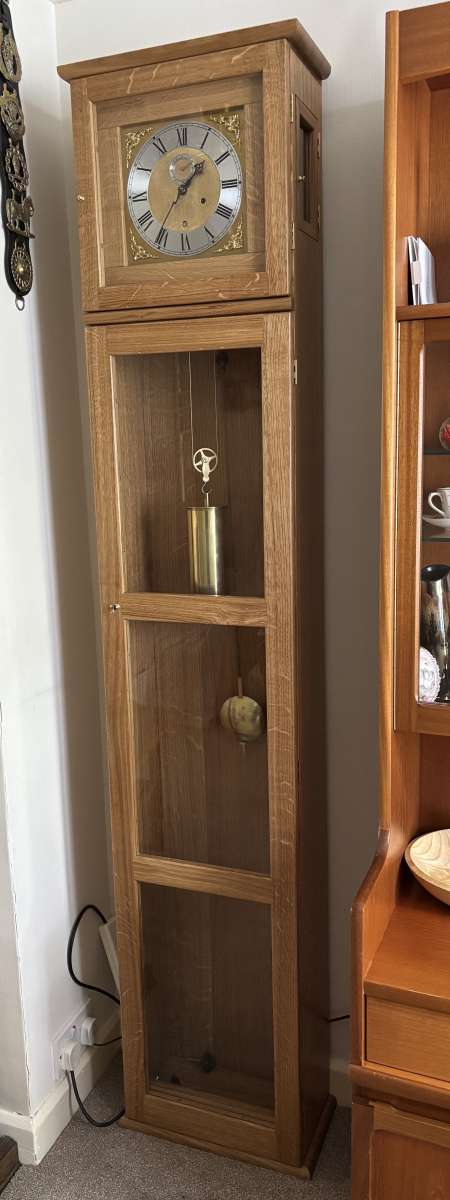
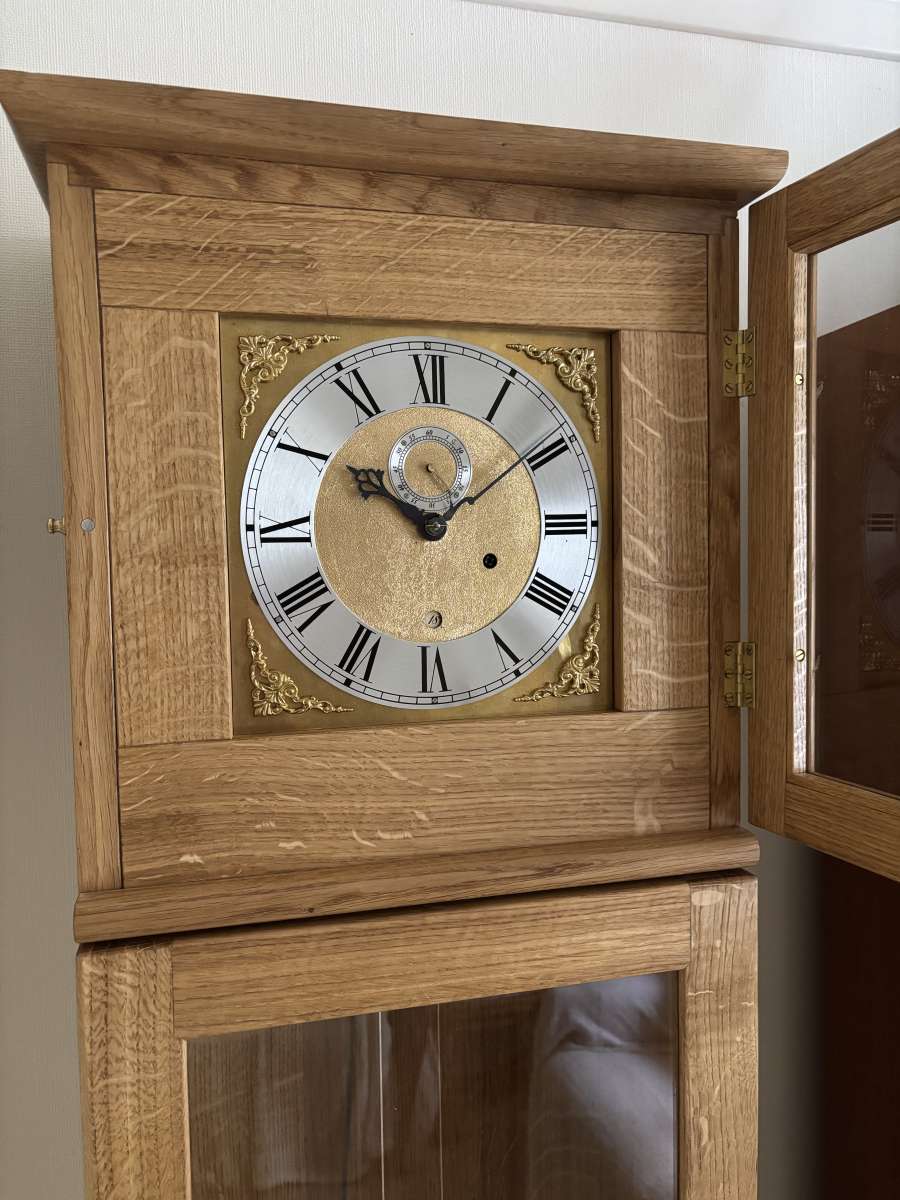
                                    Just finished John Wilding 8 day clock with calendar and chime and used 1/4 sawn oak to make the case. IMG_0015IMG_0011

                                    #849696
                                    Russell Eberhardt
                                    Participant
                                      @russelleberhardt48058

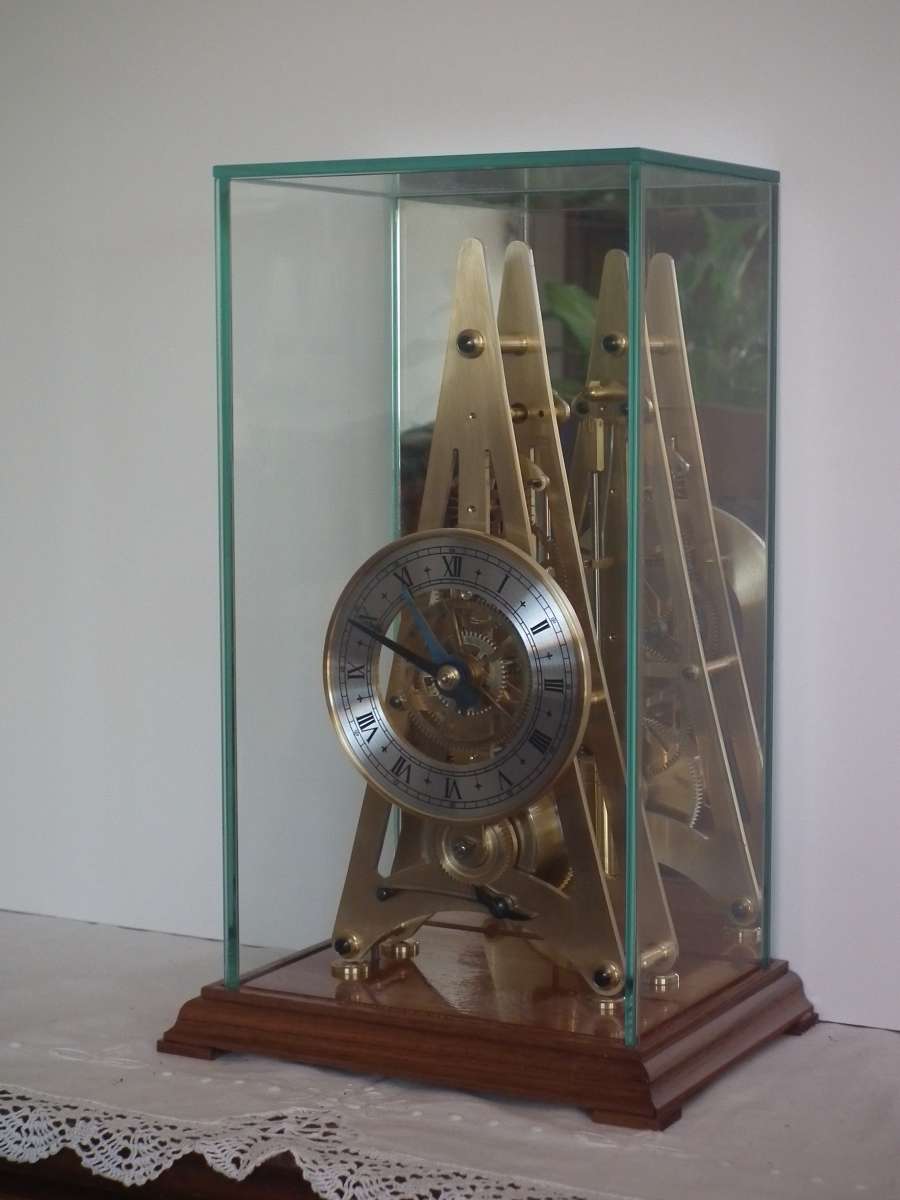
                                      My first clock was John Parslows 15-day skeleton timepiece.  It was a fairly straight forward build with detailed instructions given in a short series of articles in ME starting March 2008.  You should be able to find them in the archives.

                                      DSCF2209

                                      Still running well with just a clean and lube after its first ten years of running.

                                      Russell

                                      #851833
                                      timdotd
                                      Participant
                                        @timdotd

                                        I‘m about 60% of the way through building Richard Simmonds‘ weight driven clock design, and I can strongly recommend his book. I’ve found it much clearer and more detailed than John Wilding‘s 8-day version, with the added advantage of being dimensioned in metric

                                        #851851
                                        iacooper
                                        Participant
                                          @iacooper

                                          As a first introduction to making a clock I’ve been working through Richard Simmonds’ book over the last 7 months as well.

                                          I’ve yet to make the pendulum, but otherwise it’s about finished now.   Overall I’ve found it pretty clear to follow and having been in touch with Richard he has been very helpful and friendly.  There are a couple of issues in the drawings but most are fairly obvious when you look at the components and what they mate with.  Unfortunately one of the more serious concerns the outside diameters of a number of wheels in the drawings which are wrong – the table of diameters on page 18 are about right though, so going with those would be best.   Fortunately I noticed the discrepancy before cutting metal, calculated the diameters based on Wild’s book myself and then looked to confirm with Richard Simmonds himself before I made swarf.  Finding the problem later on might have been a bit disheartening.

                                          The only one that has properly caught me out was drilling and tapping the mounting holes for the maintaining springs, where I blindly put them where shown on the drawing (both offset on the same side of the centre line).   It’s my own fault because as I drilled them I thought that seemed odd as I would have expected them offset either side….   I then found the one spring didn’t come close to sitting in the right position  <blush>.  Hey Ho.

                                          This weekend’s job is more polishing of hands before bluing, then do the suspension spring.

                                          I understand Richard is planning to add a page to his website detailing updates and clarifications to the design in due course.

                                          (oh, and as someone with a mint-imperial lathe I can confirm the mental gymnastics with a calculator aren’t too difficult to cope with the metric drawings!  lol).

                                          Ian.

                                        Viewing 19 posts - 1 through 19 (of 19 total)
                                        • Please log in to reply to this topic. Registering is free and easy using the links on the menu at the top of this page.

                                        Latest Replies

                                        Viewing 25 topics - 1 through 25 (of 25 total)
                                        Viewing 25 topics - 1 through 25 (of 25 total)

                                        View full reply list.