help with threading

help with threading

Home Forums Manual machine tools help with threading

Viewing 17 posts - 1 through 17 (of 17 total)
  • Author
    Posts
  • #365101
    eben
    Participant
      @eben

      hi guys, any suggestions on the following strange threading results ?

      trying my hand at metric single point threading on an old ML7

      compound set to 29.something, half nut stays engaged.

      stopping the lathe and backing out with cross slide, then back in to zero.

      using a partial form insert.

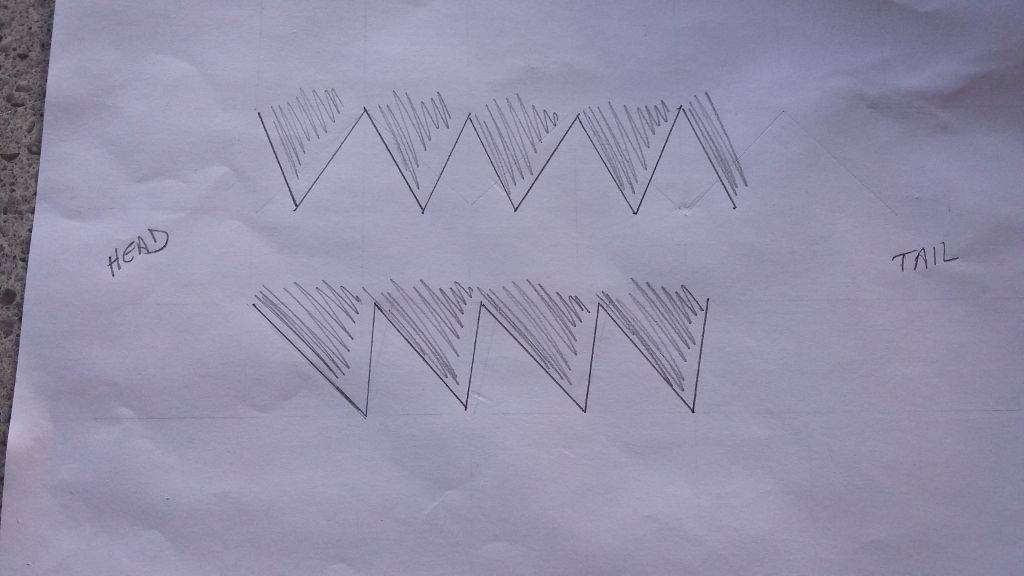
      the side of the thread on the tailstock end is more vertical than expected. what i expect is the top drawing, what I am getting is the bottom drawing.

      any ideas ?

      20180802_124847.jpg

      #13260
      eben
      Participant
        @eben
        #365102
        eben
        Participant
          @eben

          i've also made sure that the tool is perpendicular to the work.

          #365106
          Hopper
          Participant
            @hopper

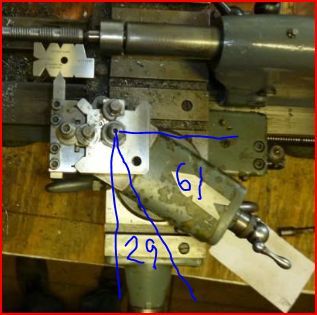
            Sounds like you have made the very common beginner's misfire of setting the topslide at 29 degrees from its normal position parallel to the bed axis. For screwcutting, the topslide should be set at 29 degrees from the axis of the cross slide, ie at 61 degrees from the axis of the lathe bed.

            This means you will have to take the topslide securing bolts out and rotate the topslide around until it is almost square with the lathe axis, then put them back in. In this position, the graduations on the topslide no longer are in line with the index mark on the cross slide but are hanging out in mid air. Usual fix is to set the topslide angle using a protractor or angle gauge.

            Edited By Hopper on 02/08/2018 03:01:48

            #365112
            JasonB
            Moderator
              @jasonb

              1+ for what Hopper says, this is a sketch I prepared earlier where someone needed to swing the topslide round more to the 29deg position

              threads 2.jpg

              #365113
              eben
              Participant
                @eben

                thanks gents, yup – looks like the compound was at 61 degrees

                #365116
                Anonymous

                  With inserts there is no point in canting over the top slide, just leave it parallel to the spindle axis and leave it alone. That way the cross slide reads thread depth directly. Threading inserts are symmetric and cut on both flanks, so no need to cant the top slide so as to cut on one flank.

                  Andrew

                  #365119
                  pgk pgk
                  Participant
                    @pgkpgk17461

                    I'm guessing the whole logic of threading with the top slide has historic recommendations from having to cut really deep and coarse threads. A properly ground HSS tool should be just as capable of cutting on both flanks as an insert such that it's a matter of avoiding chatter when any form tool bites over too large an area?

                    When using threading inserts does everyone purchase a range so they have the correct helix angle for the threads being cut? For instance I note that JB cutting does thread inserts with differing edge lengths. It;s unclear whether these have differing helix angles for deeper plunging or just to fit a specific tool??

                    There's folk on here done way more thread cutting than myself but I admit that both using an HSS hand ground (with an 'average' helix angle for metric coarse of the sizes i might do) and a simple triangular insert both seem to give satisfactory functional pretty threads.

                    pgk

                    #365123
                    JasonB
                    Moderator
                      @jasonb

                      JB do partial form inserts which as well as their overall size differences will cut a range of pitches and have clearance for those pitches unless you are doing something odd like 2.0mm pitch on a 5mm dia shaft. These may leave the peaks pointed and they will possibly need dressing with a needle file run along the thread

                      You can also but "full Form" inserts which are ground to suit one specific pitch and thread form and will round the peaks and valleys as needed. Again available in different O/A sizes to suit your holder.

                      JB don't give a lot of info but if you look at an industrial tooling site they will give the pitch range for a specific insert

                      Edited By JasonB on 02/08/2018 09:14:37

                      #365125
                      Michael Gilligan
                      Participant
                        @michaelgilligan61133
                        Posted by JasonB on 02/08/2018 09:13:04:

                        JB do partial form inserts which as well as their overall size differences will cut a range of pitches and have clearance for those pitches …

                        .

                        Partial form is what eben professes to be using

                        Some explanatory detail from you and/or Andrew would be appreciated, as I have never used either version.

                        MichaelG.

                        #365128
                        Mick B1
                        Participant
                          @mickb1

                          The reason for putting the cut on with the compound slide when half-angle screwcutting is that if plunge-cutting, two swarf streams collide on the top surface of the tool, and some chips will be deflected back to the surface about to be cut, trapped inside the swarf-curl and cause scuffing of the flank surface.

                          In some conditions that doesn't occur enough to matter, in others it does.

                          Notice that Ruby here:-

                          **LINK**

                          …is applying a heavyish plunge cut directly from the crosslide and has a single stream of dull red swarf coming off. I wonder if she's offsetting each cut by a calculated longitudinal value to achieve that.

                          #365132
                          duncan webster 1
                          Participant
                            @duncanwebster1

                            Leave the topslide set parallel, but every time you advance the cross slide by 10 thou, advance the topslide by 5 thou. This way you generate the thread angle and the tool only cuts on one side. Then you can have top rake on the tool, it only cuts on one face, and you don't get 2 ribbons of swarf colliding. If you set cross and topslide dials to zero when the tool is just touching the OD, the topslide keeps a record of where you are up to as well.

                            Works every time. You do actually get a very light scrape on the non cutting side, just cleans it up.

                            #365135
                            Mick B1
                            Participant
                              @mickb1
                              Posted by duncan webster on 02/08/2018 10:07:10:

                              Leave the topslide set parallel, but every time you advance the cross slide by 10 thou, advance the topslide by 5 thou. This way you generate the thread angle and the tool only cuts on one side.

                              Works every time. You do actually get a very light scrape on the non cutting side, just cleans it up.

                              Ah. Simple, tidy solution – thanks for sharing.laugh

                              Reckon that's maybe what Ruby was doing.

                              #365141
                              JasonB
                              Moderator
                                @jasonb

                                If you do move with both cross and top slide remember that the tool could be 0.050" nearer to a shoulder by the end of a 0.1" deep cut so adjust and stops, trips, clutches or runout groove to suit or risk a crash. OK if disengaging or stopping by eye.

                                #365159
                                Anonymous
                                  Posted by Michael Gilligan on 02/08/2018 09:19:44:

                                  Partial form is what eben professes to be using

                                  Some explanatory detail from you and/or Andrew would be appreciated, as I have never used either version.

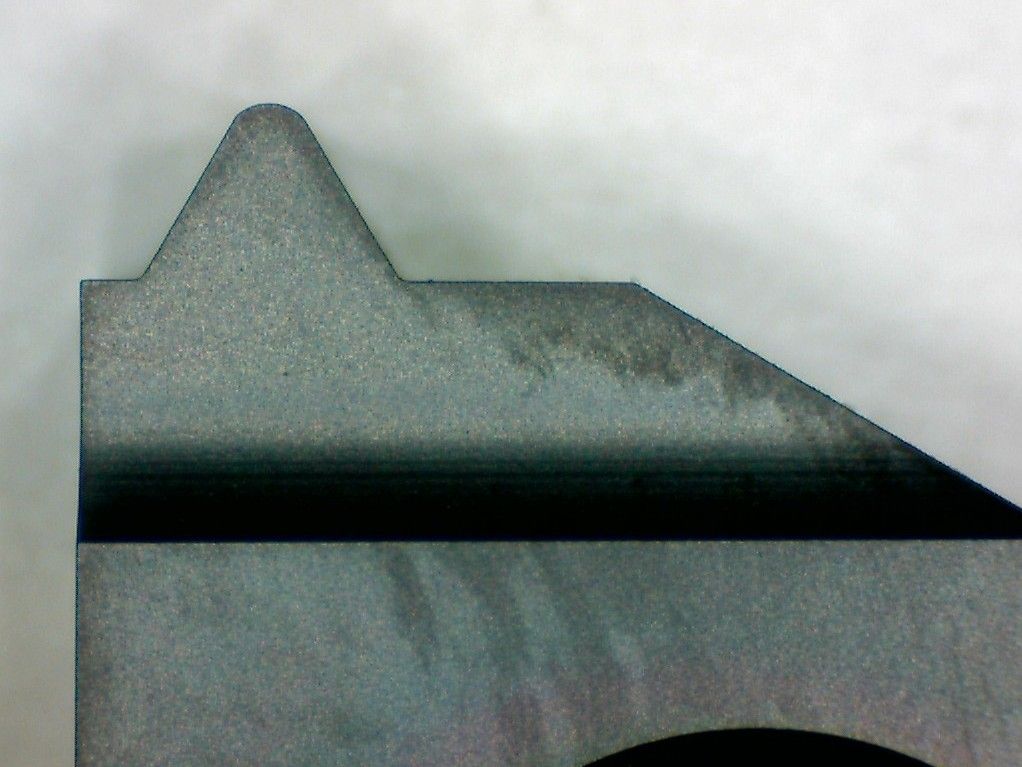
                                  This picture shows a full profile insert for a 2.0mm ISO (metric) thread:

                                  16er-2.0iso_me.jpg

                                  The insert is designed to cut ISO threads only with a 2mm pitch. Note that the profile will form, at the full depth, the correct curved root profile and the truncated crest profile.

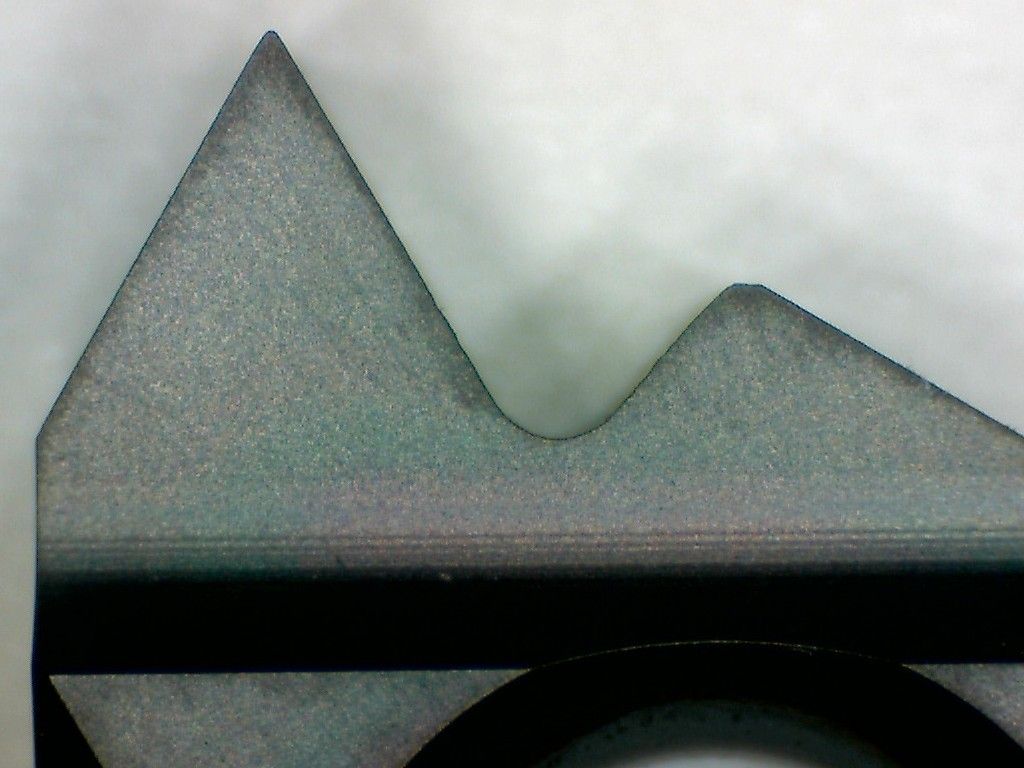
                                  This picture shows a partial profile insert for ISO threads:

                                  16er-ag60_me.jpg

                                  Obviously the thread angle is 60°, and the insert will cut a range of ISO pitches. There are two points to note. The root radius is set by the smallest pitch the insert can cut, and is incorrect for larger pitches. The insert does not form the crest, so the work OD needs to be correct beforehand. The incorrect root radius means that the actual thread depth for proper mating may not be the same as the theoretical depth.

                                  I've screwcut almost all my V-threads using full profile inserts and plunge cutting. I don't recall ever having had a problem with swarf getting trapped. The process just works. Mind you I cut fairly fast, several hundred rpm, so that may help with swarf ejection.

                                  Andrew

                                  #365160
                                  Michael Gilligan
                                  Participant
                                    @michaelgilligan61133

                                    Thanks for the helpful comments and the very clear images, Andrew yes

                                    MichaelG.

                                    #365234
                                    Jon
                                    Participant
                                      @jon

                                      Confirm what Andrew says, i always use full profile tips daily on quality aftermarket items. Not once seen two edges collide on any pitch from 0.5mm to 3mm pitch or imperial to 11 tpi in any metal aluminiums, plastics, manganese bronze, steel to titaniums.

                                      What i suspect is those that get a bad finish are super imposing rather than addressing or acknowledging the issue of tool, machine flex or actual poor tips used.
                                      I do have a pack of cheap AG60 tips £25, to get a tolerable finish with brings out the machinist in you resorting to additional measures.

                                      Said it often, theres no substitire for quality tools as hard as it is to muster. By that i dont mean shop branded stuff.
                                      First choice of screw cutting inserts for me are Iscar approx £5-6 each, not far behind are Stelram and Seco. If not convinced try one.

                                      Other downside is partial profile tips will cut a lot deeper at the non root that is created, every thread has some form of radius to it. Therefore not ideal when wanting two parts to join up exact with no runout. Will require a full profile tip for every pitch created, double that if doing internal threading, adds up but can buy singularly.

                                    Viewing 17 posts - 1 through 17 (of 17 total)
                                    • Please log in to reply to this topic. Registering is free and easy using the links on the menu at the top of this page.

                                    Latest Replies

                                    Home Forums Manual machine tools Topics

                                    Viewing 25 topics - 1 through 25 (of 25 total)
                                    Viewing 25 topics - 1 through 25 (of 25 total)

                                    View full reply list.