Reference squares , Cylindrical squares and absolute methods .

Reference squares , Cylindrical squares and absolute methods .

Home Forums Beginners questions Reference squares , Cylindrical squares and absolute methods .

Viewing 22 posts - 1 through 22 (of 22 total)
  • Author
    Posts
  • #112537
    MICHAEL WILLIAMS
    Participant
      @michaelwilliams41215
      For Harold Hall and anyone else interested here is a composite of previous postings relating to making accurate reference squares :
       
       
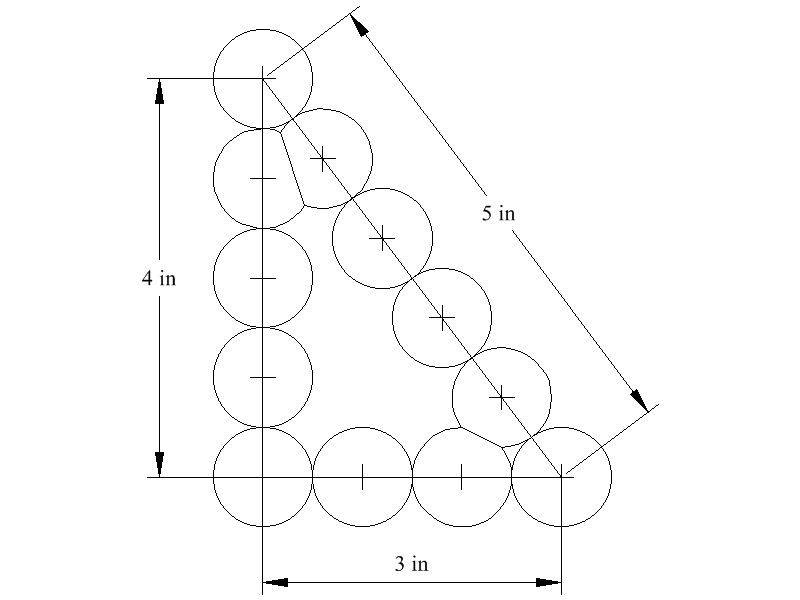
      (1) To make a 3-4-5 toolmakers button square :
       
      Make some identical rollers say 1inch diameter drilled big clearance for cap screws about 6 mm dia .
       
      On a sutably shaped steel plate mark out and drill holes at 1 inch pitch in the 3-4-5 (nb)configuration . Do the marking and drilling as accurately as possible but final accuracy of the square does not depend on exact accuracy of spacings . Tap each hole 6mm .
       
      nb : note that rollers are counted on an edge as one more than the number of pitches – so for instance the five side has six rollers to get 5 pitches .
       
      Position  rollers on the edge with the ' 5 ' edge and arrange them to touch each other and touch a straight edge . Obtain best accuracy and lock down screws . By trial and error position the remaining rollers in the remaining holes so that they touch each other , the end rollers of the '5' row and a straight edge tested along each side . Lock down all remainining screws .
       
      With all rollers along each side touching and also touching the straight edge(s) an almost exact 3-4-5 triangle is formed and the 90 deg angle is accurate to typically 0.0002 inch in 10 inches .
       
      Sounds difficult but with the basic parts made beforehand takes about 20 minutes to assemble .
       
      A developed version of the same basic idea can be used to set out other angles and make master dividing plates .
       
      The 3-4-5 method of making squares is an a example of an 'absolute' method – that is you don't need to know the exact dimensions of the rollers – only that they are the same .
       
      When laying out patterns with rollers it is usually nescessary to cut parts of the rollers away so that they don't interfere in unplanned places – other than that it is dead simple to do .
       
      A non absolute but perfectly practical alternative way of doing the samething is to just use rollers at the corners and separate them with accurately made rectangular bars of calculated length .
       
      The common sine bar uses essentially the same principle .
       
      (2) Another absolute method is to make 3 ordinary squares but with hinged blades . By testing them all against each other on a straight edge and adjusting so that they all touch full length on the blades in any combination you end up with three perfect 90 deg squares .
       
      Its a bit tricky to make three ordinary squares with narrow blades by scraping and testing against each other on a surface plate . More usually three angle plates are made with faces at least 20 mm wide .
       
      (3) Super precision cylindrical squares are made by turning and grinding the cylinder surface to best accuracy and then dividing the length into numerous zones and hand finishing each zone to be exactly the same diameter . Each zone is usually separated by a cylindrical V groove . Again this is an absolute method – you don't need to know the exact diameter of the cylinder- only that all the zones are the same diameter . Hand finishing is usually done by lapping but for home workshop a fine slip stone would do perfectly well .
       
      The base seating end of the cylinder is always finished at the same setting as the cylindrical surface and again is usually hand lapped for flatness .
       
      (4) The cylindrical square has a rarely seen but perfectly practical inverse – basically a faceplate with a smaller diameter true bar coming out from the centre of it . Can be turned from solid or made in two parts . Very easy to make in small sizes .
       
      A type of precision toolmakers square is similar and uses a precision round bar inserted into a hole in a rectangular bar .
       
      Michael Williams .
       

      Edited By MICHAEL WILLIAMS on 19/02/2013 10:35:52

      #6588
      MICHAEL WILLIAMS
      Participant
        @michaelwilliams41215
        #112541
        Michael Gilligan
        Participant
          @michaelgilligan61133

          Very useful summary

          Thanks for posting

          MichaelG.

          #112553
          MICHAEL WILLIAMS
          Participant
            @michaelwilliams41215

            square 345.jpg

            Edited By David Clark 1 on 24/02/2013 10:37:29

            #112554
            Thor 🇳🇴
            Participant
              @thor

              Hi Michael W,

              thanks for the thorough explanation, much appreciated.

              Rergards

              Thor

              #112619
              Sub Mandrel
              Participant
                @submandrel

                Wow, that's really interesting. The picture helps too. Thanks Michael.

                Now I get the method I can also see how to make a 60 degree 'square' with three buttons and a 30 degree one with four, arranged in a diamond, then removing one button.

                This could be the raw material of a useful artilc]e for one of the mags?

                Neil

                #112631
                Michael Gilligan
                Participant
                  @michaelgilligan61133

                  Of course [at the limit] the difficulty comes in Michael's first instruction; "Make some identical rollers".

                  I am certain that Michael is perfectly aware of this; and in no way does it detract from the elegant method … but [if striving for perfection] it is worth recognising.

                  MichaelG.

                  #112718
                  Harold Hall 1
                  Participant
                    @haroldhall1

                    Thanks Michael (W) very interesting! Initially, I had a problem making sense of number 4 but eventually it clicked, brain not as agile as it once was.

                    I think though I will stick with what I call " Workshop Grade Cylindrical Squares"

                    I am sure most will know, but for those that do not. Builders have in the past used three bars screwed together with distances between the screws probably being 3, 4 and 5 feet. I used the method when setting out walls in a new garden.

                    For the mathematically minded 5, 12 and 13 also produces a perfect square, but of course much less practical.

                    Harold

                    Edited By Harold Hall 1 on 21/02/2013 10:15:53

                    #112720
                    Anonymous

                      Errr, I think that a number that is a perfect square is an integer that is a square of an integer, not related to right angle triangles.

                      A right angle triangle where all the sides are integers is a Pythagorean triangle, and the integers that represent the three sides form a Pythagorean triple. Euclid's formula can be used to generate Pythagorean triples, given two postive non-equal integers.

                      Regards,

                      Andrew

                      #112721
                      The Merry Miller
                      Participant
                        @themerrymiller


                        That makes it all very clear now!!!

                        Len. P.


                        Edited By The Merry Miller on 21/02/2013 11:25:43

                        #112724
                        Gordon W
                        Participant
                          @gordonw

                          Or :- the square on the hypotenuse equals the sum of the squares on the other two sides.

                          #112727
                          Bazyle
                          Participant
                            @bazyle

                            Doesn't making item (4) assume your cross slide is accuately at 90 to the bed which is won't be. The making of a cylindrical square in a trued up lathe specificly avoids that assumption as only the outermost rim touches the surface plate.

                            'Good enough for me'. I use a spacer from a horizontal arbor. Seems to have been made quite good and square to avoid introducing bend into the aerbor when clamped up.

                            #112728
                            Michael Gilligan
                            Participant
                              @michaelgilligan61133
                              Posted by Harold Hall 1 on 21/02/2013 10:11:55:

                              I am sure most will know, but for those that do not. Builders have in the past used three bars screwed together with distances between the screws probably being 3, 4 and 5 feet. I used the method when setting out walls in a new garden.

                              For the mathematically minded 5, 12 and 13 also produces a perfect square, but of course much less practical.

                              Harold

                              .

                              The real beauty of 3 4 5 is that [to Builders' tolerances] you can set out a right angle with nothing more than a piece of string. … No need for any measuring instruments at all.

                              Take a suitable length of string [maybe the full length of your proposed building]

                              Fold it in half, then quarters; marking each fold.

                              You now have something four units long, which can be used to "measure" strings of 3 and 5.

                              …. Further investigation along the same lines will give you the Golden Ratio.

                              Divine Proportion = Expediency ? : Let's Discuss

                              MichaelG.

                              #112729
                              Joseph Ramon
                              Participant
                                @josephramon28170

                                The squirrel on the hippopotamus is equal to the squirrels on the other two lions.

                                Joey

                                Well, it was all getting a bit too highbrow.

                                #112731
                                Harold Hall 1
                                Participant
                                  @haroldhall1

                                  I must remember the string method Michael (G) next time I lay out a brand new garden on a hillside, but that is unlikely. Too old now to even contemplate it on the flat.

                                  Sorry to say you final comment leaves me standing, will have to leave it at that.

                                  Joseph. Your translation of Pythagoras's Theorem is new to me, like it. Actually, my wife was only saying this morning that we had not seen the squirrels in our garden for a couple of months, I can now tell here were they have gone.

                                  Harold

                                  #112735
                                  Trevor Drabble 1
                                  Participant
                                    @trevordrabble1

                                    For those who have reservations about their machine ability, may I suggest alternative sources of accurately machined bar such as the use of rollers from a roller bearing or silver steel or precision ground mild steel. All above may be obtained fairly cheaply if one is prepared to shop around for obsolete or odd-sized stock or even bar ends.

                                    #112741
                                    jason udall
                                    Participant
                                      @jasonudall57142

                                      Punch line of old joke.. " the squaw on the hippopotomus is equall to the sons of the squaws on the other two hides".. guess it was some sort of tug of (sq)war……

                                      "kinky naughty canibals must ask zombies for supper"

                                      #112743
                                      pmm1
                                      Participant
                                        @pmm1

                                        Try coins. Old halfpennies were 1 inch diameter

                                        #112752
                                        Andyf
                                        Participant
                                          @andyf

                                          I don't know the tolerance on the diameter of the old 1/2d, Paul, but on the modern £1 coin it's 0.1mm either side of 22.5mm, so one brand new, unworn £1 might be 0.2mm or 0.008" bigger than the next. That's way outside the precision that Michael was describing in his original post.

                                          £1, £2 and "silver" UK coins wouldn't do anyway, because of their milled edges, which only leaves coppers. I suspect that tolerances on those may be wider, because vending machines, parking meters etc don't take them any more.

                                          Andy

                                          #112773
                                          MICHAEL WILLIAMS
                                          Participant
                                            @michaelwilliams41215

                                            Making master index plates .

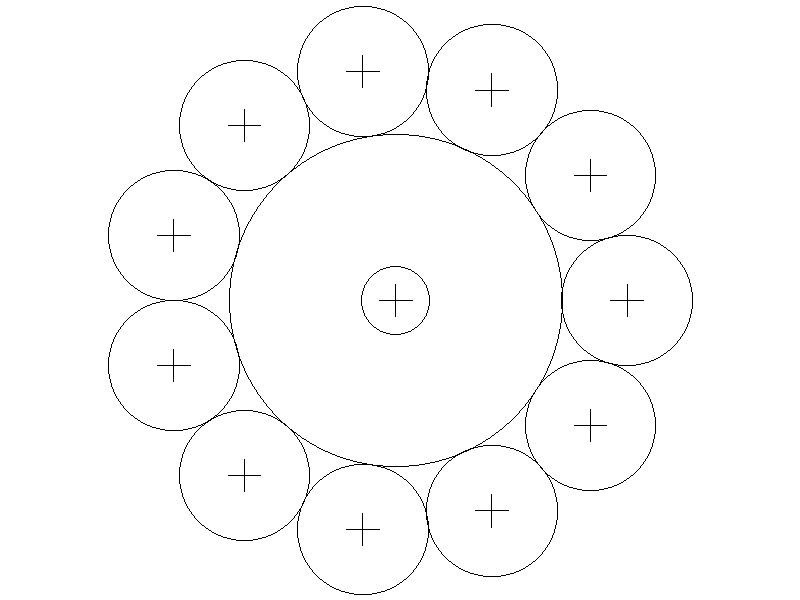
                                            General procedure as for the 3-4-5 square but this time a round backplate with ring of holes for the rollers and rollers themselves touch a disc rather than a straightedge .

                                            Arrange means such as centre dowel and few small screws so that centre disc can be aligned with backplate and held in place .

                                            Turn centre disc to calculated diameter plus a few thou over .

                                            Assemble centre disc to backplate and then assemble rollers – bedding each one against the previous and against the centre disc . Lightly do up holding screws .

                                            Between the first and last assembled rollers there will be a gap . Measure gap and calculate how much centre disc has to be skimmed to close gap exactly . Skim centre disc . Best to proceed slowly and have two or three reductions – each one progressively finer .

                                            Feeler gauges and Blue can be useful but often work can be done with nothing more than ' feel ' .

                                            Reassemble with newly sized centre disc and all rollers . Choose a different roller as the last one assembled . All rollers should now be touching each other and centre disc . Test and verify – small corrections are possible but seldom needed . Keep everything very clean – no swarf and no oil for final assembly and check . Light oil afterwards . Centre disc could be removed but usually left in place .

                                            As a final check – clock over all the rollers to make sure that there isn't one standing proud .

                                            Master plates for any number of index positions can be made this way . Can be used for any purpose but particularly useful for prime numbers . Usually master is used to make ordinary working index plates for day to day use ..

                                            Regards ,

                                            Michael Williams .

                                            Here is what a plate for eleven index positions would look like :


                                            master plate 11.jpg

                                            Edited By David Clark 1 on 24/02/2013 10:38:24

                                            #112867
                                            MICHAEL WILLIAMS
                                            Participant
                                              @michaelwilliams41215

                                              Null post

                                              #112890
                                              Michael Horner
                                              Participant
                                                @michaelhorner54327

                                                Now I know why they invented CNC!wink 2

                                                Cheers Michael.

                                              Viewing 22 posts - 1 through 22 (of 22 total)
                                              • Please log in to reply to this topic. Registering is free and easy using the links on the menu at the top of this page.

                                              Latest Replies

                                              Home Forums Beginners questions Topics

                                              Viewing 25 topics - 1 through 25 (of 25 total)
                                              Viewing 25 topics - 1 through 25 (of 25 total)

                                              View full reply list.