Home › Forums › The Tea Room › Hydrogen
If you produce ethanol from biomass it should be nett zero carbon. It will emit CO2 from the tailpipe, but the plants from which it was made absorbed it in the first place. Unfortunately ethanol has a lower calorific value than petrol.
Except you have cut down the plants that were absorbing the CO2 and now have to wait some months or in the case of forests, years, for the next crop to regrow to meet the same capacity to absorb C02. Hard to see how it is net zero in that period?
You have to grow the crops before you cut them down, but it's a similar argument to burning biomass at Drax, which I think is a very silly idea. And if you're devoting large areas of land to growing crops to make bioethanol, where do you grow the crops to feed people. I didn't say it was a good idea! Using waste chip fat doesn't sound too bad, but I bet it doesn't scratch the surface of replacing fossil fuels.
Edited By duncan webster on 09/01/2023 23:48:39
Indeed. There is rising awareness in the EU about burning biomass wood pellets. They still classify it as "renewables" but huge questions have been raised over it and it is unlikely to be a long term alternative once the Russian gas problem is solved or alternatives found. Really, cutting down trees and burning them in steam boilers is James-Watt-era technology. Making them into pellets and giving them a sexy name like biomass doesn't change a thing.
Yes we would all need to eat a heck of lot more chips to replace fossil fuels with chip oil!
Edited By Hopper on 10/01/2023 09:47:31
Drax to me seems a bit of a temporary gain in the mix. If you start from being entirely coal burning, moving to biomass helps in the short term by switching from historic to present carbon although the energy/carbon ratios need to be watched but the prior existence of all the generation and transmission infrastructure has to be factored in. …
I kind of agree with Duncan but it also ‘sort of depends’
regards Martin
+1 Generating electricity by burning helps deal with supply gaps left by renewable sources, like solar not working at night and windless days. Burning isn't the only way of filling gaps, but Drax is in good working order, and it's carbon footprint is substantially reduced by burning biomass rather than coal.
Growing plants to supply biofuel naturally recycles some Carbon Dioxide, whereas simply burning fossil fuels adds more. Ideally Drax wouldn't exist at all, but if it has to be used, then biofuel is less damaging than coal. The win may be imperfect, but it's still a win.
I feel there's a perception that renewable energy is only worth having if it's a direct plug-in replacement for fossil fuels. That's mistaken. People need cheap clean energy, and it doesn't matter where it comes from. Existing energy needs are already met with a basket of technologies: a mix of nuclear, gas, oil, wind, solar, geothermal, hydro, biofuels and coal etc. One way of looking at energy supply, is that renewables simply alter what's in an existing basket.
Compared with other methods, renewables have different pros and cons. On the downside, switching to them is a technical challenge. On the upside, renewables are renewable – unlike fossil fuels, which absolutely cannot meet future needs.
Dave
There seems to be a lot of technology and trouble needed to get water to boil ![]()
Edited By roy entwistle on 10/01/2023 10:48:31
Posted by SillyOldDuffer on 10/01/2023 09:47:37:,
… but Drax is in good working order, and it's carbon footprint is substantially reduced by burning biomass rather than coal…
Dave
Not entirely convinced by that:-
Doesn't add up to me, have a look at the BBC News article on Drax.
John
Using the heater in my Ioniq doesn`t hit the range much at all. I think at full charge with climate control on I loose about 10 miles. What does make a big impact is the cold weather. Summer time and near 20 degrees I will get about 205 miles range. Winter time near freezing and it drops to about 150 miles.
Posted by SillyOldDuffer on 10/01/2023 09:47:37:,
… but Drax is in good working order, and it's carbon footprint is substantially reduced by burning biomass rather than coal…
Dave
Not entirely convinced by that:-
Doesn't add up to me, have a look at the BBC News article on Drax.
John
Then add on to that, the forest they cut down in Canada is no longer absorbing C02. It will be what? 20 years to 100 years before the forest regrows to where it is absorbing as much CO2 per day as it was the day before the chainsaws arrived.
So not only have we released massive amounts of CO2 into the air by burning the wood, we have reduced the planet's ability to absorb CO2 out of the air in the process.
Not as much of a joke as one may think! They are working on making batteries from wood, well from lignin extracted from wood. This just popped up on the BBC **LINK**
But will they end up clearcutting the forests to make batteries for clean green electric cars? ![]()
Yes quite. Some are saying the same about Bio Ethanol and Bio Diesel. Using farmland for producing fuel to burn in cars when many are already short of food doesn’t seem to make much sense? In addition they still produce particulates and other noxious stuff.
Not as much of a joke as one may think! They are working on making batteries from wood, well from lignin extracted from wood. This just popped up on the BBC **LINK**
But will they end up clearcutting the forests to make batteries for clean green electric cars? ![]()
Yes quite. Some are saying the same about Bio Ethanol and Bio Diesel. Using farmland for producing fuel to burn in cars when many are already short of food doesn’t seem to make much sense? In addition they still produce particulates and other noxious stuff.
You could argue the same about putting solar farms on good agricultural land. The big problem is continually ignored: the human population size has become greater than the earth can support in the long term.
All new buildings should by law be fitted with solar panel roofs, and existing supermarkets, warehouses etc assessed to see whether they could be used, might need strengthening. I must admit I chickened out from fitting panels to my 90 year old slate roof, even tho it faces south it is shaded by a massive tree, so would not have been over effective.
Not only should the panels be compulsory but also the orientation of the roofs and the level of insulation.
It seems to me to be criminally insane to allow properties to be constructed without this as a minimum standard and yet it continues to be the case that to go green you have to modify brand new houses.
Planning permission was obtained by a company for 300 houses in a local village with one of the conditions that no gas boilers were to be fitted. The land was then sold on and the condition removed. This is not building for the future.
regards Martin
The major problem is that we use too much energy. Until recently energy came without real problems. Now we are waking up to the fact that all energies have their down sides at least.
One of those thinking vicars, like Malthus, in the early nineteenth century observed that as engines became more efficient more fuel per head of population was used. It is very hard to see the world reducing its fuel consumption.
JA
The big problem the EV backers hide is the fact the damaged caused to the environment by extracting the raw materials to make the batteries and the pollution problem caused by the end of life of the batteries.
To mine 1000kg of cobalt you need mine 1,500,000 kg of material.
The major problem is that we use too much energy. Until recently energy came without real problems. Now we are waking up to the fact that all energies have their down sides at least.
One of those thinking vicars, like Malthus, in the early nineteenth century observed that as engines became more efficient more fuel per head of population was used. It is very hard to see the world reducing its fuel consumption.
JA
Estimates are that properly insulating the UK housing stock would reduce energy consumption (by homes) by a third.
regards Martin
The table of efficiencies in the OP is compelling. Steam trains' efficiency was about10%?
I too am unimpressed by the cost of electric cars, given that they are much simpler and have only a fraction of the parts count of a modern ICE car, with all its emission systems etc. They should be much cheaper than the ICE equivalents.
I have heard it said that car manufacturers are keeping the price of their electric cars high because they want to fully amortise (if that's the right word), the cost of their ICE production lines, so they want to sell a certain minimum number of ICE cars first.
It bemuses me when people say that electric cars won't work or be too difficult – for example, they say there isn't enough grid capacity or charging points. I wonder what would have happened during WW2 if we had said 'Oh, we can't compete with the enemy airforce, we just can't do this'. No, we built factories to manufacture more Hurricanes, Spitfires, Lancasters, Wellingtons, and Merlin engines etc; We just got on with it.
Another bemusement is people talking about 'whole life' cost of electric cars – did we ever talk about 'whole life' costs of ICE cars?
Why are electric cars hugely powerful? I suspect it is because the naysayers, think – or like to joke – that electric cars are like milk-floats; slow and impractical, so the manufacturers have had to build really sporty electric cars to destroy that myth. I reckon most electric cars could probably make do with half the motor power they have and that would still be more than sufficient in today's UK traffic, and would enable much greater ranges? Also, cars these days have so many small electric motors that add weight: electric windows, electrically moving seats, electrically moving HVAC air valves, even electric tailgates and doors?? Why do we need any of those, their weight just uses more fuel.
Regarding green energy, it is slightly annoying, since we could have had wind turbines, probably 50 years ago and saved a lot of CO2 emissions. As for the wind not blowing, I don't understand why nobody – especially in the island we live in – seems to have thought of putting tidal flow turbines under the water, attached to the base of every off-shore wind turbine post. The tide moves 4 times every day, 24/7/365, no matter what the weather is doing or if the sun is not shining. Tides can be accurately predicted years into the future, so other generating plants, such as nuclear could be scheduled around the tides. You would put the gearbox and generator above the water level inside the wind turbine post, and only need the water turbine and drive shaft under the water, so the whole system would be out of the weather. Also, an electrical cable is already in place, and any planning permission has already been granted for the wind turbine itself. Yes, sea water is challenging to materials, but not impossible: shipping has learned how to deal with it for many years.
Properly insulating homes may indeed save fuel as you say is estimated; but that is a huge amount of insulation for a huge number of buildings, and we always come back to materials availability, transport and own-environmental questions, labour-time, costs – and to who pays….
What I find deeply ironical as well as eyesores is the new proliferation of brightly-lit video-type advertising hoardings. The worst I have seen are above the M5 through West Bromwich – how are they even legal? Even the smaller, 1m X 2m, two-sided one on my local bus-shelter has a powerful-sounding fan running 24hrs a day, adding to whatever the electronics consume. These are recent inventions so how do they square with the demand to use less "energy" for transport? Or with the realisation that they use semi-precious metals and petroleum-derivative materials, all costly to obtain and costly or impossible to salvage when scrapped?
Along with the surplus, meretricious, kW/h wasting rubbish in the M-way service-areas? One might question taking multi-hundred-mile journeys purely for "social, domestic & pleasure"; and in time, changing to battery-powered cars will probably, greatly reduce those anyway. Even so, irrespective of travel purpose, who other than the companies concerned really needs the overhead video advertisements, or the service-areas' gee-gaw shops, amusement-machines and piped music?
The big problem the EV backers hide is the fact the damaged caused to the environment by extracting the raw materials to make the batteries and the pollution problem caused by the end of life of the batteries.
To mine 1000kg of cobalt you need mine 1,500,000 kg of material.
The big problem the EV bashers hide is the fact of the damage caused to the environment by extracting the raw materials used to make IC vehicles and the pollution problem caused by burning diesel and petrol, smelting steel, and end of life issues caused by plastics and used lubricating oil etc.
In terms of rock to metal ratio Cobalt is in the same league as Molybdenum, Vanadium, Copper, Tungsten. Tin, Titanium and Chromium. If the ratio is unacceptable for Electric Vehicles, it's also unacceptable for all other vehicles, and much else besides.
Supply of all metals is at risk because ores created by billions of years by geological processes, are diminishing. Plenty of metal in the earth's core, but extracting them is much harder than from surface deposits.
Britain was once the world's largest source of new metals, including Gold, Silver, Iron, Lead, Tin, Arsenic, Copper and Zinc. Not now! All our easy sources have been thoroughly exploited apart from Tungsten. The same is happening the world over.
Only the end of civilisation if we fail to manage resources. The answer is alternative sources of energy and recycling, not expecting everything to last forever.
Dave
Edited By SillyOldDuffer on 10/01/2023 18:53:30
John –
Britain is home to some of the best brains in the world for designing tidal-flow turbines, but as ever we are let down by a combination of money-trading spivs, journalists, campaigners and politicians of whom far too many seem barely to know a Watt from a Joule, or a speed Knot from a granny-knot.
It is not that we can't build such schemes, but that we won't.
.
As for the surplus guff in cars, and top speeds well above the maximum legal limits; much of that is selling-points as motorists have been led to expect or "need" far more than what is really necessary for efficiency. comfort and safety. It's probably all part of the human tendency to want ever more, beyond need, merely the "latest must-have".
All in all I think later in this century a lot of very big chickens will be coming home to roost. Free-range vegan fowl grown without batteries from recyclable, all-natural materials, of course. Though "recyclable" only by Nature.
A few thoughts in response to some posts.
Electric Motors are excellent at producing high torque.
Once metals are extracted from the ground they are very recyclable and reuse is more energy efficient and less polluting.
Batteries in cars are idea targets for recycling of materials. Easy to get at, valuable and can be designed with recycling in mind. The notion of a battery recycling plant as a front end to a battery manufacturing plant is easy to imagine and desirable for any number of reasons.
EV’s are probably expensive due to the newness of the product and the relatively low volumes involved. Also like the automobile when it first emerged there was a rich (in money) market to exploit. Sometime later the affordable car eventually arrived. EV’s will become cheaper.
A fly in the ointment maybe older drivers who can afford EV’s don’t really do the mileage to benefit from the mileage cost savings and younger people who do cannot afford them.(often)
regards Martin
Edited By Martin Kyte on 10/01/2023 19:59:43
I live in the Highlands of Scotland and EV are not practical as their are very few charging points and unless there are EV with four wheel drive and low ratio gearboxes they will never be any good up here!
I believe that certain Teslas have 4WD and nearly 100% torque at almost zero revs.
Electric is definitely the way to go, as soon as the range and charging issues are solved. Better to have our personal transport powered by very efficiently produced electricity, than by badly maintained individual ICE engines.
As far as range is concerned; how many of us travel more than 100 miles each way to work? We can charge our electric cars at home for more range than we actually use each day, so it really should not be a problem – as long as the purchase price can be brought under control.
The maximum range I ever need is 250 miles in one go, and that is very rare.
Edited By John Doe 2 on 11/01/2023 01:05:10
I believe that certain Teslas have 4WD and nearly 100% torque at almost zero revs.
Electric is definitely the way to go, as soon as the range and charging issues are solved. Better to have our personal transport powered by very efficiently produced electricity, than by badly maintained individual ICE engines.
As far as range is concerned; how many of us travel more than 100 miles each way to work? We can charge our electric cars at home for more range than we actually use each day, so it really should not be a problem – as long as the purchase price can be brought under control.
The maximum range I ever need is 250 miles in one go, and that is very rare.
Edited By John Doe 2 on 11/01/2023 01:05:10
My bold,
Not everyone can charge their car at home. I can't. I have no off road parking. It is not allowed to lay a mainslead across the pavement. Lampost charging will not work because the lamp posts are on the wrong side of the pavement. I don't see them putting kerbstone sockets in either. People in flats and apartments can have the same issue.
And no I'm not anti EV. My car is a plug-in hybrid. When working at the office I can charge it at work which is enough for the commute. However there a few options Last time I checked a couple of months ago Cambridge city had less than 40 public EV chargers and most of those are only nominally public being in hotels and the like. I also think that there is "double accounting" as chargers that have both a Chademo and a Type two connection were counted as two chargers but only one can be used at a time.
The whole issue of supply capacity, both generation and distribution is another matter and a complex one. We will almost certainly see management of when our vehicles can be charged to control peak demand. Everyone in a city going haome at 5:30 and plugging in even a 16A charger is a huge load.
Robert G8RPI.
It needs more than that, John. It also needs not assuming what suits you, suits all.
It needs huge numbers of reliable public charging-points wherever you are in the country (including the empty wilderness of the Scottish Highlands, and the distant, populous, deprived areas like Cornwall). They can and do break down!
And enough of them to lessen the huge increases already being reported in journey times, due to the queues.
It needs standard connection systems, no more than two (I believe some cars use d.c and some a.c. connectors but I may be wrong); on all chargers, to suit all makes and models of car.
It needs the option of direct card-payment methods, with the price by kW/h displayed, as on many liquid-fuel pumps; on all chargers. Not having to use a portable telephone that always and already carries the risk of no coverage where and when you need it most. Not to mention adding to the cost of re-charging, the call and agency fees.
It needs sufficient constant electricity supply to many thousands of high-power chargers both public and private, on top of the intended, vastly increased domestic electricity consumption.
It needs the Government, car makers and charger makers to comprehend that a huge number of motorists now and in future will never be able to charge their vehicles at home! These people don't comprehend it now because they can all afford brand-new cars and leafy-suburban homes with big drives.
Finally it also needs the notion that because many motorists only ever drive short distances then all do, be seen for what it is – a meaningless assumption based on a shallow statistic.
.
A battery-car is out of the question for me. I cannot afford one, I cannot charge it at home.
I cannot see a 250-mile range going far in the Scottish Highlands in bad Winter weather, (a road atlas shows the size and emptiness of that country) though such a range might only apply to a car likely to be useless in such conditions anyway. I doubt any battery-equivalent of the real Land-Rovers and Range Rovers that could give you some chance of reaching Glasgow from Thurso in Winter, would have anywhere near that range. Even with the heater off.
For me 250-mile theoretical range would barely reach half-way to my relatives near Glasgow – from the Southern England sub-tropics where, we are blithely told by the Greens, we can all install umpteen-kW chargers in the garages all our homes have.
Anyway I'd need allow 20, not 10, hours to anticipate long-time queues for possibly very few readily-accessible, compatible and working chargers between Bristol (80 miles from home), Birmingham (180), Preston (260)…..
'
The recovery-companies are going to do well with diesel-powered portable chargers!
Who is going to pay the rate necessary for them to make a profit spending a couple of hours with each car using £50k worth of equipment?
It's five years since I quit as a recovery driver, and the companies were struggling with the low rates the breakdown providers paid – a years cover ought to have been about three times what it was.
I live in the Highlands of Scotland and EV are not practical as their are very few charging points and unless there are EV with four wheel drive and low ratio gearboxes they will never be any good up here!
That's a much better reason for not wanting an EV than worrying about the rock to metal ratio of Cobalt.
The Highlands of Scotland are much less suited to EV than my locale which is rural and semi-rural, full of people and infrastructure!. Even so hardly anybody drives off-road here. The main exception is Waitrose car-park which is full of spotlessly clean Sports Utility Vehicles! (Non-brits might not know Waitrose is a posh supermarket.)
Places like the Highlands, and there are many, many other examples around the world, will find it harder to replace working vehicles like Land Rovers and Toyotas. But, it took rather a long time for internal combustion to take root in the Highlands, and people managed without them. In the early days of motoring good roads were few and there were no petrol stations in the Scottish north! Off-road vehicles were rare anywhere in the UK before 1945, and only became affordable as war-surplus. Now they're taken for granted.
Off-road EVs exist, but they're pricey and short-range. Although new prices will drop and a second-hand market will grow, city dwellers and semi-rural types like me will benefit first. At the moment it's hard to see an EV replacing the simple rugged capabilities of a classic Land Rover.
One advantage of EVs is they can be recharged at home, but this may not be possible on existing power-cabling.
Although the difficulty of switching to EVs is grossly exaggerated (because most car drivers do short range trips in and around towns), they don't suit everyone. But that's no reason to damn the whole lot out of hand. Inverting the logic results in refusing to make and sell 4×4 vehicles because – in London – they're whacked with congestion charges, and parking charges are massive, even if you can find a space. As a result, few central Londoners own cars, because Tube, Taxies, bikes and buses are cheaper and more practical.
Important to understand the switch isn't being made because a few tree-huggers want to punish libertarians on ideological grounds. It's being made because fossil fuel stocks are depleting (god isn't making any more), and because large-scale dumping of Carbon Dioxide into the atmosphere is causing climate change, the consequences of which threaten everything you and I hold dear.
On a personal time-scale, EVs are unlikely to inconvenience anyone over 70 years of age much. Major changes take a few decades by which time most of today's objectors will be beyond caring. If anyone is worried about their children and grand-children, the answer to their problems won't be what worked in the past for us.
Dave
Edited By SillyOldDuffer on 11/01/2023 09:22:10
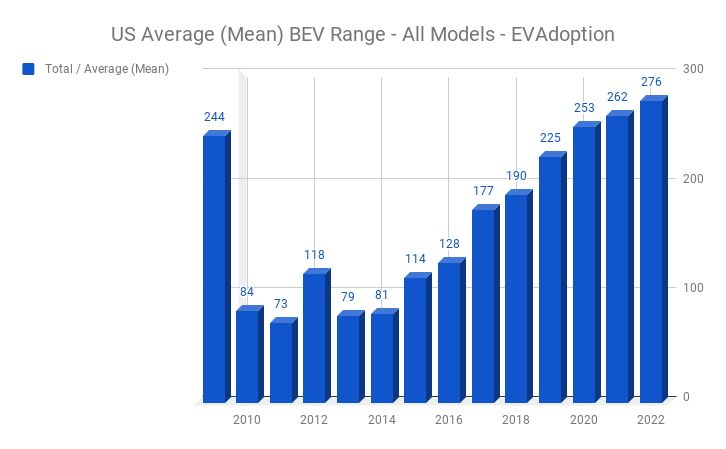
EV battery range appears to be doubling every 6 yrs or so…. https://evadoption.com/us-bev-battery-range-increases-an-average-17-per-year-and-38-miles-each-model-update/
Once 1,000 miles EV range is achieved, and assuming ICE cars still have a range of 500 miles on average, then comparatively half the number of public refuelling (charging) points will be required.
Granted, 1,000 mile range could still be 24 years away, but that might coincide with the last remaining ICE car being scrapped. I anticipate 1,000 mile range to happen quite a bit sooner though.
There is still the issue of home charging, but give it time. Humans are good at solving problems.
Ches.
PS: Is induction charging whist waiting at traffic lights a goer?
Home › Forums › The Tea Room › Topics
Started by: Bill Dawes
in: General Questions
Dave Halford
Started by: SteveP
in: I/C Engines
SteveP
Started by: Buffer
in: General Questions
Robert Atkinson 2
Started by: COLIN MARTIN 2
in: Materials
Julie Ann
Started by: Bill Dawes
in: General Questions
Howard Lewis
Started by:
JasonB
in: The Tea Room
JasonB
Started by:
duncan webster 1
in: Electronics in the Workshop
John Haine
Started by: Alan Ambrose
in: Manual machine tools
Adam Harris
Started by:
David George 1
in: CAD – Technical drawing & design
Mark Rand
Started by: Chris Crew
in: The Tea Room
Chris Crew
Started by: Dougie Swan
in: General Questions
Ian P
Started by: James A
in: Manual machine tools
Andy Stopford
Started by: Andrew Tinsley
in: Workshop Tools and Tooling
Clive Foster
Started by:
dee
in: Related Hobbies including Vehicle Restoration
duncan webster 1
Started by: Harry Broadbent
in: Model Engineer & Workshop
vintagengineer
Started by:
Michael Gilligan
in: Clocks and Scientific Instruments
Kiwi Bloke
Started by: Tony Ray
in: Workshop Tools and Tooling
bernard towers
Started by: lucerne
in: Manual machine tools
bernard towers
Started by:
dean clarke 2
in: I/C Engines
dean clarke 2
Started by: jimalm
in: Electronics in the Workshop
Vic
Started by:
Neil Wyatt
in: Manual machine tools
Howard Lewis
Started by: Roger Harvey
in: Workshop Tools and Tooling
ega
Started by: Andrew Tinsley
in: Workshop Tools and Tooling
Andrew Tinsley
Started by: Dalboy
in: General Questions
Graham Meek
Started by: Peter Simpson 3
in: Beginners questions
Peter Simpson 3