How satisfactory are threads cut with partial profile threading inserts?

How satisfactory are threads cut with partial profile threading inserts?

Home Forums Workshop Tools and Tooling How satisfactory are threads cut with partial profile threading inserts?

Viewing 18 posts - 1 through 18 (of 18 total)
  • Author
    Posts
  • #829604
    Bill Phinn
    Participant
      @billphinn90025

      The single point threading I’ve done so far has relied on a cheap 60 degree external threading insert (and holder) that came with a group of carbide insert turning tools courtesy of a Chinese seller on Amazon.

      It’s a partial profile insert, which I believe is supposed to be able to cut anything from 0.5-3.0mm pitch. Threads I’ve cut with this so far have seemed very satisfactory, but what I’d chiefly like to know is how much of an issue it is that the root of the thread will not have quite the correct radius because of the pointed tool tip.

      When I acquire more threading inserts, should I get more universal/partial profile inserts or stump up for a reasonable spread of full profile ones?

      Lastly, a word on designators. The threading holder I’ve got is designated SER1010H11. What does the H11 mean at the end? And will 16ER inserts fit it?

      Thanks.

      #829607
      peak4
      Participant
        @peak4

        Here you go, this pdf should reveal all.
        H11 holder for 11mm bits, H16 for 16mm

        https://www.cutwel.co.uk/media/product-pdfs/downloads/Korloy%20Thread%20Turning%20Inserts.pdf?

        Bill

        #829609
        Julie Ann
        Participant
          @julieann

          There are two issues with partial form threading inserts. One the root radius is set for the finest pitch. So for coarser pitches the depth of cut needs to be increased above the theoretical value. It can be calculated, or done by trial and error. Two the crest of the thread is not finished so will need to trimmed with a fine file to get rid of the inevitable extrusion of metal during the cutting process.

          I always use full form threading inserts. Most of my screwcutting is Whitworth form. A full form insert forms the correct radius on the crest as well as the root. No messing with files, just a quick brush to get rid of swarf before testing for fit. Experience shows that thread depth, as put on via the cross slide, is usually within a couple of thou of the theoretical value.

          To summarise I use full form inserts for all thread forms; Whitworth, Unified and metric. Just makes life easier. I tend to cut a lot of same pitches/tpi so don’t have anything like the full range of inserts; just buy as needed.

          Julie

          #829612
          Nigel Graham 2
          Participant
            @nigelgraham2

            I generally cut to the “book” depth – sometimes turning a liitle witness spigot to that diameter on the end first – then finish to size and profile with a die.

            I’ve not met problems with simply truncating the thread crest by a very light surfacing cut.

            #829616
            Fulmen
            Participant
              @fulmen

              Unless you’re working on a high stress / cyclic load part or need to conform to a certain standard? Nah, you’re usually good as long as the nose radius isn’t over spec.

              The biggest benefit of a full profile insert is simplicity, they will produce thread that is on-spec, burr free and can be checked with a single micrometer measurement.

              #829622
              Huub
              Participant
                @huub

                In general, I use partial profile inserts. In the tool table of the CNC, the tool nose radius is a parameter and the software calculates the required cutting depth. I cut mainly “any pitch” 60° threads and do not have the storage space for another 20 boxes threading inserts. I only make prototypes as hobby and time is not an issue.
                Besides the limited single pitch use of full profile inserts, the cutting forces increases when the crest part of the thread is also cut. My not so rigid lathe doesn’t like that

                For thread pitches smaller than 0.5 mm I use sharp (no tool nose radius) self ground HSS tools.

                If I would do this on a commercial base, I would like Julie, use full profile threads.


                #829628
                JasonB
                Moderator
                  @jasonb

                  Partial form satisfy my needs. I don’t have a lot of call for screwcutting and what I do need is usually fine pitch 0.5 to 1.0mm but of larger diameters upto 50mm. I can live with running a needle file over the crests or simply starting with a reduced diameter.

                  If it is a standard thread like Metric coarse or BSP then I can part screwcut and finish with a die so that takes care of teh final profile.

                  As with everything what the threads are intended for, how many you are going to cut and budget will often be the deciding factor and only you can answer that.

                  #829629
                  cedric 1
                  Participant
                    @cedric

                    Make the OD of your job 5 or 10 thou etc undersized, depending on pitch and thread depth. This means your crest radius is not critical because you have clearance there. You lose no significant strength until you get below 65 per cent thread engagement.

                    Do likewise with female threads.

                    In practice you don’t want a perfect 100 per cent form thread because without clearance, any little bit of dirt or oil etc can stop them screwing together.

                    You say you are happy with the results so far with your partial form tool, so carry on with that and don’t get overzealous on theoretical perfectionism. Unless you are doing space shuttle parts, metrology  etc of course.

                    #829632
                    David George 1
                    Participant
                      @davidgeorge1

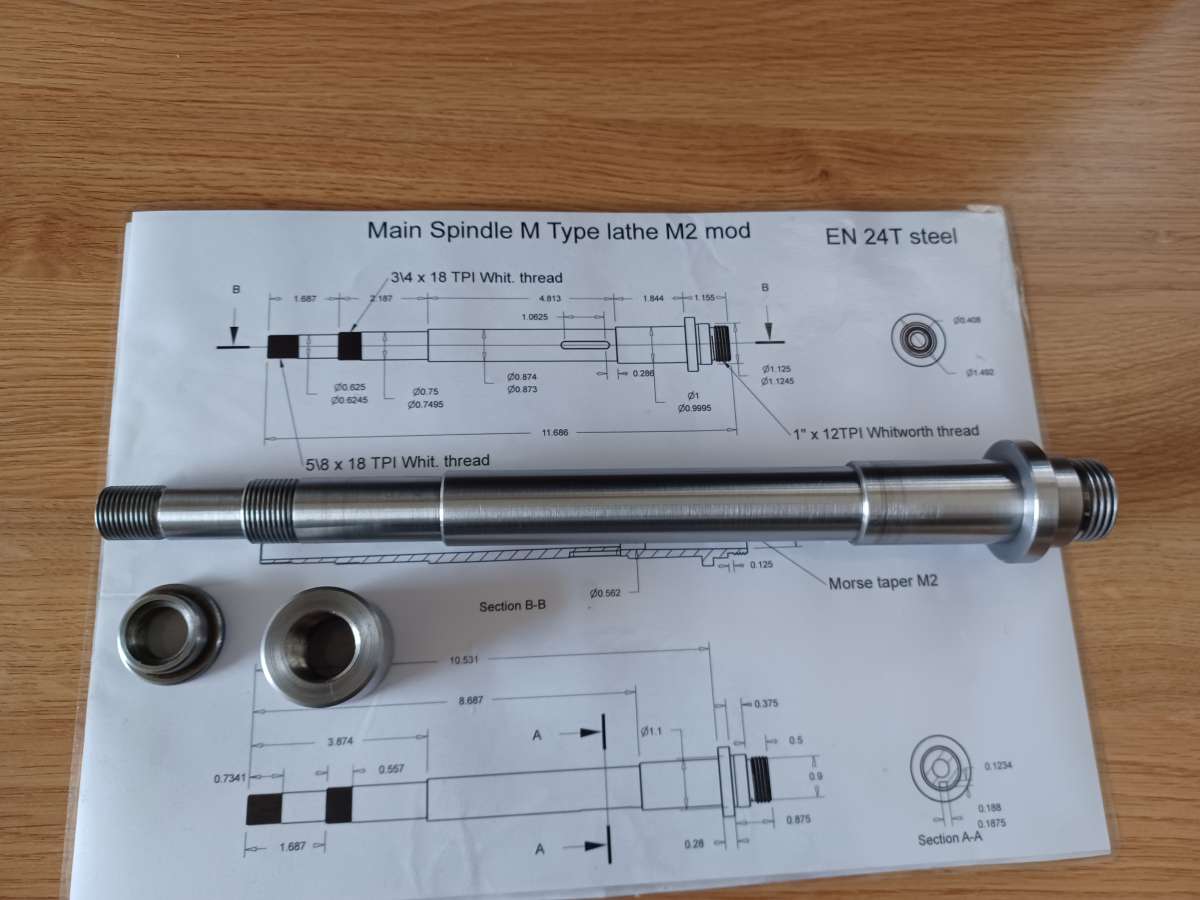
                      I use both partial form for general screw cutting which may be finished with a die but for some parts i.e. a lathe spindle I use a full form cutting insert as the hollow spindle could be compromised by the root depth being too deep on both the chuck holding and the rear bearing tensioning threads.


                      20230313_095108

                      David

                      #829660
                      bernard towers
                      Participant
                        @bernardtowers37738

                        David, If you use the direct in approach(no angle on the topside) I cut to proper spec depth and then advance topslide towards chuck by small increments till I have a nce fit with a gauge.

                        #829676
                        Bill Phinn
                        Participant
                          @billphinn90025

                          Thanks to everyone for your replies.

                          If I’ve understood things correctly, when using a full form insert that is, say, 20 TPI, you could theoretically start out with 5/16” round stock and produce 1/4”x20 threaded bar from it because the crest-cutting feature of the insert would keep reducing the diameter until you decide to stop. Not that you’d really want to do things that way.

                          Julie’s post, among others, has persuaded me to want to at least try full form inserts. It’s really the bigger stuff I want to do single point treading for, so I probably wouldn’t need to buy too many inserts.

                          It looks like the 11ER partial insert I’ve currently got may only cut up to 1.5mm or perhaps 1.75mm pitch, so if I want to cut bigger pitches I will have to get 16ER inserts and a new holder. I’ve yet to see a holder for 16ER inserts that is as small as the 10mm square one I’ve got, so maybe I’ll need to size up to a 12mm one.

                          #829687
                          David George 1
                          Participant
                            @davidgeorge1

                            Hi Have a lookmon here for cutting tools and holders.      https://www.shop-apt.co.uk

                            They are very helpfull even with dificult to fit smaller lathes etc.

                            David

                            #829689
                            bernard towers
                            Participant
                              @bernardtowers37738

                              Bill, My 16er holders are 10mm tall by 12mm wide!!!. They came from Jenny at JB Cutting tools.


                              #829721
                              larry phelan 1
                              Participant
                                @larryphelan1

                                Pity me ! I,m still using bits of HSS ground by eye and mounted as near centre height as I can see !  Still, the bits go together OK.

                                #829726
                                martin haysom
                                Participant
                                  @martinhaysom48469
                                  On larry phelan 1 Said:

                                  Pity me ! I,m still using bits of HSS ground by eye and mounted as near centre height as I can see !  Still, the bits go together OK.

                                  works for me too

                                  #829729
                                  Andrew Crow
                                  Participant
                                    @andrewcrow91475

                                    A cheap way of cutting full form threads is to use die blades from a Coventry die head, you can still see them on ebay etc. Or try to find some where one of the blades has been damaged so making the set unusable in the die head.

                                    Make a simple holder and grind off the tapered lead so you are cutting with a full tooth, when it wears grind it off and use the next tooth and so on. Don’t attempt to grind the top rake.

                                    #829731
                                    Nigel Graham 2
                                    Participant
                                      @nigelgraham2

                                      Tracy Tools sell holders for Coventry die chasers. These are designed for both hand-chasing if mounted in a suitable handle, or holding in the tool-post.

                                      #830265
                                      Bill Phinn
                                      Participant
                                        @billphinn90025

                                        Thank you for the further replies.

                                        I ordered a 16ER 12mm shank external threading holder from the source Bernard recommended. It is 12×12, as described, and came with five inserts (two of which were thrown in as extras). I can’t unfortunately use one of these on my lathe as it is a 12 TPI insert, which my metric lead screw won’t accommodate. The 12mm holder fits my 250-000 QCTP fine.

                                        I’ve also ordered a couple of full profile 16ER inserts in 1.25mm and 1.5mm pitches, as these seem to be the pitches I thread most.

                                        I’d be interested to know what tables showing depths of cut when single point threading (both when threading with the cross slide and threading with the compound, and for both partial and full form inserts) people recommend consulting.


                                      Viewing 18 posts - 1 through 18 (of 18 total)
                                      • Please log in to reply to this topic. Registering is free and easy using the links on the menu at the top of this page.

                                      Latest Replies

                                      Viewing 25 topics - 1 through 25 (of 25 total)
                                      Viewing 25 topics - 1 through 25 (of 25 total)

                                      View full reply list.