How does bluetooth work?

How does bluetooth work?

Home Forums Electronics in the Workshop How does bluetooth work?

Viewing 23 posts - 1 through 23 (of 23 total)
  • Author
    Posts
  • #830774
    Ian Parkin
    Participant
      @ianparkin39383

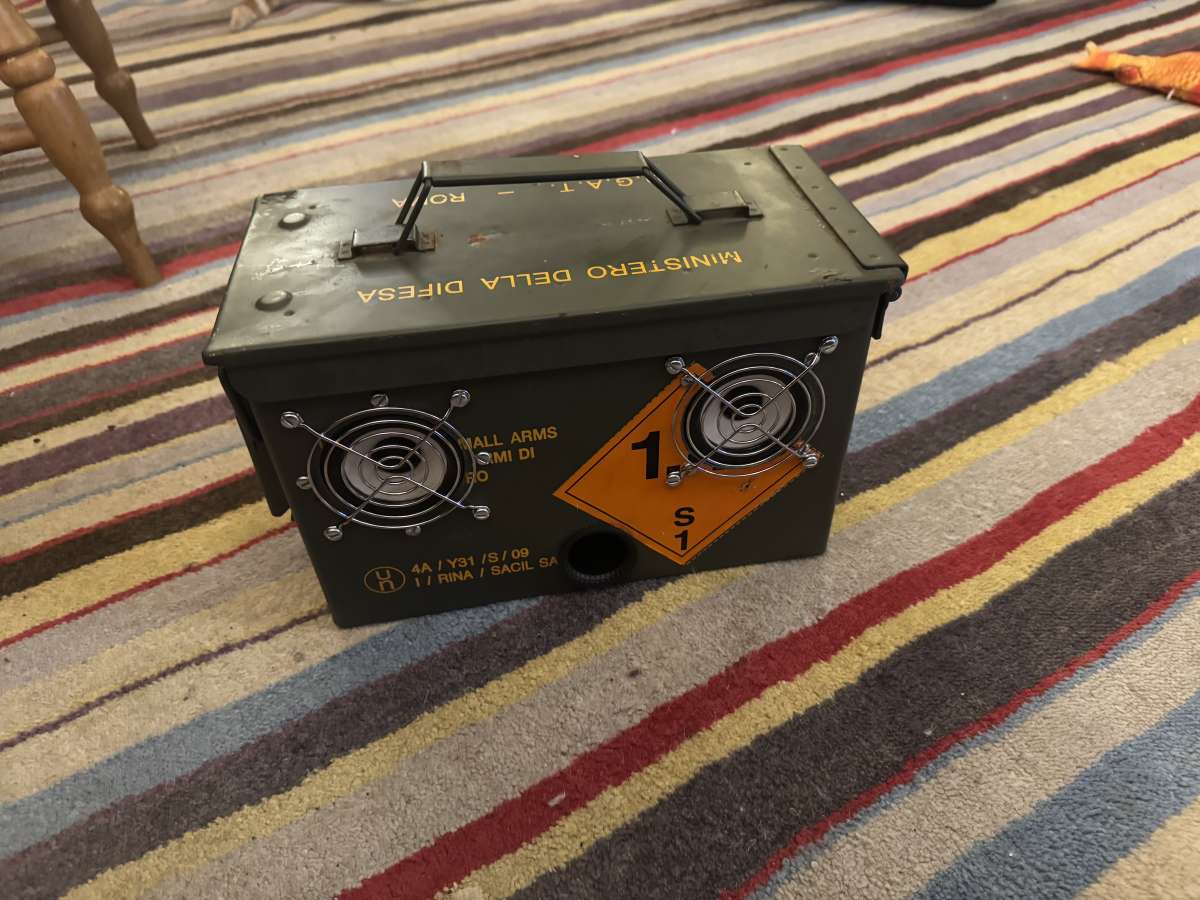
      Ive been building up an Ammobox boombox for a neighbours son…

      So its got 2 70mm holes filled by speakers and a 30mm hole filled with a plastic bass port

      IMG_9713

      I bought a cheap amp with bluetooth connection thinking I was going to have a problem getting the signal in..but to my surprise it works fine certainly up to 30 metres…so far..

      Can any expert explain how bluetooth works signal wise? getting into a nearly sealed metal box?

      #830787
      Robert Atkinson 2
      Participant
        @robertatkinson2

        Bluetooth is UHF radio, around 2400 MHz so just below what is normally considered microwave. A slot or hole of more than a quarter of a wavelength, about 32mm, in thin metal will allow these frequencies to pass easily. The speaker cones are paper or plastic so will not restrict it either. Both speakers and bass port will allow the signals to pass. You may find it is directional if you use it outside where there are no walls etc for the signals to bounce off.

        Robert.

        #830795
        Ian Parkin
        Participant
          @ianparkin39383

          Thanks Robert

          thats that gap in my knowledge sorted

          #830813
          blowlamp
          Participant
            @blowlamp

            I can confirm that our microwave oven blocks my Bluetooth headphones annoyingly effectively.


            Martin.

            #830830
            george baker 1
            Participant
              @georgebaker1

              Hi

              I thought Bluetooth was spec’ed for 10m

              George

              #830841
              Robert Atkinson 2
              Participant
                @robertatkinson2

                Class 2 Bluetooth is specified for 10m range. The higher power class 1 units are 100m range.
                While all Bluetooth modules should meet various specifications but most of the cheap modules have never been tested and are probably not compliant.

                Microwave ovens and bluetooth along with a lot of wireless network devices use the 2400 MHz (2.4 GHz) Industrial Scientific & Medical (ISM) band. This band is licence free and devices using them may interfere with one another. Note that by the modern definitions a microwave oven is actually  UHF oven as the UNF band is 300 MHz to 3000 MHz (3 GHz) (1 m to 100 cm wavelength) and microwave is 3 GHz to 30 GHz.

                Robert.

                #830843
                Julie Ann
                Participant
                  @julieann

                  How does Bluetooth work? The simple answer is active frequency hopping with Gaussian frequency-shift keying or, in later versions, pi/4 DQPSK (differential quadrature phase shift keying). However, I suspect that isn’t the answer that was expected.

                  The original Bluetooth specification appeared in the late 1990s and was around 700 pages long. I know that because I was tasked with reading it at work. The original specification was indeed for a range of 10m. However, there were different power levels in the specification giving ranges of around 1m, 10m and 100m.

                  There are now many variations within both Classic Bluetooth and Low Energy Bluetooth, with ranges up to 300m. As is often the case in hi tech what started out as a fairly simple system for wireless headsets is now so complicated that designers have to use modules and software from specialist companies rather than develop their own solutions.

                  The question of range is moot anyway as the range of any radio system is dependent upon a whole range of external factors. Such as the antennas and their environment, what, if anything, is in the way between transmitter and reciever, and what multipath reception is like.

                  Julie

                  #830848
                  JA
                  Participant
                    @ja
                    On Julie Ann Said:

                    How does Bluetooth work? The simple answer is active frequency hopping with Gaussian frequency-shift keying or, in later versions, pi/4 DQPSK (differential quadrature phase shift keying). However, I suspect that isn’t the answer that was expected.

                    ……………………


                    Julie

                    Simple?

                    JA

                    #830855
                    Robert Atkinson 2
                    Participant
                      @robertatkinson2

                      Blame Hedy Lamarr. Yes the actress.

                      I was going to answer the original post with “magic”….

                      Robert.

                      #830863
                      John Haine
                      Participant
                        @johnhaine32865

                        I think Lamarr’s role is somewhat over estimated.  She came up with the idea of using a radio transmitter and receiver which continuously change their frequency in a coordinated way to minimise the chances of eavesdropping and jamming but it was beyond the capabilities of radio technology at the time.  The patent expired in 1959 but frequency hopping radios started to appear some years later when fast hopping frequency synthesisers became possible. If you’re interested you can read the patent here:

                        https://patents.google.com/patent/US2292387A/en

                        Also see this from the Smithsonian:

                        https://airandspace.si.edu/multimedia-gallery/4790640jpg which would have you believe that somehow it inspired GPS, which uses an entirely different system.

                        Regarding range most of these short range radio modules are bedevilled by the fact that the last thing their designers think about is the antenna.  Whilst the design target operating range can be of the order of 10m, with a decent antenna at each end of the link they can usually do a great deal better.

                        #830893
                        Mike Hurley
                        Participant
                          @mikehurley60381

                          Particularly stupid idea of 2025! –

                          Decided to update my Yamaha Electric piano by adding a bluetooth transmitter so I could use my wireless headhones instead of the wired ones I had for it that had packed up.

                          Genius idea – saved me buying new wired headphones – and it worked beautifully

                          Win a spot prize if you guess what I’m going to say next..

                          Unfortunately, fingers and resultant sound failed to coincide, and even my ‘Les Dawson’ quality playing sounded even worse than usual. Talk about not thinking something through. DOH!

                          ps –  might be fun for other members to recount similar dim  flashes of ‘inspiration’ in a new thread?

                          Mike


                          #830899
                          John Haine
                          Participant
                            @johnhaine32865

                            Mike, my Yamaha piano came with Bluetooth and I had the same thought – but actually it doesn’t support the headset profile for exactly the reason you mention.  Main application I think is for a Midi link and to tablets etc for “computer assisted learning”.  I remember an organist once described that a problem with some electrically-activated pipe organs can be the delay between pressing a key and the sound starting so they had to get used to playing slightly in advance, especially when accompanying another instrument.

                            #830912
                            Julie Ann
                            Participant
                              @julieann
                              On JA Said:

                              Simple?

                              Frequency hopping simply means that instead of transmitting on one frequency the system transmits on a series of frequencies spread across the whole band in use. The different frequencies are used in a predefined pattern which is also known by the receiver. Frequency hopping makes message interception more difficult. it also reduces the effect of interfering signals as the interference is unlikely to be over the whole band. Classic Bluetooth uses 79 channels each of 1MHz bandwidth.

                              Active frequency hopping means that the system avoids using those frequencies that are known to be noisy. It sounds good but several Bluetooth devices operating in close proximity can unintentionally interfere with each other.

                              Gaussian frequency-shift keying means that the data pulses which control the frequency shifts are first filtered with a Gaussian low pass filter. A Gaussian filter has minimal time delay while also having no over or undershoot. The practical result is that the frequency shifts happen over a short time rather than instantly, thus reducing signal bandwidth and potential interference between different transmit bands.

                              The more advanced QPSK uses four states, represented by phase differences, per symbol transmitted. Since there are four states two bits can be encoded per symbol.

                              The pi/4 means that two sets of QPSK are used, shifted by 45 degrees. Hence twice the amount of data can be carried, at the expense of smaller phases shifts between symbols and possibly increased error rates.

                              Hope that helps.

                              Julie

                              #830918
                              Fulmen
                              Participant
                                @fulmen

                                @ Julie:

                                #830930
                                JA
                                Participant
                                  @ja

                                  Julie

                                  It is still beyond me but I am too old to care. I only have one Bluetooth device, the speakers for my computer. Are things like wireless car locks and garage door locks Bluetooth?

                                  Thanks, anyway.

                                  JA

                                  #830934
                                  SillyOldDuffer
                                  Moderator
                                    @sillyoldduffer
                                    On John Haine Said:

                                    …Regarding range most of these short range radio modules are bedevilled by the fact that the last thing their designers think about is the antenna.  Whilst the design target operating range can be of the order of 10m, with a decent antenna at each end of the link they can usually do a great deal better.

                                    Well, though all things are possible, I think Bluetooth antenna are carefully thought through.   The system is explicitly designed to be low-range as a way of reducing interference with other Bluetooth users:

                                    • Class 2 transmitters (headphones etc) are limited to only 2.5mW.
                                    • Class 2 antenna are generally a trace on a tiny PCB – easy to fit inside an earpiece, not Goonhilly.  A reasonable match to the transmitter’s output stage with no gain, approximately isotropic, just “good enough” to send and receive mildly reliably over a 10 metre.  Not intended to do better, and being a bit deaf means the receiver is less affected by nearby Bluetooth devices and Microwave ovens!
                                    • Bluetooth transmits in the 2.4GHz band,  deliberately intended to restrict range. Most of the signal is absorbed by water molecules!   On a wet planet, 2.4GHz is daft for long-range communications. but it’s brilliant at soaking up unwanted signals!
                                    • Bluetooth range is limited even if sooper-dooper antennas are installed because the packet switching protocol fails if packets take too long to reach their destination.

                                    As Julie said, Bluetooth is complicated!  Many variables.  My list shows how Class 2 Bluetooth is crippled, but, of course there are applications which need more range.   BLE gets more range from a different protocol and wider channels, Class 1 from more power, and devices can be fitted with efficient antenna and less deaf receivers.

                                    Slightly surprised a Bluetooth signal gets into Ian’s Boombox from 30 metres away.   Fair amount of luck in it I think, might be difficult for others to repeat the trick!

                                    Dave


                                    #830935
                                    Robert Atkinson 2
                                    Participant
                                      @robertatkinson2
                                      On John Haine Said:

                                      <SNIP>Regarding range most of these short range radio modules are bedevilled by the fact that the last thing their designers think about is the antenna.  Whilst the design target operating range can be of the order of 10m, with a decent antenna at each end of the link they can usually do a great deal better.

                                      The designers should be considering the antenna. The power rating limits for these devices that allow licence free operation are specified as radiated power. This includes any gain (or loss) in the antenna.
                                      Fitting a different antenna requires the equipment to be re-approved.

                                      Robert.

                                      #830967
                                      JA
                                      Participant
                                        @ja

                                        Am I correct in understanding that frequency hopping with Bluetooth has nothing to do with security and everything to do with trying to use as many local Bluetooth devices as possible?

                                        JA

                                        #830969
                                        John Haine
                                        Participant
                                          @johnhaine32865

                                          That’s basically correct.

                                          #830986
                                          Julie Ann
                                          Participant
                                            @julieann
                                            On JA Said:

                                            …Are things like wireless car locks and garage door locks Bluetooth?

                                            I don’t know for sure but it is highly unlikely as Bluetooth is insecure. It was originally intended as a cable replacement for things like headsets. My mums hearing aids connect to the landline phone via Bluetooth.

                                            Julie

                                            #830990
                                            Julie Ann
                                            Participant
                                              @julieann
                                              On JA Said:

                                              Am I correct in understanding that frequency hopping with Bluetooth has nothing to do with security and everything to do with trying to use as many local Bluetooth devices as possible?

                                              I am afraid I don’t entirely agree with Johns answer, although it is correct that frequency hopping in Bluetooth is not related to security.

                                              A Bluetooth network is a master/slave system with one master and up to seven slaves, called a piconet. The frequency hopping pattern is set by the master and communicated to the networked slaves. The algorithm for frequency hopping set by the master is determined using a semi-random process. So it is highly unlikely that a second master will be using the same hopping sequence as the first master. If the hopping sequences are different there will be little to no interference between the piconets.

                                              Frequency hopping is all to with rejecting interference from outside sources, whether it be another Bluetooth piconet or, more likely, any of the myriad of other devices that operate in the ISM band.

                                              Julie

                                              #830992
                                              Julie Ann
                                              Participant
                                                @julieann

                                                Fulmen: That’s one smart doggy; is he saying I got something wrong!

                                                Julie

                                                #831025
                                                Robert Atkinson 2
                                                Participant
                                                  @robertatkinson2

                                                  Julie is correct, bluetooth is not suited to remote control applications.
                                                  Car locks use a range of technologies and frequencies. Older systems used UHF at around 430 MHz (some, including Renault, used infrared for a while) for the doors and RFID (like chips used in dogs and contactless credit cards) at kilohertz frequences for the immobiliser. Both of these originally used a fixed code number. Later more secure ones use a “rolling code” that changed with each use. Modern “keyless” systems use a range of technologies and frequencies. These include low frequency NFC (near field communication) a development of RFID, UHF and GHz frequencies. The exact usage varys from manufacturer to manufacturer.

                                                  Robert.

                                                Viewing 23 posts - 1 through 23 (of 23 total)
                                                • Please log in to reply to this topic. Registering is free and easy using the links on the menu at the top of this page.

                                                Latest Replies

                                                Viewing 25 topics - 1 through 25 (of 25 total)
                                                Viewing 25 topics - 1 through 25 (of 25 total)

                                                View full reply list.