Help to identify watch makers lathe

Help to identify watch makers lathe

Home Forums Manual machine tools Help to identify watch makers lathe

Viewing 9 posts - 1 through 9 (of 9 total)
  • Author
    Posts
  • #14076
    AJAX
    Participant
      @ajax

      L.W.CO LD 8852

      #505708
      AJAX
      Participant
        @ajax

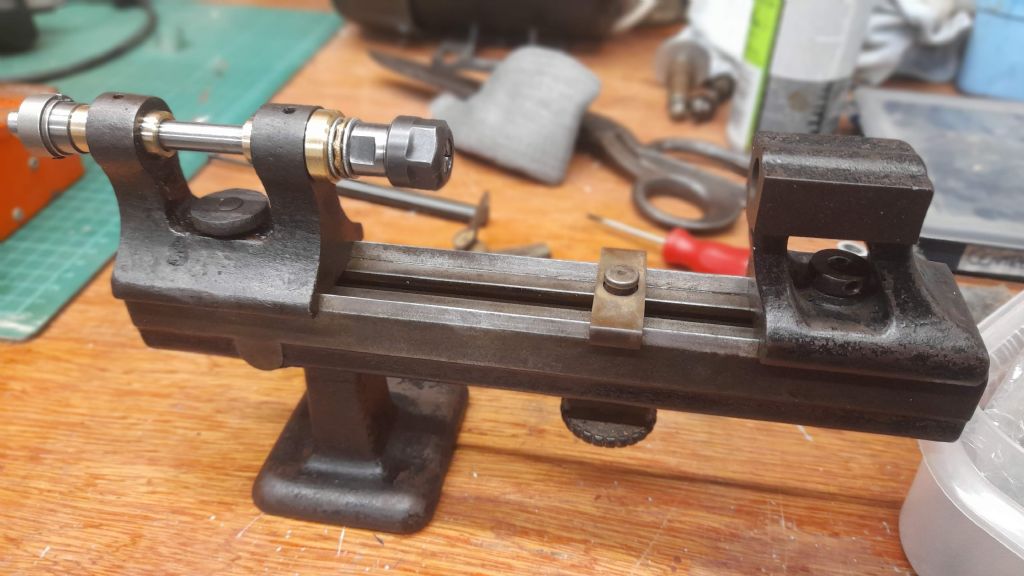
        I have acquired a small watch makers lathe when purchasing a few other items. It's obviously old (and incomplete) but it was cheap and I can tinker around with it and make missing parts. I'm not sure what I'll do with it when it's made usable, but I may give it to my kids.

        The original spindle and bearings had some issues but I've kept them safe if needed again. For the moment, I've added an ER11 chuck and spindle assembly (I expect the horologists will never forgive me) and turned some plain bearings between centres. I've also added a small thrust bearing. I've tried it, and it works well.

        20201106_222739.jpg

        More photos in album

        It would be interesting to identify the origins of this lathe but the only makers marks (?) I can find are on the tool rest which appear to say L.W.CO LD 8852 — I've already checked the lathes.co.uk website and can't find any matches, although it's quite possible I've missed a matching page somewhere.

        I have some pulleys that came with the lathe, but I will probably leave these untouched and turn some new ones to match my current spindle arrangement. I also need to make some parts for the tailstock, but haven't given this much thought yet.

        Brian

        #505713
        Michael Gilligan
        Participant
          @michaelgilligan61133

          I don’t recognise the castings, Brian … but the bed profile has the generic style of the ‘Webster Whitcomb’ design which was standardised amongst the American factories.

          The only clue I have found so far is mention [in 1908] of LANGENDORF WATCH CO.

          Good luck with it … it should be very useful yes

          MichaelG.

          .

          Edit: I think Langendorf is probably a ‘Red Herring’

          https://en.wikipedia.org/wiki/Langendorf_Watch_Company_SA

          Edited By Michael Gilligan on 07/11/2020 07:20:09

          #505732
          John Haine
          Participant
            @johnhaine32865

            Very sensible to use an ER spindle, but have you checked the runout?

            #505939
            AJAX
            Participant
              @ajax
              Posted by Michael Gilligan on 07/11/2020 07:07:23:

              I don’t recognise the castings, Brian … but the bed profile has the generic style of the ‘Webster Whitcomb’ design which was standardised amongst the American factories.

              The only clue I have found so far is mention [in 1908] of LANGENDORF WATCH CO.

              Good luck with it … it should be very useful yes

              MichaelG.

              .

              Edit: I think Langendorf is probably a ‘Red Herring’

              **LINK**

              Edited By Michael Gilligan on 07/11/2020 07:20:09

              Michael, thanks for the information.

              #505940
              AJAX
              Participant
                @ajax
                Posted by John Haine on 07/11/2020 09:21:12:

                Very sensible to use an ER spindle, but have you checked the runout?

                Not measured (yet) but it should be an improvement over the original spindle and bearings that were in poor condition. I expect it will be changed again if I can find a use for this tool. I'm quite happy to tinker.

                #505942
                AJAX
                Participant
                  @ajax

                  From what I have seen (and the very little I know) most watchmakers lathes appear to use "traditional" round section belts which can be made into custom sizes. As I have complete flexibility over what pulleys I decide to make and use, and I am using a non-original spindle and bronze bearings, would there be better belts to use? For example, poly vee or toothed belt. I plan to use a variable speed drive (I'll make the electronics myself) and don't envisage needing stepped pulleys. Once again, I have to point out this project is just a bit of fun and I am not involved in watch or clock making.

                  #505980
                  SillyOldDuffer
                  Moderator
                    @sillyoldduffer
                    Posted by AJAX on 08/11/2020 08:18:49:

                    From what I have seen (and the very little I know) most watchmakers lathes appear to use "traditional" round section belts which can be made into custom sizes. As I have complete flexibility over what pulleys I decide to make and use, and I am using a non-original spindle and bronze bearings, would there be better belts to use? For example, poly vee or toothed belt. I plan to use a variable speed drive (I'll make the electronics myself) and don't envisage needing stepped pulleys. Once again, I have to point out this project is just a bit of fun and I am not involved in watch or clock making.

                    I'd approach the question by nailing down what the lathe is going to be used for first. What's "better" depends on purpose and context.

                    That style of lathe is emphatically aimed at the small precision hand operations associated with clock, watch and instrument making. Shaping and burnishing tiny spindles rather than hacking metal.

                    Some differences from general-purpose machines:

                    • Small, allowing close access to work, maybe with the operator wearing a loupe
                    • High speed (up to 10000rpm), low power and low metal removal rate
                    • Emphasis on accuracy (well-made, low run-out )
                    • Many hand operations rather than tool-post supported cutting
                    • Dozens of small Collets, with chucks secondary, if at all
                    • Specialised accessories galore
                    • No screw-cutting, reverse, or power traverse

                    Round belts are well suited to watchmaking-type work. Easy to swap between pulleys, quiet, and able to slip safely if there's a dig-in. V belts transfer more power, but are harder to swap between pulleys, and power isn't needed or wanted for fine delicate work. Toothed belts don't slip but there's no advantage to a watchmaker in that either, and they whine at high speed.

                    On the other hand, conversion into a small plain turning lathe with a bit of beef could be very useful for certain jobs. For that, I'd go for V, but a saddle and cross-slide would be my priority rather than belts.

                    Dave

                    #506289
                    AJAX
                    Participant
                      @ajax
                      Posted by SillyOldDuffer on 08/11/2020 10:44:16:

                      Posted by AJAX on 08/11/2020 08:18:49:

                      From what I have seen (and the very little I know) most watchmakers lathes appear to use "traditional" round section belts which can be made into custom sizes. As I have complete flexibility over what pulleys I decide to make and use, and I am using a non-original spindle and bronze bearings, would there be better belts to use? For example, poly vee or toothed belt. I plan to use a variable speed drive (I'll make the electronics myself) and don't envisage needing stepped pulleys. Once again, I have to point out this project is just a bit of fun and I am not involved in watch or clock making.

                      I'd approach the question by nailing down what the lathe is going to be used for first. What's "better" depends on purpose and context.

                      That style of lathe is emphatically aimed at the small precision hand operations associated with clock, watch and instrument making. Shaping and burnishing tiny spindles rather than hacking metal.

                      Some differences from general-purpose machines:

                      • Small, allowing close access to work, maybe with the operator wearing a loupe
                      • High speed (up to 10000rpm), low power and low metal removal rate
                      • Emphasis on accuracy (well-made, low run-out )
                      • Many hand operations rather than tool-post supported cutting
                      • Dozens of small Collets, with chucks secondary, if at all
                      • Specialised accessories galore
                      • No screw-cutting, reverse, or power traverse

                      Round belts are well suited to watchmaking-type work. Easy to swap between pulleys, quiet, and able to slip safely if there's a dig-in. V belts transfer more power, but are harder to swap between pulleys, and power isn't needed or wanted for fine delicate work. Toothed belts don't slip but there's no advantage to a watchmaker in that either, and they whine at high speed.

                      On the other hand, conversion into a small plain turning lathe with a bit of beef could be very useful for certain jobs. For that, I'd go for V, but a saddle and cross-slide would be my priority rather than belts.

                      Dave

                      Hello Dave, and thanks for the suggestions. If the lathe is used, because that's not entirely certain, I expect it will be used for freehand turning and tinkering. I quite like the idea of making a saddle and cross-slide, but that would be another job on my forever growing to-do list. For now I'd be quite happy setting up the drive and using the tool rest with one or two minor improvements.

                      Incidentally, I wasn't familiar with the word "loupe" but they are exactly what I need!

                    Viewing 9 posts - 1 through 9 (of 9 total)
                    • Please log in to reply to this topic. Registering is free and easy using the links on the menu at the top of this page.

                    Latest Replies

                    Home Forums Manual machine tools Topics

                    Viewing 25 topics - 1 through 25 (of 25 total)
                    Viewing 25 topics - 1 through 25 (of 25 total)

                    View full reply list.