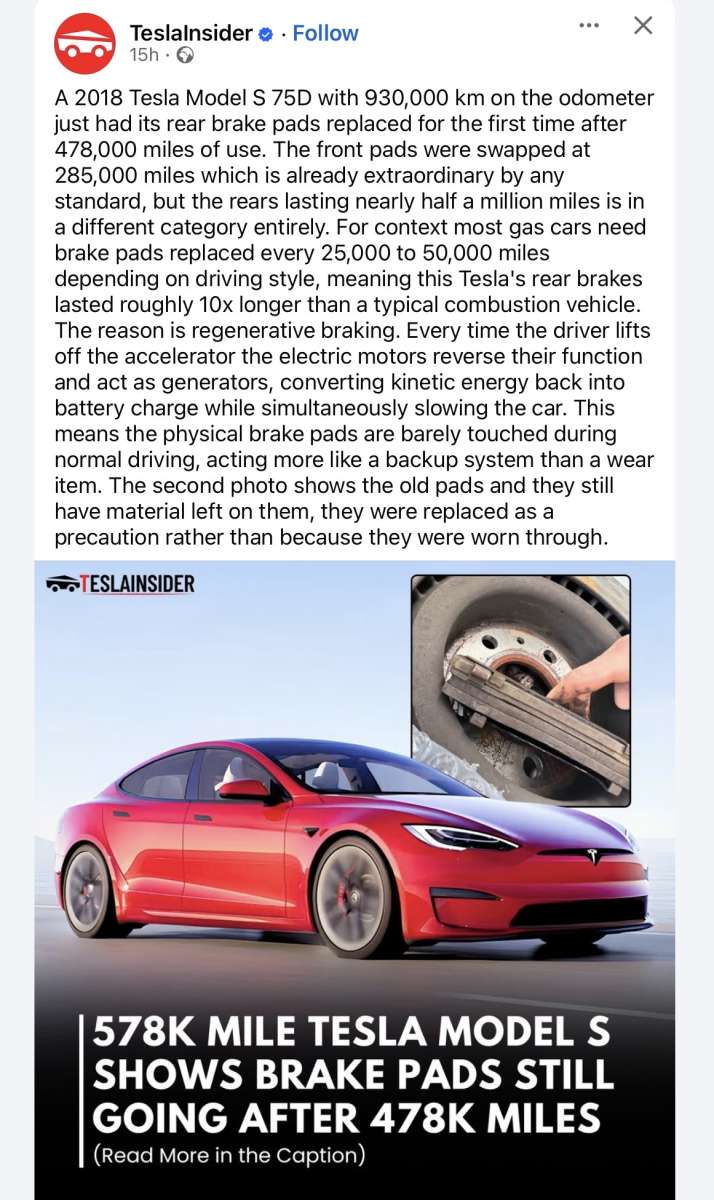
Brake Pads

Brake Pads

Home Forums The Tea Room Brake Pads

Viewing 20 posts - 1 through 20 (of 20 total)
  • Author
    Posts
  • #847449
    Vic
    Participant
      @vic

      That’s some mileage for a set of Brake Pads!

      IMG_0878

      #847453
      noel shelley
      Participant
        @noelshelley55608

        Braking and it’s technology has changed over the last 50 years. Pads are much harder and much of the wear is on the discs. Those figures are interesting but I still won’t buy a Tesla. There are numerous scams in the motor trade one is that you will be told the pads AND DISCs need replacing and some times that all 4 sets at that. Noel.

        #847459
        John MC
        Participant
          @johnmc39344

          The driver is probably using the regenerative braking to slow the car, perhaps only using the brakes for that last bit of braking to bring the car to a standstill.

          I can bring my electric car to a dead stop by not touching the brake pedal, not easy to judge in a queue of traffic!

          #847544
          not done it yet
          Participant
            @notdoneityet
            On John MC Said:

            I can bring my electric car to a dead stop by not touching the brake pedal, not easy to judge in a queue of traffic!

            Even using the brake pedal may well use regenerative braking until that last few mph.  Adaptive cruise control will generally achieve it without recourse to driver input – but stops the vehicle too close to the one in front for my liking.

            Emergency braking (regenerative + mechanical) will be applied by the car, if necessary.  Hopefully not needed too often!

            #847565
            Graham Stoppani
            Participant
              @grahamstoppani46499

              Things are evolving so quickly that the need for anything more than a single disc (or drum) to use as a parking break will become the norm. A UK company called Yasa make electric motors that fit behind the wheel. Their motors are so powerful that with regenerative breaking they have the stopping power of the disc breaks on a Formula 1 car.


              https://youtu.be/B2Hl4c1iZK0?si=UfMdE1cwLTsjsZeM

              #847566
              Nealeb
              Participant
                @nealeb

                I’m finding that after a couple of months with an EV I barely ever touch the brake pedal, although I have never been a “last few yards” heavy braker. Regenerative braking, at least on my car, seems very nicely judged for normal driving, especially in town. It shows in the way that energy consumption improves in start-stop conditions where the old diesel suffered badly.

                The place I find regenerative braking problematic is parking on my own drive. I have to reverse up a steep slope to stop a fairly precise distance from a garage door – have to allow the door to open but can’t be too far from it to avoid blocking the drive. But the slope flattens for the last few feet so the car moves more easily which confuses the system. Still experimenting with regeneration settings but it needs very precise throttle control and usually ends up with a quick dab on the brakes!

                #847663
                Fulmen
                Participant
                  @fulmen

                  The problem with regenerative breaking is that you need somewhere to put all that energy. I can see this on my Leaf, with a full charge there is almost no capacity for RB. So I don’t think you can simply skip the brakes, not without adding brake resistors or something similar.

                  And while RB is great it can also create new problems. Here where it’s wet, cold and salty, rust on the break system can be a major problem on older cars. Calipers and pads can seize up due to rust/dirt buildup if they aren’t used regularly, which causes the disk to rust. Running the brakes hot once a month can save you a lot of money.

                  #847680
                  Nealeb
                  Participant
                    @nealeb

                    Interesting point re no RB when battery fully charged. Current advice seems to be that you should not charge beyond 80% normally and just reserve higher charge levels for when you need that extra bit of range. Hence there is likely to be a bit of headroom in the battery for RB. The Leaf, I guess, has a relatively small battery so this might be a problem in the first few miles after a full recharge? Must admit that I haven’t noticed the problem myself even though I live at the top of a hill and all journeys start with a bit of regen braking! I’ll have to see if the battery level does climb slightly, although I suspect that heating/cooling sap enough energy for a few minutes after a start to mask this.

                    #847686
                    Fulmen
                    Participant
                      @fulmen

                      The Leaf has a power meter on the dash that shows engine power/braking. In fact I just noticed this a couple of days ago, with nearly full battery (idk, 90-95% or so) the max brake power range was shorter than usual. Which makes sense, as charge level increases the maximum charge current drops.

                      I can’t find any way to limit the charge level, and with a puny 40kwh battery I kinda need everything I’ve got.

                      #847725
                      not done it yet
                      Participant
                        @notdoneityet

                        A couple or three points.

                        First, most cars don’t need 1000HP motors. Whether that is a single motor or in-wheel system (100HP would be adequate for mine).  The problem of unsprung weight may be overcome in the very near future.

                        Secondly, I was probably silly and once charged my battery to 100% for a long journey home, while still at a high elevation.  I experienced absolutely zero regen for much of the initial 1 1/2 mile descent – I could have stopped charging at around 98%, and finished with 100% if the battery could absorb adequate charging power while driving slowly down that first descent (wouldn’t happen at normal driving speeds, of course).

                        Thirdly, the (generally) accepted 80% charge level is solely for minimising journey times, not for regen. Etiquette also comes into it in that one is not charging for far longer than necessary, if the station is busy.   My car charges at a steady, near 100kW right up to 80%, then the charge rate slows drastically for that final 20%.  It requires about 50-55 minutes to reach 100% from a very low SOC, but puts the first 75-80% in at close to 100kW, taking only around 35 minute to charge.  This being for the cheap and reliable Supercharger charging speed, which is limited for the 800V architecture of my vehicle.

                        The single advantage I did have was that I effectively started my journey home at the bottom of that hill – the car was down to minimum spare range by the time I reached my target recharge station in Gretna, as it was.  No range anxiety, just a very low remaining range, which was anticipated and fully under control.

                        #847733
                        Dave Halford
                        Participant
                          @davehalford22513

                          Good point, why does every EV need so much performance and why does the long range battery come with bigger motors?

                          I understood the 80% charge rate was primarily for battery life and obviously regen would be affected for the same reason. Some arrange to only advertise the 80% as the full range so owners never know.

                          #847742
                          Vic
                          Participant
                            @vic

                            It’s early days for me with an EV, and split with driving a petrol car. So far though I prefer using it in D mode without regen but I haven’t used the car much in heavy traffic.

                            #847743
                            Vic
                            Participant
                              @vic
                              On Dave Halford Said:

                              Good point, why does every EV need so much performance and why does the long range battery come with bigger motors?

                              I understood the 80% charge rate was primarily for battery life and obviously regen would be affected for the same reason. Some arrange to only advertise the 80% as the full range so owners never know.

                              If you mean quick acceleration, that’s just the way they are? I’ve no idea though why those with bigger batteries have higher performance motors.

                              I’ve read many times now that for several reasons it’s a good idea to charge them to 100% once in a while but with one caveat, don’t leave the car sitting at 100% for too long, especially in summer. In essence it’s ok to charge the car fully if you have a long journey the next day.

                              #847752
                              Robert Atkinson 2
                              Participant
                                @robertatkinson2

                                More internet nonsense. Obvously an EV will use friction brakes less than an an ICE.
                                That is also the case for PHEV’s and some hybrids. Mild hybrids don’t have adequate battery capacity for significant dynamic braking. One downside, as I mentioned in the PHEV thread is you can get rusty brake disks due to lack of use. I can approach most junctions that I know in my PHEV using just the dynamic braking. It has paddles on the steering column to allow you to adjust the amount of braking. It is very noticable that dynamic braking is significantly reduced with a fully charged battery.

                                Changing brake disks at the same time as pads is not rally a “sharp” practice if there is any uneven wear or corrosion pitting. Discs are relatively cheap labour is expensive. Changing the disks at the same time as pads add little time and the new pads will last longer. What is sharp practice is charging the “book” labour hours for both the pad change task AND the disc change task. The disc change only task includes most of the labour for changing the pads.

                                Robert.

                                #847762
                                Nealeb
                                Participant
                                  @nealeb

                                  I think it may be more that bigger motors need bigger batteries? A bit chicken-and-egg.

                                  I’ve been looking at Zapmap and other charging point apps, both in UK and France (French and Scottish trips starting from Devon in my near future). I note that the Supercharger network, at least at motorway services, gives you something like 5 mins after you have reached 80% and if the charging points are busy before starting a time-based charge. Obviously discouraging charger-sitters. Seems to be quite a few French charging points as well that will start time-based charging after some fixed period (but long enough to get a decent charge). Doesn’t sound like a silly idea.

                                  #847783
                                  not done it yet
                                  Participant
                                    @notdoneityet
                                    On Dave Halford Said:

                                    Good point, why does every EV need so much performance and <b>why does the long range battery come with bigger motors?</b>

                                    I understood the 80% charge rate was primarily for battery life and obviously regen would be affected for the same reason. Some arrange to only advertise the 80% as the full range so owners never know.

                                    They don’t, but the long range cars come with larger batteries!  They do not<u> </u>necessarily have bigger motors – they can be the same motor which, would obviously need a bigger battery capacity to go further than the standard range car.

                                    For instance, my car only came with two battery sizes (over 3 years ago) but choices ranged from small battery (with only 2WD, I think), or the larger battery with either 2WD or AWD.  The AWD mainly benefitted with increased traction – but with lower range than the 2WD options.

                                    #847785
                                    not done it yet
                                    Participant
                                      @notdoneityet
                                      On Nealeb Said:

                                      I think it may be more that bigger motors need bigger batteries? A bit chicken-and-egg.

                                      I’ve been looking at Zapmap and other charging point apps, both in UK and France (French and Scottish trips starting from Devon in my near future). <b>I note that the Supercharger network, at least at motorway services, gives you something like 5 mins after you have reached 80% and if the charging points are busy before starting a time-based charge.</b> Obviously discouraging charger-sitters. Seems to be quite a few French charging points as well that will start time-based charging after some fixed period (but long enough to get a decent charge). Doesn’t sound like a silly idea.

                                      I’m not 100% sure, but I think the truth is likely that the ‘congestion’ charge is only initiated after the charge session is complete (ie charging ceased), not automatically at 80%.

                                      If I was going to risk such a surcharge, I would set the charge level to 100% (if I am correct – but please enlighten me if I’m wrong).

                                      #847829
                                      Nealeb
                                      Participant
                                        @nealeb

                                        Tesla say 80% (see here) but I have no personal experience of it. Only applies when charging site is busy, it seems. Don’t know if it only applies to Teslas or if anyone can join in at those charging points, although I thought I had heard that Tesla had opened up their network. Not sure.  If not a Tesla, don’t know how they know the level of charge – is there data fed back via the charge cable?

                                        #847854
                                        not done it yet
                                        Participant
                                          @notdoneityet

                                          Thanks for that, Neal.  I’ve only charged at O2A Superchargers at off-peak rates the few times I have needed to charge (at a public charging station) in the last 2 1/2 years.  Yes, the car ‘talks’ to the charger before and while charging.

                                          #847884
                                          vic newey
                                          Participant
                                            @vicnewey60017

                                            My first Prius had 80,000 on the clock when l sold with original pads barely worn. My current one l had from new is now 10 years old and still has unworn pads. Having the engine off 50% + of driving time means the exhaust is still in excellent condition according to MOT as well.

                                          Viewing 20 posts - 1 through 20 (of 20 total)
                                          • Please log in to reply to this topic. Registering is free and easy using the links on the menu at the top of this page.

                                          Latest Replies

                                          Home Forums The Tea Room Topics

                                          Viewing 25 topics - 1 through 25 (of 25 total)
                                          Viewing 25 topics - 1 through 25 (of 25 total)

                                          View full reply list.