How does someone gauge the power of a DC or AC motor?

How does someone gauge the power of a DC or AC motor?

Home Forums Beginners questions How does someone gauge the power of a DC or AC motor?

Viewing 25 posts - 1 through 25 (of 38 total)
  • Author
    Posts
  • #9925
    Chris TickTock
    Participant
      @christicktock
      #436377
      Chris TickTock
      Participant
        @christicktock

        Hi, I openly admit to asking thisc question in almost total ignorance, but you have to start somewhere.

        I am investigation attatching a 50mm diamond disk to a 400 rpm motor. I have looked on ebay and found a motor of suitable rotation speed it is 12v but how does one gauge if the torque would be sufficient. This applies to both Ac and DC so any help gratefully received.

        Chris

        #436379
        Bill Davies 2
        Participant
          @billdavies2

          I suggest you look at similar commericial products, with similar dimensions and speeds. The free running speed is not the same that for as maximum power, which is 50% of that speed. 400 RPM suggests some kind of gearing, it is very low for AC and DC motors unless a powerful motor is used at much lower than its rated speed.

          Bill

          #436380
          Robert Atkinson 2
          Participant
            @robertatkinson2

            Hmm,

            You don't need to know the power of the motor, you need to know the torque required to turn the disk. This will depend on what you are cutting and how fast you want to cut it.

            More information please.

            Robert G8RPI.

            #436381
            not done it yet
            Participant
              @notdoneityet

              Someone doesn’t. The motor manufacturers supply the information. Those that design motors have the experience and testing facilities to provide the true result and supply that information on the rating plate. Mechanical power out is a function of Electrical power in and power wasted (mainly as heat but will include cooling fans if fitted). Known or expected efficiencies are the name of the game.

              Motors sold into commercial ventures are often sold on efficiency and longevity – lifetime costs.

              Many items are mis-represented by some manufacturers who naughtily quote figures which might even be gross input power – just like compressor suppliers who quote ‘swept volume of air’ but conveniently forget that not all that air is transferred to the outlet – the figures work OK when the outlet is at atmospheric pressure but most certainly not when close to the maximum working pressure!

              Start by looking at the maximum current at 12 volts. That will give you the power if the efficiency were 100% – which it will not be, obviously. Then there are different power factors to take into account (obviously none for DC motors). Cheap motors are likely to be very inefficient – as well as not long-lived.

              Watch out for motors where the electrical input is the same as the output power claimed.

              Torque is merely a function of speed and power.

              #436383
              Chris TickTock
              Participant
                @christicktock
                Posted by Bill Davies 2 on 07/11/2019 21:43:07:

                I suggest you look at similar commericial products, with similar dimensions and speeds. The free running speed is not the same that for as maximum power, which is 50% of that speed. 400 RPM suggests some kind of gearing, it is very low for AC and DC motors unless a powerful motor is used at much lower than its rated speed.

                Bill

                Thanks Bill, I think I will need a powerful motor geared with a reduction ratio to acheive enough power to give correct torque at the approx speed when under use. As the diamond disks I intend to use were made to run on small jewlers lathes I think I should look at the spec of my Sherline and other similar lathes to give a benchmark. The other alternative would be to use a more powerful motor with some degree of speed control.

                Chris

                #436385
                John Haine
                Participant
                  @johnhaine32865

                  You can overthink this. If you have a Sherline, bung the disc on a mandrel, fit it on the lathe, start cutting and see what happens. If the discs are designed for small jewelers' lathes (watchmaking lathes?) the Sherline should be well able to do it. Success in engineering is often just down to trying stuff out.

                  #436393
                  Bill Davies 2
                  Participant
                    @billdavies2

                    I think John has the right idea. But I've crunched some numbers, so I've overthought it already.

                    I note that 110mm diamond tile saws use 450-500W motors. The disc speeds are approaching 15,000RPM (probably busting speed, rather than cutting speed). Allowing significant losses, I assume the power at the disc is 300W. Converting to Imperial units, which I assume are more familair to most people here, we have 0.4HP available.

                    Unless I've cocked up (it's late) I get about 0.14 ft-lbf torque, or 1.28 lbf at the periphery of the grinding disc. A 50mm disc would have about twice that force at the periphery. I don't know Chris' application, but cutting ceramic tiles must absorb quite a lot of power. I'm not sure why Chris chooses 400 RPM.

                    I hope this offers some useful info,

                    Bill

                    Edited By Bill Davies 2 on 07/11/2019 23:16:31

                    #436398
                    duncan webster 1
                    Participant
                      @duncanwebster1

                      Speaking in complete ignorance (as usual) but 400 rpm sounds very slow for a 50 mm diamond grinding disc

                      I have a 100mm CBN disc and the manufacturer recommended 3000 rpm

                      #436400
                      Jeff Dayman
                      Participant
                        @jeffdayman43397

                        Not sure why OP wants to reinvent the wheel by using a slow DC motor for grinding. Motor may be pooched already if running at only 400 rpm. By the time you find a 12 VDC supply like a battery charger, connect it and test it with the motor, and ask on here re power and how to do it, you've gone to a bit of trouble for something that's probably not fast enough. I'd go AC bench grinder if I were you. Life's too short. Many cheap bench grinders w AC motors available at minimum cost (new or used ) that will drive the diamond wheel perfectly at about 3000 rpm as it should, with decent power for light or heavy-ish grinding. Due to cost of diamond wheel I suggest lighter cuts to make the wheel last. 400 rpm far too slow in my opinion.

                        #436402
                        Robert Atkinson 2
                        Participant
                          @robertatkinson2

                          OP has said they are cutting discs, not grinding. Still need to know what is being cut and speed expectations and why 400RPM. If it to reduce heat then faster cutter speed with slower feed might still be a better choice. The heat put into the work piece (opposed to at the cutter interface) is proportional to the rate of material removal, which includes depth of cut, cutter speed and feed rate. If work piece heating is the issue and it's a dry cut, look at it's mass and thermal capacity of the materiel and the maximum temperature you want. Basic physics (how long does it take to boil a litre of water?) will tell you the maximum time you can cut it for a given power input (torgue and speed) This will give an idea of the maximum motor power and feed rate. It will be conservative because of losses etc but will give an idea if the motor is too big for your limits. It the feed rate turns out to bee far too slow you need to rethink e.g. wet cutting.

                          Robert G8RPI.

                          #436403
                          JasonB
                          Moderator
                            @jasonb

                            His other thread on diamond grinding and lapping will give an idea of use

                            Chris can you post a link to these discs, I can't find any with google. Do sound a bit more like diamond coated discs for lapping stone and glass for lapidary rather than shapening.

                            Like others 400rpm sounds slow at that diameter if you are using these to shape your own tools they it will take forever. If they are just to tough up a previously shaped tool then may be OK and slow speed will not generate heat. At this speed the cutting speed won't be far off my Tormek but I would not use that for initial shaping, 67.6m/min on the Tormek vs. 60m/min on the little discs

                            By way of power the Tormek turns a 250mm wheel with 200W input power but drive system plays a big part in things.


                            Edited By JasonB on 08/11/2019 07:52:12

                            #436406
                            Juddy
                            Participant
                              @juddy

                              If you only want to spin a 50mm disc I would go for something like this: **LINK**

                              I have one of these and for the price its very good. Showing out of stock at the moment but Aim Tools seem to have a good turn around on stock and I expect its available from other places.

                              #436415
                              SillyOldDuffer
                              Moderator
                                @sillyoldduffer

                                As Bill said the best way is to copy someone else. Find the specification of a commercial machine, and buy a similar motor.

                                To design from first principles its necessary to clear up confusion about Work, Power and Torque. Be warned, the scientific and engineering definitions of 'Force', 'Energy', 'Work' and 'Power' are far more specific than the same words used loosely in day to day chat. It matters.

                                Work is the amount on energy needed to achieve a task. It's measured in Joules and time taken is not considered.

                                Power is the rate at which work is done. It is measured in Watts, where a Watt is 1 Joule per Second. If a 1000W motor takes 10 seconds to complete a job then 100W motor will take 100 seconds to deliver the same result. Both motors do 10000 joules of work. Time is considered!

                                Torque is the measure of turning force in Newton Metres and time is not relevant.

                                Although power and torque are intertwined they're not the same thing, and the motor type chosen impacts on both. For example, an electric stepper motor has excellent torque even when stopped between steps, whereas a single phase motor has poor torque at low speeds and improves as it speeds up. The relationship between torque, power and speed isn't linear, and each motor will have graphs showing the relationship over a range of speeds and loads. Very often these graphs aren't provided and have to be asked for. Although maximum Torque is not achieved at maximum power and neither are achieved at maximum speed, reasonable performance can be expected somewhere in the middle.

                                It takes a certain amount of work to cut metal. Table XIX of my 1947 Newnes Engineer's Reference Book gives examples, all in Cubic Inches per Horse Power per Minute:

                                • Mild Steel – 0.75
                                • High Tensile Steels – 0.87
                                • Cast Iron – 1
                                • Soft Brass – 2.3
                                • Hard Brass – 0.9
                                • Aluminium – 3.0
                                • Duralumin – 2.7
                                • Magnesium alloy – 3.5

                                One Horse Power is about 735W

                                So, given the rate at which it is wanted to remove a particular metal it's possible to calculate the minimum output power needed from the motor.

                                However, there are many booby traps. One is optimum cutting speeds vary by metal, as does the ability of cutters to cope with the heat generated. Carbon steel (like a file) loses hardness at low temperatures, say 120C; HSS is much better, staying hard up to a low red-heat, though this is not recommended for long life; carbide out-performs HSS by a factor or at least two, major advantage. As cutting at high temperature softens metals, considerably less work is needed to remove metal when carbide is used brutally, saving the big boys lots of money. But getting the best out of carbide needs fast powerful machines, not often found in a home workshop. Other limits apply, for example the brazing on a brazed carbide tool melts before the carbide tip. Diamond is an interesting one. Carbon has a very high melting point but the advantage disappears in air because Carbon burns. Likewise the relatively poor temperature characteristics of the diamond disk and bonding agent prevent diamond performing to maximum potential. Further, the need to achieve a particular speed and the torque required to maintain a particular feed-rate are as interesting to the designer as a motor's power output. Another booby trap is the machines ability to deliver power to the cutting point – the drive-train and air resistance consume power. Not only does motor efficiency varies by speed and motor type, but many motors are rated to work in bursts and need time to cool-down before the next effort. Putting a continuously rated motor on intermittent work wastes money, overloading an intermittently rated motor risks burning it out. And it would be unwise to fit a motor sized to meet a minimum calculated load only by working flat out – prudent to add a safety margin!

                                In practice, machine tool designed take all these factors into consideration and the usual result is a somewhat over-powered motor for the machine, and a bunch of limitations, often related to cost! An industrial machine will be expensively built to do a lot of work quickly, while a hobby lathe won't. The Sherline is a small hobby lathe with a tiny motor, emphatically not designed to remove metal at high-speed on a production line! May not matter – within limits, hobbyists manage well within a range of motor powers even on the same machine, for example early Myford lathes used 1/3HP single-phase motors and upgraded later to 1/2HP. Some owners have upgraded to as much as 1HP 3-phase. From this you can conclude that 1/3HP is a little too small, and 1HP is plenty. 1/2 or 3/4HP single-phase is 'sensible', 3HP would be too much.

                                If the diamond disk is for sharpening cutters, the amount of metal removed is low, and a small fast motor plus patience would be appropriate. Cutting removes a lot more metal and generally the operator wants it done quickly. This requires a much bigger motor: my bench grinder and angle grinder are both 750W at 3000rpm. For fine work, my Dremel is about 150W max, speed variable between 5000 and 30000rpm. I don't use the Dremel to cut paving slabs!

                                As this is complicated, and there's more to worry about, Bob's advice is rock-solid. Copy someone else!

                                Dave

                                #436417
                                Grindstone Cowboy
                                Participant
                                  @grindstonecowboy

                                  Clearly our Old Duffer isn't as silly as he claims yes Great explanation!

                                  Has the first part of this conversation disappeared for everyone else as well, or is it just me? First post appears to be from Bill now.

                                  Rob

                                  #436421
                                  Chris TickTock
                                  Participant
                                    @christicktock

                                    Thanks Guys, there is a lot of information set cutters.jpga special thankyou to the old Duffer for the huge contribution…need time to digest that.

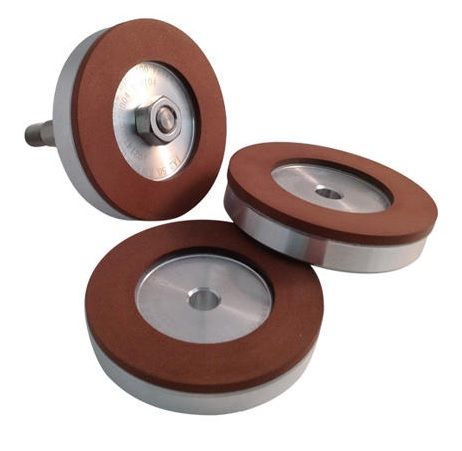
                                    firstly i will upload the disks note they are from eternal tools and are sold as diamond grinding disks to be run with light pressure and at low speeds. From research I take the speed to be around the 400 rpm. What i am minded to do is convert a n old bench grinder with a speed say at 3000 rpm and link it via pully to another pully of suitable ratio to get the speed near 400 rpm which will afford all the torque I need and I doubt other than a simple ratio calculation that will be all the mathematics I will hopefully need. Not to say that I am over looking any advice here I am not and will read it to see what is useful.

                                    The problem then shifts to the spindle and bearings on the additional reduction spindle. Any pointers as to where to get suitable bearings appreciated. obviously if i can get a variable speed powerful motor I can simplify the design. The reason as i understand it for running at the slow speed is heat can deteriorate the grinders surface. Another option for me is to be a crappy old lathe and adapt that with an angled table.

                                    Chris

                                    #436423
                                    JasonB
                                    Moderator
                                      @jasonb

                                      I'd just get a cheap or even slightly more expensive spindle and run that via a belt off your lathe motor so you have the vari speed.

                                      #436426
                                      Chris TickTock
                                      Participant
                                        @christicktock
                                        Posted by JasonB on 08/11/2019 11:39:19:

                                        I'd just get a cheap or even slightly more expensive spindle and run that via a belt off your lathe motor so you have the vari speed.

                                        Thanks Jason,

                                        Funny enough I contemplated using the cheap spindle. If it would hold up it might do but the ratio of pullies is dictating a lot, for instance if using a step doen ratio of 10:1 the spindle would be carryong a largish pulley..I dont think I want to use my lathe with the diamond grinder but instead make a separate device.

                                        I have never come across the head powered spindle. I take it pullies go on one end but what goes on the other? I am awaiting the arrival of the cutting disk and arbour before thinking again.

                                        Chris

                                        #436427
                                        Chris TickTock
                                        Participant
                                          @christicktock

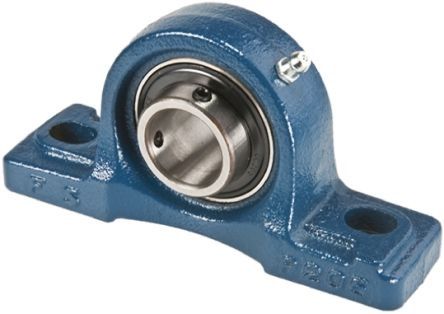
                                          Can anyone help with the feasability of adding a spindle using bearings as shoen. I need to make a spindle to take a suitably sized pulley. That hopefully I can do, but I have never used bearings so I need something to hold the spindle in place. For a starting point here is an RS stock nos 750-8930 that has an internal diameter just under 16mm. Using these as bearings what other components would be beeded apart from the spindle and pulley/

                                          Chrispillowblock bearings.jpg

                                          #436431
                                          JasonB
                                          Moderator
                                            @jasonb
                                            Posted by Chris TickTock on 08/11/2019 12:17:39:

                                            Posted by JasonB on 08/11/2019 11:39:19:

                                            I'd just get a cheap or even slightly more expensive spindle and run that via a belt off your lathe motor so you have the vari speed.

                                            I have never come across the head powered spindle. I take it pullies go on one end but what goes on the other? I am awaiting the arrival of the cutting disk and arbour before thinking again.

                                            Chris

                                            Pully goes on the end with the keyway and the other end has a tapered hole and external thread with closing nut to take ER16 collets which would grip a simple arbor for your wheels

                                            #436534
                                            Chris TickTock
                                            Participant
                                              @christicktock

                                              Hi Guys,

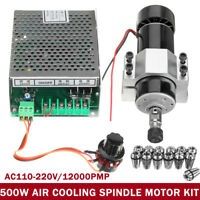
                                              Rather than spend too much time making something there is a piece of kit here: It is a 500w CNc motor with speed control and 13 E!! collets. My only hesitation is in not understanding what they mean by idle speed stated as 2000-12000. Baring in mind the DC input for this motor has a range of 12v to 100 are they talking about the no load speed? My concern is I need to run my diamond lap disks around the 400 rpm so 2000 would be too high.

                                              chrismotorkit.jpg

                                              #436538
                                              Ian P
                                              Participant
                                                @ianp

                                                For a motor, mount, power supply, speed control pot, 13 ER collets and an adapter to hold them in I am sure its very good value. (they seem to be less then £50), however….

                                                Whether its will do the job you want it to do is another matter. I would not expect any great accuracy from the collets and even less from the collet holder clamped to the motor shaft with grub screw. For the size of diamond wheels you showed earlier an ER11 collet adapter would not be an idea way of mounting them, the total overhang from the front motor bearings is far more than ideal.

                                                You now mention that you want to use the diamond wheels for lapping, that is quite different from using them for grinding, what is your intended use of these wheels and with what materials?

                                                Ian P

                                                #436539
                                                peak4
                                                Participant
                                                  @peak4

                                                  From the photos you posted of the diamond laps, 400rpm seems about right.
                                                  Sorry for using an ebay link, but how about something Like This ER16 spindle

                                                  A normal cheap 240v motor will run at 1425 rpm, so you need about 3.5/1 reduction.
                                                  Take the small pulley off the spindle, and re-use it as the motor pulley, procure a suitable belt and pulley 3.5 times the diameter of the one you already have, and fit it to the spindle.

                                                  Another ebay search for "NVR switch", will point you to one of the cheap black and yellow switches, so it all works safely. For the loads you're likely to be putting on the setup, I can't see the point of fancy overload/overheating protection for the motor.

                                                  Bill


                                                  Edited By peak4 on 09/11/2019 15:00:53

                                                  #436540
                                                  Ian P
                                                  Participant
                                                    @ianp

                                                    I left it too late to edit but I wanted to add that one should not take the sellers description too seriously.

                                                    The motor you showed purports to have a 'governor', which I assume refers to the speed potentiometer and I doubt there is much in the way of actual speed regulation.

                                                    The ER16 spindle Bill linked to is described as 'High precision', that too is in the eye of the beholder. No details of what bearings are used and whether it is capable of accepting axial loads.

                                                    Ian P

                                                    #436549
                                                    JasonB
                                                    Moderator
                                                      @jasonb
                                                      Posted by Chris TickTock on 09/11/2019 13:52:10:

                                                      My only hesitation is in not understanding what they mean by idle speed stated as 2000-12000. Baring in mind the DC input for this motor has a range of 12v to 100 are they talking about the no load speed?

                                                      Yes slowest no load speed will be 2000rpm and I doubt you will drop much more when running as you won't be putting much pressure on the wheels for lapping so too fast for what you want.

                                                    Viewing 25 posts - 1 through 25 (of 38 total)
                                                    • Please log in to reply to this topic. Registering is free and easy using the links on the menu at the top of this page.

                                                    Latest Replies

                                                    Home Forums Beginners questions Topics

                                                    Viewing 25 topics - 1 through 25 (of 25 total)
                                                    Viewing 25 topics - 1 through 25 (of 25 total)

                                                    View full reply list.