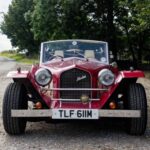
Warco 720

Warco 720

Home › Forums › Manual machine tools › Warco 720

Viewing 25 posts - 1 through 25 (of 29 total)
  • Author
    Posts
  • #770492
    Mick Bailey
    Participant
      @mickbailey28509

      I’m intrigued by this particular model and sometimes see them for sale and wonder if buying one would be regrettable. I went to look at one two years ago for £600 with a whole load of quality accessories, but decided I didn’t know enough about them to go ahead with the purchase, only what I’d read on lathes.co.uk.

      The overall quality seemed to be OK – nowhere near the Myford though, and a few poorly machined parts, but the question in my mind was where do you get spares from, and is there any compatibility with the original Super 7?

      The spindle runs in roller bearings and I also wonder if these are standard sizes. The lubrication arrangement looks to be different too – maybe grease nipples rather than oil for the spindle.

      I have a few Taiwanese machine tools from that era and the only source of parts is either make them or find a scrap donor machine. My rather heavily built bobbin sander needed a pair of ball races which were marked as standard sizes, but the bores had been ground out to an odd size. It cost more than I’d paid for the machine to get the replacements resized at the time.


      #770500
      peak4
      Participant
        @peak4

        I had the same slight dilemma, but bought one anyway; I would do so again under similar circumstances.
        I also have a pre power x feed genuine S7 changewheel model.
        Yes main spindle is on taper rollers and uses grease; as far as I can tell, the rest of the lubrication is as per genuine Myford S7.

        For those not aware, the 720 is a 70’s/80’s copy of a Super7B with power cross feed.

        Quality of parts isn’t up to Myford, and some of the shafts, such as where the belt adjustment fits, are mild steel so subject to wear; clearly they could be re-made.
        I had an issue with the clutch, where it would spontaneously engage, so I needed to modify the cross shaft a bit, but again, no major issue.
        The rack on mine was a bit short, so the saddle ran off the right hand end, but I replaced it with one from an ML7 so fine now.
        Metric threads can be cut using the 21/33/34 gear dodge, but you will need to budget for a genuine Myford stub/drive gear, as the Warco one is a single piece twin gear, so you can’t change just the drive gear for the 33 tooth one. Other than that, it works fine.
        It’s an imperial lathe with an 8tpi leadscrew, but the fittings are metric, so for 1/4″BSF think 6mm, 2BA 5mm etc.

        Mine has a Newton Tesla 750 motor package, which I’d certainly recommend.

        Some accessories certainly fit, I’m using Myford steadies and a taper turning attachment

        If you’re anywhere near Buxton Derbyshire, drop in for a brew  and play with one.

        Bill

        #770502
        Mick Bailey
        Participant
          @mickbailey28509

          Thanks Bill. I live close to Leek, so not far off and would like to see one of these lathes first-hand in case I come across another for sale at the right price.

          I wonder how many were sold? – They aren’t common and I’ve no idea what they cost new compared to an equivalent S7 at the time, or whether they were supplied with a range of accessories.

          #770509
          Bazyle
          Participant
            @bazyle

            I think that’s the one we have in the club workshop at Exeter Model Engineers. If you are near and want to see come along to a public running day (1st Sunday) or a a Tuesday evening training session when we start them again next year.

            #770513
            peak4
            Participant
              @peak4
              #770519
              Nicholas Farr
              Participant
                @nicholasfarr14254

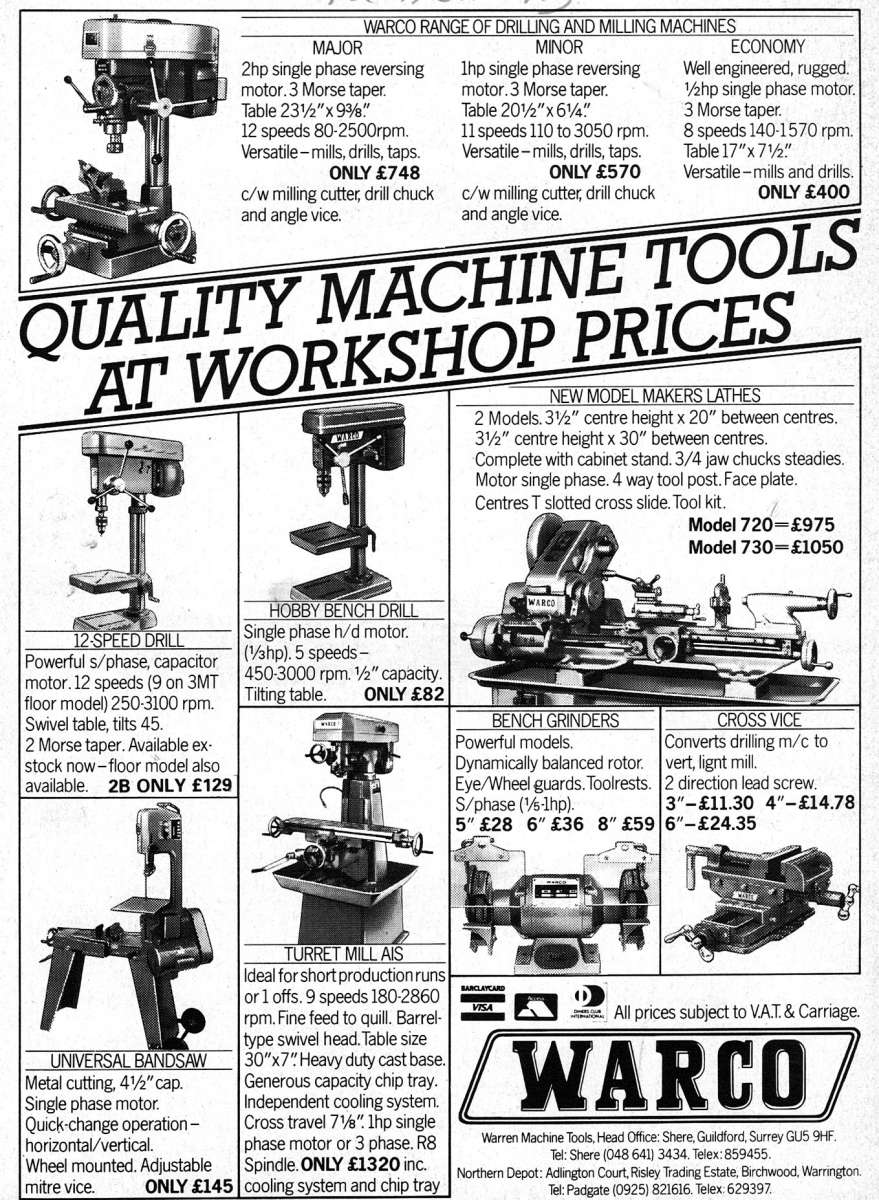
                Hi Mick Bailey, I don’t know what the Myford one cost, but below is a scan of a Warco advert on the back of ME in September 1981, but in the second November issue, they were £1150 & £1225.

                Scan_20241216

                Regards Nick.

                #770534
                Martin of Wick
                Participant
                  @martinofwick

                  Interesting (or depressing) that £975 -RPI’d = nearly £4k at todays prices. No idea what a genuine Myford would have cost in 1980, presumably a significant amount more or Warco wouldn’t have bothered importing a clone.

                  The size comparable WM250 is a veritable bargain at £2k (todays prices), the benefits of cnc I suppose.

                  #770547
                  mgnbuk
                  Participant
                    @mgnbuk

                    The size comparable WM250 is a veritable bargain at £2k (todays prices), the benefits of cnc I suppose.

                    More likely as a result of a change from Taiwan to PRC for manufacture + the new lathe is a lower spec than the 720.

                    A lot of the early ’80s machinery came from Taiwan  – guess they became too expensive at a time that the PRC started making hobby sized machinery cheaper.

                    One been hanging around on Ebay for a while now.

                    Nigel B.


                    #770558
                    Mick Bailey
                    Participant
                      @mickbailey28509

                      Having seen the scan of the ad I do now remember seeing it at the time. I’m thinking the new price (especially when they put it up in November) may have been fairly close to what a good used S7 would have been in the early 80s.

                      #770637
                      Mick Bailey
                      Participant
                        @mickbailey28509

                        I’d like to see the pdf of the manual Bill.

                        The one on Ebay right now is interesting, but appears to have been partly dismantled, so doing any accuracy checks would mean reassembling it and setting it up prior to purchase. It’s a strong price to my mind and possibly the reason for it being on sale for a while is either it doesn’t bear close inspection, or there’s little flexibility in the price.

                        The one I previously viewed was in as-new condition for £600 and had no sign of use. In hindsight I should have bought that one at the time.


                        #770638
                        Martin of Wick
                        Participant
                          @martinofwick

                          You can get a decent version of the genuine article for not much more. Ergo, priced unrealistically (like much on ebay), unless somebody actually wants the ersatz version to complete their lathe collection.

                          #770655
                          Mick Bailey
                          Participant
                            @mickbailey28509

                            The Warco only appeals if it’s cheap enough. I already have an ML7 and it would make a nice addition, being able to interchange accessories.


                            #770661
                            peak4
                            Participant
                              @peak4
                              #770679
                              SillyOldDuffer
                              Moderator
                                @sillyoldduffer
                                #770695
                                Mick Bailey
                                Participant
                                  @mickbailey28509

                                  Also, accessories that may be useful for one lathe sometimes may not be necessary for another. The limited spindle bore on a standard ML7 or S7 is quite small, so steadies become more important for some longer large diameter jobs. Myfords also don’t part off too well unless a rear toolpost is used, but my old Raglan would part slices off a 2″ square alloy block as fast as I could feed the tool in from the regular toolpost without any chatter.

                                  Taper turning on Myfords is limited due to top slide travel and the taper turning attachment is a real bonus.

                                  Myfords benefit from internally threaded chucks and to have an additional 6″ 4-jaw included is a real bonus.

                                  A limiting factor with some model engines is the flywheel diameter. A large diameter turning attachment for a Myford may be an advantage, where a larger (say 5″) lathe wouldnt have a problem.

                                  A collet chuck and collets, long cross slide, suitably sized tooling, quick-change toolpost, boring bars, lever tailstock, tailstock die holder, makers cabinet, reversing switch, variable speed drive, raising blocks, etc are also nice-haves with any Myford.

                                  The thing with accessories is they often don’t increase what someone is prepared to pay for the lathe. I call them throw-ins.


                                  #770697
                                  mgnbuk
                                  Participant
                                    @mgnbuk

                                    Although popular with hobbyists and in small commercial workshops, Myfords were considered too lightly built (ie cheap) for rough educational and industrial hard-work.

                                    Bolleux Dave !

                                    (Insert “Smiley” ! )

                                    You do seem to have rather a downer on Myfords & a tendancy to “big up” Boxfords. I wonder how much use you have had on examples of each to come to these conclusions ?

                                    When working on site at engineering concerns throughout the UK I regularly saw Myfords in toolrooms & cannot recall an occasion where I saw a Boxford, so (admittedly ancedotally) industrial users didn’t seem to share your opinion when it came to getting their corporate check books out..

                                    Nigel B.

                                    #770717
                                    Bazyle
                                    Participant
                                      @bazyle

                                      Partly it was marketing as Boxford targeted education and Industry respected they were big enough for training. A workshop equipped with nothing smaller than a Colchester Triumph would appreciate that they needed one small lathe for the 1/4 in dia jobs and while possible on the big lathe was a waste of resource. A Boxford wasn’t much of a  step down and if the cost of a Schaublin or other precision lathe wasn’t justified then Myford was a happy medium.
                                      So where I started work the 50+ staffed machine shop supporting the development labs had both a Boxford and Myford while all the regular work was on Hardinge HLVs.  As in-house work shrunk the Boxford had a holiday in the woodshop before I rescued it. After I left one of my colleagues got an HLV for peanuts and another dozen must be somewhere.

                                      #770756
                                      Lathejack
                                      Participant
                                        @lathejack

                                        I’ve always been intrigued by the Warco copies of the Myford lathe. I’ve never seen one in the flesh but many years ago I did see a Warco badged Myford ML10 type lathe on another dealers stand at Harrogate MES, so it appears they may have copied that too, although I’ve never seen another.

                                        20 years ago I was at Warco’s showroom in Chiddingfold buying a new lathe and I asked Roger Warren about their 720 and 730 Myford copies. Mr Warren told me that at first Myford said they were not concerned with them selling the copies of the Super 7 lathe, but later Myford took action because of some of the design details used in the power crossfeed mechanism of the Warco lathe, seems odd but that is what I remember of our conversation, it was a long time ago.

                                        Mr Warren went on to say that he arranged a meeting with Myford at their premises in Beeston Nottingham, but after travelling all the way there from Chiddingfold he arrived at the due time to find they had all just gone out. I seem to remember him saying the result was that Warco ended up paying some thousands of pounds in costs and had to destroy or dispose of all remaining stock of the 720 and 730 lathes. What a shame.

                                        #770793
                                        Diogenes
                                        Participant
                                          @diogenes

                                          My ML7 was purchased & worked from new in manufacturing, spending a couple of decades with the original business, and passing to another ‘business’ concern on their closure – another couple of decades there, and I bought it on the owners retirement.. ..only two owners from new😉..

                                          #770797
                                          Mick Bailey
                                          Participant
                                            @mickbailey28509

                                            I dont think the ML10 was necessarily bought by someone who couldn’t afford an ML7, or that  “All these machines attempted to satisfy customers with limited financial means”. My view is that the machines met specific requirements for capacity, quality and function. They were well designed overall and well supported. Did someone making models in a spare bedroom using an ML10 for small parts buy it because they couldn’t afford anything else, or was it just that they only needed a small lathe?

                                            Does someone drive a Skida Citigo only because they have limited financial needs, or is it they just need a small car? Its a mistake to think that a person has bought something only because they have limited funds.


                                            #770900
                                            SillyOldDuffer
                                            Moderator
                                              @sillyoldduffer
                                              #771601
                                              mgnbuk
                                              Participant
                                                @mgnbuk

                                                Bet he doesn’t: based on previous experience he’ll cherry-pick minor details, and ignore whatever unsettles his argument.

                                                Wrong assement Dave – Nigel eventually stops responding  to your verbose opinionated assaults when it is apparant that he is flogging a dead horse. Falls into the “life is too short” bracket.

                                                In this case, my comment was in reference to you specific comment “Myfords were considered too lightly built (ie cheap) for rough educational and industrial hard-work.” which is presented as a hard fact rather than a personal opinion. If this was such a widely held opinion of professional users at the time, cite your sources. Otherwise it is just your opinion.

                                                So far as chequebooks matter, the original Myford failed in 2011 whilst Boxford are still making machine tools.

                                                Well – sort of, but not the machine tools most on here would recognise.

                                                Current Boxford seems to have stopped making the class of machine tool under discussion around 2011/2012. This is when they left the original Boy Lane facility to relocate to a new, purpose built smaller place in Elland. If you care to use Google Streetview to take a walk down Boy Lane, Wheatley towards the viaduct you see the current new housing estate built on the site. But the older images available (as you walk under the viaduct) show the old works as I remember it from working there still being present in April 2009, but the October 2012 image shows an excavator amid the rubble of the demolished buildings.

                                                Boxford’s Youtube channel has a time lapse showing construction of the new Elland site around the end of 2011 + a walk-around the new faciltiy. No machiney shown of sufficient capacity to make the gear head lathes (AFAIK the older Southbend-derived models had gone well before that, but don’t have dates) – which ties up with a comment made taliking to Boxford staff on a stand at (IIRC) the first Doncaster exhibition. I introduced myself & discussed my time working there, which included assisting in the installation of the new bed grinder with induction hardening facility installed for prducing the new gear head lathes – I was told the grinder was not at the new site. Boxfords left the Elland site in 2020, relocating to a, errr.. “less prestigeous” site near Sowerby Bridge. There were suggestions that all the old spares were skipped at the time of the move, possibly confirmed by the latest Boxford website having lost the “legacy” spares tab that had searcheable parts lists for the older machines. The only reference to their past is in the “about” page & comprises one B&W picture of a liveried late ’60s / early ’70s Transit pick-up with an earlier lathe on the back. Their current focus appears to be small laser cutting and welding machines, though small (desk top) PC based machines are shown in the product line-up.

                                                Am I happy to claim to be  a Boxford “fan boy” – had they not made a place available for me to finish my apprenticeship my subsequent working life would probably have been more difficult. But I have owned a Super7 for over 25 years & it replaced a Boxford CUD. Guess that makes me a Myford “fan boy” as well.

                                                As long-winded a reply as one of yours, Dave ! I have no problem with opinions, but please don’t present your opions in a way than suggests they are established facts without citing the sources.

                                                Peace.

                                                Nigel B.

                                                #771653
                                                bernard towers
                                                Participant
                                                  @bernardtowers37738

                                                  Brave man Nigel Braver than me!!!

                                                  #771690
                                                  SillyOldDuffer
                                                  Moderator
                                                    @sillyoldduffer
                                                    #771771
                                                    Paul Kemp
                                                    Participant
                                                      @paulkemp46892

                                                      Dave,

                                                      “I’m amazed me saying “Myfords were considered too lightly built (ie cheap) for rough educational and industrial hard-work.” is controversial.   Isn’t it bleeding obvious that’s true?  Though my WM280 is rather more heavily built than a Myford, I explained it’s unsuitable too!   Same reason – both lathes are too light.  Perhaps Nigel will explain why firms and colleges bought big machines if a cheaper Myford would do?”

                                                      Were considered by whom?

                                                      I saw Myfords in garages, small electrical shops etc when I were a lad.  Others on here have previously reported their use in commercial settings.  Sounds like an assumption to me (and it seems Nigel) that they were too lightly built for commercial use based on a perception they did not populate large manufacturing facilities or jobbing shops.  Agree it’s obvious they were not suited to manufacturing and jobbing but that wasn’t based on how heavy they were or how much they didnt cost but because they were physically too small!  Smallest machine you were likely to find in that setting in my experience were Colchester’s or Holbrook’s etc etc and the primary reason for that was the Myford was too small in swing and up the spout.  That didn’t mean though they were a bad deal or inadequate for the occasional needs of garages, small electrical motor work etc and in fact were capable of a job of work, in the 50’s they were a good price compared to say a Boxford.  Your WM280 would probably have done a turn commercially in the role I describe above too, were it not for the fact that garages and the like do not repair components any more, just replace!  Myfords now are in my opinion over priced both new and used compared to the cheaper imports but British manufacturers struggle to compete generally.  Although Myford are a British brand I believe a fair bit of manufacturing is outsourced overseas (happy to be corrected on that) and they still can’t compete.

                                                      The true answer to your exam question is no Myfords are not suitable for rough educational and industrial hard work but then neither are the smaller Boxfords, Warco, Axminster, yada yada yada.  They were suitable though for small commercial use and were indeed used.  None of them are likely to be used in that role now, so what is the real question?

                                                      I have three lathes in my armoury, Hobbymat, ML7 and Harrison L6, they all give acceptable results in a capable manner, my weapon of choice depends on what I am making!  Small stuff such as steam fittings, pins etc get done on the Hobbymat, medium stuff on the Myford and the Harrison with gap bed and large faceplate can do the bigger stuff – but even that is too small for some bits like the flywheel and large gears for my half size traction engine.  Luckily I also have access to a Holbrook, Edgewick and large Dean Smith and Grace.  None of them are perfect, the Holbrook is limited in swing with no gap bed and the tailstock weighs a ton but it has a taper turning attachment!  The smaller Harrison can swing more in the gap than you can get over the bed on the Holbrook.  The Myford does what it says on the tin.  I really don’t get this my lathe is better than yours or that lathe is no good for that, posturing!  The best lathe for you is the one that swings the biggest thing you want to turn / is the one you have in your shed that you use and the one you can afford!  That said from my experience of using a Boxford model A back in the 70’s I would rather have an ML7 but that’s a personal choice on machines in a similar size range and I did a fair bit of turning on both.

                                                      Paul.

                                                    Viewing 25 posts - 1 through 25 (of 29 total)
                                                    • Please log in to reply to this topic. Registering is free and easy using the links on the menu at the top of this page.

                                                    Latest Replies

                                                    Home › Forums › Manual machine tools › Topics

                                                    Viewing 25 topics - 1 through 25 (of 25 total)
                                                    Viewing 25 topics - 1 through 25 (of 25 total)

                                                    View full reply list.