Centre help!!!

Centre help!!!

Viewing 25 posts - 1 through 25 (of 25 total)
  • Author
    Posts
  • #270110
    Christine Walker
    Participant
      @christinewalker32747

      Hello lovely forum friends, I need your help again, please!

      Arrrgh! OK, I am trying to cut a groove into the outside perimeter of a circular piece (end on so to speak). My other thread explained it with a diagram.

      So the problem I am having, is that the workpiece isn't centring properly. In a nutshell, I have a 190mm diameter workpiece, mounted on a 180mm diameter piece of ply which is bolted to my faceplate. Somewhere along the line, something isn't centred properly, because the tool touches the perimeter in some places and is up to 2mm away in other places around the circumference.

      As far as I can tell, I thought I had drilled everything in the centre. I drew the correct size circles in Illustrator and put a centre hole in. These were printed and transferred to the work piece, and used as templates. Everything fitted perfectly. Then, when mounted on the lathe spindle, it is, as explained above, spinning off centre.

      And I don't know what to do to get it right. It is driving me mad! Any of you chaps any ideas of how to get the workpiece spinning in a perfect motion?

      Thank you in advance.

      Christine

      #32850
      Christine Walker
      Participant
        @christinewalker32747

        Workpiece spinning off centre!

        #270112
        JasonB
        Moderator
          @jasonb

          Loosen the bolts that are holding the ply a little and then tap the ply/work to adjust its position until it runs true then tighten up.

          Ideally an oversize bit of ply should be mounted on teh faceplate and then turned down until your plastic tube fits snugly. (assuming it has an even wall thickness.

          J

          #270116
          Michael Gilligan
          Participant
            @michaelgilligan61133

            Leave the fixings [to the faceplate] very slightly loose, and then … with the job spinning, nudge it gently into place with a pusher mounted in the tool-post. … It should self-centre !!

            Re-tighten the fixings, and check that nothing has moved.

            Repeat if necessary.

            MichaelG.

            .

            Jason was quicker

            Edited By Michael Gilligan on 05/12/2016 21:05:34

            #270117
            Christine Walker
            Participant
              @christinewalker32747

              Thanks Jason – -its a disk rather than a tube. I did try your method but unfortunately I used locking nuts which won't turn without the bolt head being held, which I can't access because the workpiece is covering them! I'll try changing the nuts.

              Thanks

              #270118
              Christine Walker
              Participant
                @christinewalker32747

                Thanks Michael – that sounds interesting – I'll give it a go.

                Thanks

                Edited By Christine Walker on 05/12/2016 21:11:05

                #270127
                Jeff Dayman
                Participant
                  @jeffdayman43397

                  Hi Christine –

                  Another approach – Cut a piece of wood say 2 x 4 x 4 " and glue / screw that to your plywood/work disk assembly, centre of block close to centre of plywood/work disk. Then chuck the 4 x 4 block in your four jaw chuck, and then adjust the chuck to get your work disk running on centre. I've used this plywood-with-back-block method in the 4 jaw many times with success. Main point is – don't limit yourself to just the faceplate for plywood-mounted work. Good luck. JD

                  #270133
                  Christine Walker
                  Participant
                    @christinewalker32747

                    Hi Jeff

                    That too is a great idea. Thanks for the advice. I've got some good ideas to try now. Thank you.

                    #270138
                    Ian P
                    Participant
                      @ianp

                      Christine

                      If I understand correctly, you are trying to cut a groove for an 'O' ring in the OD of an existing component?

                      Ideally you should machine the part OD and the groove at the same time (well, one after the other really). That ensure the groove has a constant depth to ensure the sealing ring is equally compressed.

                      If, because the OD already exists and is at the finished diameter then you will have to use the methods suggested in the previous replies to adjust the workpiece position. The best (but not the only) way to do this is to use a dial test indicator. If you don't have one let us know and we can suggest alternatives.

                      I would not recommend using Michael's 'Pusher' method, its a recipe for disaster!

                      Ian P

                      #270141
                      Michael Gilligan
                      Participant
                        @michaelgilligan61133
                        Posted by Ian Phillips on 05/12/2016 22:33:06:

                        I would not recommend using Michael's 'Pusher' method, its a recipe for disaster!

                        .

                        Thanks, Ian … generations of optical workers must be wrong. devil

                        MichaelG.

                        .

                        Yes; I know that Christine's workpiece is larger than the typical lens assembly.

                        #270173
                        Ian P
                        Participant
                          @ianp

                          Michael

                          My advice was specific to this particular workpiece. I dont know what optical operatives do but you cannot seriously suggest that this disk (near the limit of her lathes diameter) would succumb to being aligned by being rotated against a fixed stop, even if it was a roller. We dont even know that this workpiece is exactly circular, if its slightly oval or irregular the pusher method would struggle anyway.

                          As regards lens centering, the only reason I can think of why it would be set up using its existing OD as a reference would be to reduce its diameter, is that the main objective here? (minor pun).

                          I would have thought the primary goal was to centre on the lens optical axis anyway.

                          Ian P

                          why would it need to be accurately centred by its already

                          #270179
                          Christine Walker
                          Participant
                            @christinewalker32747

                            Morning everyone

                            Thanks all for the replies. I am going to try Jeff's suggestion of the 4-jaw chuck. However, I don't have one, so need to buy one! So today's problem… I can't find the specification for my lathe's spindle! I have googled and even tried the supplier, but got no where.

                            I know it's a long shot, but it's a Chinese (I believe Real Bull?) CJ0623b… does anyone out there happen to know what thread pitch I need, please? All I can seem to find out is the spindle bore is 20mm!

                            Also, would you recommend a 4 inch or 5 inch chuck?

                            Again, thank you all for your help. (Ian P – I hope the workpiece is round!)

                            Christine

                            #270180
                            Christine Walker
                            Participant
                              @christinewalker32747

                              Chaps – I have managed to find out the spindle nose is 39 x 4mm… whatever that means. 20mm hole through spindle.

                              Forgive the stupid question, but would a chuck with a 1"1/4 x 12 TPI fit?

                              Christine

                              #270182
                              Michael Gilligan
                              Participant
                                @michaelgilligan61133
                                Posted by Ian Phillips on 06/12/2016 08:42:15:

                                As regards lens centering, the only reason I can think of why it would be set up using its existing OD as a reference would be to reduce its diameter, is that the main objective here? (minor pun).

                                I would have thought the primary goal was to centre on the lens optical axis anyway.

                                Ian P

                                why would it need to be accurately centred by its already

                                .

                                Pre-dating the current [rather exotic] lens centering machines …

                                Freshly ground lenses are not typically centered accurately on their optical axis: They are therefore made slightly oversize and the edges are ground after the lenses have been centered [on a wax chuck in the lathe] … A similar process is used when watchmakers mount jewels in chatons.

                                Also when aligning individual elements for cementing with Canada Balsam.

                                In all these cases the best approximation to perfect optical alignment is achiieved by using a 'pusher' against the important surface, allowing it to self-centre on the warm 'wax'.

                                .

                                What I suggested to Chistine is a logical development of a well-proven technique … It may, or may not prove to be the optimal solution, but I don't think it a 'recipe for disaster'

                                MichaelG.

                                #270194
                                SillyOldDuffer
                                Moderator
                                  @sillyoldduffer
                                  Posted by Christine Walker on 06/12/2016 09:09:25:

                                  Chaps – I have managed to find out the spindle nose is 39 x 4mm… whatever that means. 20mm hole through spindle.

                                  Forgive the stupid question, but would a chuck with a 1"1/4 x 12 TPI fit?

                                  Christine

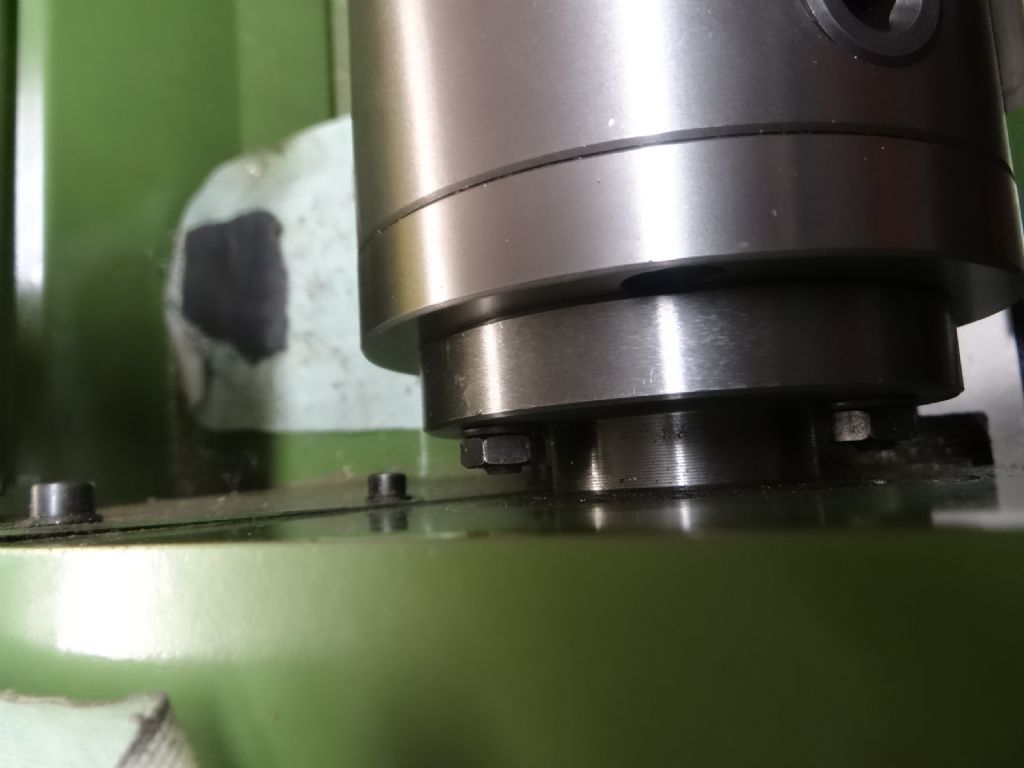
                                  Probably not. A photo would help if you have the wherewithal. I'm not familiar with your particular lathe but it looks to be one of the Mini-lathe family. These usually have bolt on chucks rather than a screw-fit type. In the picture below two of the three nuts securing a bolt on chuck can be seen sandwiched between the back of the chuck and the headstock.

                                  dsc04084.jpg

                                  Put a book or lump of wood under the chuck to protect the ways if the chuck drops off when you undo the nuts. It's likely to be a tight fit and you may have to gently lever the chuck off.

                                  Next step is to find a 4-jaw chuck that fits the flange on your particular lathe. The flange will have a register and 3 or 4 holes in it. Your looking for a match to the register diameter and the holes. Sometimes a backplate converter is needed. The good news is that ArcEuroTrade and others all carry good ranges of bolt-on chucks. With luck a CJ0623B owner will be along to advise: if not, I'd ring Amadeal and ask if they have a 4jaw chuck to fit the CJ0623b – they used to sell it.

                                  The easiest way to centre work in a 4 jaw chuck is with a Dial Indicator and Stand. I blanched at the cost but it's worth it.

                                  Dave

                                  #270215
                                  KWIL
                                  Participant
                                    @kwil

                                    Operators manual with data

                                    **LINK**

                                    #270225
                                    Mike E.
                                    Participant
                                      @mikee-85511

                                      When a faceplate is attached to a lathe, a one time facing cut is taken to make sure it runs true. Are you sure that he plywood attached to your faceplate also runs true ?

                                      Reading these posts I'm wondering if the "plywood" is the problem ? Unlike metal, if an item is attached to plywood it may compress unevenly causing a small unperceived wobble causing you indicating issues, something to consider.

                                      #270236
                                      Les Jones 1
                                      Participant
                                        @lesjones1

                                        Hi Christine,
                                        Is it not possible to start with a piece of ply larger than 180mm bolted to the faceplate and machine the 180mm with it in position on the faceplate. That way it will be true.

                                        Les.

                                        #270240
                                        Ajohnw
                                        Participant
                                          @ajohnw51620

                                          The details I can find suggest that the lathe may have a 1 1/2" by 8 tpi spindle nose or 39x4mm. It looks like Chester Machine tools did sell them so there is a slight chance that they can help with a 4 jaw. No way does 1 1/2" – 39mm so you may be able to tell which by measuring it. It wouldn't be a bad idea to check the thread pitch with screw gauges as well

                                          The swing over the cross slide seems to be 5 5/16" or 135mm so a 5" or 125mm 4 jaw should be ok but a 100mm or 4" one could be used with the jaws sticking out a bit. I'd tend to go for the larger size for a 4 jaw.

                                          Really for this sort of thing you would have been better off setting up pretty central and then machining both the outside diameter and the groove.

                                          There is one other way of doing this sort of thing if there can be a hole in the middle of the disk. For this size chuck some 1" bar, turn a 1/2 dia spigot leaving a square shoulder. Run a dia part way down the spigot. You then need some large washers to clamp the work between. They could be square pieces of plate of some sort. Maybe even ply but aluminium or steel would be better. Double sided sticky tape could help of ply was used but it can be a pain to part afterwards.

                                          John

                                          #270246
                                          Christine Walker
                                          Participant
                                            @christinewalker32747

                                            Hi Les – The problem is, I have the ply mounted to the faceplate with four bolts. Then, in the centre (or what I hoped was the centre!) is a M10 hole. Through this hole, an M10 bolt passes, which also passes through the workpiece in the centre (or again, what I hoped was the centre). There is no other way to hold the workplace than like this. It is too big for chuck jaws and dogs on the face plate. (It's about 10mm dia bigger than the faceplate). Therefore, somewhere in that centring hole I have done something slightly wrong, but checking and double checking, I can't see where.

                                            Hi Ajohnw – I have mounted it though the centre (as explained above). However, I didn't have the O ring at that point (awaiting delivery) so had to remove the work piece to do something else. I remounted it, but then found there is this difference when I am machining end on. I don't know why. I can't fathom it. Something, somewhere isn't centred.

                                            MikeE – It could be the ply. Because I have checked the workpiece all over and it is perfect according to my digital callipers. But then again, the ply appears to be too!

                                            Thanks all

                                            C

                                            #270275
                                            Les Jones 1
                                            Participant
                                              @lesjones1

                                              Hi Christine,
                                              Would it not also possible to drill the 10mm hole in the plywood after it is mounted on the faceplate ? I initially imaginned the workpice to be a ring 190mm OD and 180 mm ID. From what you say now its is a 190mm disk with a 180mm depression in one face and a 10 mm hole in the middle.I am assuming the workpiece is mounted on the plywood AFTER the plywood has been bolted to the faceplate. Some pictures would be helpfull.

                                              Les.

                                              #270276
                                              Ian P
                                              Participant
                                                @ianp

                                                Christine

                                                If your workpiece is a flat disk of some sort of plastic then I am not sure the plywood is any benefit in this case. I would be tempted to sit the job directly on the faceplate (with sheet of paper) and put a length of threaded rod through the lathe spindle to act as the central clamping bolt. Whatever the material its proportions you will need to use a large 'washer' so that the clamping pressure is applied nearer to the OD than to the centre of the part .

                                                If the job is plastic, even if its 1" thick a central M10 bolt with a small washer will only really clamp the central part of the disk especially if it pulling up against a compressible material like plywood. Even if your workpiece was thick hardened steel the plywood would compress so the resulting gripping area would be concentrated near the bolt rather than where its needed (closer to the periphery.

                                                The key to clamping with a central bolt is to use a large washer but they are not the sort of thing one has lying around. What you might be able to use is a large changewheel or maybe a pulley. It does not have to round, but it does need to be a reasonable size and its face (that is clamping the job) needs to be relieved.

                                                Ian P

                                                #270277
                                                Russell Eberhardt
                                                Participant
                                                  @russelleberhardt48058

                                                  O.K. forgetting the four jaw chuck for now perhaps you could try this:

                                                  Get a new piece of plywood or better MDF, cut a 180 mm circle and drill it to bolt to the faceplate. Don't drill the centre hole yet. Bolt it to the faceplate and drill the centre hole from the tialstock using the highest speed and a really sharp drill. The hole will now be truly centred on the lathe spindle.  Clean off all the sawdust!

                                                  Remove the faceplate and bolt your workpiece in place firmly but not too tight. Put it back on the lathe and rotate by hand to check that it runs true. If it doesn't a few well judged taps with a soft headed hammer should true it up ( a 10 mm bolt will be slightly loose in a 10 mm hole). Remove from the lathe and fully tighten the central bolt again, replace and recheck. Hopefully it will still run true.

                                                  Russell.

                                                  Edited By Russell Eberhardt on 06/12/2016 15:27:35

                                                  #270281
                                                  Ajohnw
                                                  Participant
                                                    @ajohnw51620

                                                    If the hole you have in the part is fairly central you could pull it directly back onto your face plate with a length of all thread and then tap it to spin true and then finally tighten the all thread.

                                                    I made several things on a Taig this way that were too big for it really. It's best to make a shouldered part that fit's nicely in the rear of the spindle with a hole in it to keep the all thread fairly true to the axis of the spindle.

                                                    At the work end you will need another nut, a penny washer and a decent sized piece of ply or whatever to press onto the work. I'd suggest a 100mm square piece for a part this big but a piece of aluminium say 1/2" thick would be a better option.

                                                    I used M6 all thread and found it offered plenty of holding power. Sometimes the work could have an M6 hole in it but I don't think that would be a good idea when holding PVC.

                                                    You shouldn't willy nilly face off a surface plate. They should be produced pretty flat and your lathe will face a dish into it. Usually a concave one as lathes are generally made that way. It's done so that separate faced parts can rest on each other without rocking.

                                                    I should mention that when holding work this way both ends of the all thread need to be fairly true to the axis of the spindle. If it's at too much of an an angle it might work loose while turning. I just took a bit of care with that aspect and never had a problem so never made anything to centralise the all thread at the other end of the spindle.

                                                    John

                                                    Edited By Ajohnw on 06/12/2016 15:48:33

                                                    #270327
                                                    Christine Walker
                                                    Participant
                                                      @christinewalker32747

                                                      Guys – thank you so much for all this info. I never even thought of using the tailstock to drill or centre it. That is a great idea.

                                                      I think too you are right about the ply compressing- I will try removing it.

                                                      You guys are the best. Thank you all.

                                                      Christine

                                                    Viewing 25 posts - 1 through 25 (of 25 total)
                                                    • Please log in to reply to this topic. Registering is free and easy using the links on the menu at the top of this page.

                                                    Latest Replies

                                                    Viewing 25 topics - 1 through 25 (of 25 total)
                                                    Viewing 25 topics - 1 through 25 (of 25 total)

                                                    View full reply list.