Workshop flooring and lighting

Workshop flooring and lighting

Home Forums General Questions Workshop flooring and lighting

Viewing 13 posts - 1 through 13 (of 13 total)
  • Author
    Posts
  • #24098
    Matt Stevens 1
    Participant
      @mattstevens1
      #203592
      Matt Stevens 1
      Participant
        @mattstevens1

        So – now I am starting to get my machines together, I wanted to finish off my workshop once only and do it right! I have the opportunity to change the floors/walls or whatever to suit.

        The workshop is in a basement with a concrete floor and wooden walls with drywall covering.

        What should I do with the floor? I could leave it as is….paint it with 'garage floor paint' or there is some flooring that they use in car showrooms which is expensive. Other options? I am just thinking that with metal chips around, painting might be the better option?

        Lighting….what style lighting is best over a lathe/mill etc? I am thinking to suspend fluorescent lighting but is this a good idea with the 60Hz flicker possibility? Is it the right kind of light?

        Advice before spending my money would be appreciated.

        Thanks

        #203594
        Bazyle
        Participant
          @bazyle

          Best advice is to read the last 9 months of postings on this forum – this and similar topics have been covered several times.

          #203596
          Frances IoM
          Participant
            @francesiom58905

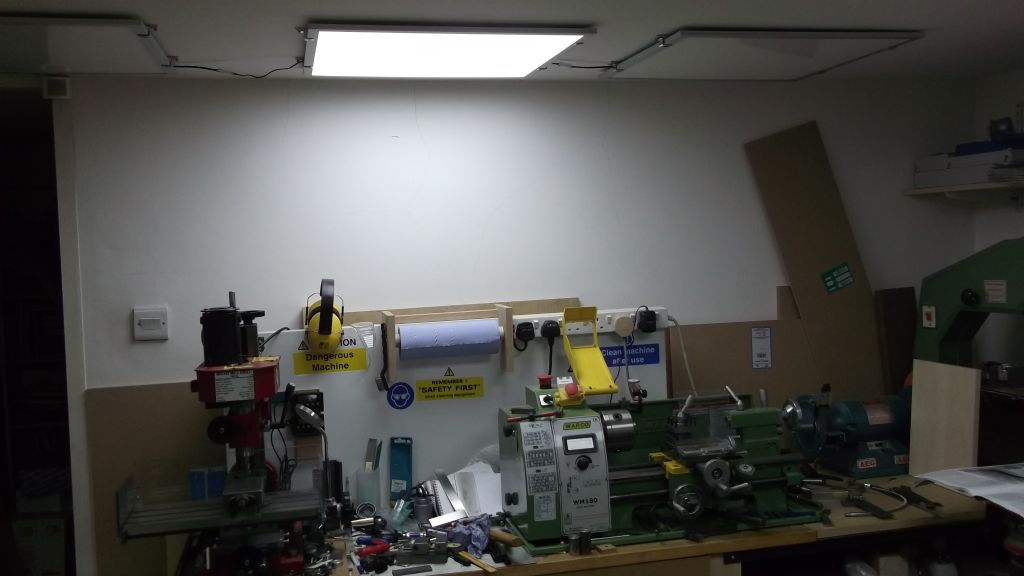
            workbench.jpg

            I too have a cellar workshop (set up years ago mainly for woodwork) = T+G wooden floor suspended on small battens – around the metal bashing half of workshop I've now fitted a rubber mat (the thick one mainly holes as sold by Axminster + others) – works well but also built a small plastic guard around the mill to prevent swarf thrown off over the wooden floor – replaced lights recently with 4 600mm sq LED panels (now around ?65 + VAT from distributors such as Wilts) cool white JCC tiles mounted flat (2mm spacers) to ceiling – no problem with heat so far after a year as only 30W spread over 4 sq ft – later installed 2 extra switchable panels one over the other side of a mill and a lathe as central light over middle of bench was excellent but with older eyes brighter lights help for detailed work.
            Extended the original 32A ring main with flexible trunking and added another 16A switched spur off the box (all ccts use RCBOs) – left room in fuse box for another 16 or 32A cct if needed

            The one remaining nuisance is that the drill press originally bought some years ago is in woodworking half and metal swarf doesn't mix well with woodwork (neither does wood working dust agree with metal work – I need to improve dust extraction from a saw bench not designed to allow easy extraction) but not really enough room for a second drill press tho.

            Edited By Frances IoM on 08/09/2015 18:51:48

            #203603
            Muzzer
            Participant
              @muzzer

              Similar looking 600 x 600 and 38W LED are now under £40 (inc VAT) from Toolstation. Looks like a good deal.

              My main suggestion would be to go for well diffused lighting so you don't get any significant shadows – like these panels Frances mentions for instance. And it's difficult to have too much lighting. I find those single LED lamps (eg the ubiquitous example from IKEA) almost make it more difficult to see what you are doing.

              Murray

              #203608
              Ajohnw
              Participant
                @ajohnw51620

                I think you will find that modern electronic ballasts for fluorescent light work at a much higher frequency than 60Hz. There can be a problem with the old ones in the Europe with 50Hz as they can make 3000rpm look stationary but in practice having seen this it's more a case of the rotation rate looking a little odd even if the rpm is carefully tuned.

                I use a modern lower diameter 5ft 60w tube light with an electronic ballast plus local machine lighting. That gives a decent level of room light but my ceiling is pretty high. As you can see from the photo that has been posted ceiling lighting doesn't produce very even lighting. The local lights I use are sold by Ikea. They are on flexible stems that can either be fitted with a shelf clamp or a base for wall fixing.

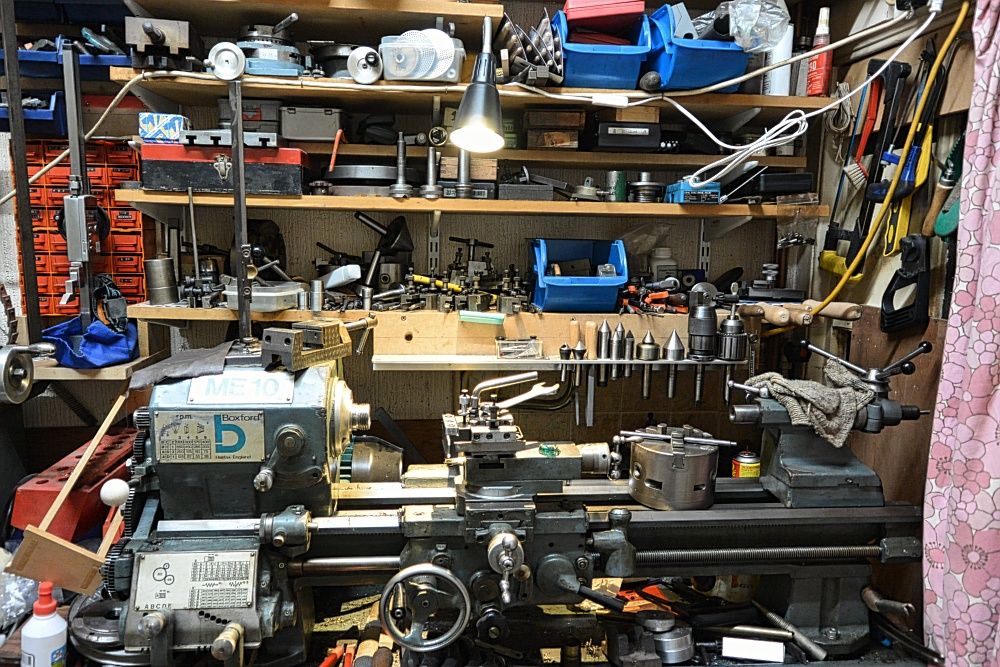
                I also have shelves directly behind the lathe -excuse mess, I am having a very slow tidy up, the milling gear will be some where else soon and more holes needed in the angle for mostly tail stock bits an pieces. This shows the light I mentioned – cabling to be tidied up when I am sure about where it will be fitted.

                ikealight.jpg

                The light takes some very semi spot led lights which they also sell. The light will probably finish up on the next shelf up. Ikea don't sell cool white led lighting at all which I personally think is a good thing. The blue output on those has to be very high and the wattage ratings are misleading as out eyes are not very sensitive to the blue they emit. The fluorescent is a broad spectrum daylight type as I am also interested in photography and the PC I use for that is in the same room.

                The room has concrete floors covered with decent quality cushion flooring – a sort of soft lino. Swarf sweeps up easily. Carpets are bad news if there is swarf around. Cold feet are best fixed with some home made duckboard. Wood laths will do for that.

                If it's a plain raw concrete floor I would at least coat it with a sealant suitable for foot traffic. There is wide variety available.

                The shelves were cut into 8' strips from 8'x4' sheets of 16mm mdf at the DIY store that supplied it and mounted on shelf brackets that plug into strips that are fixed to the wall with raw plugs and wood screws. B&Q in the UK but the shelving brackets etc are much cheaper at Screwfix – same company same things. These are the brackets

                **LINK**

                Plus the wall trips to match. With circa 2ft spacing they will take a very high load. I also have some racking but I feel something more flexible is needed by the machines.

                John

                #203613
                Frances IoM
                Participant
                  @francesiom58905

                  my photo is very deceptive in that camera is looking direct at panel and has made rest of area look dim – the actual light in lumens/sq foot over workbench considerably exceeds the standards required- light actually is very diffuse over the bench – the added two lights were there mostly to compensate for the shadows caused by the equipment itself – I have a small LED on flexible stem to put light right at mill cutter tip if needed

                  Agree however than modern HF ballasts are a vast improvement on older fluorescent fittings but tubes need changing and also I didn’t fancy breaking the tube due to hits by various bits of metal – the ceiling height is probably below minimum height for industrial/office premises but the cellar was tanked 30 years ago when I certainly couldn’t have borne cost of digging out another foot depth (which would also have needed underpinning of walls
                  One problem with tanking is that I do not wish to drill into the external walls thus all storeage built into the workbenches that line 3 of the walls (the saw bench occupies the middle of room)

                  One thing I would ensure is that you have some maintained emergency light (these are quite cheap and allow you to find the exit or switchboard without tripping over things if power goes (RCBOs are much better in that need to have a complete power failure to lose all circuits)

                  Edited By Frances IoM on 08/09/2015 21:32:58

                  #203616
                  Neil Wyatt
                  Moderator
                    @neilwyatt

                    Nice curtains, John.

                    Neil

                    #203617
                    Frances IoM
                    Participant
                      @francesiom58905

                      The difference between warm white and cool white is quite significant the warm white looks considerably dimmer (I have in my Manx flat a large high ceiling living room in which I installed two dimmable warm white panels – cool white was much too harsh whereas in kitchen I placed 2 cool white – one non dimmable over cooker + food prep area with a dimmable cool white over small dining area – you have to see the two in one setting to realise how different they are – however neither is daylight so if you need to paint eg motor bikes to concors condition as a friend does you need quite different lights

                      #203626
                      Robert Dodds
                      Participant
                        @robertdodds43397

                        The 2 foot spacing of the wall brackets that John W1 mentions is important to prevent sag of the shelves under load. I couldn't pitch that close, having a timber frame at 4 foot spacing but got round it by bolting a length of bedstead angle to back and front edges of the shelves. As a bonus they give a nice ledge to stop stuff falling off!

                        Bob D

                        #203630
                        Ajohnw
                        Participant
                          @ajohnw51620
                          Posted by Neil Wyatt on 08/09/2015 21:30:42:

                          Nice curtains, John.

                          Neil

                          laughThey came with the house – around 26 years ago Neil. My wife washes them periodically but the colours don't fade. No idea how old they are. I'd guess 70's or so. The colours in the shot are pretty accurate.

                          Sweden it seems stick to around 2700K max for led lighting. I assume this is to avoid exposing peoples eyes to the level of far blue that higher colour temperatures need. Those do tend to have higher wattage figures but as far as our eyes are concerned this wont be that apparent, Actually having played around with 6k and higher high power leds I reckon that the Swedes are bang on and that they are best avoided.

                          These are the lights and the bulb

                          **LINK**

                          I've also tried the type some others use on here, low voltage and a single led but the above give a larger pool of decent levels of even illumination. A Swedish lighting engineer told me they also blend in well with the strip light I have – they do too.

                          John

                          Edited By John W1 on 09/09/2015 00:03:12

                          #203633
                          Hopper
                          Participant
                            @hopper

                            Here's a lighting idea I saw posted somewhere or other buy have not tried out for myself yet. It is 5-meter strips of LED bulbs running off 12 volts. Just string them along the ceiling and hook them up. Grand cost of $12 (6GBP).

                            Link to them on eBay (no connection to me etc.) is **LINK**

                            At the price might be well worth a try. The pic I saw of the workshop with these set up seemed to be very well lit. But like I say, I have not tried them myself yet.

                            #203739
                            Ian Welford
                            Participant
                              @ianwelford58739

                              I painted my floor with garage paint, then put 18mm chipboard over it ( warmer on feet and kinder to dropped tools!

                              I also use the rubber backed floor mats on the bits I stand at for a long time. Big advantage is you can atke them to bin, roll into tube and knock to dislodge swarf into bin, works for me anyway.

                              I use 5ft fluorescents overall and spot light by each machine but I do like the sound of those flat panel type light. We're being re lamped at work with LED's so I'll see how that works out then decide.

                              Put more power sockets in that you think you'll need and a central ceiling socket is also useful! If you wire a shower on-off pull cord switch to the ceiling socket it's easy to control.

                            Viewing 13 posts - 1 through 13 (of 13 total)
                            • Please log in to reply to this topic. Registering is free and easy using the links on the menu at the top of this page.

                            Latest Replies

                            Home Forums General Questions Topics

                            Viewing 25 topics - 1 through 25 (of 25 total)
                            Viewing 25 topics - 1 through 25 (of 25 total)

                            View full reply list.