Selecting lathe tool shank size

Selecting lathe tool shank size

Home Forums Workshop Tools and Tooling Selecting lathe tool shank size

Viewing 18 posts - 1 through 18 (of 18 total)
  • Author
    Posts
  • #837827
    heavydamper64
    Participant
      @heavydamper64

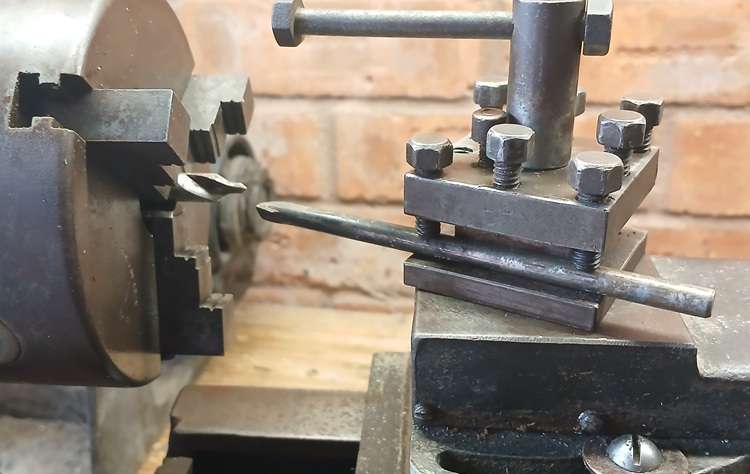
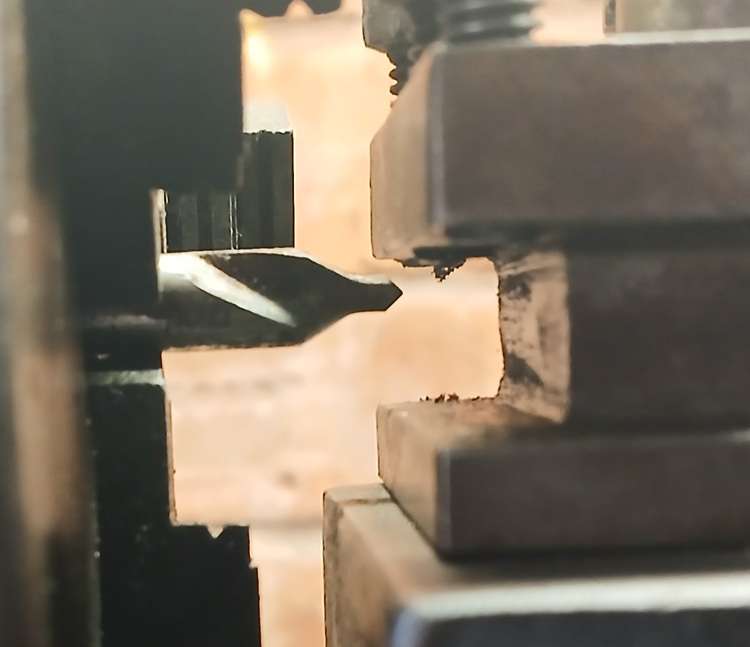
      My lathe (Myford ML4) came with very minimal tooling so I need to buy boring bars etc. There’s a wide choice of shank sizes to choose from, but how to determine what size I need? Obviously it’s more of a pain if the cutting edge is too high, so my presumption was that I shouldn’t use the largest size that would fit.

      As a demonstration of relative heights I’ve put a centre drill in the chuck

      lathe ctr 1

      lathe ctr 2

      #837843
      Andrew Crow
      Participant
        @andrewcrow91475

        Try and obtain a copy of The Model Engineers Workshop Manual by George Thomas, there is a whole section on boring tools and holders. There are lots of other useful tools and attachments in there also, although aimed at the Myford S7 much of it should be relevant for the ML4.

        #837844
        Andrew Crow
        Participant
          @andrewcrow91475

          You could also look up some of the threads on this forum by David George who has made a really good job of restoring and using an ML4.

          #837847
          Bazyle
          Participant
            @bazyle

            1/4 inch or at the most 3/8 inch but that might be too big. I can’t understand why people keep suggesting the largest tool that they can cram in. When eating an apple do you shove the whole thig into you mouth in on go because it can just about fit? Would you reject a boiled chicken egg because it doesn’t completely choke you and only select an ostrich egg?

            #837848
            JasonB
            Moderator
              @jasonb

              I’m going to disagree about big shanks in this case.

              With boring bars a big shank is often an advantage as they tend to be used with a lot more overhang than an external turning tool. Having said that you will also need a small one if boring a small hole where the tool won’t fit if the shank is too large. Over the years I have built up a range from 3mm to 28mm shank.

              I certainly would not want to bore a 2″ dia hole 6″ deep with a 1/4″ shank boring bar.

              External turning generally has little overhang so smaller is OK, easier to grind small section HSS or small shank Insert holders use smallerand therefor cheaper inserts. 6mm or 1/4″ would be OK for most things external. Parting tools I would go for a larger shank on as rigidity will help with those sort of cuts.

              #837851
              duncan webster 1
              Participant
                @duncanwebster1

                1/4 or 5/16. Cheaper and easier to grind than anything bigger and plenty stiff enough

                #837870
                John Haine
                Participant
                  @johnhaine32865

                  You need a selection of boring bars to cover the range of hole sizes, but they are easy to make in larger sizes.  I suggest you them as you need them for a project.

                  #837880
                  cedric 1
                  Participant
                    @cedric

                    <p style=”text-align: left;”>Buy one of those cheap sets of insert boring bars with a 6, 8, 10 and 12mm shanks. Then buy xxGT ground inserts for them. That will do almost everything you need for now.</p>

                    #837950
                    heavydamper64
                    Participant
                      @heavydamper64

                      Many thanks for your inputs, it looks like I’ve getting an addition to my library and will most likely start off with a set of 6mm shank tools and grow it from there as the need arises.

                      #837957
                      cedric 1
                      Participant
                        @cedric
                        1. It depends on what tooling you are talking about. Carbide Insert tooling with 10mm shank should fit straight in the ML4. Easier to obtain cheap on the net than smaller shanks.

                        But HSS in 10mm takes a lot of grinding, so 6mm can be easier to deal with. Just shim it up to height.

                        And boring bars are best bought in a set as mentioned already.

                        For your library, the best book I know for getting started on a vintage British lathe is LH Sparey”s book The Amateur’s Lathe. Written back in the era, it addresses all the basics including tool selection. It is aimed more at the very beginner than GH Thomas’s books.

                        #837982
                        David George 1
                        Participant
                          @davidgeorge1

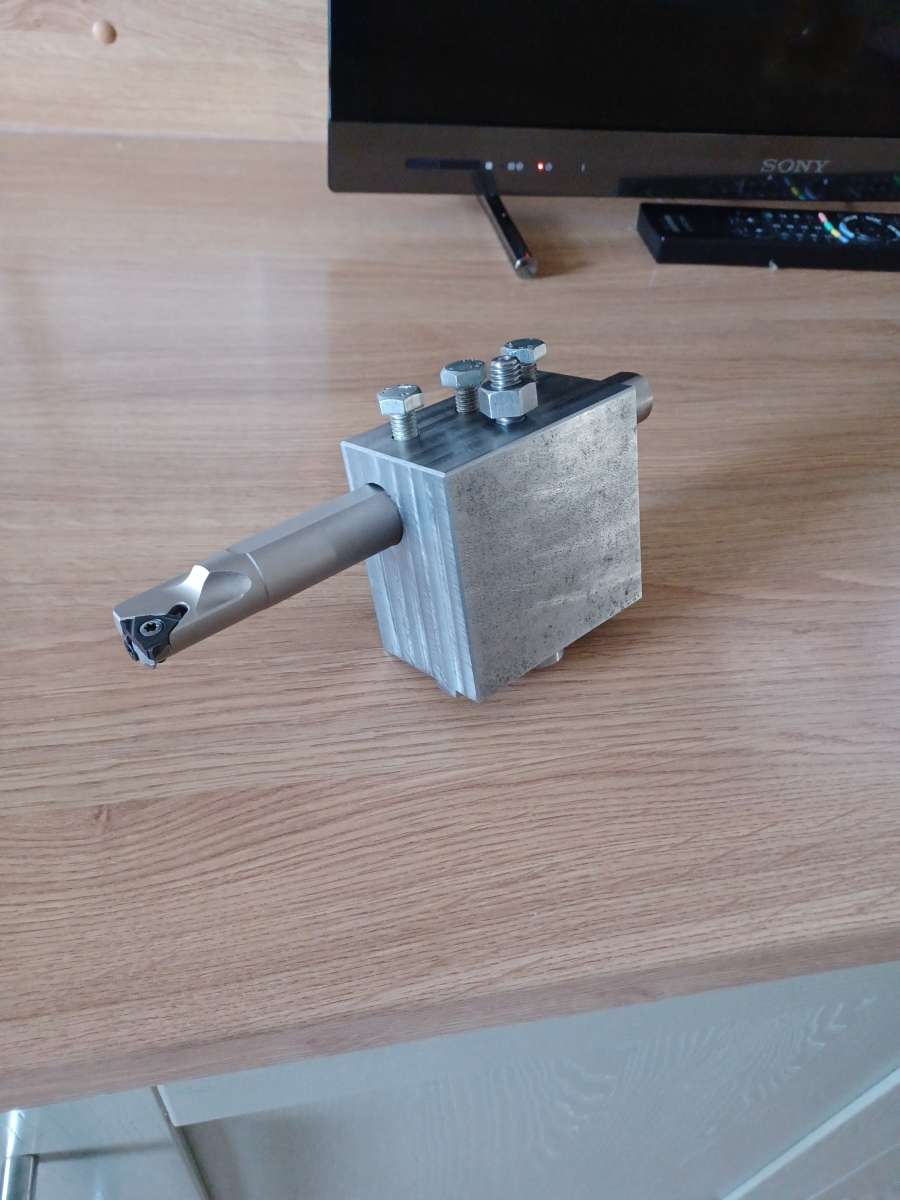
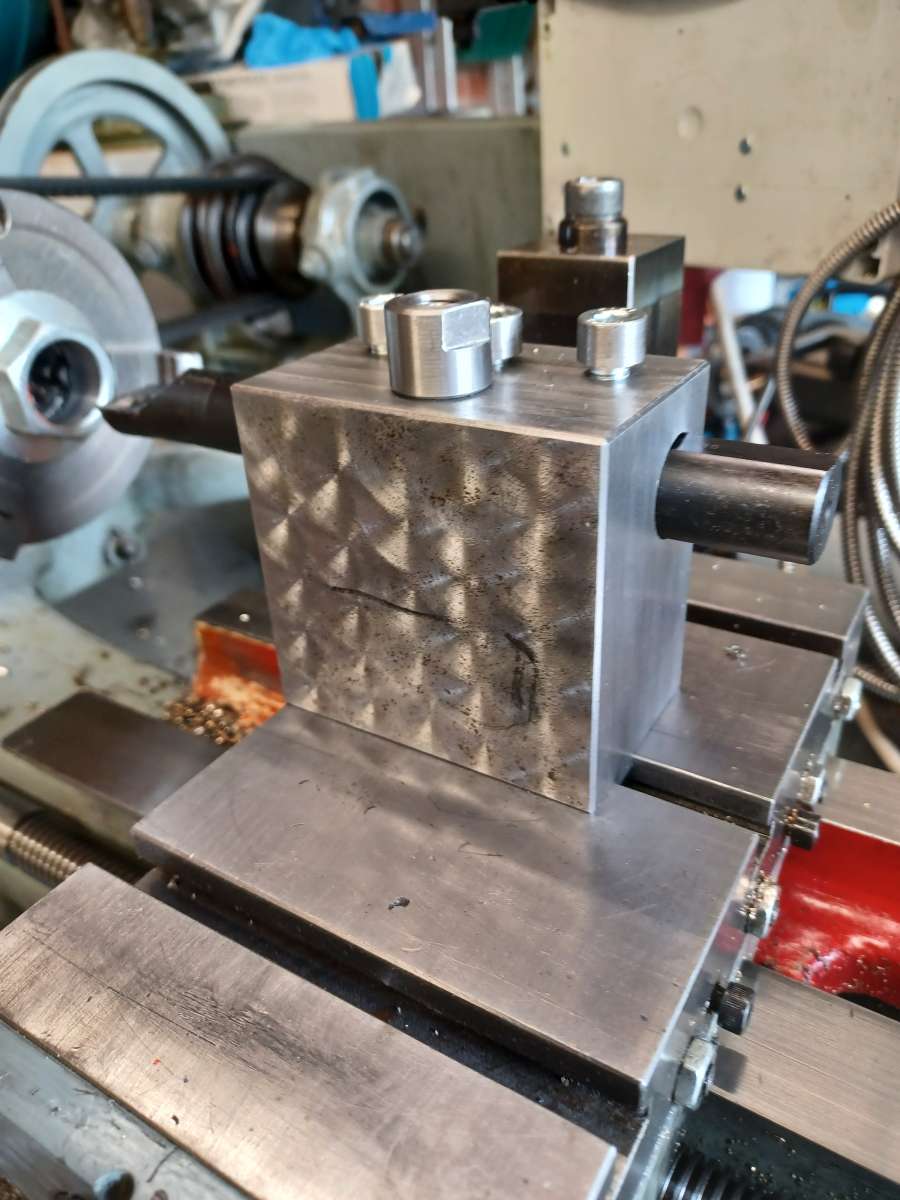
                          The tool height on a boring bar for exchangeable tips are on the centre height i.e. centre of the shank diameter so if you drill and ream a holder using the drill in the main spindle the tip on a boring or screw cutting bar will automatically be on centre height. Recently I needed to bore and internal thread a 1.250″ thread and the thread insert and the smallest shank diameter is 20mm  so I made a solid block to replace the tool post drilled and reamed a hole using the spindle which makes it perfect for larger jobs as well with a larger boring bar as well the clamp screws on top hold the top clamp the boring bar strait and flat. It only takes a couple of minutes to swap the tool posts on my lathe or if you like put it further along the top slide to use it.

                          20230702_201251

                          20230811_160611

                          David


                          #838051
                          duncan webster 1
                          Participant
                            @duncanwebster1

                            I’d missed the bit about boring bars, yes bigger is better. My remarks were directed at normal turning tools. For that a tangential tool takes a lot of beating on a small light lathe. Dead easy to keep sharp.

                            #838059
                            Clive Foster
                            Participant
                              @clivefoster55965

                              As a footnote to this topic its worth keeping an eye put for a couple or four “suitable” sizes of large MT shank drills at an affordable price on E-Bay, Facebook Marketplace et al to make starter holes. Drilling is the quickest way to remove material so getting somewhere close with a drill before finishing off with the boring tool is worthwhile saving in time and tool wear. Working your way out from the largest box set drill that can be held in the usual tailstock chuck  (1/2″ or 13.5 mm  Ø) to an inch or two can be a miserable experience.

                              Exact size of your big drills doesn’t matter so frequently bargains can be found in odd sizes that won’t fit anything specific. Fractional inch in by 1/64 th sizes for example.

                              In smaller sizes a broken slot drill (2 flutes) that still has one good edge can quickly be turned into a decent small boring tool with a bit of attention from the grinder to make clearance on the damaged side. One day i shall take my own advice and make a holder or two for the broken slot drills I’m religiously saving!

                              Clive


                              #838062
                              old mart
                              Participant
                                @oldmart

                                Common sizes of tools are now metric so you have to select a size which is just below the measured bottom of the toolpost and the centreline. Boring bars which take inserts have the cutting height at 1/2 of the nominal diameter, so if your lathe takes 8mm tooling, and assuming that the toolpost aperture can accomodate the size, up to 16mm boring bars could be used.

                                #838149
                                vintagengineer
                                Participant
                                  @vintagengineer

                                  The easy solution is to make your own

                                  #838166
                                  JasonB
                                  Moderator
                                    @jasonb

                                    Don’t you just love it when someone suggests to a beginner “make your own” and then does not go on to explain how😉

                                    #838236
                                    Howard Lewis
                                    Participant
                                      @howardlewis46836

                                      The advantage of using the largest possible size shank boring bar is rigidity.

                                      But the larger the shank the larger minimum size hole into which the bar can be inserted for machining.

                                      So a 6 mm shank bar, will probably need a 9 mm drilling into which it will fit to start boring operations.

                                      The heavier the cut, the greater the deflections, so more “spring cuts” will be needed to reach finished size.

                                      Probably, for a ML4, a 6 mm bar will be adequate. A 8 mm largest, and 10 mm might even be too large

                                      Smaller that 6 mm, will probably call for a lot of grinding of a HSS toolbit, to thin one side to allow entry into a smaller hole, and greater need for small cuts and spring cuts.

                                      #839066
                                      old mart
                                      Participant
                                        @oldmart

                                        You will need to gradually get a collection of different size boring bars up to the maximum size your lathe can hold. There is always a compromise between fitting the largest that will fit in the drilled pilot hole and the problem of having to deal with constant swarf removal. If you have a deep hole to finish by boring try to get most of the metal removed by drilling so the stiffest boring bar that can fit. Through holes are easier, but beware of hitting part of the lathe such as the end of a chuck or faceplate.

                                        Here is a very good value starter set of small boring bars which take a common size of carbide insert on ebay UK.

                                        ebay  317191816398

                                      Viewing 18 posts - 1 through 18 (of 18 total)
                                      • Please log in to reply to this topic. Registering is free and easy using the links on the menu at the top of this page.

                                      Latest Replies

                                      Viewing 25 topics - 1 through 25 (of 25 total)
                                      Viewing 25 topics - 1 through 25 (of 25 total)

                                      View full reply list.