Power factor correction of a three-phase car lift

Power factor correction of a three-phase car lift

Home Forums Electronics in the Workshop Power factor correction of a three-phase car lift

Viewing 25 posts - 1 through 25 (of 27 total)
  • Author
    Posts
  • #843350
    Andrew Skinner
    Participant
      @andrewskinner94774

      I wonder if some electrical engineers could look over my attempts to improve the lift motor’s power supply:

      Lift – 2.7-tonne, screw-type, two-poster. Motor is a custom 3ph 400V 4-pole 3.5kW unit.

      Supply – single phase 240V to rotary converter, nominal 7.5 kW (or kVA). Voltage drops all reasonable.

      Problem: near capacity (2.6-tonne RR sport) it struggles and stalls.

      I’m not buying another rotary due to expense. My assertion here is the power’s there, just not being used efficiently:

      Motor plate: 400V, 50Hz, 11A, cosphi 0.65, (giving a phi of 49.5*)

      Now, lifting a 2-tonne car at 30 mm/s puts only about 600W of gravitational potential into the car, so this is a hugely inefficient machine, tempered by only being used for seconds in the hour.

      Taking the motor plate values, I get:

      Apparent power, |S| = (sqrt3)VI = 7.62 kVA

      Real power, P = |S|cosphi = 4.95 kW

      Reactive power, Q = Ptan(phi) = 5.80 kVAr

      So, under rated conditions, a lot of the power is just bouncing back and forth. I assume this holds similarly for the real-world conditions of my lift, running on the rotary.

      So, I thought power factor correction capacitors, ‘injecting’ some VArs, might help harness that useless power:

      Target cosphi = 0.95, phi = 18.2*. Assume real power is constant:

      P = 4.95 kW from above.

      |S| = P/(cosphi) = 5.21 kVA

      Q = Ptan(phi) = 1.63 kVAr


      kVAr needed = actual – target = 5.80 – 1.63 = 4.17 kVAr, or 1.39 kVAr per phase.


      Given Q = V^2/Xc and cap. reactance Xc = 1/2(pi)fC, we get C = Q/V^2.2.(pi).f

      With a Q=1.39 kVAr, V=400, f=50, the required capacitance per phase = 27.7 uF.


      Apparently, overcompensating can lead to LC oscillations and voltage spikes in the windings, so I decided to go with 20 uF in a delta across the motor windings.


      It seems to have worked – it just about lifts the RR sport, and the line currents during lifting have reduced by 20-25%. No voltage spikes detected using the Fluke on peak detect.


      If anyone has bothered to trawl through all that, I’d welcome thoughts/comments/improvements. Cheers.

      #843398
      vintagengineer
      Participant
        @vintagengineer

        I would have thought a RR Sport weighs more than 2600kg. That might be the dry unladen weight.

        #843422
        Clive Foster
        Participant
          @clivefoster55965

          Thinking about this problem it would be interesting to see what both the current and voltage phase relationships look like. Voltage is easy. Just hook up a scope via suitable probes, but I don’t know if there is any easily affordable way of monitoring the currents.

          It’s certainly not an unknown thing. Years ago a friend of mine had similar problems running his lift off a converter. As I recall it he simply derated the thing as it was well up to lifting his, and his wife’s, cars but struggled with large vehicles. Wonderful excuse to stop folk coming round to borrow the use of it.

          A major inherent weakness of converters when working hard is the innate tendency for both voltage and current phase relationships to wander around. Static types are inherently terrible, especially as they run up to speed, and adding a pilot motor to make them a sort of crypto rotary converter is well known to improve behaviour. However even pukka rotary converters are not immune to the issue. There is limit to the ability of the motor to stabilise the output. It’s well known that compressors often need significantly oversized rotary converters if they are to successfully run up under any sort of load.

          Once upon a tine there was a minor, short lived, vogue for magic boxes connected to banks of smaller capacitors which were said to use interactive switching to stabilise both power factor correction and voltage current phase relationships in real time. Which, for most practical purposes, are different ways of saying the same thing. Sort of like a poor mans version of the Phase Perfect system beloved by many in the USA. The only one I ever got near had failed necessitating conversion to a conventional rotary converter. Unsurprising as the current and voltage sensing arrangements were distinctly underwhelming.

          Clive

          #843430
          Andrew Skinner
          Participant
            @andrewskinner94774

            Thanks both.

            Vintagengineer – it could be more than 2.6, but the 3.2-tonne version of my lift is, as far as I can see, is pretty much the same, including the motor. So I think it should be able to lift it.

            Clive – yes, I’m told the weakness of rotaries at the top of their capabilities is phase balance, which I can’t do much about. The rotary runs my big old woodworking machines as well so I’m reluctant to tune it to the lift only, and in any case I don’t have a circuit diagram for it.

            It nearly lifted the RRS all the way up every time, but often struggled and we’d have to go down and start again. So, given we’re only getting 5 kW from 7.5 kVA, the power’s there, and three cheap motor run caps seem to have made the difference. It’s not perfect, though.

            By the way, it’s not my RRS, it’s my mate’s. I’m cured of the addiction to these cars, having had a Disco 3 and 4 go bang. My mate also had a Disco 3 go bang, so naturally has gone for a 2007 RRS as replacement, basically another Disco 3 with “Range Rover” written on it. Nowt queer, as they say.

            It hoists my Td5 Landy and the wife’s V40 up and down with no bother at all.

            #843457
            Dave Halford
            Participant
              @davehalford22513

              It’s possible the difference between the 2.6 and the 3.2 tonne hoist may be in the gearing.

              Though why the hoist starts OK but fails higher up sound more mechanical.

              #843471
              Andrew Skinner
              Participant
                @andrewskinner94774

                Re: gearing, not that I can see – the motor pulley is quite small already, and the driven pulley quite large. There doesn’t seem to be room for much alteration there, as I had considered making a lower-geared set of pulleys.

                I fitted a new pair of phosphor-bronze lift nuts, TR40x5 left and right-hand, made by a mate with CNC. They were tight-ish to install, but didn’t bind up. There certainly could be a tight spot halfway up, which should ease with ‘exercise’, but I think the problem is also the motor getting hotter as the car progresses. It has no cooling fan and is tiny for the 3.5 kW rating. Duty cycle only 30%. It’s nearly too hot to touch after lifting.

                #843474
                Robert Atkinson 2
                Participant
                  @robertatkinson2
                  On Clive Foster Said:

                  Thinking about this problem it would be interesting to see what both the current and voltage phase relationships look like. Voltage is easy. Just hook up a scope via suitable probes, but I don’t know if there is any easily affordable way of monitoring the currents.

                  It’s certainly not an unknown thing.

                  <SNIP>

                  Clive

                  This will do it
                  https://www.ebay.co.uk/itm/327077621529?

                  Shows Current, voltage, real power, apparent power and power factor.
                  As a bonus it also works on DC and has a output that you can use to display current on an oscilloscope.

                  Robert.

                  #843559
                  Andrew Skinner
                  Participant
                    @andrewskinner94774
                    “This will do it

                    https://www.ebay.co.uk/itm/327077621529?

                    Shows Current, voltage, real power, apparent power and power factor.
                    As a bonus it also works on DC and has a output that you can use to display current on an oscilloscope.

                    Robert.”

                    How did you know I had a weakness for test equipment?! That’s now on the way to me.

                    #843578
                    Robert Atkinson 2
                    Participant
                      @robertatkinson2

                      Well I would have bought it but I allready have one, plus two of the lower power 200A version and two 3-phase adaptors. And A LEM-HEME version that also does harmonics and 4 HEME AC DC clamps…

                      I subscribe to this thread

                      https://www.eevblog.com/forum/testgear/test-equipment-anonymous-(tea)-group-therapy-thread

                      Robert.

                      #843584
                      Andrew Skinner
                      Participant
                        @andrewskinner94774
                        On Robert Atkinson 2 Said:

                        Well I would have bought it but I allready have one, plus two of the lower power 200A version and two 3-phase adaptors. And A LEM-HEME version that also does harmonics and 4 HEME AC DC clamps…

                        I subscribe to this thread

                        https://www.eevblog.com/forum/testgear/test-equipment-anonymous-(tea)-group-therapy-thread

                        Robert.

                        Would you be willing to sell one of those three phase adaptors or any leads? It looks like it needs special leads for the scope function.

                        Also, I can’t seem to find a manual online.

                        #843625
                        Robert Atkinson 2
                        Participant
                          @robertatkinson2

                          Hi Andrew,

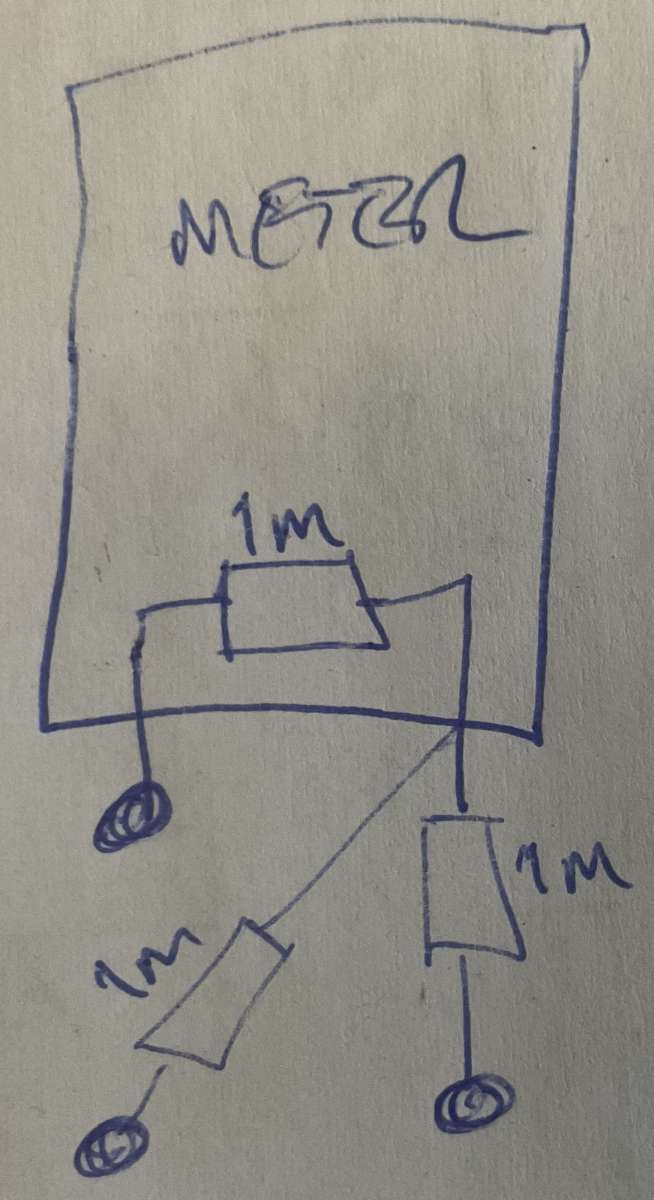
                          The 3 phase adaptor is just two 1 Megohm resistors that create a star arrangement with the meter imput resistance, also 1M, to create an virtual neutral. You only need it if you don’t have access to a neutral.
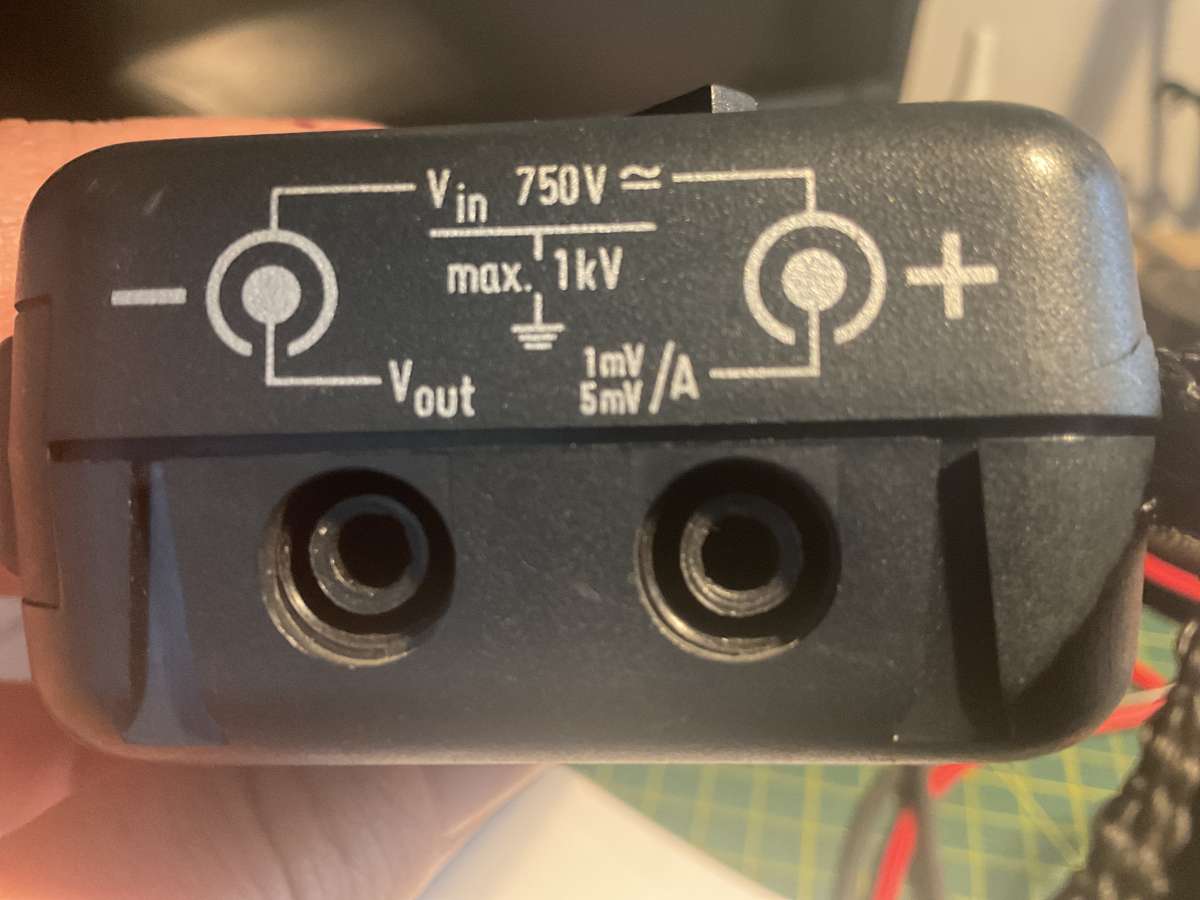
                          The scope output is a bit unusual. It’s a 2mm socket at the base of the 4mm voltage input sockets. I used plugs like this :
                          https://www.rapidonline.com/sks-hirschmann-938420100-mstf-2mm-straight-blade-plug-black-07-1229
                          With heatshrink over it rather than the normal cover.
                          There is a switch in the battery compartment to select RMS or instant output.

                          The manual is here: https://elektrotanya.com/itt_mx220_mx1220_power_clamp_meter_owners_manual.pdf/download.html

                          I’ll sell you a 3ph adaptor if you really want one.

                          Robert.


                          #843668
                          Andrew Skinner
                          Participant
                            @andrewskinner94774

                            Thanks Robert. I’ll have a play with it and a read of the manual when it arrives, then get back to you on the adaptor.

                            The rotary does provide a neutral, but it’s not a true one.

                            #843696
                            Andrew Skinner
                            Participant
                              @andrewskinner94774

                              It should be here in a couple of days. I have a few 5% 1 Meg resistors – would this be the arrangement for the three phase adaptor?:

                              IMG_1407

                              #843730
                              Robert Atkinson 2
                              Participant
                                @robertatkinson2

                                Yes, that is the correct configuration. Make sure the resistors are rated for the voltage. I’d use something like this https://uk.farnell.com/yageo/hhv50sft-52-1m/resistor-1m-1-0-5w-1-6kv-axial/dp/4667307

                                Robert.

                                #843742
                                Simon Williams 3
                                Participant
                                  @simonwilliams3

                                  I’ll happily defer to greater knowledge, particularly in respect of the behaviour of the rotary converter, but it seems to me that the original question – which was along the lines of “is power factor correction going to solve the shortcomings of my car lift” has got lost.  I believe the addition of power factor correction won’t – can’t – make the basic machine work in a power envelope other than that it already occupies,  Here’s why:

                                  Stripped to its essentials the mechanism converts electrical power to work done – force times distance.  The motor simply has a voltage applied to its terminals and draws a current determined mostly by the load resistance of the mechanism.  The real vector of the supply current multiplied by the applied voltage gives the power drawn; some of this energy is translated  into the gravitational potential of raising the Range Rover.

                                  Now with capacitors connected the same motor with the same internal relationship between applied voltage and current drawn and the same conversion of electrical power to mechanical shaft output operates.  The power factor correction components don’t alter the workings of the motor, only the terminal characteristics of the overall machine.  If the maths is about right the current drawn by  the motor plus pfc assembly approaches unity power factor and the machine becomes a more efficient converter of electrical to mechanical power. Which presumably means that the rotary converter has an easier life and there is some – albeit marginal- improvement in the operation of the lift as witnessed.

                                  So what can the OP do to get the last knockings of performance out of his lift?  May I suggest that the energy calculation is useful.  Using the motor rating plate information he has a motor with a full load current of 11 amps – that’s 11 x 230 x 3 = 7.6 KW input power- doing 600 watts of useful work.  I know that overcoming friction is useful, particularly the friction which means the raised ramp is self sustaining but less than 10% efficiency overall doesn’t make sense.  The OP says that the lift motor has a 30% duty factor on it, and gets hot.

                                  He also says that the voltage droops are as expected, but I feel the devil is in the detail.  Operating close to the maximum duty of the lift system the cabling between the rotary convertor and the lift motor has to be up to the job, bearing in mind that a 10% (= 2 volt line to neutral) droop in applied voltage causes a 20 % loss of motor power.

                                  The other element of the system which is begging for closer examination is the phase relationship between the three conductors of the rotary converter output and the power factor of the three phase source,  The load motor’s efficiency at converting applied power into mechanical work will only be optimum if the rotary’s output is symmetrically three phase at unity power factor.

                                  #843760
                                  Robert Atkinson 2
                                  Participant
                                    @robertatkinson2

                                    The power factor correction brings, or tries to, the real power (lifting capability) in line with the apparent power (RMS volts x RMS amps VA). The real power depends on the phase of the voltage and current. Taking the extreme example of a pure capacitive load. This will draw curret but at 90 degrees  so at peak voltage there is no current. Averaged over a cycle the power is zero as is the power factor.
                                    However the current does affect the source of power. In particular any resistance in the source (including wiring) will develop a voltage drop proportional to, and in phase with the current and thus will dissipate real power that must be supplied by and dissipated in, the source. This is why electricity companies don’t like poor power factor, it causes their equipment to over heat. It also reduces the real power available to the load.

                                    Robert.

                                    #843840
                                    Andrew Skinner
                                    Participant
                                      @andrewskinner94774

                                      The 7.6 kVA indicates the loading of the power source, the rotary. Of this, we only get 5 kW of real power to the motor. So that’s 600/5000 or 12% efficiency. Assuming 80% motor efficiency that’s 4 kW to the mechanism.

                                      Not great, but even if it takes one minute to raise a car fully up, at 5 kW charged rate that’s about 2 pence.

                                      #843858
                                      duncan webster 1
                                      Participant
                                        @duncanwebster1

                                        Screw jacks are fairly inefficient, a lot of the power is dissipated in friction between screw and nut, and the thrust washer unless that is rolling element.

                                        #843866
                                        Andrew Skinner
                                        Participant
                                          @andrewskinner94774

                                          Oh, regarding the voltage rating of the 1 M resistors, they’re 1/2 watt, fairly large ones, so hopefully up to the job. I bought them a while ago, to use in making a Gabriel electrode for a Jacob’s ladder. Two in series have held up against the 8 kV from the neon transformer.

                                          For the three phase measurement, let’s say it goes L1, L2, L3 from left to right in the my diagram above; I assume the current clamp is clipped round L1?

                                          #843885
                                          Nigel McBurney 1
                                          Participant
                                            @nigelmcburney1

                                            i was given a 2 post car lift, basically it ran off a static converter 7.5 hp built by a small manufacturer fred in a shed , i had used another of his rotary converters 4hp for driving machines which had main motors,feed motors,pumpp motors without any switching and it still works ok. the 7.5 hp drove a Colchester Triumph which ran better with 7.5 hp slave motor with the makers approval. The lift i believe was 2.5 ton ration it would lift a peugot 306 diesel though not easily and soon failed after lifting a volvo 740. I had it repaired and also raised the belt drive ratio from 3 to 1 to 27 to 1 by adding two extra sets of pulleys. I also have a 6hp Transwave converter ex bulders skip whip I still use, So I contacted Transwave stating that though I was not using their make of converter on the lift could they offer any advice, their comment was car lifts and large compressors were always full of problems, both not any clutch so the motor was very quickly on full load and the motor get not did time to fully run up to speed. and underated motors on lifts were on full load with little or no reserve power to keep cost down,the best cure was to bring the lift right down to floor level and then start lift allowing the motor time to speed up over a few inches before the weight of the car was taken up, after a second repair to the converter,and the volvo replaced by a Discovery 3 the lift ended up in the scrapyard,

                                            #843889
                                            Andrew Skinner
                                            Participant
                                              @andrewskinner94774

                                              Yes, the loaded start is a problem for these things, although mine copes fine with the 2-tonne-ish Defender, and the little Volvo V40. Stop-start at any height. Your Discovery 3 would be about the same weight as the RRS.

                                              Another option I had considered was replacing the 4-pole motor with a 6-pole, which would slow everything down. Since the RRS could go bang at any minute (feeble crankshaft), I’m not willing to spend lots of money catering for it. I’ve got an eye out for a 3ph, 3 or 4 kW, 6-pole, face mount motor secondhand. Perhaps one from a large lathe would suit.

                                              #843905
                                              Robert Atkinson 2
                                              Participant
                                                @robertatkinson2
                                                On Andrew Skinner Said:

                                                Oh, regarding the voltage rating of the 1 M resistors, they’re 1/2 watt, fairly large ones, so hopefully up to the job. I bought them a while ago, to use in making a Gabriel electrode for a Jacob’s ladder. Two in series have held up against the 8 kV from the neon transformer.

                                                For the three phase measurement, let’s say it goes L1, L2, L3 from left to right in the my diagram above; I assume the current clamp is clipped round L1?

                                                Correct. If you want to check a different phase you should measure voltage (direct connection to meter and current on the same phase. Should not need to bother with a motor and proper 3 phase supply but could be interesting on a static or rotary converter.

                                                #844044
                                                Andrew Skinner
                                                Participant
                                                  @andrewskinner94774

                                                  It’s here. Can I check something?

                                                  image

                                                  The manual says the measured voltage should go in the 4mm banana sockets, but this diagram suggests it should be the outer contact. What I don’t want to do is feed 415V into the scope output.

                                                  #844047
                                                  Robert Atkinson 2
                                                  Participant
                                                    @robertatkinson2

                                                    A standard 4mm plug is used for the voltage input. Should be a safety shrouded type for mains. The ‘scope output is a 2mm socket at the bottom of the 4mm socket. No way a 4mm will touch it. I assume the scope output isn’t isolated fron the voltage input so this stops you using both at once.
                                                    Don’t forget it works with DC so you can play with batteries or the car without using dangerous voltage. If you put multple turns of wire around the curren jaw the senstivity is multiplied by the number of turns.

                                                    Robert.

                                                    #844070
                                                    Andrew Skinner
                                                    Participant
                                                      @andrewskinner94774

                                                      Here are some results. I did four measurements, lift unloaded(U) and loaded(L) with a Defender, with(C) and without(noC) the capacitor compensation:

                                                      Car lift motor power factor.

                                                      UnoC: 0.43i

                                                      UC:0.53i

                                                      LnoC:0.84i

                                                      LC:0.94i

                                                      We can see pf improves with loading, which is normal. The uncompensated, loaded lift has a better pf than I thought, or the motor plate suggested, and finally, despite this, I seem to have hit on almost exactly the right amount of compensation, according to the last result.

                                                      Measurements taken with the resistor star connection as suggested, ignoring the weird floaty neutral.

                                                      So, thanks Robert, that’s all been very useful.

                                                    Viewing 25 posts - 1 through 25 (of 27 total)
                                                    • Please log in to reply to this topic. Registering is free and easy using the links on the menu at the top of this page.

                                                    Latest Replies

                                                    Viewing 25 topics - 1 through 25 (of 25 total)
                                                    Viewing 25 topics - 1 through 25 (of 25 total)

                                                    View full reply list.