Drilling accuracy question.

Drilling accuracy question.

Home Forums Beginners questions Drilling accuracy question.

Viewing 25 posts - 1 through 25 (of 56 total)
  • Author
    Posts
  • #817396
    gerry madden
    Participant
      @gerrymadden53711

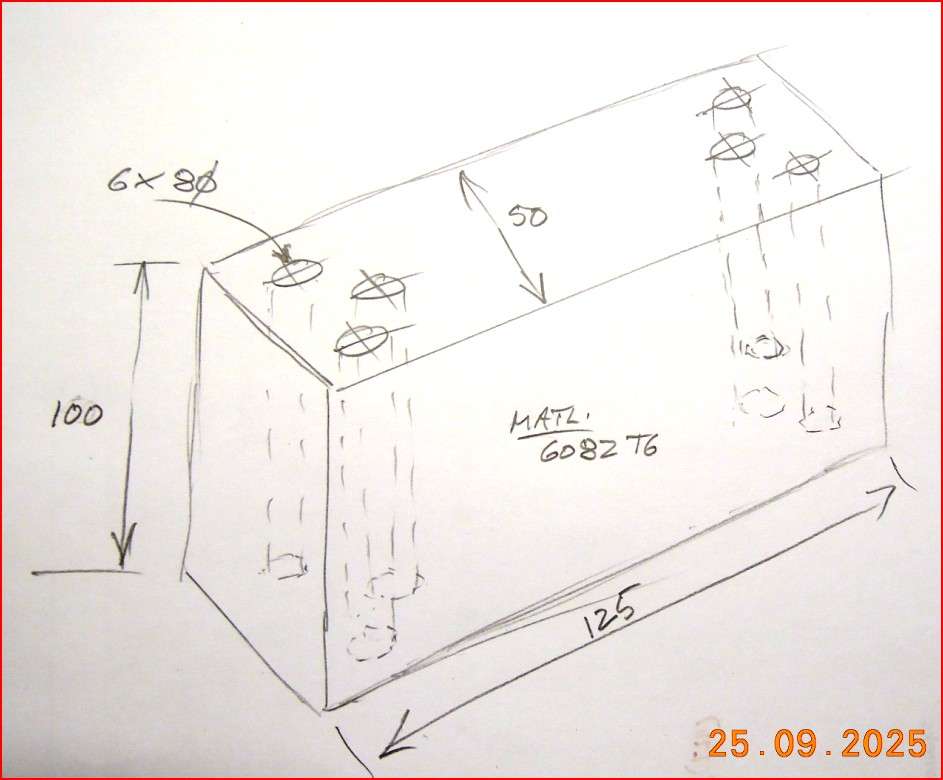
      I will soon want to drill 6 holes in the aluminium block as shown below. A key requirement is to achieve hole positioning on the lower side where the drill exits, as close to the pattern that I start with on the top side.

      Over such a depth a drill may wander, so I will start with buying a good quality one. I will start each hole with a spotting drill. The block will be squared up as best I can.

      But what else could I do to reduce the pattern ‘scatter’ on the base surface. I did wonder about perhaps rotating the workpiece 90 degs after say each inch of depth to cancel out tramming/misalignment errors in the mill, but don’t think I have ever seen such a thing done before. Would this be sensible, and/or is there anything else I can do to keep these holes parallel?

      The hole will be a clearance hole for a 5/16″ AN bolt so I’m not looking for GD&T precision (whatever that’s all about 🙂 )  I’m more just wanting to the best ‘home workshop’ job I can do, so that when I go to hang a correctly drilled plate/bracket on the bottom face, I don’t have to resort to modifications of the bracket.  Also I also don’t really want to drill from both sides and end up with six internal dog-legs and steps!

      (Sorry distortion by the camera makes the block look trapezoidal! It will be rectangular, to good home-workshop standards.)

      Screenshot 2025-09-25 164235

      Gerry,


      #817400
      Martin Kyte
      Participant
        @martinkyte99762

        So why don’t you drill from the bottom face?

        #817402
        Nigel Graham 2
        Participant
          @nigelgraham2

          Rotating the block introduces the risk of slight lateral errors, albeit very small ones, potentially enough to set the drill a-wandering.

          Taking only shallow bites with frequent clearing of the flutes will help keep the drill going straight.

          Do the bolts need go all the way through the block?

          Can you modify the design so that you can screw the bracket on from its own side, using tapped holes and set-screws or studs and nuts, that don’t need penetrate ever so deeply?

          Do the fasteners also hold something on top, as if the block is just a big spacer? If so, can you use the same principle but when inverting the block to drill the opposing face, being careful to set off from the same datum faces?

          Would it greatly matter if you do drill from both sides but perhaps 0.3mm over-diameter for about 30mm depth from both faces, so even if the holes have drifted slightly their centre portion is still very close to your intended centres?


          #817403
          DC31k
          Participant
            @dc31k

            Being worried in general about tramming or misalignment errors is similar to Chicken Licken worrying about the sky falling on his head.

            Measure the errors you have and assess their actual significance over the 100mm depth of the block.

            8mm is not a conventional clearance diameter even for a close fit 5/16″ nominal item (too small). See:

            Imperial Clearance Hole Sizes

            If the holes are to fasten two components together, and you cannot dril with the item inverted as suggested above, drill both together. Then, to some extent, neither the absolute position of the hole entry nor the exit is critical.

            #817404
            gerry madden
            Participant
              @gerrymadden53711

              Apologies, I could have added that the block will be sandwiched between two plates (as a big spacer) and through-bolts will go through all three parts. I can really change this design with internal tapping etc. Similarly, oversizing some or all of the holes on either side would compromise some of the structures integrity.

              Martin, …?! I’m tempted to say ‘cos i dont have an upside down drill’ but I might be missing something in your response 🙂  The hole pattern is important on both sides. I know I can control one.

              Gerry


              #817407
              gerry madden
              Participant
                @gerrymadden53711

                DC31k, yes you are absolutely right. I couldn’t remember my target size so just rounded it off for the post. So it would actually be about 8.2. But on 100mm depth I fear drill wander, could be more…. but I may be wrong.

                Gerry

                #817409
                Diogenes
                Participant
                  @diogenes

                  Agree with DC that 8mm is a bit of a squeaky fit for 5/16 – can you use a bigger clearance and (say) hollow dowels if alignment is critical..?

                  Start with a ‘good’ stub drill and go as deep as you can, working as you know you should.

                  Continue with a ‘good’ jobbers drill, if you know you have competent positioning facilities flip the work at half-time and repeat starting with the stub drill again.

                  #817410
                  JasonB
                  Moderator
                    @jasonb

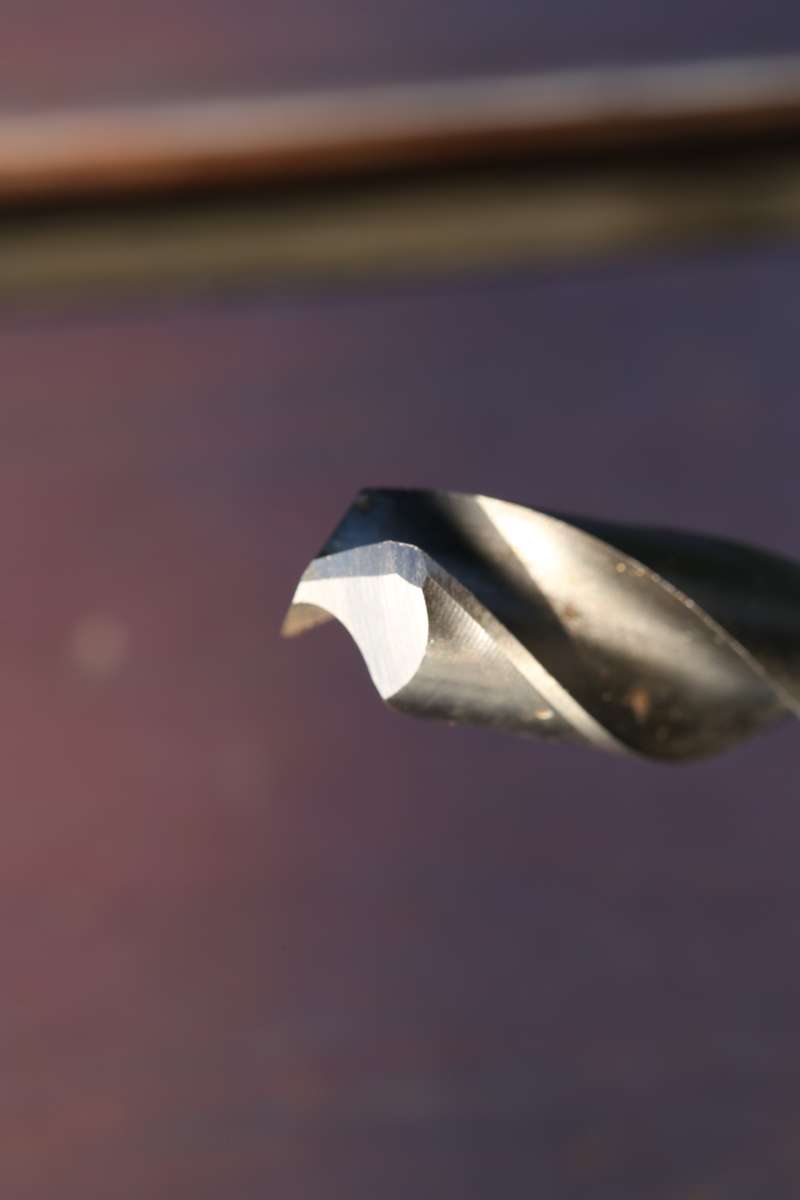
                    When I want a hole as straight as possible I start with a stub drill then move onto a jobber and you may even need an extra length one for that depth of hole. Being short the stub drill is less likely to wander and it’s hole will help giude subsequent drills.

                    Withdraw the drill often to stop any build up of swarf pushing the drill off line and use paraffin or WD 40 to stop tip build up.

                    #817411
                    JA
                    Participant
                      @ja

                      I think you are worrying too much. If it was a casting it would be more of a concern.

                      Use a new good quality drill (Dormer comes to mind), lubricate with a fluid of you choice and clear the swarf from the hole very frequently. After about 80mm you should be nibbling at the cut, say about 1mm at a time.

                      JA

                      #817412
                      SillyOldDuffer
                      Moderator
                        @sillyoldduffer

                        Well, strap in!  Any hole deeper than than 3x the drill diameter is a deep hole, liable to drift off.  100/8mm = 12.4, so four times over the limit.  Six straight holes is a challenge!

                        Suggestions:

                        • Drill in a lathe.  Holes are allegedly less likely to wander when the work rotates rather than the drill.
                        • The work and machine should be as rigid as possible.  Drill presses aren’t as rigid as mills.
                        • A pilot should be started with a centre or spotting drill
                        • Set the main drill accurately at a right angle to the job.  (Gerry said “The block will be squared up as best I can.”  Pay close attention to that! )
                        • Use sharp correctly ground HSS or carbide drills, and make sure they stay sharp throughout!  Both sides ground exactly the same, so both cutting edges are balanced.  One of my books says hand sharpening isn’t good enough for this, no matter what skilled men believe!
                        • The drill should be firmly held in a good chuck, collets are better than Jacobs
                        • Ensure a good start by shortening the drill shank (or pass it through the collet).  This reduces the chance of the drill bending.   If the initial hole is straight well beyond 3x diameter, it will tend to keep the drill’s helix straight as the hole gets deeper.
                        • Speed is important:  a bit lower than theoretical
                        • Lubrication essential – neat cutting oil in Aluminium
                        • Don’t force the pace – it increases the chance of wandering due to the helix unwinding.
                        • Absolutely vital to remove swarf – peck!  Consider a parabolic drill – they remove swarf better

                        When it matters Industry don’t expect twist drills to cut straight holes.   One approach is to drill a smaller hole and correct by boring.  Another is to use a ‘Ratio Drill with Cooling Ducts‘;  these are extra stiff, and blow swarf out by force feeding lubricant to the tip through the body.   Or, a gun drill when a ratio drill isn’t good enough.  £££

                        Once took me three attempts to successfully twist drill four straight 6mm holes through a 60mm deep block.   The air turned blue whilst my wallet wept…

                        Dave


                        #817414
                        Bazyle
                        Participant
                          @bazyle

                          As it is a spacer can you use a bit of tube so it is a question of the drill being straight enough to end up on the far wall in the right position.

                          #817416
                          Nicholas Farr
                          Participant
                            @nicholasfarr14254

                            Hi, rotating the work won’t guaranty the drill will follow a straight path, and if the drill has already wandered slightly, the drill will just follow the wandering. I do much the same a JasonB says.

                            Regards Nick.

                            #817418
                            Robert Atkinson 2
                            Participant
                              @robertatkinson2

                              As a AN5 bolt is a controlled specification fastener with a maximum shank size of 0.312″ (7.925mm) one will fit into a straight 8mm hole  – just.

                              How about drilling 6mm and then a 8mm long series end mill to finish?

                              Robert.

                              #817423
                              bernard towers
                              Participant
                                @bernardtowers37738

                                you could try a drill with a secondary point angle they are supposed to help with long hole drillingS11A7251

                                #817426
                                dk0
                                Participant
                                  @dk0


                                  Unfortunately, we live far away, otherwise I would make the 6 holes straight with wire EDM.

                                  (Pre-hole with drill 7.5 mm and finishing with wire to dia. 8)

                                  #817431
                                  cogdobbler
                                  Participant
                                    @cogdobbler

                                    “The hole will be a clearance hole for an AN 5/16 bolt”.

                                    So why are you worrying? They are clearance holes. Drill them a bit oversize and let the bolts find their own happy medium. At least 1/64 over, or even 1/32. Or you could go even more if needed.

                                    Do as you already suggested and start each hole with a spotting drill to say half-inch deep so that hole acts as a guide for the longer drill bit.

                                    Drill from the side that has to match the holes in the existing bracket.


                                    #817432
                                    Neil Lickfold
                                    Participant
                                      @neillickfold44316

                                      Drill half way from each side. On hobby gear, 100mm can be a challenge for sure. When marking out, mark out on both ends. The drill suggestions have been good, especially the ones with a bit of a chamfer on the corners. They go really well in 6082 ali.

                                      #817434
                                      Nigel Graham 2
                                      Participant
                                        @nigelgraham2

                                        You explain this block is a spacer between two components. Any way to align those to each other around the spacer, e.g. by aligning faces in the same plane? If so the holes could be quite generously clearance diameters.

                                        Another approach would be, use two 50mm thick blocks. I take it you are drilling these on a milling-machine so can set the distances accurately, whether using a DRO or the handwheel dials.

                                        The more usual way to ensure alignment on massive lumps of metal like this, is dowels, needing only fairly shallow but reamed holes. The bolt-holes can then be quite generous fits.

                                        #817439
                                        Richard Simpson
                                        Participant
                                          @richardsimpson88330

                                          Using the careful techniques described above should allow you to drill an accurate hole.  If you are still worried, and we are only discussing a spacer here with clearance holes, then use a bigger clearance.

                                          Lubricant, gentle pressure, a sharp drill bit and frequent clearing should give you an accurate hole.

                                          Another solution is to cut it in half and use two spacers half the depth.

                                          #817451
                                          noel shelley
                                          Participant
                                            @noelshelley55608

                                            Careful marking out and then drill from both sides using the techniques as described above. If only clearance then just make it big enough to get the bolt through. Noel.

                                            #817452
                                            Robin
                                            Participant
                                              @robin

                                              I think accuracy depends on tool sharpness, spotting drill placement, BIG drills and swarf clearance. All rather tedious compared to the fascinating question of turning the tool or turning the workpiece. All things being relative, how can it matter? I didn’t think it did until someone put a stupid idea in my head that never went away. When you turn the workpiece, you define a straight line through the part which follows the axis of rotation and can be identified as the place where the cutting speed is zero. Nobody ever told me how to align the drill tip to this magical axis. I think you have to do the funny handshakes before you become privvy to that bit 😀

                                              #817453
                                              Graham Meek
                                              Participant
                                                @grahammeek88282

                                                In the past when faced with similar jobs the easiest way to ensure the correct exit position is to drill the hole pattern on the one side using coordinate location. Centre drilling and using something like a 4 or 5 mm drill, drilling to half the depth of the block.

                                                Turn the block over and working from the same edges layout the hole pattern again using the coordinates used previously. Again centre drill and drill 4 or 5 mm to break into the existing holes. Open up with a 7.5 mm drill and finally with an 8 mm drill. The existing holes act to guide the larger drills and reduce the wander. Entry and exit points are in the right place.

                                                Yes it takes longer but it is guaranteed to give what is wanted.

                                                Regards

                                                Gray,


                                                #817489
                                                old mart
                                                Participant
                                                  @oldmart

                                                  A new top quality drill would stay quite straight with frequent swarf clearing and lubrication. I have the luxury of having some solid carbide drills which will not only drill straight, but leave holes exact size looking better than reamed holes, but they and need very careful delicate use. Running a reamer down a hole will ensure straightness.

                                                  As usual, Jason’s starting off with a stub drill is the better way to get started straight. A few tests, perhaps with a round bar of aluminium in a lathe would prove whether the drill stays straight as it would be easy to judge just how close to the centre the exit hole is.

                                                  No need to apologise for the sketch, it shows everything perfectly well.

                                                  Drilling from the bottom would ensure the holes come out accurately where it matters as already mentioned


                                                  #817567
                                                  Trevor Drabble 1
                                                  Participant
                                                    @trevordrabble1

                                                    Obviously stiffness over such a long length relative to the diameter is one of the most important factors here along with correct technique. My suggestion therefore is to follow Jason’s advice and start with a stub drill and then switch to a quality ( dormer or similar ) crankshaft drill  ( as used to drill long small diameter oil  holes in crankshafts) . These drills have a thickened web in order to improve stiffness. Correct cutting speed and feed is also important in order to achieve good cutting and prevent rubbing , the latter of which results in excessive pressure on the drill point which in turn results in wandering. You should therefore drill not only as fast as you are comfortable with  , but more importantly maintain a feed of 0.004″ – 0.008″ per revolution and to do this with a repeated short cycle pecking action which will allow the essential lubricant ( paraffin in this case ) to flush away the resultant chips . I hope you will find this information of use .

                                                    #817576
                                                    Michael Gilligan
                                                    Participant
                                                      @michaelgilligan61133

                                                      I am sure that Gerry has his own very good reasons for wanting the the spacer to be made like this … and I am enjoying reading the expert advice

                                                      But … Surely a ‘Production Engineer’ would be re-thinking the design

                                                      A simple extrusion could provide accurately positioned ‘holes’ by the metre !

                                                      … a 100 mm slice makes the spacer.

                                                      MichaelG.

                                                      .

                                                      Coffee time:

                                                      .

                                                    Viewing 25 posts - 1 through 25 (of 56 total)
                                                    • Please log in to reply to this topic. Registering is free and easy using the links on the menu at the top of this page.

                                                    Latest Replies

                                                    Home Forums Beginners questions Topics

                                                    Viewing 25 topics - 1 through 25 (of 25 total)
                                                    Viewing 25 topics - 1 through 25 (of 25 total)

                                                    View full reply list.