Don’t understand !

Don’t understand !

Home Forums Help and Assistance! (Offered or Wanted) Don’t understand !

Viewing 14 posts - 1 through 14 (of 14 total)
  • Author
    Posts
  • #548984
    Fowlers Fury
    Participant
      @fowlersfury

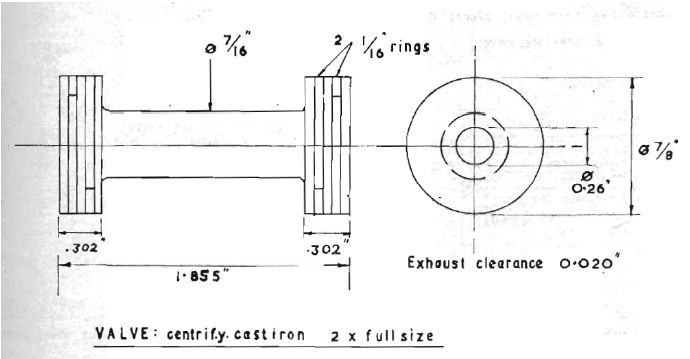
      In a Martin Evans series from back in 1975, he appears to have pasted, as an after-thought, a drawing of the inside valve "bobbin" of a 3 cylinder loco.
      It's clear enough except for his comment "Exhaust clearance 0.020". (Elsewhere he specified exactly where the exhaust ports should be positioned within the valve chamber. Furthermore, he shows the ends of the bobbin (not the rings) at mid posn. exactly in line with the outer edges of the transfer passages to the main cylinder).

      I'd welcome info please on what this comment might mean in terms of the bobbin.

      valve query.jpg

      #33845
      Fowlers Fury
      Participant
        @fowlersfury

        A Martin Evans’ dwg comment

        #548990
        JasonB
        Moderator
          @jasonb

          What is the actual distance between the passages, best not to assume the two lines are lined up in which case 1 7/8" (1.875) seems likely.

          #548991
          Martin Kyte
          Participant
            @martinkyte99762

            The exaust clearance is the amount by which the valve is open to exaust at mid point of travel. This is the INNER edge of the valve bobbin. So on your drawing the gap between the inner edges of the bobbin is 1.855 -2 x 0.302 = 1.251" To give 20' exaust clearance the distance between the INNER faces of the tranfer ports in the valve cylinder would be 2 x 0.020 less than this or 1.211" apart.

            I think I have understood it correctly. There are many who will be more expert at valve gear than I am I'm sure so maybe someone would like to confirm.

            regards Martin

            #548992
            J Hancock
            Participant
              @jhancock95746

              Is he not referring to the clearance of the spool on the valve shaft ?

              #548994
              Martin Kyte
              Participant
                @martinkyte99762

                Actually that would be for outside steam admission.

                regards Martin

                #549034
                Fowlers Fury
                Participant
                  @fowlersfury

                  Very grateful to Jason B and Martin K.
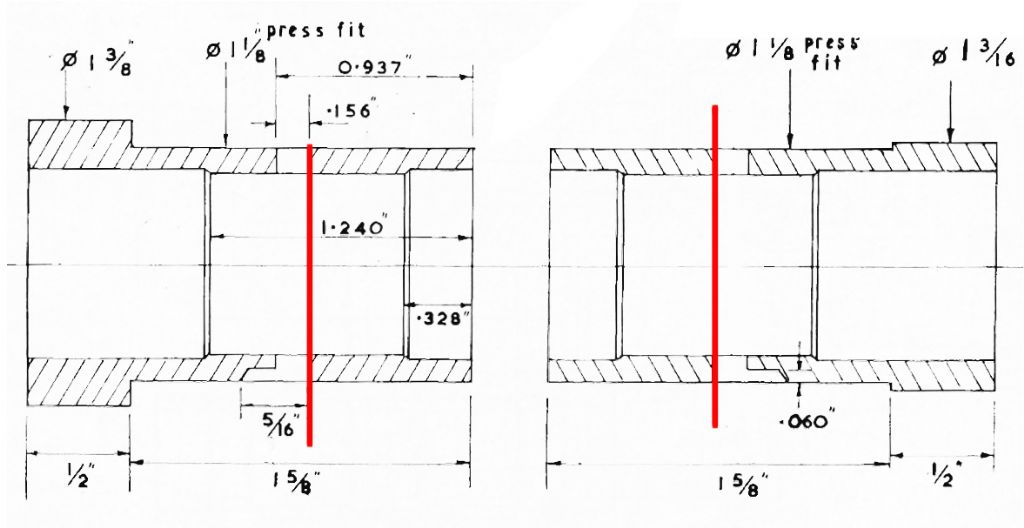
                  The Evans dwg of the valve chamber is reproduced below.
                  In answer to Jason ~ yes, his distance is 1.874"
                  I made one attempt to machine the valve chamber i.e. liner, in 2 parts but found particular difficulties with the varying bore and especially producing square holes for the ports in precise locations. So – next, the valve liner was made in 3 parts (see red lines below) which proved a much better method for maintaining accuracy.
                  However for months now, I've been unable to get the valve timing to make sense. Martin Evans did not make any reference to setting the eccentric etc. All my dimensions are within about 0.004" of Evans' dwg (checked innumerable times). I've tried the old LBSC methodology of equalising air bubbles from the drain cocks at F&BDCs but cannot get equivalent air flow. I've tried exactly centralising the bobbin within the chamber again though there's no logic to air emerging from the drain cocks as the wheels are rotated by hand. All done with the main piston at precisely mid point.
                  I've read ad nauseam articles by such luminaries as Dons Young & Ashton etc but found no references to this "exhaust clearance" or at least, nothing I could understand.
                  In desperation, I've spent many hours producing a CAD dwg of the entire valve chamber and bobbin in order to "move" the bobbin along the X axis and see how the ports were (theoretically) uncovered. It was checking Evans' dwg for the nth time that I noticed this "Exhaust clearance 0.020" which prompted the plea for help.

                  I think Martin however has identified the problem (and my naivety) .
                  Now though, machining the bobbin to create that "0,020" is easy enough so renewed thanks !

                  evans valve chamber.jpg

                  #549040
                  JasonB
                  Moderator
                    @jasonb

                    Well the way I goy my 1 7/8" was to add the length of the bobbin 1.855" and the 0.020" Exhaust Clearance. Not read any of the above mentioned people but assume it ensures the exhaust is open before the inlet on the opposite end of the cylinder

                    #549053
                    Martin Kyte
                    Participant
                      @martinkyte99762

                      Jason is correct for inside steam admission. I had the thing 'inside out'

                      regards Martin

                      #549065
                      duncan webster 1
                      Participant
                        @duncanwebster1

                        Excuse me for throwing in more confusion, but I think exhaust clearance is the amount the exhaust is open when the valve is central. So does Mr Wikipedia ex clear . The drawings give 0.01" each end, so exhaust clearance is 0.01", not 0.02"

                        I wouldn't have thought exhaust clearance was needed on a 5"g model, all it achieves is letting the exhaust out sooner, ie reducing the cylinder power output. Piston speed is very low in models, so unless the ports are badly designed there shouldn't be a problem with pressure drops. I know of some 15"g locos which have exhaust lap, this might be going a bit far!. If cut off is 25% for example exhaust will open at 75% stroke, opening sooner doesn't seem like a good idea

                        Lots of big engines had screwed in plugs through which you could see the valves opening and closing. You can see them on NG15

                        #549068
                        Martin Kyte
                        Participant
                          @martinkyte99762

                          At last a valve gear expert. Thanks Duncan.

                          regards Martin

                          #549105
                          Paul Kemp
                          Participant
                            @paulkemp46892

                            Duncan, not quite sure I follow on exhaust clearance reducing cylinder power? I guess that might happen if you have zero lap on the admission side but the clearance on the exhaust also relates to the port spacing? Admission "clearance" could be considered to be introduced by the effect of introducing lead (inlet opens before dead centre)? Exhaust clearance only introduces a small difference in actual valve events and at the point the exhaust opens the majority of the expansive effort on the inlet steam would mainly be spent? At high speeds it is just as important to get the expanded or "dead" steam out as getting fresh steam in? Clearance surely also give the effect of keeping the exhaust open longer reducing the resistance on the other side of the piston? Is your 25% / 75% relationship true if you consider at 25% cut off valve travel is consequently reduced so would closing the inlet early necessarily result in the same proportion of opening exhaust early? In full gear (say 80% cut off) would exhaust open at 20% stroke? If you look at an indicator diagram that situation gives zero expansive effort at full gear or 25% cut off? Been a long day so I am probably missing something!

                            Paul.

                            #549134
                            duncan webster 1
                            Participant
                              @duncanwebster1

                              An expert eh! Perhaps ex as in has been and spurt as in drip under pressure.

                              As Paul says, it is important to get the exhaust out, but pressure drop in ports is proportional to steam velocity squared, and if ports are something like to scale, since model piston speeds are much lower than full size, pressure drop will be very much lower . I'm trying to avoid using algebra. This is borne out by Prof Hall's indicator tests using a Speedy cylinder. Unfortunately the link to that paper seems to be broken. Modern full size simple expansion locos didn't have exhaust clearance as far as I can ascertain, someone will now prove me wrong, so models don't need it. However, I hadn't appreciated that FF is building a compound, so I need to do some more thinking. Having made the bobbins I certainly wouldn't bin them. Back pressure on the HP piston is of course much higher on a compound.

                              On the topic of expansion: if we have a cylinder with a clearance volume of 10% of the swept volume (which is typical full size) working at 25% cut off, it will exhaust at ~75% (not quite due to the effect of lead), so the expansion ratio is (75+10) : 25+10), ie 2.4 : 1. If the steam chest pressure is 80 psig (95 psia) the pressure at exhaust will be 95/2.4 – 15 = 24 psig. I could work out what percentage loss of indicator diagram this represents, but it would get a bit heavy for this forum. If there is general interest I will prepare a monograph (posh name for an article on a single topic!), but ME seems uninterested in techy stuff nowadays, and it would be a fair amount of work. Keep the grey matter churning tho'. I've driven little locos which will just about limp along with only 25 psi boiler pressure (I'm not very good at this keeping the fire going bit), so chucking it away doesn't feel right, but we do need some backpressure to drive the blastpipe, so it's all a balancing act, as is all engineering.

                              Big mill engines always had separate valve gears for exhaust and admission. So did Caprotti valve locos. It can be done with piston/slide valves, indeed it was tried, but must not have been worth the extra complexity

                              edited to remove ****** Smileys

                              Edited By duncan webster on 10/06/2021 13:02:01

                              #549137
                              duncan webster 1
                              Participant
                                @duncanwebster1

                                I should have mentioned that amongst Bill Hall's work was a method of calculating pressure drops in ports which allowed for piston speed and varying port openings to produce a theoretical indicator diagram. It agreed remarkably well with actual test results from a full size Britannia tested at Rugby. I spent one Christmas repeating the model, not sure I could do it again, but it agreed with Bill's. Unfortunately he then wrapped it up with his complete loco model. I might be able to find Bill's source code but it would be a fair job to disentangle it, not least because reading someone else's code is never easy.

                              Viewing 14 posts - 1 through 14 (of 14 total)
                              • Please log in to reply to this topic. Registering is free and easy using the links on the menu at the top of this page.

                              Latest Replies

                              Viewing 25 topics - 1 through 25 (of 25 total)
                              Viewing 25 topics - 1 through 25 (of 25 total)

                              View full reply list.