Cheaper rust control with a dehumidifier.

Cheaper rust control with a dehumidifier.

Home Forums Hints And Tips for model engineers Cheaper rust control with a dehumidifier.

Viewing 24 posts - 1 through 24 (of 24 total)
  • Author
    Posts
  • #841127
    beeza650
    Participant
      @beeza650

      I bought a WiFi electriQ DESD8LW desiccant dehumidifier for the garage to stop rust. I can set it to achieve 50% humidity and it will happily turn off when it gets there using 610W.

      The thing is, condensation on tools occurs when their temperature is below air dew point which means if avoiding rust is the only goal here then we’re unnecessarily paying for dry air.

      I solved that, 100% for free, albeit my employer paid for the ChatGPT credits.

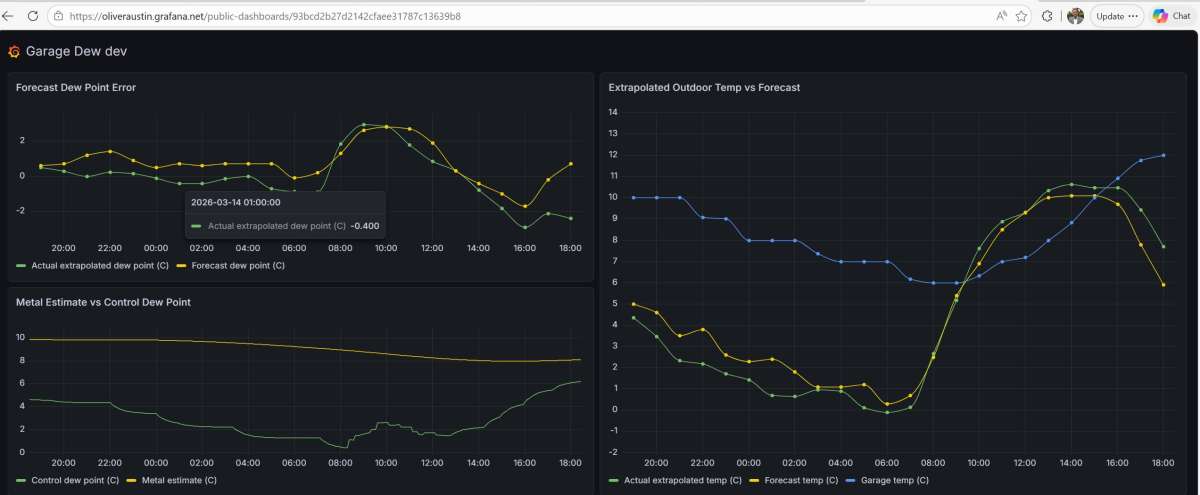
      Basically I take the temperature and humidity data from nearby airports, extrapolate that to where I live and use the garage temp and humidity from the dehumidifier to predict when condensation is likely to form and turn it on to prevent that.

      At first I thought I should use forecast rather than actual weather data but because my garage is fairly well air-tight/insulated it lags far enough behind that extrapolated actuals are a better measure.

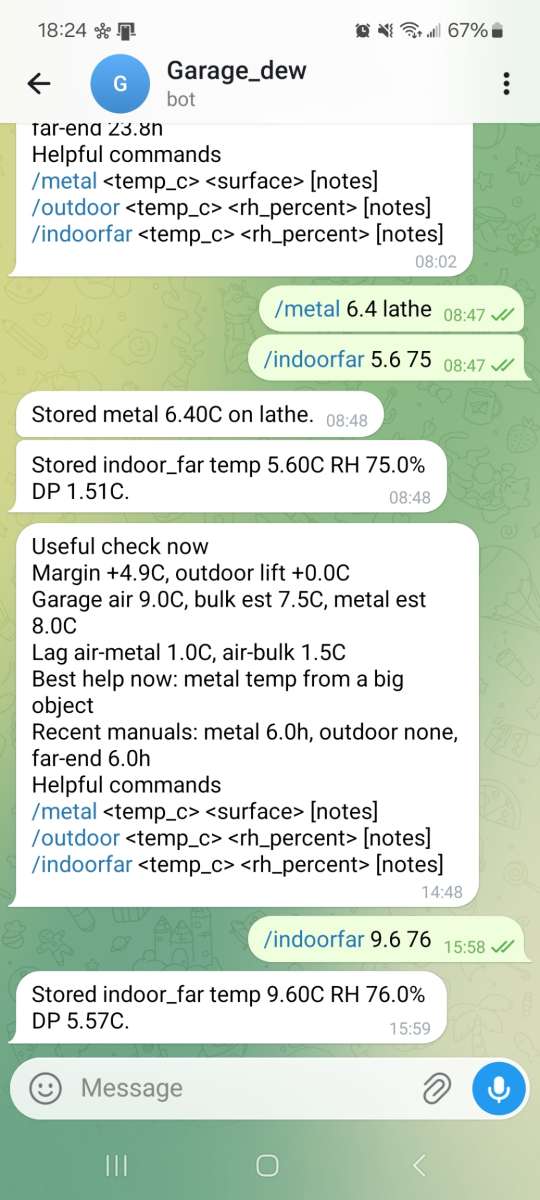
      I’ve also got a way to tell it more accurate readings manually using Telegram e.g. the temp of my lathe. The model uses these to tune its predictions.

      Here’s the (free) Grafana dashboard that I’ll improve a bit next week.

      I use a free for life Oracle VM, PostgreSQL as the DB. Open Meteo and Metar for the forecast and actual weather data and Tuya APIs to interact with the dehumidifier. Telegram is used to send me alerts when it’s turning it on and also to suggest good times to take manual readings to tune the model that I can reply to.

      Screenshot_20260314_182449_TelegramScreenshot 2026-03-14 182928

      #841142
      southernchap
      Participant
        @southernchap

        Great post.

        Might look into this.

        #841148
        IanT
        Participant
          @iant

          I’m not sure of the benefits over just reading the external temperature and humidity locally – assuming there is some lag between inside and outside levels?

          My larger machines are in a very damp, cold outside garage currently but I’m looking to improve this very unsatisfactory situation with a new (insulated) shed, as soon as I can level it’s intended site – which will involve hiring a digger & skip etc.

          I suspect a custom system could be more finely tuned (and therefore cheaper to run) than the in-built humidity control though. I could do this very simply (taking both internal & external measurements) using one of my PicoMites. It has an inbuilt ‘Humid’ command that supports the DS18B20 temperature sensor and DHT22 (or RHT03 or AM2302) temperature/humidity sensor directly. A few lines code (and a relay switch) sounds simple enough.

          Your scheme does sound technically impressive but a bit complicated. Do you have any data on what your new scheme is saving you over just setting the dehumidifier?

          Regards,


          IanT

          #841153
          Graham Meek
          Participant
            @grahammeek88282

            I have used dehumidifiers for the past 30+ years. Never had any problem with rust. The old dehumidifiers used to freeze up in my exposed but well insulated workshop. The latest one which came to me second-hand switches itself on and off as it requires, (Smart Mode). This has some form of heater to clear the frost. I have yet to find the instructions on the internet for this so I cannot be more explicit.

            I also have a heater wired through a thermostat which cuts in at below 5C. This is mounted above head height and can be used in the summertime to blow cold air around the workshop.

            Regards

            Gray,

            #841156
            Bo’sun
            Participant
              @bosun58570

              Like Graham, I have used dehumidifiers (they don’t last forever) for many years now.  They’re not a panacea for rust prevention, but certainly go a long way towards helping.  The first couple were refrigerant ones, and they worked well except when the temperature got too low.  The advent of desiccant dehumidifiers has been great, as they work at lower temperatures.

              My desiccant dehumidifier is permanently connected to a drain (protected from frost), and works all year round.  The drain can occasionally get blocked (I don’t know what by), but is easily blown clear with an airline.  In the event of a blockage, the dehumidifier just reverts to the built in reservoir and throws up a full indicator lamp.

              One lesson I have learnt the hard way however, is to regularly clean the air inlet filter screen.

              #841158
              Charles Lamont
              Participant
                @charleslamont71117

                In a cold shop a dessicant dehumidifier will work better than a compressor one.

                #841161
                Robert Atkinson 2
                Participant
                  @robertatkinson2

                  Unless the machines are covered you need to measure the temperature of the main mass of the machine(s) and the dewpoint of the air in the garage to ensure no condensation on the machines.  Probably more cost effective to measure relative humidity and air temperature and calculate dew point.
                  Using outside dewpoint will bear no relation to what is happening in the garage.

                  Robert.

                  #841163
                  beeza650
                  Participant
                    @beeza650
                    On Robert Atkinson 2 Said:

                    …you need to measure the temperature of the main mass of the machine(s) and the dewpoint of the air in the garage to ensure no condensation on the machines….
                    Using outside dewpoint will bear no relation to what is happening in the garage.

                    Robert.

                    The outside dewpoint is used as a predictor of what the interior dewpoint would be if the dehumidifier wasn’t turned on. Interior dewpoint is available using the data from the dehumidifier which is polled every 5 minutes. A predicted metal mass temp is used and I update that with the real value using the kids infrared ear thermometer when Telegram message tells me it would be a good time to do so. That way the metal temp prediction accuracy is improved over time.

                    The idea is that the humidifier can be turned on in plenty of time at low (cheaper) fan speed to gradually reduce humidity and not spike air temp and maybe even pull the metal temps up a bit before condensation would have formed.

                    #841165
                    beeza650
                    Participant
                      @beeza650
                      On IanT Said:

                      I’m not sure of the benefits over just reading the external temperature and humidity locally – assuming there is some lag between inside and outside levels?

                      I suspect a custom system could be more finely tuned (and therefore cheaper to run) than the in-built humidity control though. I could do this very simply (taking both internal & external measurements) using one of my PicoMites. It has an inbuilt ‘Humid’ command that supports the DS18B20 temperature sensor and DHT22 (or RHT03 or AM2302) temperature/humidity sensor directly. A few lines code (and a relay switch) sounds simple enough.

                      Your scheme does sound technically impressive but a bit complicated. Do you have any data on what your new scheme is saving you over just setting the dehumidifier?

                      Regards,


                      IanT

                      The benefit is extrapolating temp and humidity from nearby airfields, taking into account distance and elevation is it’s free. I don’t own an outdoor wifi temp and humidity sensor. A local sensor would be better but I’ve checked the estimate a few times and it’s been very close.

                      If I was to set the humidifier to maintain 50% humidity I’m going to guess it would be on about 6 hours a day at the moment so that’s £7.14 per week. For the last two weeks the code has not turned it on at all. I’ll probably tweak things so that during prolonged low temp periods it does a long run every now and then to stop moisture building up in cardboard and manuals and stuff.

                      I don’t know how many watts it uses in standby mode though.

                      #841169
                      stephen goodbody
                      Participant
                        @stephengoodbody77352

                        ME 4753 (4-17 October 2024) describes how to predict dew point (using freely available data) and thereby prevent workshop rust.

                        #841175
                        john fletcher 1
                        Participant
                          @johnfletcher1

                          If you want a rust free workshop then you have pay up. 28 or more years ago I bought a preowned dehumidifier and the only time is OFF is in the height of summer. In my home made shed/workshop, the tools and machinery is rust free, and its comfortable to work in. Before buying a dehumidifier I made one, following an article in Model Engineer, using the ice box from a fridge. The home made dehumidifier worked well but was bulky, unlike the compact manufactured one. By the way the water from a dehumidifier is good for use in the smoothing iron and cleaning windows.   John

                          #841221
                          not done it yet
                          Participant
                            @notdoneityet

                            My dehumidifier both reduces the humidity and raises the temperature a tad.  It is costing me just over 3p per night, currently.

                            It has not cost me more than the price of 1.5 units of leccy per night (in the depths of a cold spell) for the last several years.

                            The aggravation of automating it further, is just not worth my effort.  I can afford the 12p/night, to protect my machines, tools and metals from condensation over the worst few days of winter – and, as I wrote above, only about 20-25p/week at this time of the year.🙂

                            #841241
                            beeza650
                            Participant
                              @beeza650
                              On not done it yet Said:

                              My dehumidifier both reduces the humidity and raises the temperature a tad.  It is costing me just over 3p per night, currently.

                              It has not cost me more than the price of 1.5 units of leccy per night (in the depths of a cold spell) for the last several years.

                              The aggravation of automating it further, is just not worth my effort.  I can afford the 12p/night, to protect my machines, tools and metals from condensation over the worst few days of winter – and, as I wrote above, only about 20-25p/week at this time of the year.🙂

                              What wattage is that then? Let’s say it’s 600W and the tariff is 27.5p per KWH (mine is) that’s 11mins run time for 3p. What humidity do you have it set to and how airtight is your space?

                              “aggravation” hang on sec – the whole reason you are on this forum is because you enjoy doing things that don’t HAVE to be done. I’m personally super impressed at what you can do with Gen AI and free APIs/hosting etc. It was a really interesting journey getting there.

                              #841244
                              beeza650
                              Participant
                                @beeza650
                                On john fletcher 1 Said:

                                If you want a rust free workshop then you have pay up. 28 or more years ago I bought a preowned dehumidifier and the only time is OFF is in the height of summer. In my home made shed/workshop, the tools and machinery is rust free, and its comfortable to work in. Before buying a dehumidifier I made one, following an article in Model Engineer, using the ice box from a fridge. The home made dehumidifier worked well but was bulky, unlike the compact manufactured one. By the way the water from a dehumidifier is good for use in the smoothing iron and cleaning windows.   John

                                Yup but you can pay, % wise, somewhat less with some snazzy free automation 🙂

                                #841247
                                Bazyle
                                Participant
                                  @bazyle

                                  Elec rates vary between rural and town and cheap overnight rates.
                                  One thing to avoid is the ‘solid state’ versions. Best I can determine from online sources is that they have a COP of only a few % nowhere near efficiency of a refrigerant one and tend to quickly corrode themselves to death with the condensate.
                                  I have considered that if I had a solar panel on the shed it might be worth using a peltier as a lathe  heater not as a dehumidifier just because it would add a little bit extra to meagre sun production.

                                  #841255
                                  Macolm
                                  Participant
                                    @macolm

                                    A “refrigerator” type dehumidifier works by producing a temperature difference between evaporator and condenser, roughly balanced around ambient temperature. As the air then moves right through the process, the only change in its temperature is a small increase due to the electrical power consumed.

                                    A Peltier device similarly separates into hot and cold, but to heat up something it would need a second thermal mass from which to extract the heat, and which would become cold in the process. This could certainly be configured to heat the object to be protected, and also to extract water at the cold surface, but would need a somewhat complex design including a closed space for it to be effective. It might be well worth doing to exploit free electricity.

                                    #841261
                                    howardb
                                    Participant
                                      @howardb
                                      On Robert Atkinson 2 Said:

                                      Unless the machines are covered you need to measure the temperature of the main mass of the machine(s) and the dewpoint of the air in the garage to ensure no condensation on the machines.  Probably more cost effective to measure relative humidity and air temperature and calculate dew point.
                                      Using outside dewpoint will bear no relation to what is happening in the garage.

                                      Robert.

                                      A useful reference chart relating temperature to relative humidity and consequent dew point.

                                      https://www.typecalendar.com/dew-point-chart.html?_gallery=gg-890-39996

                                      #841262
                                      howardb
                                      Participant
                                        @howardb
                                        On john fletcher 1 Said:

                                        If you want a rust free workshop then you have pay up. 28 or more years ago I bought a preowned dehumidifier and the only time is OFF is in the height of summer. In my home made shed/workshop, the tools and machinery is rust free, and its comfortable to work in. Before buying a dehumidifier I made one, following an article in Model Engineer, using the ice box from a fridge. The home made dehumidifier worked well but was bulky, unlike the compact manufactured one. By the way the water from a dehumidifier is good for use in the smoothing iron and cleaning windows.   John

                                        We have two of these dehumidifiers, one in the workshop which is double insulated about 5.5 metres x 3.5 metres x 2.5 metres high, and one in a ground floor north facing back bedroom which has a slight foundation damp problem, and also gets used for drying spin dried damp clothes, at 300 watt consumption it’s cheaper than using a 3kw tumble dryer.


                                        A good reliable brand that works very well.


                                        #841264
                                        Robert Atkinson 2
                                        Participant
                                          @robertatkinson2
                                          On Bazyle Said:

                                          Elec rates vary between rural and town and cheap overnight rates.
                                          One thing to avoid is the ‘solid state’ versions. Best I can determine from online sources is that they have a COP of only a few % nowhere near efficiency of a refrigerant one and tend to quickly corrode themselves to death with the condensate.
                                          I have considered that if I had a solar panel on the shed it might be worth using a peltier as a lathe  heater not as a dehumidifier just because it would add a little bit extra to meagre sun production.

                                          The solid state de-humidifiers are Peltier based. Their poor efficency does mean they add heat to the environment. Using as a machine warmer and de-humidifier is valid. You do need a sealed type to prevent failure through condensation driven corrosion. Thermal cycling also shortens their life. Running with proportional control (varying the voltage to control the temperature) gives a longer life than on-off control.

                                          Robert.

                                          #841270
                                          IanT
                                          Participant
                                            @iant

                                            I also saw this recently and thought that it might have ‘Workshop’ application

                                            (and no – I haven’t run any cost savings/return projections..)

                                            Cheap/Lightweight Solar

                                            Of course Solar in this country doesn’t work that well in the Winter (or at Night) when you really need it but I get condensation on warm mornings after a cold night – usually on sunny days…

                                            IanT

                                            #841363
                                            not done it yet
                                            Participant
                                              @notdoneityet
                                              On beeza650 Said:
                                              On not done it yet Said:

                                              My dehumidifier both reduces the humidity and raises the temperature a tad.  It is costing me just over 3p per night, currently.

                                              It has not cost me more than the price of 1.5 units of leccy per night (in the depths of a cold spell) for the last several years.

                                              The aggravation of automating it further, is just not worth my effort.  I can afford the 12p/night, to protect my machines, tools and metals from condensation over the worst few days of winter – and, as I wrote above, only about 20-25p/week at this time of the year.🙂

                                              What wattage is that then? Let’s say it’s 600W and the tariff is 27.5p per KWH (mine is) that’s 11mins run time for 3p. What humidity do you have it set to and how airtight is your space?

                                              “aggravation” hang on sec – the whole reason you are on this forum is because you enjoy doing things that don’t HAVE to be done. I’m personally super impressed at what you can do with Gen AI and free APIs/hosting etc. It was a really interesting journey getting there.

                                              Wattage:  ~375W at lower setting, ~750W on the highest setting.  So let’s neither assume 600W, nor 27.5p/kWh.  My current night-time rate ‘(between 00:30h and 05:30h) is 8.5p/kWh.  I don’t set it to a humidity level, although they can be.  My space is draught proofed.

                                              It would be aggravation for me – maybe not for you – so I have no intention of running with more than my simple timers.

                                              It may be the only reason why you are on this forum.  That is not the case for me!  I can actually get by without the help and assistance of AI, thanks.  I have managed without AI for the past 7 decades!

                                              #841367
                                              Wade Beatty
                                              Participant
                                                @wadebeatty78296

                                                I have used this dehumidifier or its clone models for many years

                                                https://air-pure-tech.com/products/apt-silent-8-humidifier-31786.html

                                                I have it to a hose outside the shop and it runs almost forever. In saying that i purchase the 3 year warranty as I have needed it a couple of times and they just give you a new one. As Bosun mentioned, clean the filter now and then by blowing it off with air. I take the unit outside and use my air gun on it without mercy a couple times a year.

                                                They last longer now that i dont do so much woodwork, sanding on the big wood lathe will plug up anything.

                                                Wade

                                                #841368
                                                Bazyle
                                                Participant
                                                  @bazyle
                                                  On Macolm Said:

                                                  A “refrigerator” type dehumidifier works by producing a temperature difference between evaporator and condenser, roughly balanced around ambient temperature. As the air then moves right through the process, the only change in its temperature is a small increase due to the electrical power consumed.

                                                  A Peltier device similarly separates into hot and cold, but to heat up something it would need a second thermal mass from which to extract the heat, and which would become cold in the process. This could certainly be configured to heat the object to be protected, and also to extract water at the cold surface, but would need a somewhat complex design including a closed space for it to be effective. It might be well worth doing to exploit free electricity.

                                                  A) All dehumidifers extract the ‘heat of evaporation’ from the water they drip into a bucket so produce a bit more heat energy than they consume, but nothing like the ‘extra’ you get from a heat pump which is moving heat rather than extracting it.

                                                  B) I don’t think you can just plug in a peltier chip alone and expect magic heating results. It would require a fan circulating outside air or perhaps water from the shed waterbut against one side as a heat source and another system on the other side to extract it, all speed controlled depending on temperatures and power in the device. Not a trivial project but perhaps a fun one.

                                                  #841821
                                                  beeza650
                                                  Participant
                                                    @beeza650

                                                    I’ve made some improvements if anyone’s interested. The dashboard now shows when the dehumidifier is on and some other tweaks.

                                                    Since the sun is now out a bit the single skin SW facing big brick wall heats of fast. Inside sweats and the temp rises quickly while metal lags. The dehumidifier came on and raised the temp further without making much of a dent in the humidity and maybe even made it worse so i have set it up to tell me when the best action is to open the door and let cold drier air in.

                                                    The second thing I’ve added is a maintenance dry cycle. After 48 hours of high humidity and low temp but no condensation risk it does a low fan speed dry to keep wood and paper from getting too damp. I don’t know if that will really make a difference but it was off for weeks at a time and that didn’t feel right.

                                                  Viewing 24 posts - 1 through 24 (of 24 total)
                                                  • Please log in to reply to this topic. Registering is free and easy using the links on the menu at the top of this page.

                                                  Latest Replies

                                                  Viewing 25 topics - 1 through 25 (of 25 total)
                                                  Viewing 25 topics - 1 through 25 (of 25 total)

                                                  View full reply list.