1/2” x 25 UNS

1/2” x 25 UNS

Home Forums General Questions 1/2” x 25 UNS

  • This topic has 46 replies, 16 voices, and was last updated 22 May 2026 at 10:48 by duncan webster 1.
Viewing 22 posts - 26 through 47 (of 47 total)
  • Author
    Posts
  • #848614
    peak4
    Participant
      @peak4

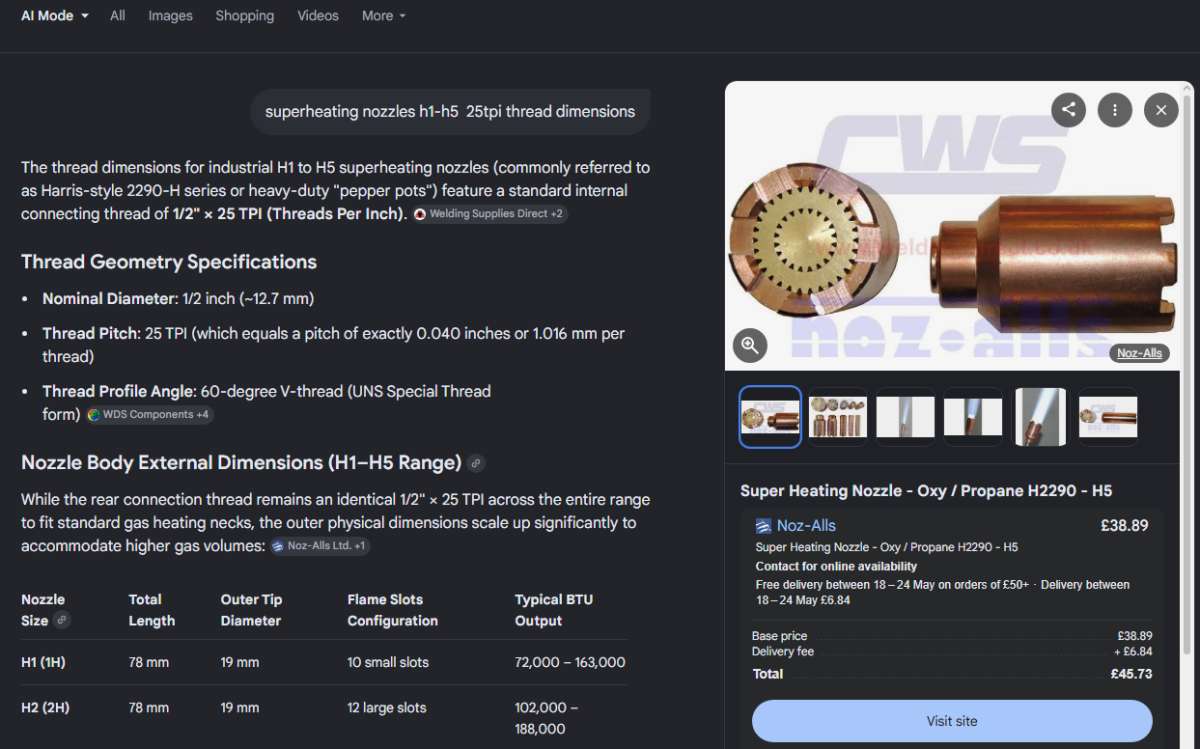
      This was how I confirmed the thread size yesterday; screenshot from a Google search
      image_2026-05-17_135040135

      Unfortunately it didn’t help source a suitable tap & die.

      Bill

      #848662
      duncan webster 1
      Participant
        @duncanwebster1

        <p style=”text-align: left;”>To add confusion, I tried to measure an oxy acet nozzle, it doesn’t fit any of my thread gauges, but my imperial ones only have even numbers at anything like the pitch. Interweb suggests 1/2 inch 27 tpi, another oddball.</p>

        #848670
        Nimble
        Participant
          @nimble

          Hi Bill,
          Managed to get to your profile after much faffing about. M.E.W. site no clear indication of how to access  (moderators please note) ended up using Google.
          Your profile does not seem to have your e.mail address. Will access again tomorrow.

          Nimble Neil

          #848688
          Bill Phinn
          Participant
            @billphinn90025

            Thanks for trying, Neil. I’ll try to pm you myself if I don’t hear from you tomorrow.

            Duncan, the swaged welding nozzles designed for the type 2,3,4 and 5 “heavy” welding shanks have 7/16” x 27 tpi threads for the mixer connection. These nozzles are actually 3/8” diameter for most of their length but are flared out (swaged) to 7/16” at the base.

            Nozzles for “Lightweight” welding shanks (DH, FN) have 1/4” x 26 tpi British Brass (or BSF, if you like, because there is no difference at 1/4”) threads.

            Of course, you cannot/should not fusion weld with these nozzles unless your fuel gas is acetylene, though some welding supplies places in the UK will irresponsibly try to make you believe fusion welding is possible with alternative fuels, viz. propane and propene.


            #848712
            Adrian R2
            Participant
              @adrianr2

              I can’t screwcut 25TPI on my lathe either, but I could if I sourced a 50T changewheel. Is that an option for you?

              Edited again, I have an 8TPI leadscrew so just 16T on the spindle and 50T on the screw will do it, no need for compound train.

              #848779
              Bill Phinn
              Participant
                @billphinn90025

                Hi Adrian, I believe my Amadeal 210 lathe has a 2mm pitch lead screw. I’m not sure what gear combination I’d need for 25 tpi.

                #848783
                peak4
                Participant
                  @peak4
                  On Bill Phinn Said:

                  Hi Adrian, I believe my Amadeal 210 lathe has a 2mm pitch lead screw. I’m not sure what gear combination I’d need for 25 tpi.

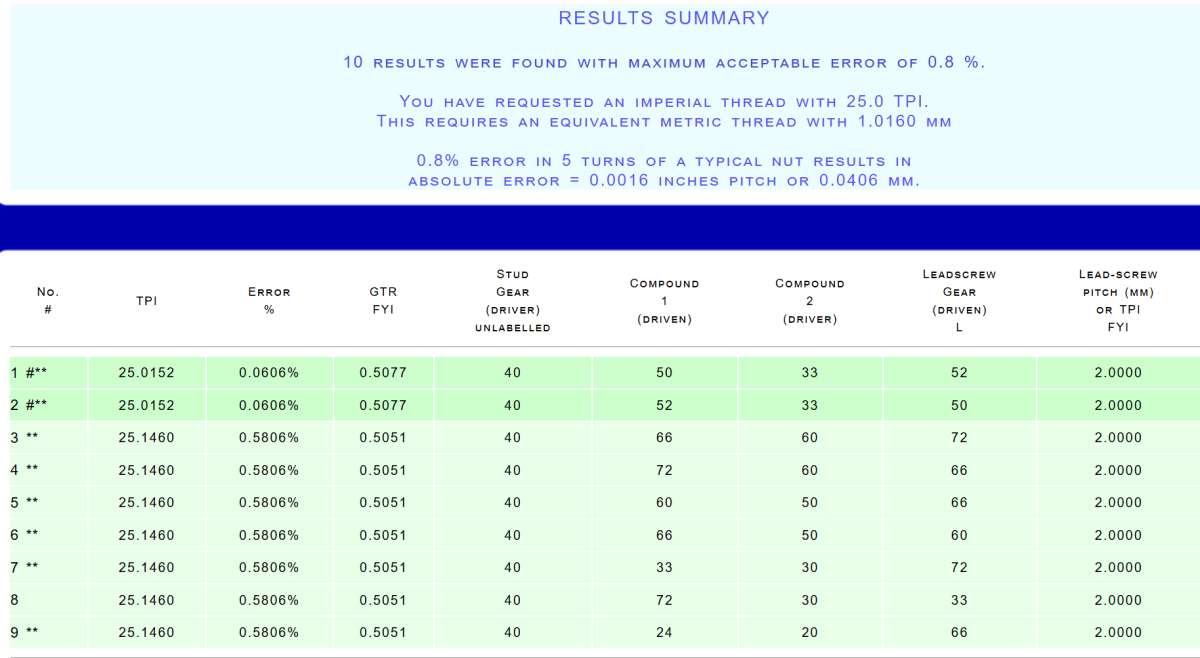
                  This program takes a bit of getting used to, but seems to work OK

                  You will need a list of what change gears you have, as well as the leadscrew pitch

                  https://ridethegeartrain.com/index.php

                  See Also
                  https://www.lathes.co.uk/transposing-changewheels/

                  Double check this;

                  image_2026-05-18_145434125

                  Bill

                  #848803
                  Bill Phinn
                  Participant
                    @billphinn90025

                    Thanks for that, Bill.

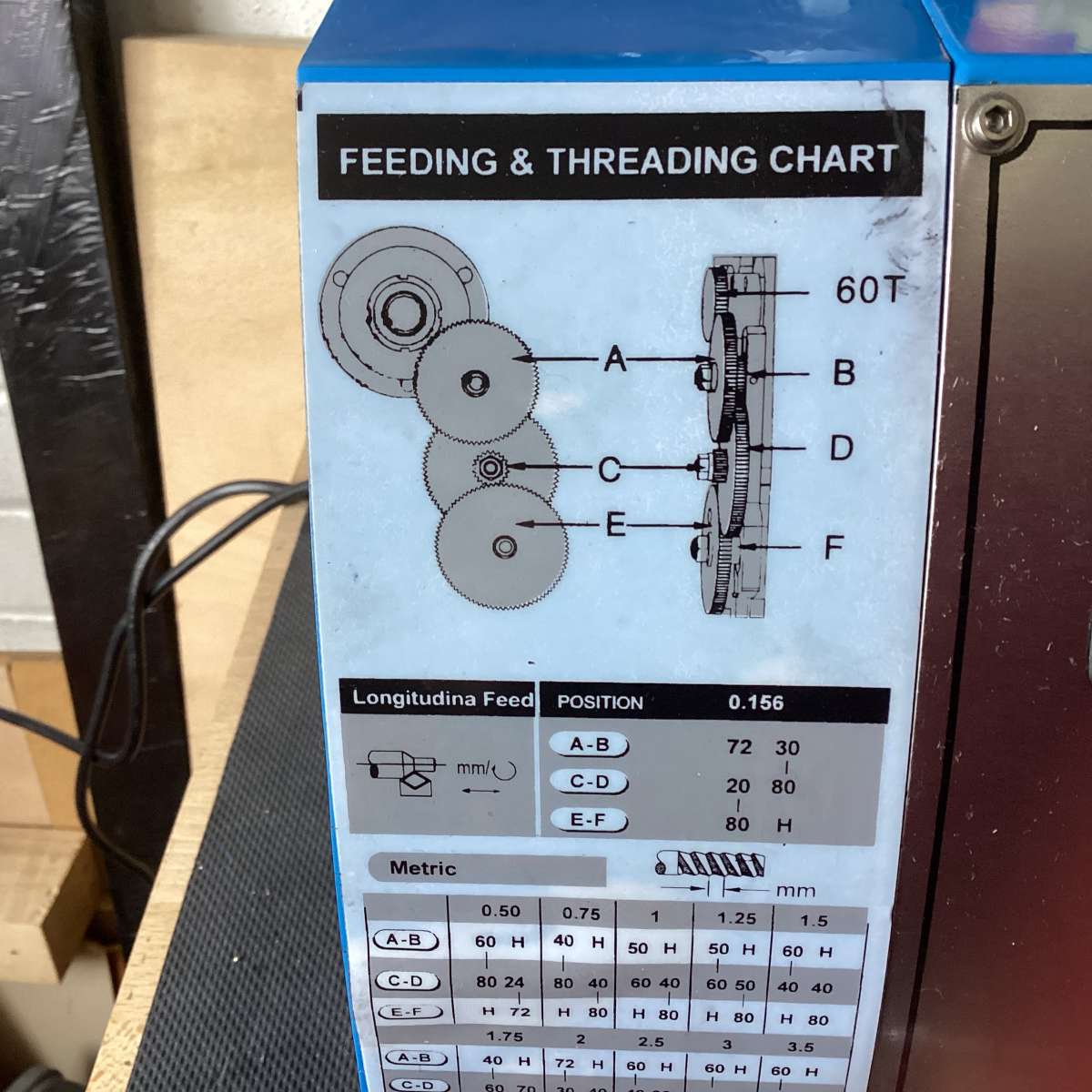
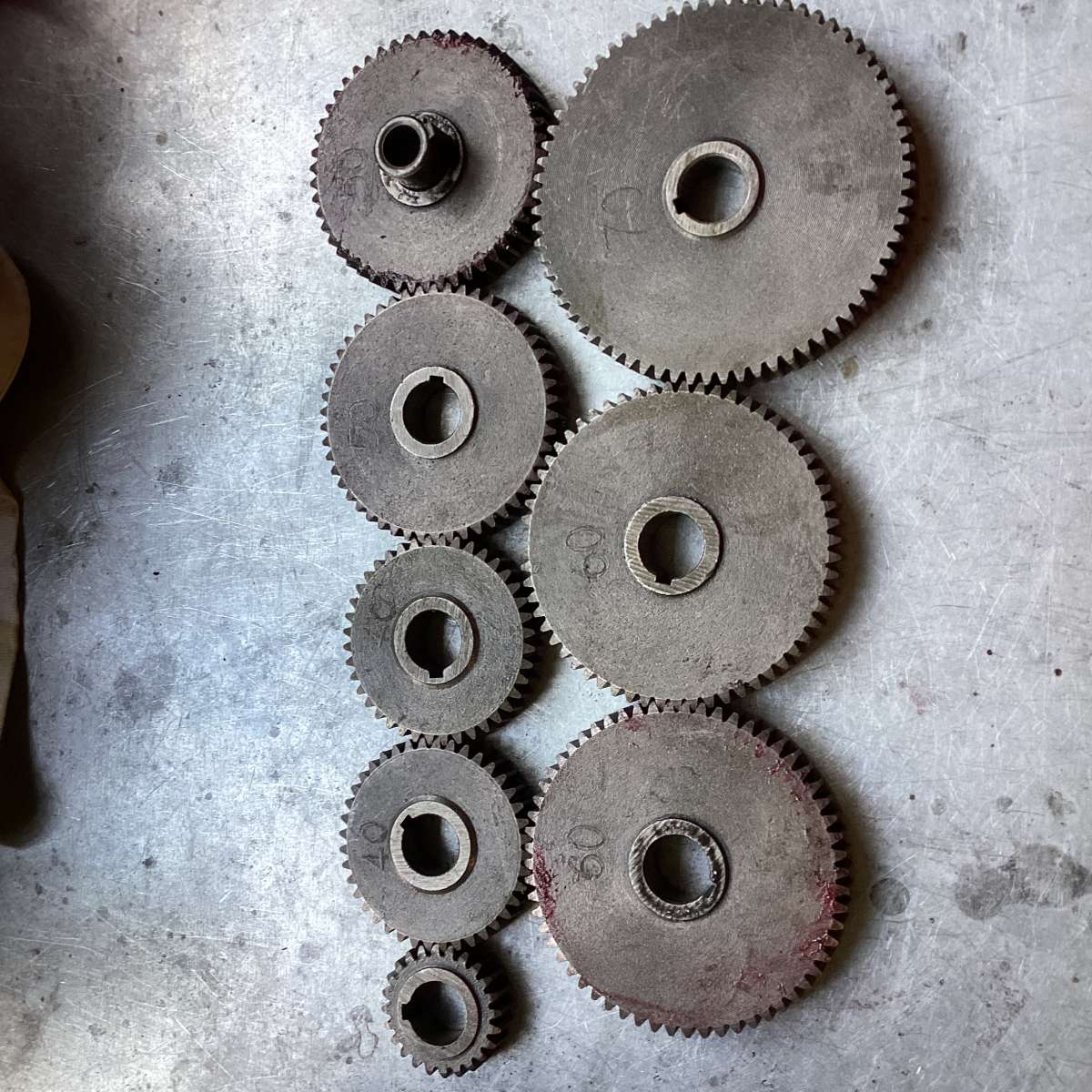
                    The gears I have are shown in the photos, i.e. the factory combination for longitudinal feed shown on the gear casing sticker, and the gears laid out on my bench.


                    IMG_1991IMG_1995

                    #848807
                    JasonB
                    Moderator
                      @jasonb

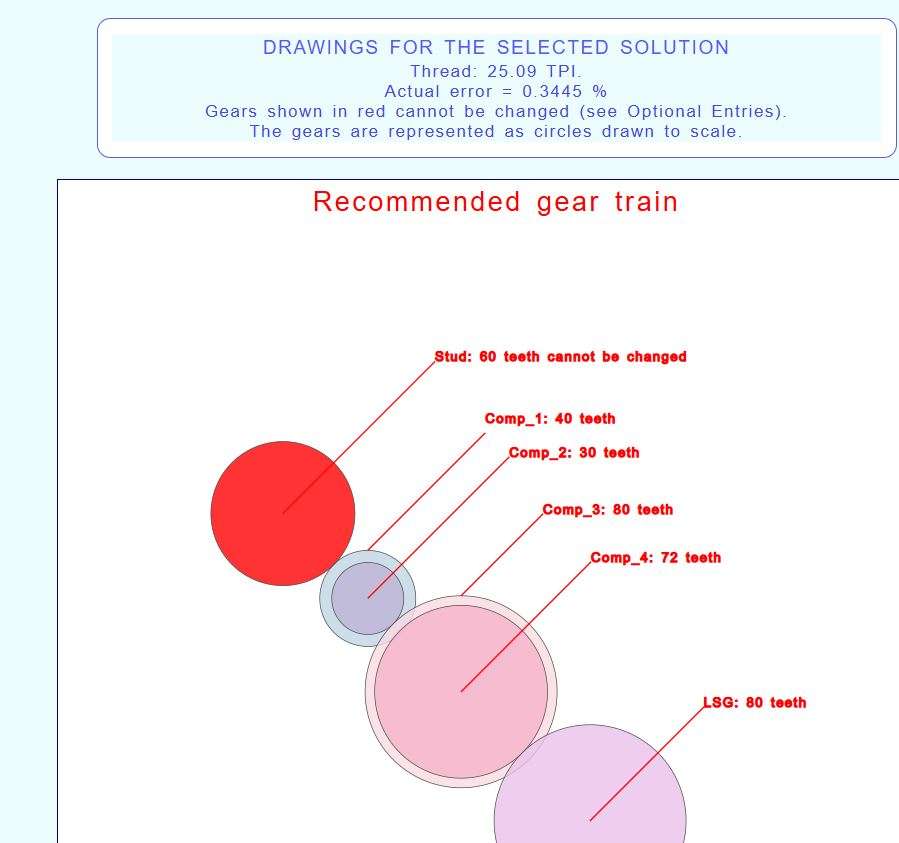
                      If I read the numbers on your gears correctly as 20, 30,40, 40, 50, 50, 60, 60, 70, 72, 80, 80 then 25.09tpi is the best you can get with them.

                      25 train

                      #848811
                      Nigel Graham 2
                      Participant
                        @nigelgraham2

                        I think Harris is using a non-standard thread.

                        Nowhere in any table of American threads I have found, is 25tpi listed. The nearest is UNEF and even that is 3 turns out.

                        Further, one of its catalogue specifications promises a proper fit “if used with Harris fittings”. Oh aye?

                        Half-inch threads to US standards:

                        UNF 20tpi

                        UNEF 28

                        NPS / NPSF 14

                        NPT /NPTF 14.


                        I encountered this sort of problem years ago when I volunteered to make an adaptor to fit a brewery keg C02 cartridge. It was metric but its pitch matched nothing in the books. I forget what, and cannot now find my drawing, but many times-sums revealed a sufficiently close 2-stage change-wheel train for my EW lathe with 1/8″ pitch leadscrew and wheels in 5-tooth increments. The application? A warm-air breather, using soda-lime and CO2 in a heat-exchanger, for warding off hypothermia in cave-accident casualties.  I lodged a copy of the drawing with the rescue organisation but I believe they no longer use that device.

                        #848820
                        Bill Phinn
                        Participant
                          @billphinn90025

                          Thanks, Jason.

                          Spur gears seem fairly cheap to buy on ebay.

                          Given that the stud gear on my lathe is 60t what gears would i need to supplement my current choices with to get the sort of accuracy shown in the top two results in Bill’s table?

                          Nigel, it isn’t just Harris using this 1/2” x 25 thread.

                          The neck tube in my picture is at least 20 years old and is branded Murex. The other one I have is unbranded and supplied by the Welders Warehouse, which ceased trading a year or two ago. The Grainger one in my screenshot isn’t branded Harris and the eBay one is branded Sua, a Chinese brand. The H1-H5 nozzles particularly are ubiquitous and sold under many different  brand names.

                          This thread may not be “standard” but it is obviously wanted enough for Taylor Tool to have it as a stock item.

                          #848836
                          peak4
                          Participant
                            @peak4
                            On Bill Phinn Said:


                            This thread may not be “standard” but it is obviously wanted enough for Taylor Tool to have it as a stock item.

                            I wonder if it’s down to the burners being designed specifically for propane, so folk don’t mix propane and acetylene components. i.e. it’s not a standard unified thread, but is standard for that gas use.
                            I remember the late J.S. discussing some weird Myford taps which were either imperial diameter with a metric thread, or vice versa.

                            Bill

                            #848851
                            duncan webster 1
                            Participant
                              @duncanwebster1

                              If you’re absolutely desperate, you could try this

                              Make a lever with arms in ratio 0.4 one end, 25 the other. Take the screw out of the topside and fit a clevis with a pin through the middle lever hole (long side of lever to back of lathe). Fix a post to the cross slide with a link to the short end of the lever. Have another from the other end of the lever to some fixed point. Set the lathe to cut 1mm pitch, 25.4 tpi. As the saddle moves to the left, the lever will pull the topside back relative to the saddle so that the tool moves at 25tpi.

                              I said you’d need to be desperate!

                              #848859
                              duncan webster 1
                              Participant
                                @duncanwebster1

                                I think I’ve got the pins at the short end the wrong way round. Other lever ratios might work better with a different pitch set, say 1.5 mm.

                                #848867
                                JasonB
                                Moderator
                                  @jasonb

                                  As for an exact train try this (can someone check my maths.

                                  25tpi = 1.106mm pitch

                                  You have a 2mm leadscrew so we need that to rotate just over half a turn per turn of the chuck

                                  2mm / 1.106 = 0.508

                                  From previous playing about with numbers it just so happens that 32/63 = 0.5079365

                                  Given you have a fixed 60T driver and a large gap between that and the leadscrew a 60T will be needed to  cancel out the 60T on the spindle and an idler to fill any gap


                                  So the train would be

                                  60T  Driver on the spindle

                                  ?T Idler on the first stud (whatever fills the gap)

                                  60T Driven on the 2nd stud

                                  32T  Driver on the 2nd stud

                                  63T Driven on the leadscrew


                                  This gives


                                  60 driving 60 = 1

                                  32 driving 63 = 0.508

                                  Multiply those two together 1 x 0.5079365

                                  Multiply leadscrew pitch by 0.5079365 = 1.015873 which is not far off the 1.016 that we wanted


                                  #848871
                                  Adrian R2
                                  Participant
                                    @adrianr2

                                    Messing around with https://bilar.co.uk/cgi-bin/change-gear-calculator.pl says a 32 and a 63 in the geartrain would give you 25.003

                                    3D printed would likely work unless you envisage production quantities.

                                    Edit, overlapped with Jason but fortunately we come to similar conclusions.

                                    Edit again another solution only needs the 63T gear whcich as a common metric to imperical conversion may be readily available.

                                    20 – 50- 80 -63 = 25.003 or 0.012% error

                                    #848883
                                    alecs
                                    Participant
                                      @alecs
                                      On Nigel Graham 2 Said:

                                      I think Harris is using a non-standard thread.

                                      Nowhere in any table of American threads I have found, is 25tpi listed. The nearest is UNEF and even that is 3 turns out.

                                      Further, one of its catalogue specifications promises a proper fit “if used with Harris fittings”. Oh aye?

                                      Half-inch threads to US standards:

                                      UNF 20tpi

                                      UNEF 28

                                      NPS / NPSF 14

                                      NPT /NPTF 14.


                                      Standard threads are only for fasteners, so a bolt made in one factory will fit a nut made in any other. The standards don’t apply to proprietry machine parts, where the maker chooses whatever suits their unique needs, or whim, or profit motive.

                                      It is common for makers of gas and volatile liquid fuel appliances to use special threads so that bodgers can’t blow themselves up by cobbling together mismatched parts, eg attaching acetylene supply to a propane torch or an oxygen bottle to a beer keg, or a nitrous oxide bottle to patient oxygen supply etc

                                      Plus of course,  they like to be the only one who can supply the oddball spare parts!

                                      #848927
                                      Bill Phinn
                                      Participant
                                        @billphinn90025

                                        Many thanks for the further replies and information, particularly for the new gearing results from Jason and Adrian.

                                        At the outset I used Bill’s link to Evan Lewis’ site before I even looked at Bill’s own results, and I ended up getting the same as him. The thing I couldn’t do was find any way of changing the default 40T for the stud gear on a 210 mini-lathe. Maybe the 40T is for the older 210 version with the smaller spindle bore than the 38mm one on mine. If anyone can tell me how to enter the stud gear tooth count manually I’d appreciate it. I can see myself making further use of that site in the future.

                                        Duncan, are there any online resources illustrating the desperate remedy you discuss? I think I’d need to see a few images to properly understand what’s involved.

                                        Alec and Bill, I’m not sure the oddball threads in this case are anything to do with safety, though that is what manufacturers may claim. I suspect their only real aim is discouraging interchangeability with rival manufacturers’ products. There is nothing to stop a user from hooking up a torch equipped with these propane heating nozzles to an oxy-acetylene supply; the oddball threads from the necktube-end of the mixer through to the nozzle itself won’t prevent that.

                                        In case anyone’s interested, I’ve been making a few multi-jet propane nozzle/necktube combinations lately. Since the Welders Warehouse closed a year or so ago, there is no UK supplier, afaik, currently selling multi-jet oxy-propane torch packages or even just a necktube/multi-jet propane brazing nozzle combination*.

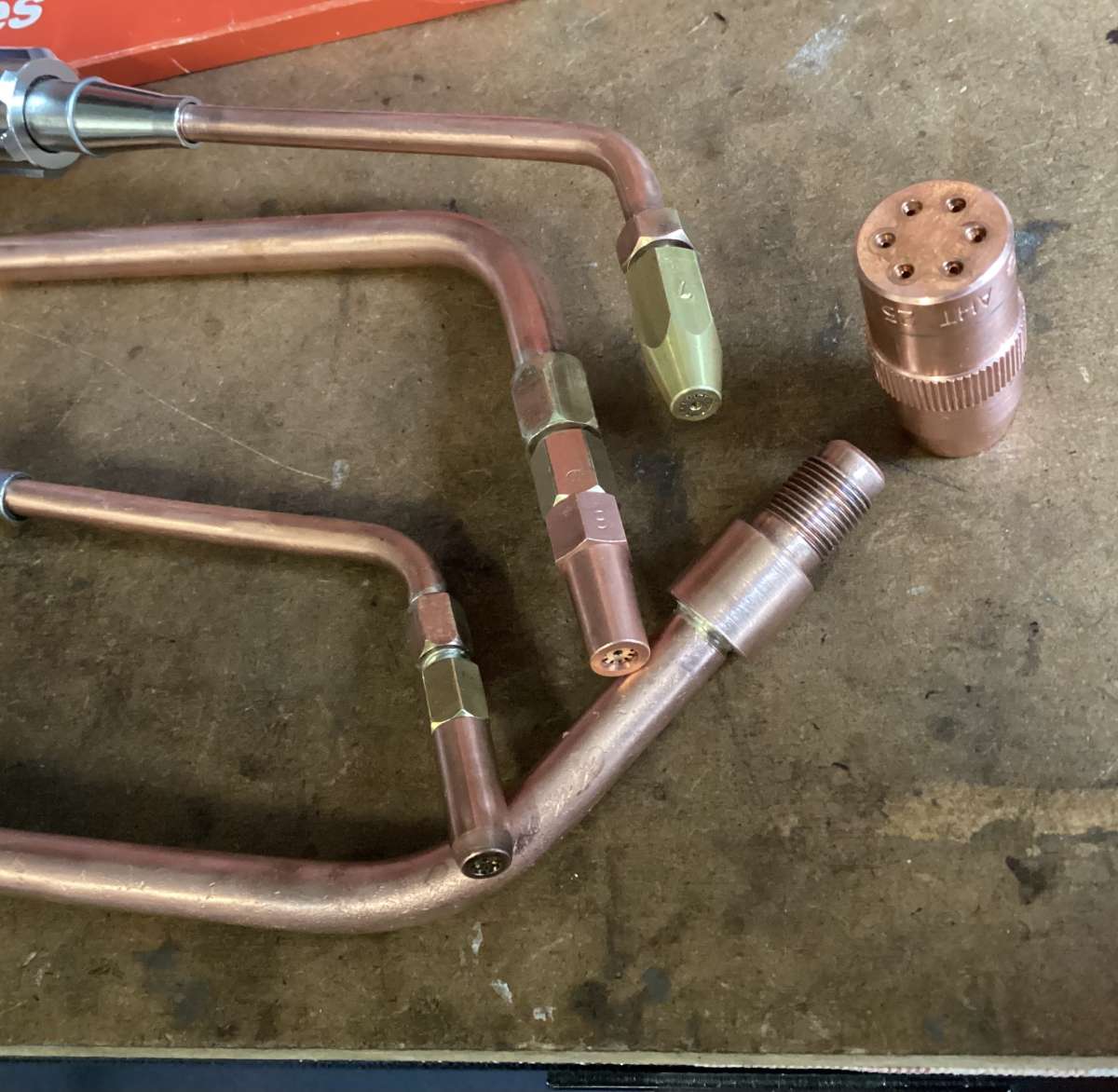
                                        My pic shows three different types of multi-jet propane brazing nozzle and an AHT-25 acetylene pepperpot heating nozzle that I “propanized” by counterboring the 0.9mm exit holes. The thread on AHT heating nozzles is 7/16”-27 UNS, so it was pretty easy to repurpose a secondhand swaged welding tip by silver-soldering on a copper heatsink that doubled up as a male thread for the nozzle. 7/16”-27 taps and dies are freely available online for not much money.


                                        *Nozalls do sell Kemper OxiKit 555 Walkover nozzles, which might just qualify as being multi-jet.

                                        IMG_1965

                                        #849027
                                        duncan webster 1
                                        Participant
                                          @duncanwebster1

                                          Will do a sketch tomorrow


                                          #849059
                                          duncan webster 1
                                          Participant
                                            @duncanwebster1

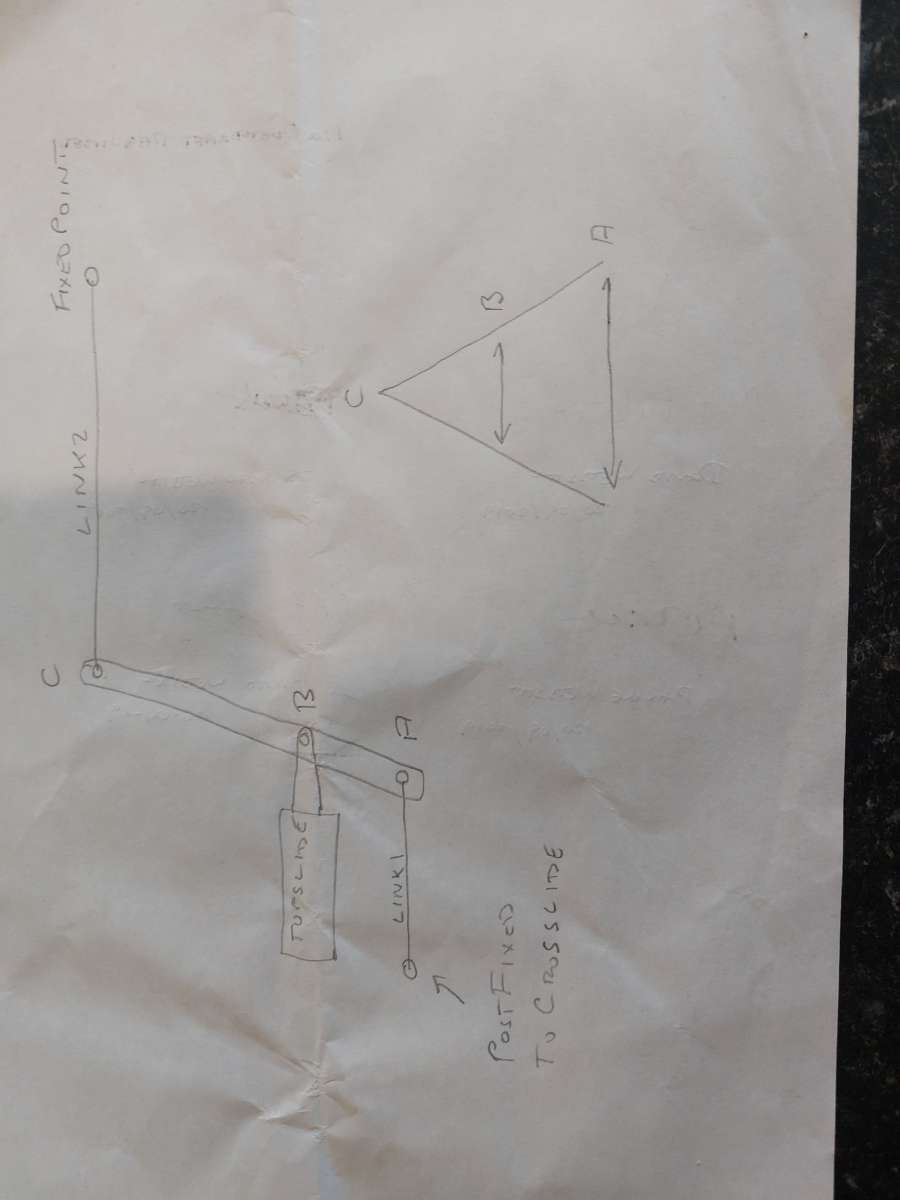
                                            sorry it’s a bit faint. The end C of the lever is connected by a link to some fixed point. The point B is connected to the topslide via a clevis fixed in place of the topslide screw support. The end A is connected via a link to a post fixed to the cross slide.

                                            Now suppose the lathe is set to turn 1.5 mm pitch. In one rev the saddle moves 1.5 mm (obviously), but point C doesn’t move, so the topslide moves by 1.5*BC/AC, and we want this to be 1/25″ which is 1.016 mm. Rearrange and we get BC/AC = !.016/1.5, so if AC is 150mm (to pick a convenient sounding figure) , BC is 101.6 mm.

                                            As the saddle moves, the point A will move in and out  very slightly, which will make the link connecting A to the cross slide move from being not parallel to the bed. This will cause a very small error, which could be calculated if we knew how long the thread was, but it will be very small especially if you arrange the start finish points of the thread to have the ABC lever slanted each side  as in the second sketch. A similar error exists with point C but as the link that end can be much longer the error is even smaller.

                                            Apart from an intellectual exercise I can’t see anyone actually doing this! On my lathe getting a suitable post in front of the topslide on the cross slide would not be easy.

                                            1000012430


                                            #849144
                                            Bill Phinn
                                            Participant
                                              @billphinn90025

                                              Thanks a lot for the explanation, Duncan.

                                              Hopefully, the small error required would be the same for every pass, otherwise the thread might look a bit ragged by the end of the job.

                                              #849181
                                              duncan webster 1
                                              Participant
                                                @duncanwebster1

                                                Yes it would repeat the same every pass, and as I said it would be very small. All depends on lever/link lengths compared to length of thread. The longer the better for levers/links.


                                              Viewing 22 posts - 26 through 47 (of 47 total)
                                              • Please log in to reply to this topic. Registering is free and easy using the links on the menu at the top of this page.

                                              Latest Replies

                                              Home Forums General Questions Topics

                                              Viewing 25 topics - 1 through 25 (of 25 total)
                                              Viewing 25 topics - 1 through 25 (of 25 total)

                                              View full reply list.