
carbide insert lathe tools

carbide insert lathe tools

Home › Forums › Workshop Tools and Tooling › carbide insert lathe tools

Viewing 25 posts - 1 through 25 (of 27 total)
  • Author
    Posts
  • #869985
    davidwf
    Participant
      @davidwf

      I have a Myford ML7 which I bare metal stripped and re-furbished a few years back, As most of the original cutters had seen better dys I fitted it with a Chronos quick change tool post and a set of these tools

      Even turning a soft aluminium bilet I have found the tips break or shatter within a few seconds and no, I am not being rough with them

      Am I doing something wrong or are the tool tips just rubbish ?

      The tools seem quite popular so I am guessing they are OK

      #869997
      JasonB
      Moderator
        @jasonb

        Holders should be Ok. But if that is what you bought 12mm is likely too tall for a Myford Supplied tips maybe less so but even cheapies should be lasting longer.

        Check the tip of the insert is dead on centre height.

        Invest in a few **GT inserts which are better for non ferrous, buy from the likes of APT but sort out why yoi are damaging them first. Post some photos or a video of your setup so we can see what may be wrong

        #870003
        davidwf
        Participant
          @davidwf

          wow, thank you for the prompt reply

          I have set the tool tip to be a fraction of hares breadth below centre –  turning to the middle leaves the thinnest hair of a spike which can be snapped off with a finger so that all seems OK

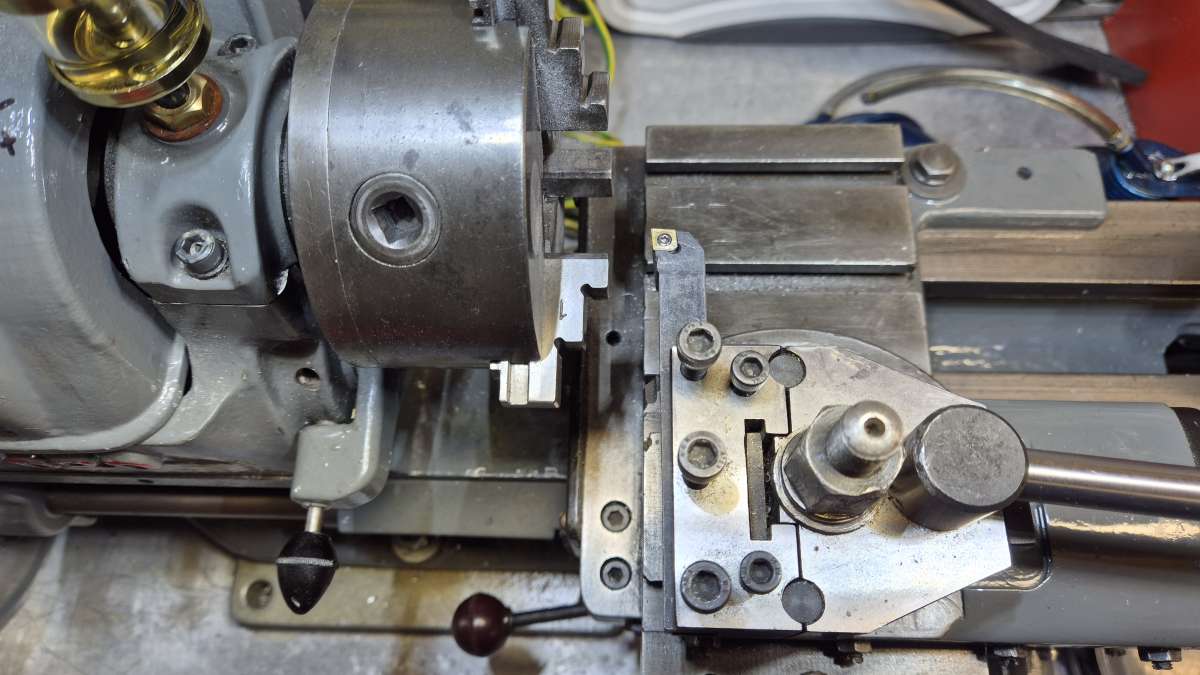
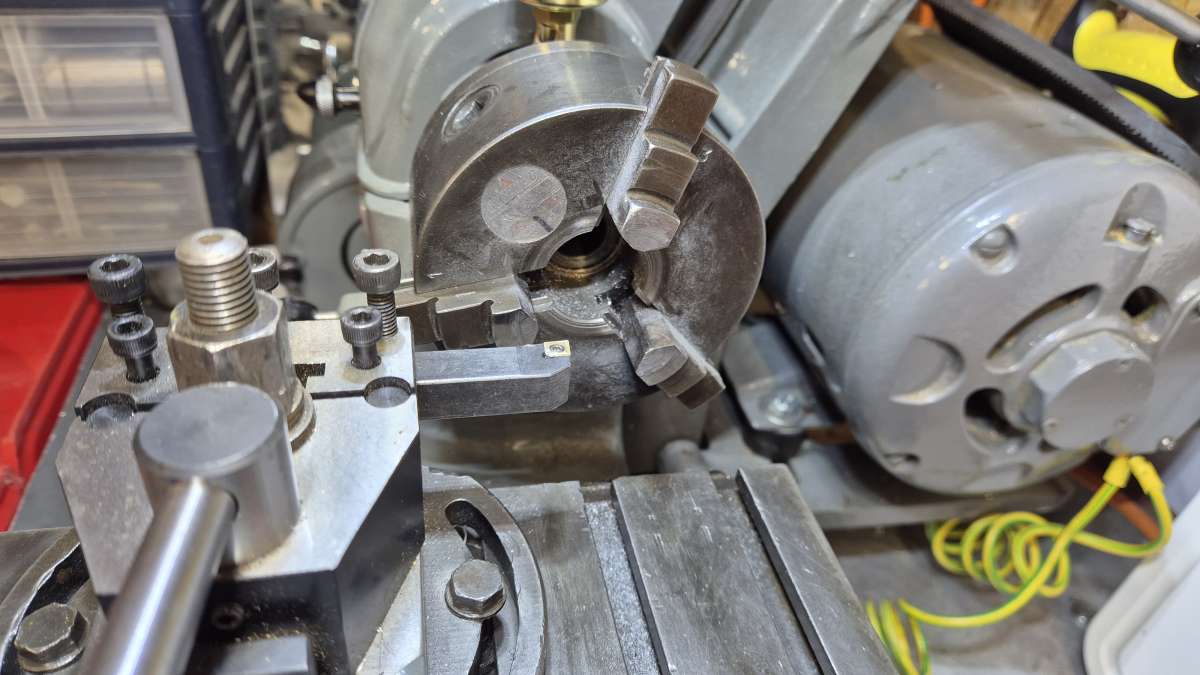
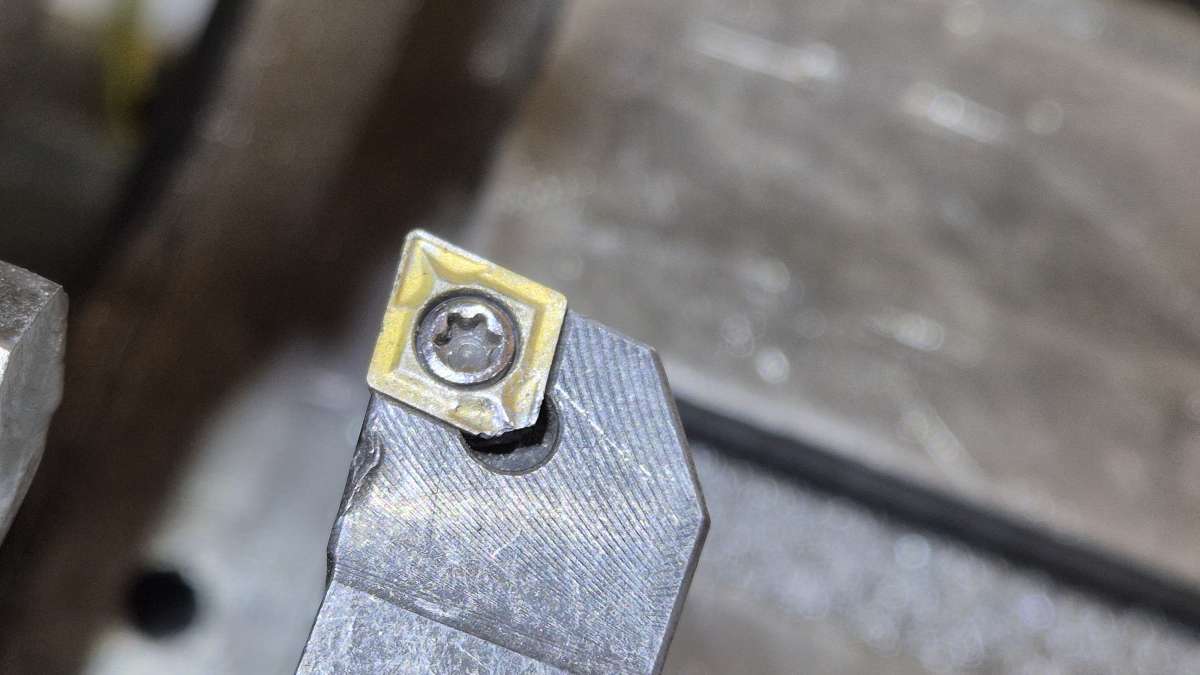
          pics attached

          20261018_104857

          20261018_104852

          20261018_104910

          #870004
          davidwf
          Participant
            @davidwf

            I note the sad demise of Chronos tools….such a shame….

            Looking on APT site I didnt realise there were SO many different tips available…..somewhat different to the originally supplied 3 or 4 tools you could re-grind…….and lasted forever….

            Is there a general tip that can be used for aluminium and steel….I only make the odd part for repairs etc.

            #870012
            davidwf
            Participant
              @davidwf

              The tips I bought from Amazon worked out at just 84p each….

              https://www.amazon.co.uk/Carbide-Turning-CCMT21-51%EF%BC%88CCMT060204%EF%BC%89CCMT-Mutilayer-Replacement/dp/B07VHJ2LC6/ref=pd_ci_mcx_mh_mcx_views_2_title

              as opposed to the APT ones at nearly £5 each

              https://www.shop-apt.co.uk/carbide-inserts-for-turning-apt/ccmt-080304-tin25-carbide-inserts-for-turning-pvd-coated-for-general-use-aptcanela.html

              which LOOK identical…..now I am a firm believer in getting what you pay for ….but 7 times the cost ????

              #870013
              John Haine
              Participant
                @johnhaine32865

                If you want a general purpose tool that is easy to sharpen you can’t go far wrong with one of these:

                https://www.eccentricengineering.com.au/product-category/the-diamond-tool-holder/

                …or several designs for making them have been posted here. A bit pricey but compared to a set of TC holder + tips.

                #870016
                Macolm
                Participant
                  @macolm

                  Be sure cutting edge is definitely not below centre line at contact point. Carbide must not be subject to any tension (pull) component of force.  Check for absence of even slight downward tool deflection from applied cutting forces, which could put tip into tension. Rigidity is vital! In the end, though, poor quality carbide fails much more easily than that from premium makers. See if you can find suitable (eg Sandvik) inserts on the Internet.

                  #870019
                  Howard Lewis
                  Participant
                    @howardlewis46836

                    The tool looks to be standing out a fairly long way, so might be vibrating.

                    Also a QCTP is little less rigid than a four way (More overhang from the clamping point)

                    Reduced rigidity is likely to allow the tool to move which may account for your shipped tips.

                    Try again with minimum tool protrusion and see if things improve.

                    Carbide tips were developed in industry to maximise the rate of metal removal, so the limitation on your ML will the maximum speed that the plain headstock bearings can tolerate (But I always felt that my ML7 was not sufficiently rigid) It seems unlikely that 7 Series machine will have the power and rigidity to stand the speeds and feeds employed in industry, so tend towards caution than turning off clock springs!

                    A carbide tip will function quite happily with small D O C and fine feeds.

                    I use carbide tips in a larger lathe for roughing, boring and radius turning without chipping, other than when I am careless, so maybe fine tuning procedures might improve matters.

                    Howard

                    #870023
                    davidwf
                    Participant
                      @davidwf

                      @ John Haine

                      pretty certain they are aligned properly….like I said they leave literally a hares breadth of spike at the centre, no more

                      I would prefer either the indexible tools (like I have) or the brazed tip ones that I used to use

                      Dont know about the downward deflection….like I said they are cutting soft aluminium so I wouldnt have thought there would be much resistance or drag

                      #870025
                      davidwf
                      Participant
                        @davidwf

                        Thanks for the prompt replies…

                        so, consensus of opinion seems to be that the carbide tips & holders may not be suitable for the slower speeds I am using as opposed to the insane speeds that CNC machines use…..makes sense I guess

                        Although there is no noticeable play in the headstock bearings and the lube system works oK I wouldnt feel happy about running my 60 + year old machine at stupidly high speeds

                        Maybe for my use I should go back to the more solid tool bars…..

                        #870026
                        Howard Lewis
                        Participant
                          @howardlewis46836

                          Actually, my favourite go to is the Tangential Turning tool. Once the capital is invested, a 1/4″ toolbit lasts a long time, even in my hands, and can be resharpened at 9 pm on a Saturday night when the the shops are closed and the last carbide tip has just failed!

                          As an aside, I don’t get on with brazed tips.  They do seem to chip very easily in my hands!

                          Initially, I had problems with chatter because of excess overhang. so keeping the tip as close as possible to the toolpost cured that.

                          I always set any tool to centre height, to avoid problems (Which is why I suggest newbies making a Centre Height Gauge as an early project)

                          Howard

                          #870040
                          peter1972
                          Participant
                            @peter1972

                            I guess the issue is caused by the soft pure or low-alloy aluminium forming a built-up edge on the top of the carbide insert. You appear to be using coated inserts. You should be using highly-polished uncoated inserts for aluminium. Chatter or small depth of cut can make matters worse.

                            #870044
                            howardb
                            Participant
                              @howardb

                              I always set any tool to centre height, to avoid problems (Which is why I suggest newbies making a Centre Height Gauge as an early project)

                              Howard

                              The first job I did after recommisioning my machines after being in storage during the workshop build in 2016- absolutely essential, but never bothered with one before in 55 years in engineering !!

                              The next important mantra to remember is –

                              Overhang!! Overhang!! Overhang!!

                              Of tools from the toolpost and workpiece from the chuck jaws, mimimum practically possible is eesential.


                              #870048
                              Macolm
                              Participant
                                @macolm

                                I do not find any need to run carbide fast, in fact, unless the edge is chipped, it can be very slow and still provide a good finish. For aluminium use a WD40 aerosol. It may not be the best, but it is totally adequate and very convenient.

                                I have had the same bad experience of brazed carbide lathe tools, but have no experience of any recently manufactured items. In contrast, the occasional use of carbide wood router bits for an unusual profile on aluminium has been satisfactory.

                                #870053
                                Andrew Tinsley
                                Participant
                                  @andrewtinsley63637

                                  Absolutely nothing wrong with using replacable carbide tip tooling on an ML7. I use them a lot on my Myford without any trouble.

                                  I suspect that you have a lathe problem. Saddle gib strips being loose, worn head stock bearings etc. You should not be using coated tips on aluminium, causes build up of aluminium on the tips then poor cutting and danger of digging in. You have far too much tool protruding from the toolpost. This causes chatter and breakage. ALWAYS use the minimum projection, especially with a well worn lathe.

                                  Somewhat bothered that you do not want to use top speed on your ML7. Nothing wrong with using any speed the lathe is capable of. I suspect that your lathe is badly worn in some areas. A bare metal repaint will not solve these problems!

                                  Andrew.


                                  #870059
                                  JasonB
                                  Moderator
                                    @jasonb

                                    You have linked to two different size inserts so I can’t be sure what size you have, though most likely the smaller 06 and 07 inserts but subject to checking these inserts will do for all metals that you are likely to want to turn on your Myford from Aluminium to steel, cast iron, stainless, brass, bronze, plastics..

                                    https://www.shop-apt.co.uk/carbide-tips-hobby-use/pack-of-2-ccgt-060204-alu-ak10-carbide-tips.html

                                    And the longer ones

                                    https://www.shop-apt.co.uk/carbide-tips-hobby-use/pack-of-2-dcgt-070204-alu-ak10-carbide-tips.html

                                    Those prices are for two inserts, they also do boxes of 10 which work out a bit cheaper.

                                    As said too much tool stickout and check for any play in ways and spindle.

                                    Speed is not an issue and if as you say you used Brazed carbide before then it’s the same cutting material, just in a different form. And subject to work diameter you could well overspeed carbide even on a Myford as RPM is only part of the equation when working out cutting speed.

                                    #870069
                                    Versaboss
                                    Participant
                                      @versaboss
                                      On davidwf Said:

                                      …tool tip to be a fraction of hares breadth below centre


                                      Well, permit me to say this depends heavily on how breadth your hares are.
                                      In my part of the world this would set the tooltip well below the bead of almost any lathe in a hobby workshop…

                                      Regards,
                                      Hans

                                      (What did Mrs Beeton say? First catch your hare, or something like that)


                                      #870076
                                      davidwf
                                      Participant
                                        @davidwf

                                        I tweaked the tool height so there are no centre spikes now…..i had always been under the impression it should be set slightly below centre….

                                        I also pulled the holder back into the post (why make them that long???)  and the result is much better……tried several test pieces of aluminium and mild steel and no chipping, point taken regarding the type of bits – having previously only used the brazed carbide tools “for everything” I assumed a single carbide bit would do likewise but apparently not

                                        I also tried at max spindle speed and again noted improvement, I dont have a problem with doing that just never really saw the need

                                        During the stripdown I did also adjust all the bearing clearances etc. and am happy they are good

                                        So, it would seem I need to invest in some different tips

                                        Thanks again for all your answers and the speed of them

                                        #870092
                                        davidwf
                                        Participant
                                          @davidwf

                                          I  found these which state they are for aluminium

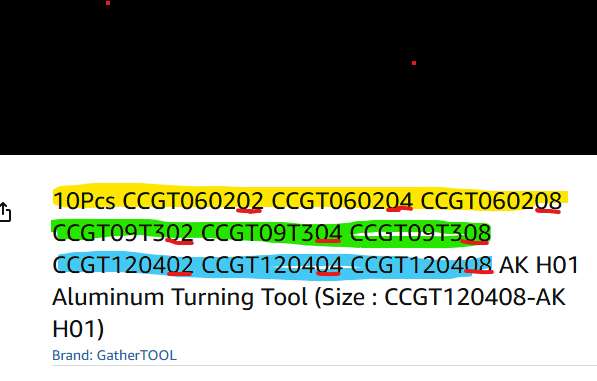
                                          https://www.amazon.co.uk/CCGT060202-CCGT060204-CCGT060208-CCGT09T302-CCGT09T304/dp/B0CH1G7D7H/ref=sr_1_1?sr=8-1

                                          but am very confused at their sizing……can anyone decipher please

                                          #870095
                                          Pete
                                          Participant
                                            @pete41194

                                            There could be many or even a combination of reasons. And I can only offer some general tips about using carbide. But I’d definitely agree that the amount of tool extension is far too much. There may be rare times due to work piece features and extending the tool might be required simply because there’s no other choice. Turning an offset crank shaft throw would be one example. Your tool looks to be extended at least a full inch more than it needs to be. Due to how brittle it is, carbide in general doesn’t tolerate any chatter and vibration well. Although today there’s specific grades for interrupted cutting conditions. I’d reposition that tool shank with the bare minimum of extension outside the tool holder and run it dead on center. Tool and work piece rigidity is everything when machining metal. When boring, I might run the tool tip height a few thousandths above center. But I’ve never purposely run any cutting tool below center because there’s no positive reasons to do so.

                                            You say slower speeds, how slow? Turning aluminum dry can create what’s called a Built Up Edge (BUE) on the tip of the carbide. It’s friction welding the aluminum to the tip. When that breaks or is forced off, it usually removes a section of the carbide tip along with it. Although not anywhere as severe as your last picture shows. That to me looks like a complete fracture of the cutting tip. For us, the easiest cutting fluid to use for aluminum might be WD-40. But Carbide is also intolerant of what’s called thermal shock between high cutting tip temperatures and sudden cooling. So any application of cutting fluid needs to be fairly steady. Simple brush application seems to work well enough from my experience. Also never stop the lathe while the cutting tool is touching the work surface, back the tool away and then stop the lathe if you don’t already know that. Most times that will partially chip the carbide cutting tip more than enough to matter on any material. But you still wouldn’t remove the whole tip like your last picture.

                                            84p per insert isn’t much when you consider everything involved in creating a replaceable carbide tip. For anyone using carbide tips, well worth the 6:20 of time to watch. https://www.youtube.com/watch?v=0QrynzJ_lZ4 It’s amazing to me we can even buy quality carbide tips at what seems high prices considering what is involved in their production. No one can be certain if your tip quality may be the real cause or not. But trying a few recognizable brand name tips might give you an answer. Years ago and fwiw, I bought a set of braised carbide tools because they were very cheap. They also had extremely poor durability, due I suspect now to the manufacturer cutting corners on the carbide quality, the metallic binder or sintering process since they were so fragile. I’d actually describe the carbide as ‘crumbly’. All of them were a complete waste of money. The industrial quality and short braised carbide boring bars I bought later for my boring head were quite expensive, and in my opinion definitely worth what they cost.

                                            You haven’t shown the work piece shape you were cutting. Any lack of tail stock support for the free end of the work piece can be another cause of edge failure if your getting high amounts of chatter? But again it shouldn’t be the whole tip. The rough rule of thumb is any work piece length more than about 3 times it’s diameter outside the chuck jaws is going to require tail stock support. Sometimes up to 5 times diameter might be barely possible when for various reasons it’s unavoidable, but the cutting tools need to be extremely sharp and only tiny depths of cut are possible. For the best results with aluminum, I’d also agree with others here, the highly finished and lapped specialty carbide tips for aluminum might be the better choice. But with adequate oil flow, your ML7 should still be fine at up to 900-1,000 rpm. If your concerned about it, run the lathe for a bit and check the bearing caps with your finger tips for any excessive heat.

                                            Listening to how the cut is progressing is a big part of it. When everything is correct, there should never be any sounds of high pitched squealing or vibration. Or signs of it on the work piece finish. The work piece shape, the cutting tools and even parts of the lathe all have a frequency of vibration. Learning that cost me an unnecessary set of lathe spindle bearings. The real solution was increasing the feed rate instead. That was a lesson I’ve never forgotten. With decent quality carbide tips, I’ve only had possibly a very few unexplained issues. Almost always any cutting tip failures were due to my own dumb mistakes while learning. If chatter or that squealing is present, then the rule of thumb is to either lower the rpm, increase the feed rate, or both. So far I’ve never had an instance where increasing the rpm has worked. None of the above should really create a tip failure like your picture shows though. Unless the carbide is defective, about the only time I’ve seen a failure like that is due to a massive shock load such as crashing the tool tip into the chuck jaws.

                                            In comparison to the honed edges on a high speed steel cutting tool,the non ground and lapped carbide tips are by anyone’s definition quite dull. There’s at least one old video on YouTube I couldn’t seem to re-find, but it showed a high magnification slow speed video of how carbide cuts. Part of it is the high heat generated at the point the material is being cut. That heat helps to somewhat plasticize the material so it’s removed and flows off the work piece and cutting tip easier. Carbide can still cut at lower rpm, but it’s then not operating at it’s most optimum design conditions, the cutting loads will be much higher, and usually with a poorer surface finish. For your ML7 and lower available rpm concerns, high speed steel cutting tools might be the more logical choice since that’s what it was really designed to use.

                                            #870099
                                            davidwf
                                            Participant
                                              @davidwf

                                              @ Pete

                                              thank you very much for taking the trouble to type all that…..it is appreciated !

                                              I am only end facing a small cylinder – about 40mm diameter and 50mm long

                                              #870103
                                              Dave Halford
                                              Participant
                                                @davehalford22513
                                                On davidwf Said:

                                                The tips I bought from Amazon worked out at just 84p each….

                                                https://www.amazon.co.uk/Carbide-Turning-CCMT21-51%EF%BC%88CCMT060204%EF%BC%89CCMT-Mutilayer-Replacement/dp/B07VHJ2LC6/ref=pd_ci_mcx_mh_mcx_views_2_title

                                                as opposed to the APT ones at nearly £5 each

                                                https://www.shop-apt.co.uk/carbide-inserts-for-turning-apt/ccmt-080304-tin25-carbide-inserts-for-turning-pvd-coated-for-general-use-aptcanela.html

                                                which LOOK identical…..now I am a firm believer in getting what you pay for ….but 7 times the cost ????

                                                It’s best to price compare apples with apples.

                                                08 is a rare size – special holder required = expensive

                                                06 are smaller than 09 which means more carbide for the 09 so more expensive – unless they supply vast quantities of 09 which can make them cheaper.

                                                The second number is thickness 02mm, thinner than the APT 03mm, less carbide again so twice as weak.

                                                Cheap Chinese carbide are cheap because they use recycled carbide and more ‘cement’. so less carbide content, these are weaker and require lower cutting forces to survive for a reasonable time.

                                                #870109
                                                JasonB
                                                Moderator
                                                  @jasonb
                                                  On davidwf Said:

                                                  I  found these which state they are for aluminium

                                                  https://www.amazon.co.uk/CCGT060202-CCGT060204-CCGT060208-CCGT09T302-CCGT09T304/dp/B0CH1G7D7H/ref=sr_1_1?sr=8-1

                                                  but am very confused at their sizing……can anyone decipher please

                                                  The highlights show three different overall sizes, 06, 09 and 12 basically if you drew a circle that touched all 4 edges that would be it’d diameter.

                                                  In those three size groups you have different tip radii as marked in red. 0.2mm, 0.4mm and 0.8mm. Middle of the road to satrt off with would be the 0.4mm

                                                  Screenshot 2026-10-18 16025marked

                                                  #870114
                                                  JasonB
                                                  Moderator
                                                    @jasonb

                                                    Next time someone says Carbide inserts need high spindle speeds show them this.

                                                    OK it’s not a Myford and some would say its an inferior far eastern machine but I’m b******d if I can see any difference in finish between 1250rpm and 85rpm. Just a bit of unknown aluminium tube, drop of paraffin lubricant 0.25mm DOC, 0.125mm/rev feed. CCGT 060202 from APT. Increase the tip radius if you like it shiny.

                                                    Not sure many commercial lathes could spin that bit of 10mm dia ali at 32K rpm to put it in the middle of the suggested cutting speed range for aluminium, might blow your chuck apart  but all the modern CNC lathes seem to manage with slower speeds.

                                                    #870121
                                                    old mart
                                                    Participant
                                                      @oldmart

                                                      Forgive if I am repeating an already mentioned thing, but have you checked the actual seating for the insert? The area which the insert is screwed down onto must not be damaged or the support is lost. The damaged end if the insert looks rather like the result of crashing into the chuck jaws. Overhang of the tooling should be minimised unless the tip cannot reach due to the work size or shape, when the cuts taken should be smaller depth. I often use the –GT type of inserts made for aluminium for steel, especially for finishing, and the other day used one successfully to machine soft steel chuck jaws, which is an extreme interrupted cut. I buy some cheap inserts made in China on ebay, they are getting better all the time.

                                                    Viewing 25 posts - 1 through 25 (of 27 total)
                                                    • Please log in to reply to this topic. Registering is free and easy using the links on the menu at the top of this page.

                                                    Latest Replies

                                                    Viewing 25 topics - 1 through 25 (of 25 total)
                                                    Viewing 25 topics - 1 through 25 (of 25 total)

                                                    View full reply list.