Reworking a Spider/jaw coupling

Reworking a Spider/jaw coupling

Home Forums General Questions Reworking a Spider/jaw coupling

Viewing 25 posts - 1 through 25 (of 44 total)
  • Author
    Posts
  • #849324
    Paul McDonough
    Participant
      @paulmcdonough43628

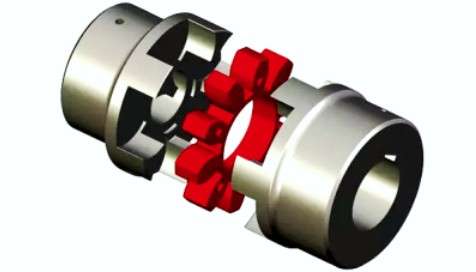
      Dear Modelllers, I want to connect my IC engine to a BLDC motor to act as an alternator, to form an electrical generator. The engine is thought to have a treaded shaft (M8) and the BLDC motor has a 10mm diameter smooth shaft with a flat machined on it, I am planning on using a rubber spider/jaw coupling to link the two but as yet I am unable to find one that suits my needs. something like this

      Spider jag coupling 2026-05-23 152420

      If all else fails I could, indeed it may be preferable, to buy a 10mm coupling and remake one end to fit my engine. This would allow me to make the engine end bigger in diameter and act as a more effective flywheel, but also I could design in a split tapered collet which is the norm for fitting such flywheels to model engines.

      My question is how would you make the jaws which engage with the rubber spider to match the end of the coupling I am replacing? I have a small lathe and mill both with DROs but no rotary table. I have used the DRO to great effect to drill holes on a circle at the desired angular pitch, such as car wheel bolt holes, but Im not sure whether this helps when creating the 3 No. jaws for the coupling, cut into the outer face of the new flywheel.

      Hopefully you have some cleaver ideas?

      #849327
      bernard towers
      Participant
        @bernardtowers37738

        why not make an oldham coupling, has more room for misalignment than the one shown. or possibly spring drive.

        #849335
        Peter Cook 6
        Participant
          @petercook6

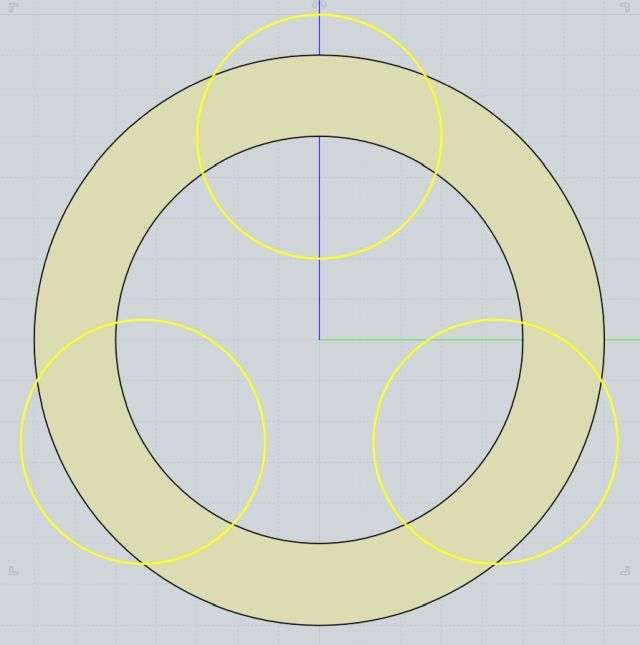
          To make that with the DRO but no rotary table, I am assuming you have a cutter of the correct diameter to cut the curved faces of the jaws. To make it you then do the requisite (3?) number of plunge cuts on the appropriate pitch circle to get the shape you need. a rough sketch something like this.

          Cutters

          After centring the part, use the DRO pitch circle function to position the cutter for the requisite plunge cuts.


          #849345
          Paul McDonough
          Participant
            @paulmcdonough43628

            Hi Bernard thanks for your suggestion, the Oldham coupling looks like a simpler version of the spider and i would agree with you easier to make with my tools. It does seem to depend on a longer section of ‘unsupported’ rubber, but its another option to consider thanks.

            #849346
            JasonB
            Moderator
              @jasonb

              I’d buy a coupling with 10mm holes both ends. Make a bush 10mm OD and M8 internally and press/loctite that into the couplings 10mm hole.  The other end will be the correct size so nothing to do there. All simple lathe work.

              #849349
              Paul McDonough
              Participant
                @paulmcdonough43628

                Interesting observation Peter, I agree, I could make this, most of the couplings i have been looking at don’t show curved sides to the fork ‘prongs’ but have flat sides a bit like sections of pie but with the point cut off! I was hoping there might be a really simple way I could run an end mill across the face of the cylinder to cut the prongs. Im trying to picture in my head how an indexed rotary table might help acheive this in a predictable manner. Given that Im looking for 120 or 90 deg increments I could make a bespoke “table” of sorts

                Coming here as i do a relative beginner I am always amazed at how model engineers have already solved my challenge many times over, you guys people have have a way of thinking that I rarely see for myself.

                Cheers

                #849350
                Peter Cook 6
                Participant
                  @petercook6

                  If 90 degree increments are OK, then size the pitch circle of the “hole” locations outside the diameter of the part, by enough to clear the cutter. If you place the first hole on the X  axis, then traverse across in X. Go back to your start point and repeat with the next hole ( 4 holes) which will be on Y, then traverse Y across.

                  120 degrees is a lot harder as you end up needing to traverse diagonally.

                  #849356
                  JasonB
                  Moderator
                    @jasonb

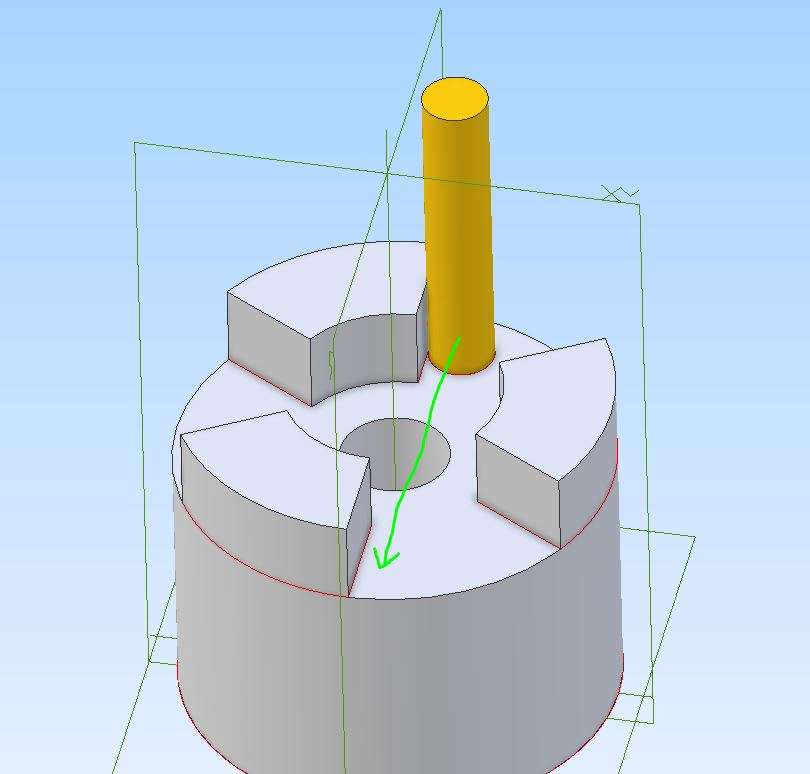
                    The pie shaped cuts are very easy just offset the cutter either side of cyr and make a cut. many ways to undex the part 3 or 4 times to give 120 or 90deg. A simple one is to hold it in a 3 or 4 jaw chuck clamped to the mill table and then simply clock the edge of a jaw true to and axis, repeat for the other two in the case of 120deg &3-jaw. 90Deg an d4-jaw would only need setting twice a syou can cut opposite pies at one setting.

                    coupling

                    #849359
                    Robert Atkinson 2
                    Participant
                      @robertatkinson2

                      I’m with JasonB. However if you want a flywheel effect you could make the fleywheed with a short 10mm locating spigot then machine boss off the coupling half and attach to the flywheel with small countersunk fasteners between the “jaws”.

                      Robert.

                      #849366
                      JasonB
                      Moderator
                        @jasonb

                        Or press/loctite/solder the coupling into a suitable hole in the disc flywheel.

                        #849375
                        Clive Foster
                        Participant
                          @clivefoster55965

                          I can confirm that the cutting methods suggested by Peter and Jason are practical and effective when using DRO functions to generate shapes and offsets of the sort desired which, at the core, are just refined versions of the simple dog clutch.

                          My work involved somewhat different shapes but the geometric cutting principles were sufficiently similar to prove the methods.

                          A heck of a lot easier with CNC of course.

                          Some CAD work will be needed to get the correct shape and offsets. Peters post is a particularly good illustration of the sort of thing you will need to figure out. I’d not care to do it on a drawing board with pencil’n paper or calculator maths in support. Despite, allegedly, once having the skills to do so.

                          Clive

                          #849378
                          Paul McDonough
                          Participant
                            @paulmcdonough43628

                            Picking up on a couple of posts here. I lime the idea of buying a 10mm coupling and creating a flywheel with 10mm sleeve and tread to suit. Neat and I don’t have to wrangle half a coupling.

                            what do you think of the idea of locking the threaded flywheel with a lock nut? Is that likely to hold?

                            #849380
                            JasonB
                            Moderator
                              @jasonb

                              Can you give some more details of the engine and it’s shaft.

                              #849392
                              Paul McDonough
                              Participant
                                @paulmcdonough43628

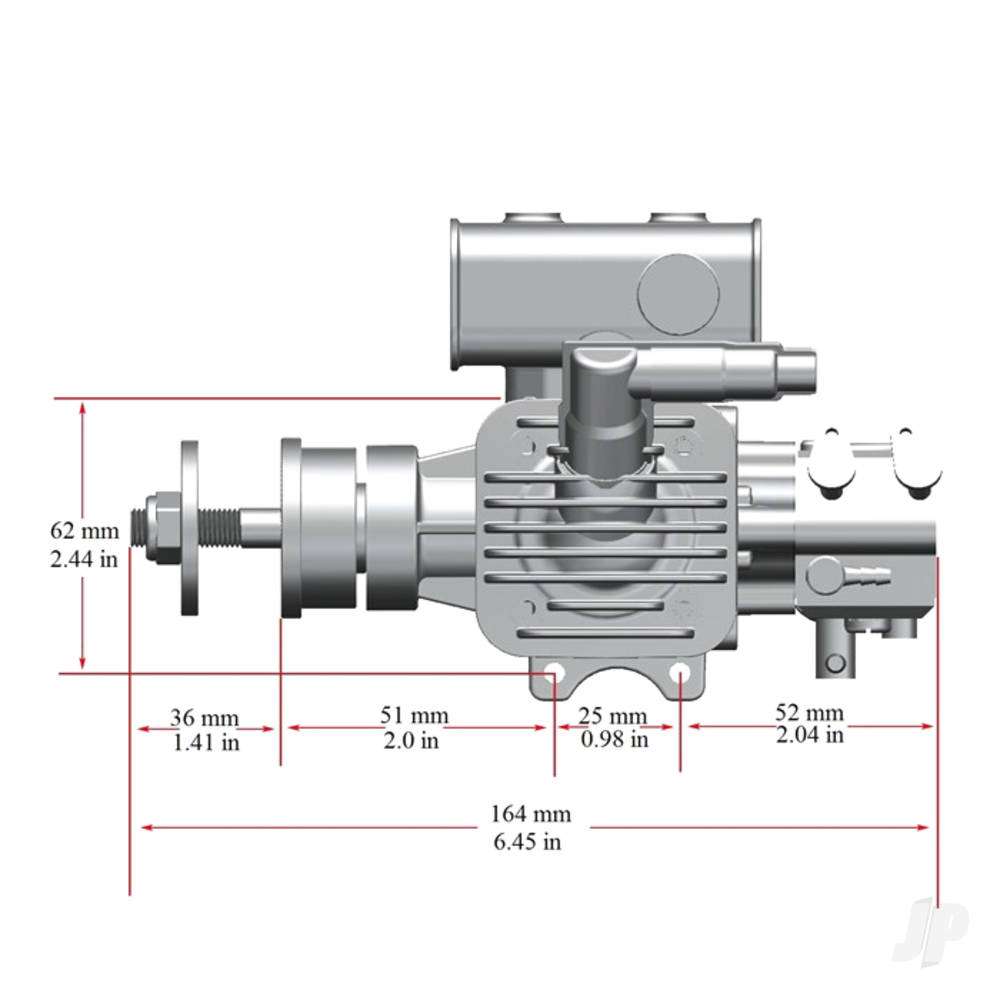
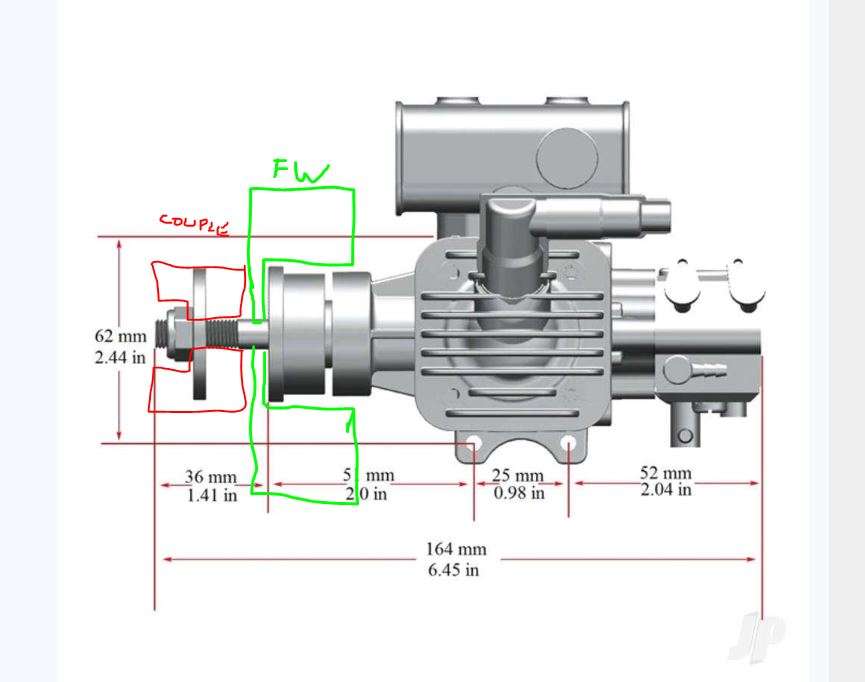
                                Hi Jason, I have fairly limited info until it arrives, it’s a RCGF 20cc 2 stroke petrol engine.  Shaft extension beyond prop driver plate is 36mm thread size isnt clear from the literature although a search through ChatGPT suggests it is likely to be M8. If like most model the prop driver plate is removable then I might be able to access a bit more of the plain shaft.


                                IMG_0525

                                #849393
                                Paul McDonough
                                Participant
                                  @paulmcdonough43628

                                  Good point Clive, I can CAD the shape and plan the passes. I should buy an indexing table the main thing that puts me off is having to clock the vice in after each time I want to use the rotary table!

                                  #849394
                                  Paul McDonough
                                  Participant
                                    @paulmcdonough43628

                                    I did wonder about making a collar to create the flywheel, I should find a coupling that best matches my requirements and give it a go.

                                    at the moment I’m thinking ahead, engine first, firm up the drive shaft available/thread size etc then worry about the ‘adapter’.

                                    what I’m most concerned about is the coupling unscrewing, particularly as I would like to use the motor/alternator to start the engine. That would be luxury  :0). But not essential.

                                    #849396
                                    Paul McDonough
                                    Participant
                                      @paulmcdonough43628

                                      Yes I see what you mean, that could give a robust fixing.

                                      cheers

                                      #849400
                                      duncan webster 1
                                      Participant
                                        @duncanwebster1

                                        If you have enough headroom and are happy with a 4″ rotary table, I bolted mine to a block which can be held in the vice. My current mill had a longer table, so I set the vice off centre and still have room to place the rotary table next to it. I have both 4″ and 6″, the little one gets a lot more use.

                                        #849403
                                        Clive Foster
                                        Participant
                                          @clivefoster55965

                                          Paul

                                          Concerning clocking a vice into alignment on replacement I’ve always found pulling back, or pushing forward against lightly nipped up bolts or studs to be sufficiently repeatable for all general work. Typically better than ± 0.002″, 0.05 mm over 4″, 100 mm.

                                          As I drive a Bridgeport I have the vertical space to leave the swivel base on my vices which makes it far easier to set up with a “good enuf for general jobs” setting by simple pull back leaving the frustrating tapping to get under a tenth thou error for the really special jobs.

                                          If you don’t use a swivel base and if the slots in your bolting lugs aren’t already sufficiently accurate, my experience is that ex-factory they are pretty good for non machined surfaces but not quite good enough there are a number of ways to get decent eatability.

                                          All of which start by inverting the vice to grip an accurately aligned block so you can operate on the underside.

                                          My preference is for quick, dirty and effective by recutting the sides of the lugs so they are true and making atop hat shaped washer-spacer to slide over to slide over the hold down bolts or studs so the pull back method becomes accurate. For dead nuts adjustment you could make a third one with a bit of eccentricity in the stem and a hex shape to fit a spanner rather than a plain washer on top. Turning the hex would shit one side a bit to get it just so. Did the enlarge lug slots thing ages ago for a different machine and found it to work well enough.

                                          The official approach is to cut a keyway so a key that securely fits the table Tee slots can be fixed to the bottom. Effective but the key fit needs to be close and a keyed vice cannot be rotated without removing the key. If the table Tee slots re less than perfect the key can jam making the vice a devil to remove.

                                          A pair of simple round bobbins just inside the mounting lugs works almost as well as a full length key and is generally considered a more Model Engineer friendly approach.

                                          No experience with the type of vice that has a slot for clamps rather than slotted bolting lugs so I can’t advice on easy alignment methods. There may be something in the Geraldi catalogue that could be used as a basis.

                                          Clive

                                          #849406
                                          noel shelley
                                          Participant
                                            @noelshelley55608

                                            What your looking for is a Lovejoy coupling ! Not worth the trouble of making. They are available in both alloy and cast iron. Any good power transmission specialist will stock them, eg Hayley/Dexis. Good luck.  Noel

                                            #849411
                                            JasonB
                                            Moderator
                                              @jasonb

                                              No reason a nut should not work, after all that is all that holds on a prop and an electric starter on the cone is often used for starting.

                                              Flywheel would not need to be too large a diameter if made to a cup shape it could slip on over the driver to keep O/A length small.

                                              Recess the ctr of the coupling so that you can fit the nut without interfering with the middle section.

                                              What you will need to think about is cooling, if a centrifugal fan could also be includes inside a duct to blow air over the head that would work well as per R/C Helicopters.

                                              fw c

                                              #849414
                                              JasonB
                                              Moderator
                                                @jasonb

                                                Another method of getting your vice set quickly that I wrote up a while ago

                                                Getting The Most From Your Brushless Mill Part 5 – Fitting Keys to a Vice

                                                #849417
                                                Paul McDonough
                                                Participant
                                                  @paulmcdonough43628

                                                  Thanks for all of the advice on aligning vices, oddly i dont mind it quite therapeutic, just not too often! Ah yes head room, what seemed like plenty when i ordered my little machine has a habit of catching me out more often than I expected. I am very limited for space so a traditional mill isn’t on the cards, shame.

                                                  #849418
                                                  Paul McDonough
                                                  Participant
                                                    @paulmcdonough43628

                                                    Thanks Jason re your sketch of a flywheel solution. Funny I didn’t think of flipping the ‘cup’ backwards probably because in all of my other engines the carb is in the way😀

                                                    i worry about relying on the thread for fixing because my tether cars have a happy nack of unscrewing themselves often with quite dramatic results.

                                                    as for cooling, i am planning on buying an electrically driven centrifugal blower. Hopefully that will be enough, I don’t plan to operate the engine hard, the loco it powers is intended to be a petrol powered hybrid, the generator charging a modest LiFePO4 battery which in turn is used to power the electric bogies via electronic speed controllers. At least thats the plan, if it fails then ill fill it with batteries and it becomes a more conventional battery electric model.

                                                    the chassis is scaled from outline drawings of a class 93 tri mode so hybrid operation would be fitting

                                                    #849419
                                                    Paul McDonough
                                                    Participant
                                                      @paulmcdonough43628

                                                      Thanks noel, agreed these couplings are easily available so hopefully there is no need to make one, just as Jason suggested buy a biggish one with room to bore out a section to accommodate the drive shaft nut. The recess needs to be 20mm in diameter to accommodate a standard socket for an M8 nut.

                                                    Viewing 25 posts - 1 through 25 (of 44 total)
                                                    • Please log in to reply to this topic. Registering is free and easy using the links on the menu at the top of this page.

                                                    Latest Replies

                                                    Home Forums General Questions Topics

                                                    Viewing 25 topics - 1 through 25 (of 25 total)
                                                    Viewing 25 topics - 1 through 25 (of 25 total)

                                                    View full reply list.